Other ways to say enjoy yourself include have fun, have a blast, have a great time, live it up, make the most of it, and have a wonderful time. The best expression depends on your situation, whether you’re talking to a friend, wishing someone well before a trip, writing a social media caption, or sending a professional message.
Some phrases sound friendly and casual, while others express excitement, encouragement, or genuine warmth. Learning these synonyms for enjoy yourself, including slang expressions, alternative words for enjoy, example sentences, and common grammar rules, helps you communicate naturally without repeating the same phrase.
35+ Other Ways to Say Enjoy Yourself
The best alternatives to enjoy yourself communicate the same general idea: experience pleasure, have fun, or make a situation worthwhile. However, some phrases sound more enthusiastic than others. Choose one that fits the occasion, your relationship with the person, and the tone you want to convey.
Common Ways to Say Enjoy Yourself
These everyday expressions work in conversations, text messages, friendly wishes, and many other situations.
| Alternative | Meaning or tone | Example sentence |
| Have fun | Enjoy an activity | Have fun at the concert tonight! |
| Have a good time | Enjoy an experience | Have a good time on your vacation. |
| Have a great time | Express a warm, positive wish | Have a great time at the wedding! |
| Have a wonderful time | Sound especially warm and thoughtful | Have a wonderful time with your family. |
| Enjoy every moment | Appreciate each part of an experience | Enjoy every moment of your trip. |
| Make the most of it | Get as much value or enjoyment as possible | Make the most of your weekend away. |
| Have a blast | Have an exciting, highly enjoyable time | Have a blast at the birthday party! |
| Have the time of your life | Experience exceptional enjoyment | I hope you have the time of your life abroad. |
| Take it all in | Appreciate an experience fully | Take it all in while you’re visiting Paris. |
| Soak it all up | Absorb and appreciate an experience | Soak it all up during your first music festival. |
| Enjoy every second | Appreciate the experience from beginning to end | Enjoy every second of your graduation day. |
| Have some fun | Make time for enjoyment | You’ve worked hard all week. Go have some fun! |
Usage tip: “Have fun” is the simplest replacement for most everyday situations. Choose “have a blast” for an exciting event and “enjoy every moment” when you want to emphasize appreciation.
Friendly and Warm Alternatives
When you want to sound caring, supportive, or sincere, choose a phrase that feels personal rather than overly enthusiastic.
- Enjoy your day! — A friendly wish for someone’s day.
- Have a lovely time! — A warm expression suited to social occasions.
- I hope you have a great time! — A thoughtful way to express genuine goodwill.
- Wishing you a wonderful experience! — A slightly more polished expression.
- Enjoy yourself to the fullest! — Encourages someone to embrace an experience.
- Make beautiful memories! — Works well for holidays, weddings, and special occasions.
- Have an amazing time! — Adds excitement to a friendly wish.
- Enjoy it while it lasts! — Encourages someone to appreciate a temporary opportunity; depending on context, it can also sound sarcastic or cautionary.
For example, if a friend is leaving for a long-awaited holiday, you could say, “Have an amazing time, take lots of pictures, and make beautiful memories!”
That sounds more personal than simply saying “Enjoy yourself.”
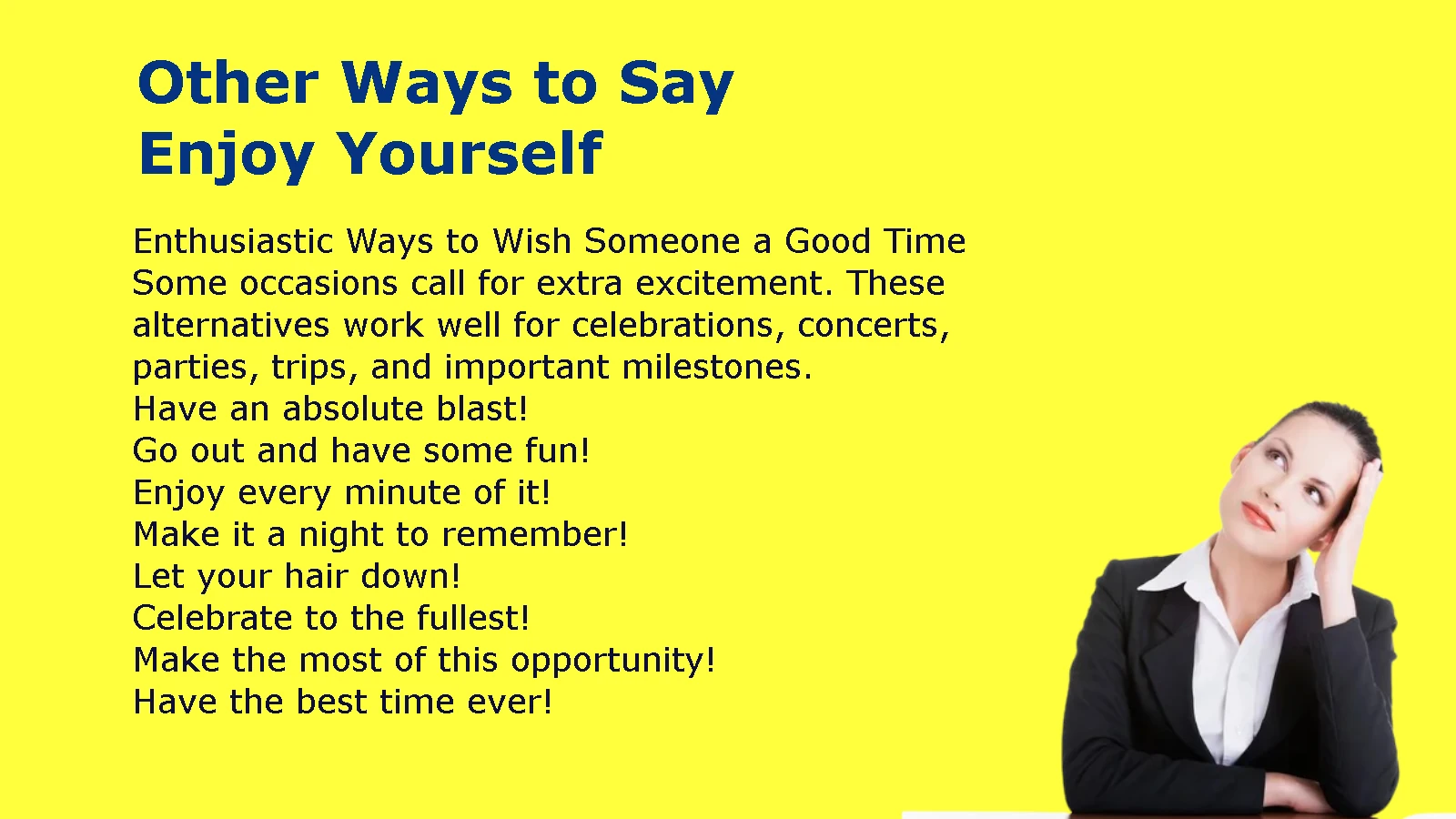
Enthusiastic Ways to Wish Someone a Good Time
Some occasions call for extra excitement. These alternatives work well for celebrations, concerts, parties, trips, and important milestones.
- Have an absolute blast!
- Go out and have some fun!
- Enjoy every minute of it!
- Make it a night to remember!
- Let your hair down!
- Celebrate to the fullest!
- Make the most of this opportunity!
- Have the best time ever!
Consider the occasion before choosing a phrase. “Make it a night to remember” fits a birthday party or celebration, while “make the most of this opportunity” works better for a special trip or once-in-a-lifetime experience.
Polite and Formal Alternatives to Enjoy Yourself
For coworkers, clients, supervisors, or people you don’t know well, a courteous expression can sound more appropriate than slang.
| Expression | Best situation | Example |
| I hope you have a wonderful time. | Professional or personal messages | I hope you have a wonderful time during your stay. |
| Enjoy your visit. | Business trips or visits | Enjoy your visit to our office. |
| I hope you enjoy the event. | Conferences or formal occasions | I hope you enjoy the annual conference. |
| Have a pleasant evening. | Professional or polite conversations | Have a pleasant evening with your guests. |
| I hope you have an enjoyable trip. | Travel-related messages | I hope you have an enjoyable trip overseas. |
| Wishing you a memorable experience. | Special events | Wishing you a memorable experience at the ceremony. |
A useful rule is to match the expression to the setting. You can tell a close friend to “have a blast,” but “I hope you enjoy the event” may feel more natural in a professional email.
Best Alternatives by Situation
Different situations call for different expressions. This comparison helps you choose an alternative without guessing which phrase sounds right.
| Situation | Suggested phrase | Why it works |
| A friend going to a party | Have a blast! | Casual and enthusiastic |
| Someone starting a vacation | Enjoy every moment! | Warm and encouraging |
| A coworker attending a conference | I hope you enjoy the event. | Polite and professional |
| A friend going on a date | Have a great time! | Friendly and neutral |
| Someone celebrating a birthday | Have the best time ever! | Excited and positive |
| A person trying something new | Give yourself permission to have fun. | Encouraging and supportive |
| A traveler visiting a new country | Soak it all up! | Encourages appreciation |
| Someone taking a well-earned break | Relax and enjoy yourself. | Calm and reassuring |
Slang Ways to Say Enjoy Yourself
Slang alternatives to enjoy yourself include “live it up,” “let loose,” “have a blast,” “go wild,” and “paint the town red.” These informal expressions often suggest excitement, freedom, or an energetic social experience. However, some imply partying or unusually lively behavior, so they don’t fit every situation.
Popular Slang Expressions for Enjoy Yourself
Here are some informal expressions you can use with friends and in casual conversations.
| Slang expression | Meaning | Example |
| Live it up | Enjoy life or a special opportunity fully | You’re on vacation, so live it up! |
| Let loose | Relax your usual restraint and have fun | It’s Friday night. Time to let loose! |
| Go wild | Act with excitement or abandon | Go wild and celebrate your big win! |
| Paint the town red | Go out and enjoy an energetic night | They’re painting the town red after graduation. |
| Have a blast | Have an extremely fun time | Have a blast at the festival! |
| Party it up | Celebrate or party enthusiastically | We’re going to party it up this weekend. |
| Kick back | Relax and enjoy some downtime | Kick back and enjoy your day off. |
| Chill out | Relax and take things easy | Chill out and enjoy the afternoon. |
| Live your best life | Make choices that bring fulfillment and happiness | She’s traveling and living her best life. |
| Go all out | Put maximum effort or enthusiasm into an occasion | Go all out for your birthday celebration. |
These expressions aren’t interchangeable in every context. “Kick back” suggests relaxation, whereas “paint the town red” suggests an energetic night out.
Likewise, “go wild” can suggest behavior without many restrictions. Use it when that meaning fits the situation.
Slang for Parties, Weekends, and Nights Out
If someone is heading to a party, club, concert, or weekend gathering, these expressions can sound more natural than “enjoy yourself.”
- Tear it up! — Have an energetic or exciting time, often at a party or performance.
- Party hard! — Celebrate enthusiastically, often with a focus on partying.
- Live it up tonight! — Make the most of the evening.
- Let loose and have fun! — Relax and enjoy yourself without worrying too much.
- Make some memories! — Enjoy an experience worth remembering.
- Go have a good one! — Have a good time; this is casual and may sound more natural in some English-speaking regions than others.
Example conversation:
“Are you going to the concert tonight?”
“Definitely! We’re planning to let loose and have a blast.”
This exchange sounds informal and enthusiastic. In contrast, “I hope you have a pleasant evening at the concert” sounds more reserved.
Casual Expressions for Text Messages
When texting friends, short expressions often feel more natural than long wishes.
Try these messages:
- Have funnn!
- Enjoy every second!
- Go have a blast!
- Have the best time!
- Make some memories!
- Live it up!
- Have an amazing one!
- Go enjoy yourself!
- Hope you have a great time!
- Have fun and tell me everything later!
The spelling “funnn” adds playful emphasis in informal texting, but it isn’t appropriate for formal writing. For professional messages, use standard spelling and complete sentences.
Which Slang Expressions Fit Different Audiences?
Not every slang expression works with every person. Consider your relationship and the activity before sending a message.
| Audience | Suitable expression | Expression to use carefully |
| Close friends | Let loose! | — |
| Younger social media audience | Live your best life! | — |
| Coworkers | Have a great time! | Party hard! |
| Family members | Have a blast! | Paint the town red! |
| Someone going to a quiet retreat | Kick back and relax! | Tear it up! |
| Someone attending a formal dinner | Enjoy your evening! | Go wild! |
The key is not to avoid slang altogether. Instead, choose slang that matches the activity and your relationship with the recipient.
What Does Enjoy Yourself Mean?
Enjoy yourself means to experience pleasure, happiness, or satisfaction while doing something. People commonly use the expression to wish someone a good time, encourage them to relax, or remind them to appreciate an experience. It can refer to anything from a quiet afternoon to a major celebration.
Definition of Enjoy Yourself
The phrase combines the verb “enjoy” with the reflexive pronoun “yourself.”
- Enjoy means to take pleasure in something.
- Yourself refers back to the person being addressed.
Together, “enjoy yourself” means to have a pleasant or satisfying experience.
For example:
“Enjoy yourself at the wedding!”
The speaker hopes the other person will have a good time at the wedding.
The expression doesn’t necessarily mean that someone must attend a party or do something exciting. Reading a book, spending time with family, exploring a new place, or relaxing at home can all count as enjoying yourself.
When to Use Enjoy Yourself
You can use “enjoy yourself” when someone is about to take part in an activity, travel somewhere, attend an event, or spend time away from their usual routine.
Common situations include:
- Parties: “Enjoy yourself at the birthday party!”
- Travel: “Enjoy yourself during your trip to Japan.”
- Holidays: “Enjoy yourself while you’re on vacation.”
- Social gatherings: “Everyone is here to have fun, so enjoy yourself.”
- Free time: “You’ve worked hard this week. Enjoy yourself this weekend.”
- Special occasions: “Enjoy yourself at your graduation celebration.”
The phrase can also appear in a question.
“Did you enjoy yourself at the dinner?”
Here, the speaker asks whether the other person had a pleasant experience.
Is Enjoy Yourself a Command, a Suggestion, or a Wish?
“Enjoy yourself” can function as a friendly wish, an instruction, or an encouraging suggestion. Its meaning depends on context, tone, and punctuation.
As a wish:
“Enjoy yourself on your trip!”
The speaker expresses goodwill before the trip begins.
As an instruction:
“Please enjoy yourself while you’re here.”
A host encourages a guest to feel comfortable and have a good time.
As encouragement:
“Don’t worry about the small details. Just enjoy yourself.”
The speaker reassures someone and encourages them to focus on the experience.
The phrase usually sounds friendly. However, depending on tone, “Enjoy yourself!” can also sound sarcastic, especially when someone behaves selfishly or ignores others.
Enjoy Yourself vs. Have Fun vs. Have a Good Time
These expressions share a similar meaning, but each has a slightly different emphasis.
| Phrase | Main emphasis | Example |
| Enjoy yourself | Personal pleasure and satisfaction | Enjoy yourself during your stay. |
| Have fun | Fun and entertainment | Have fun at the game! |
| Have a good time | A pleasant overall experience | Have a good time with your cousins. |
| Have a blast | Strong excitement and enjoyment | Have a blast at the concert! |
| Make the most of it | Getting as much as possible from an experience | Make the most of your holiday. |
| Live it up | Enjoying life freely or enthusiastically | You’re only in New York for two days, so live it up! |
Which should you choose?
Use “have fun” for a simple, casual wish. Choose “enjoy yourself” when you want to emphasize the person’s experience. “Have a blast” adds excitement, while “make the most of it” suggests appreciating an opportunity.
Enjoy Yourself Examples and Sentences
Examples show how to use “enjoy yourself” naturally in different contexts. The phrase often appears before an activity as a wish, during an activity as encouragement, or after an event in a question about someone’s experience.
Simple Sentences Using Enjoy Yourself
Here are straightforward examples for everyday English.
- Enjoy yourself at the party tonight.
- I hope you enjoy yourself on your vacation.
- Take a break from work and enjoy yourself.
- You deserve some time off, so enjoy yourself.
- Please enjoy yourself while you’re visiting us.
- Did you enjoy yourself at the restaurant?
- She told everyone to relax and enjoy themselves.
- He went on holiday to enjoy himself.
- We want our guests to feel welcome and enjoy themselves.
- Enjoy yourself, and don’t worry about tomorrow.
Notice that the subject can change the reflexive pronoun. “I” takes “myself,” “he” takes “himself,” and “they” takes “themselves” in standard usage.
Examples in Everyday Conversations
Conversation about a party
Mia: “I’m heading to Sarah’s birthday party.”
Alex: “Have a blast! I hope you enjoy yourself.”
Conversation about a holiday
Sam: “We’re leaving for the beach tomorrow.”
Riley: “That’s exciting! Enjoy every moment.”
Conversation about a new job opportunity
Jordan: “I’m attending my first industry conference next week.”
Taylor: “I hope you have a wonderful time and meet some interesting people.”
These examples show how you can replace “enjoy yourself” with a phrase that suits the activity.
Examples for Parties, Holidays, and Travel
Use the following sentences as models when writing messages or practicing English.
For parties
- Have a blast at your friend’s birthday party!
- Let loose and enjoy the music tonight.
- Have an amazing time celebrating your promotion.
- Make it a night to remember!
holidays
- Enjoy every moment of your well-deserved vacation.
- Take lots of pictures and make beautiful memories.
- Relax, explore, and have a wonderful time.
- Make the most of your time away.
For travel
- Enjoy yourself while exploring the city.
- Soak up the local culture and have fun.
- I hope you have an unforgettable trip.
- Enjoy every second of your adventure.
relaxation
- Kick back and enjoy your day off.
- Take some time for yourself and relax.
- Forget about work for a while and have fun.
- Give yourself permission to slow down.
Examples in Text Messages and Friendly Wishes
A short message can communicate warmth without sounding formal.
| Situation | Ready-to-send message |
| Friend going out | Have fun tonight! |
| Friend traveling | Have an amazing trip! |
| Sibling attending a party | Go have a blast! |
| Partner taking a break | Relax and enjoy yourself, you deserve it. |
| Friend celebrating an achievement | Celebrate big and enjoy every moment! |
| Coworker starting a holiday | Hope you have a relaxing and enjoyable vacation. |
| Friend going on a date | Have a great time! |
| Someone attending a concert | Enjoy the music and make some memories! |
How to Replace Enjoy Yourself in a Sentence
The easiest way to choose a replacement is to identify what you want the sentence to communicate.
Original: “Enjoy yourself at the concert.”
- More casual: “Have fun at the concert.”
- More enthusiastic: “Have a blast at the concert.”
- More personal: “Enjoy every moment of the concert.”
- More expressive: “Make it a night to remember.”
- More relaxed: “Take it all in and enjoy the music.”
Each alternative preserves the main idea while changing the tone slightly.
Practical example: Suppose you’re writing to a friend who has waited months to see a favorite band. “Have fun” works, but “Enjoy every second—you’ve waited so long for this!” feels more personal because it acknowledges the occasion.
Enjoy Yourself Captions for Social Media
Enjoy yourself captions are short phrases that express happiness, freedom, confidence, or appreciation for the present moment. They work for Instagram photos, vacation updates, party pictures, birthday posts, and everyday snapshots. A strong caption fits the photo and sounds natural rather than trying too hard to impress.
Short Captions About Enjoying Yourself
Use these concise captions for photos, stories, and status updates.
- Enjoy every moment.
- Just here to have fun.
- Making the most of today.
- Living in the moment.
- Good vibes, good times.
- Choosing joy every day.
- Collecting happy memories.
- Here for the good times.
- Smiling my way through life.
- Less worrying, more living.
- Finding joy in the little things.
- A little fun goes a long way.
Short captions work particularly well when the photo already tells most of the story. A simple line can feel more genuine than a long explanation.
Fun and Playful Captions
If your photo captures a party, a spontaneous adventure, or a funny moment, choose a caption with more energy.
- Out here making memories.
- Good times and zero regrets.
- Too busy having fun.
- Let the good times roll.
- A little chaos, a lot of fun.
- Weekend mode: activated.
- Here to enjoy the ride.
- Laughing through the best moments.
- Catch me having the time of my life.
- Life’s better with a little adventure.
Keep your audience in mind. A playful caption might fit a friends’ night out but feel out of place on a professional account.
Confident, Positive, and Self-Love Captions
These captions focus on personal happiness and making time for yourself.
- I’m allowed to enjoy my own life.
- Protecting my peace and choosing joy.
- Learning to enjoy the journey.
- My happiness deserves attention, too.
- Making room for the things I love.
- Becoming someone who enjoys the little things.
- Living life at my own pace.
- Finding happiness without waiting for permission.
- Enjoying my own company.
- Choosing experiences over unnecessary worries.
These captions communicate a more reflective message than party-related expressions. They suit solo travel photos, personal milestones, nature pictures, and quiet moments.
Captions for Vacations, Parties, and Nights Out
Vacation captions
- Passport ready, worries behind.
- Taking the scenic route.
- Collecting moments around the world.
- New places, fresh memories.
- Making every travel day count.
Party captions
- Tonight is all about good times.
- Let loose and enjoy the moment.
- Great music, better company.
- Making memories one dance at a time.
- Here for the celebration.
Nights out
- Out making the most of tonight.
- A night worth remembering.
- Good company makes the best memories.
- One evening, countless laughs.
- Enjoying the moment, one song at a time.
One-Line Captions for Instagram and Other Social Platforms
For a quick post, choose a caption that matches the photo’s mood.
| Photo type | Caption |
| Beach sunset | Soaking up every second. |
| Birthday celebration | Another year, more reasons to celebrate. |
| Friends together | Better memories with better company. |
| Solo coffee date | Enjoying my own little moment. |
| Concert photo | Still living in that moment. |
| Mountain adventure | Taking it all in. |
| Weekend getaway | Making the most of my days off. |
| Dinner with friends | Good food, great company, happy hearts. |
Caption tip: Choose a phrase that describes the actual moment. A peaceful sunset photo may suit “Taking it all in,” while a crowded concert picture may work better with “Living for nights like this.”
Enjoy Yourself or Enjoy Yourselves: Which Is Correct?
Both enjoy yourself and enjoy yourselves are grammatically correct. Use “enjoy yourself” when speaking to one person and “enjoy yourselves” when speaking to two or more people. The reflexive pronoun must agree with the person or people being addressed.
When to Use Enjoy Yourself
Use “yourself” when you address one person directly.
Examples:
- Enjoy yourself at the wedding.
- I hope you enjoy yourself during your stay.
- Please make yourself comfortable and enjoy yourself.
- Did you enjoy yourself at dinner?
- Take a break and enjoy yourself this weekend.
In these examples, “you” refers to one person, so “yourself” is the correct reflexive pronoun.
When to Use Enjoy Yourselves
Use “yourselves” when you address multiple people directly.
Examples:
- Enjoy yourselves at the party.
- I hope you enjoy yourselves on your vacation.
- Please make yourselves comfortable.
- Did you all enjoy yourselves at the event?
- Relax, have fun, and enjoy yourselves.
The plural form is especially common when a host welcomes a group of guests or someone wishes several friends a good time.
Singular vs. Plural Examples
| Singular | Plural |
| Enjoy yourself at the show. | Enjoy yourselves at the show. |
| Make yourself comfortable. | Make yourselves comfortable. |
| Did you enjoy yourself? | Did you enjoy yourselves? |
| I hope you have fun and enjoy yourself. | I hope you have fun and enjoy yourselves. |
| Treat yourself to a relaxing day. | Treat yourselves to a relaxing day. |
Common Mistakes and How to Correct Them
Incorrect: “Enjoy yourself, everyone!”
Better: “Enjoy yourselves, everyone!”
The speaker is addressing a group, so the plural reflexive pronoun fits.
Incorrect: “I hope you enjoys yourself.”
Correct: “I hope you enjoy yourself.”
The verb “enjoy” doesn’t take an “s” with the subject “you.”
Incorrect: “They enjoyed theirselves at the party.”
Correct: “They enjoyed themselves at the party.”
“They” takes the reflexive pronoun “themselves,” not “theirselves,” in standard English.
Remember that the pronoun depends on who “you” refers to, not on how many people are listening in general. If you’re speaking directly to one person, use “yourself.” If you’re speaking to a group, use “yourselves.”
Another Word for Enjoy: Useful Synonyms
Another word for enjoy depends on the kind of pleasure you want to express. “Appreciate” emphasizes recognizing value, “love” communicates strong affection, “relish” suggests taking particular pleasure in something, and “savor” emphasizes enjoying an experience slowly. These words overlap, but they aren’t interchangeable in every sentence.
Synonyms for Enjoy in Everyday English
Here are useful alternatives to the verb “enjoy,” along with examples that show how their meanings differ.
| Synonym | Meaning | Example sentence |
| Like | Find something pleasant or appealing | I like spending time outdoors. |
| Love | Feel strong affection or enthusiasm | She loves traveling with friends. |
| Appreciate | Recognize the value or quality of something | I appreciate the time we spend together. |
| Relish | Take great pleasure in something | He relishes the chance to perform on stage. |
| Savor | Enjoy something slowly or thoughtfully | She savored every moment of her holiday. |
| Delight in | Take pleasure in an activity or experience | They delight in exploring new places. |
| Cherish | Value something deeply | I cherish our family vacations. |
| Take pleasure in | Experience satisfaction or enjoyment | He takes pleasure in helping others. |
| Treasure | Value something as precious | We treasure the memories we made. |
| Get a kick out of | Find something especially amusing or enjoyable | I get a kick out of his funny stories. |
The right synonym depends on what follows the verb. You can “savor a meal,” “cherish a memory,” and “appreciate someone’s help,” but these phrases communicate different kinds of enjoyment.
Words That Express Pleasure, Excitement, or Appreciation
Consider the specific meaning you want to communicate.
pleasure
- Enjoy
- Like
- Relish
- Delight in
For affection
- Love
- Cherish
- Treasure
appreciation
- Appreciate
- Value
- Be grateful for
For excitement
- Look forward to
- Get a kick out of
- Be thrilled by
For example, “I enjoyed the dinner” simply says you had a pleasant experience. “I savored the dinner” suggests you paid attention to and took your time with the food. “I appreciated the dinner” may emphasize gratitude for the meal or the effort someone made.
Enjoy vs. Appreciate vs. Love vs. Relish
These words can sometimes describe the same experience, but they emphasize different feelings.
| Word | Main meaning | Example |
| Enjoy | Experience pleasure | I enjoyed the movie. |
| Appreciate | Recognize value or feel gratitude | I appreciated the thoughtful gift. |
| Love | Feel strong affection or enthusiasm | I loved the movie. |
| Relish | Take particular pleasure in something | I relished the opportunity to perform. |
Use “enjoy” when you want a neutral, flexible word. Choose “appreciate” when value or gratitude matters. Use “love” to express a stronger feeling and “relish” when you want to emphasize enthusiastic enjoyment.
How to Choose the Right Synonym for Your Sentence
Start by identifying what you want the reader to understand.
Example: “I enjoy spending time with my grandparents.”
You could rewrite it in several ways:
- “I love spending time with my grandparents.” — Strong affection.
- “I cherish the time I spend with my grandparents.” — Deep emotional value.
- “I appreciate the time I spend with my grandparents.” — Recognition of its importance.
- “I treasure the moments I share with my grandparents.” — A strong sense of lasting value.
Each sentence is grammatical, but each creates a slightly different impression.
Avoid replacing words only to make writing sound more sophisticated. A simple word often communicates your meaning more clearly than an elaborate synonym.
How to Choose the Best Alternative to Enjoy Yourself
The best alternative to “enjoy yourself” depends on your audience, purpose, and setting. For casual conversations, choose “have fun” or “have a blast.”
For Friends and Casual Conversations
With friends, natural and direct expressions usually work best.
Try:
- Have fun!
- Have a blast!
- Go enjoy yourself!
- Let loose!
- Have the best time!
- Live it up!
- Make some memories!
Example: Your friend is going to a music festival. Instead of writing “I hope you enjoy yourself at the music festival,” you could say, “Have a blast, enjoy the music, and make some memories!”
The second message feels more personal and matches the energy of the event.
For Work, Professional Messages, and Polite Wishes
In professional settings, choose clear expressions that sound warm without being overly familiar.
Examples include:
- I hope you enjoy the event.
- Have a pleasant evening.
- I hope you have a wonderful trip.
- Enjoy your visit.
- Wishing you an enjoyable experience.
Example email sentence:
“I hope you enjoy the conference and have the opportunity to connect with other professionals in your field.”
This sounds more suitable for a coworker or business contact than “Go wild and have a blast!”
For Celebrations, Trips, and Special Occasions
Special occasions often call for language that reflects the importance of the experience.
| Occasion | Suggested phrase |
| Wedding | Wishing you a wonderful celebration! |
| Birthday | Have the best time ever! |
| Graduation | Celebrate your achievement and enjoy every moment! |
| Vacation | Make the most of your trip! |
| Concert | Have a blast! |
| Family reunion | Enjoy every moment with your family. |
| Retirement | Relax, explore, and enjoy this exciting new chapter. |
| New experience | Embrace the experience and have fun! |
Choose a phrase that reflects the occasion rather than using the same generic wish every time.
For Captions, Texts, and Short Messages
When writing a caption or text, brevity often helps. Pick a phrase that captures the mood without repeating what the image or conversation already makes clear.
For example:
- Vacation photo: “Making the most of every moment.”
- Birthday text: “Have the best day ever!”
- Concert message: “Go enjoy the music!”
- Weekend update: “Just here for the good times.”
- Message to someone who needs a break: “Relax and enjoy yourself. You’ve earned it.”
A Practical Case Study: Choosing the Right Expression
Imagine three people are attending different events: one is visiting family overseas, another is going to a birthday party, and the third is attending a work conference.
Each person can receive a different message.
Person A: Visiting family overseas
“Enjoy every moment with your family and make beautiful memories.”
This emphasizes time together and meaningful experiences.
Person B: Going to a birthday party
“Have a blast tonight!”
This fits a lively social event and sounds casual.
Person C: Attending a work conference
“I hope you enjoy the conference and have a productive visit.”
This balances enjoyment with the professional purpose of the trip.
The lesson is simple: don’t choose a synonym based on meaning alone. Choose it based on the tone, situation, and relationship.
Frequently Asked Questions
What Is Another Way to Say Enjoy Yourself?
Other ways to say “enjoy yourself” include have fun, have a great time, have a blast, enjoy every moment, make the most of it, and live it up. Use “have fun” for everyday conversations, “have a blast” for exciting occasions, and “make the most of it” when encouraging someone to appreciate an opportunity.
What Is a Slang Word for Enjoy Yourself?
Popular slang expressions include live it up, let loose, go wild, paint the town red, and party it up. “Live it up” means enjoying life enthusiastically, while “let loose” suggests relaxing your usual restraint. Choose slang that matches the activity and your relationship with the person.
What Does Enjoy Yourself Mean?
“Enjoy yourself” means to experience pleasure or have a good time while doing something. You can use it when wishing someone well before a party, holiday, trip, or other activity. It can also encourage someone to relax and appreciate the experience instead of worrying about small details.
How Do You Use Enjoy Yourself in a Sentence?
You can use “enjoy yourself” as a wish, an instruction, or encouragement. For example, “Enjoy yourself at the concert,” “Please enjoy yourself while you’re here,” or “You’ve worked hard all week, so relax and enjoy yourself.” Use “yourselves” instead when addressing multiple people.
Should You Say Enjoy Yourself or Enjoy Yourselves?
Use enjoy yourself when speaking to one person and enjoy yourselves when speaking to two or more people. For example, say “Enjoy yourself at the party” to one friend, but “Enjoy yourselves at the party” to a group. Both expressions are correct when the pronoun matches the audience.
What Is Another Word for Enjoy?
Useful synonyms for “enjoy” include like, love, appreciate, relish, savor, delight in, cherish, and treasure. Each word carries a slightly different meaning. “Appreciate” emphasizes value or gratitude, “relish” suggests particular pleasure, and “savor” focuses on enjoying an experience slowly or thoughtfully.
Conclusion
There are many natural other ways to say enjoy yourself, and the best choice depends on the situation. “Have fun” works in everyday conversations, “have a blast” adds excitement, “live it up” creates a casual, energetic tone, and “enjoy every moment” expresses warmth and appreciation.
For professional messages, choose polite expressions such as “I hope you enjoy the event.” For social media, use short, expressive captions such as “Making the most of today” or “Living in the moment.” Remember to use “yourself” for one person and “yourselves” for a group.