Other ways to say sounds good include “That works for me,” “Absolutely,” “Sounds great,” and “I’m on board.” These alternatives help you express agreement, approval, enthusiasm, or confirmation without repeating the same phrase in every conversation.
The best alternative depends on your audience and situation. A professional email may call for “That works well for me,” while a text to a friend might sound more natural with “I’m in” or “Bet.” Some expressions simply acknowledge a message, while others suggest that you accept a plan or agree to take action.
| Question | Answer |
| What is the best alternative to sounds good? | That works for me. |
| What is a professional way to say sounds good? | That sounds like a good plan. |
| What can I say instead of sounds good in an email? | I agree with this approach. |
| What is a slang synonym for sounds good? | Bet, cool, or say less, depending on context. |
| Is sounds good professional? | Yes, it generally works in routine workplace conversations and many business emails. |
What Does Sounds Good Mean?
“Sounds good” is an expression people use to show agreement, approval, acceptance, or a positive response to a suggestion, invitation, or plan. It usually means that something seems acceptable or appealing, although the exact meaning depends on the conversation.
For example, if a coworker suggests moving a meeting to Thursday and you reply “Sounds good,” you communicate that the new time is acceptable.
The expression can serve several purposes:
- Agreement: You support someone’s suggestion.
- Acceptance: You agree to a plan or invitation.
- Acknowledgment: You recognize information or instructions.
- Enthusiasm: You show that you like an idea.
- Confirmation: You indicate that an arrangement works for you.
Sounds Good Meaning in Everyday Conversation
In everyday conversations, “sounds good” usually signals a positive response to something someone proposes.
Consider this exchange:
Person A: Want to grab lunch around noon?
Person B: Sounds good!
The reply accepts the invitation. It also keeps the conversation relaxed and friendly.
However, the phrase doesn’t always express strong excitement. Someone might say it simply because the suggestion is convenient.
For example:
Manager: Let’s move the deadline to Friday.
Employee: Sounds good.
This response communicates acceptance. It doesn’t necessarily mean the employee feels excited about the change.
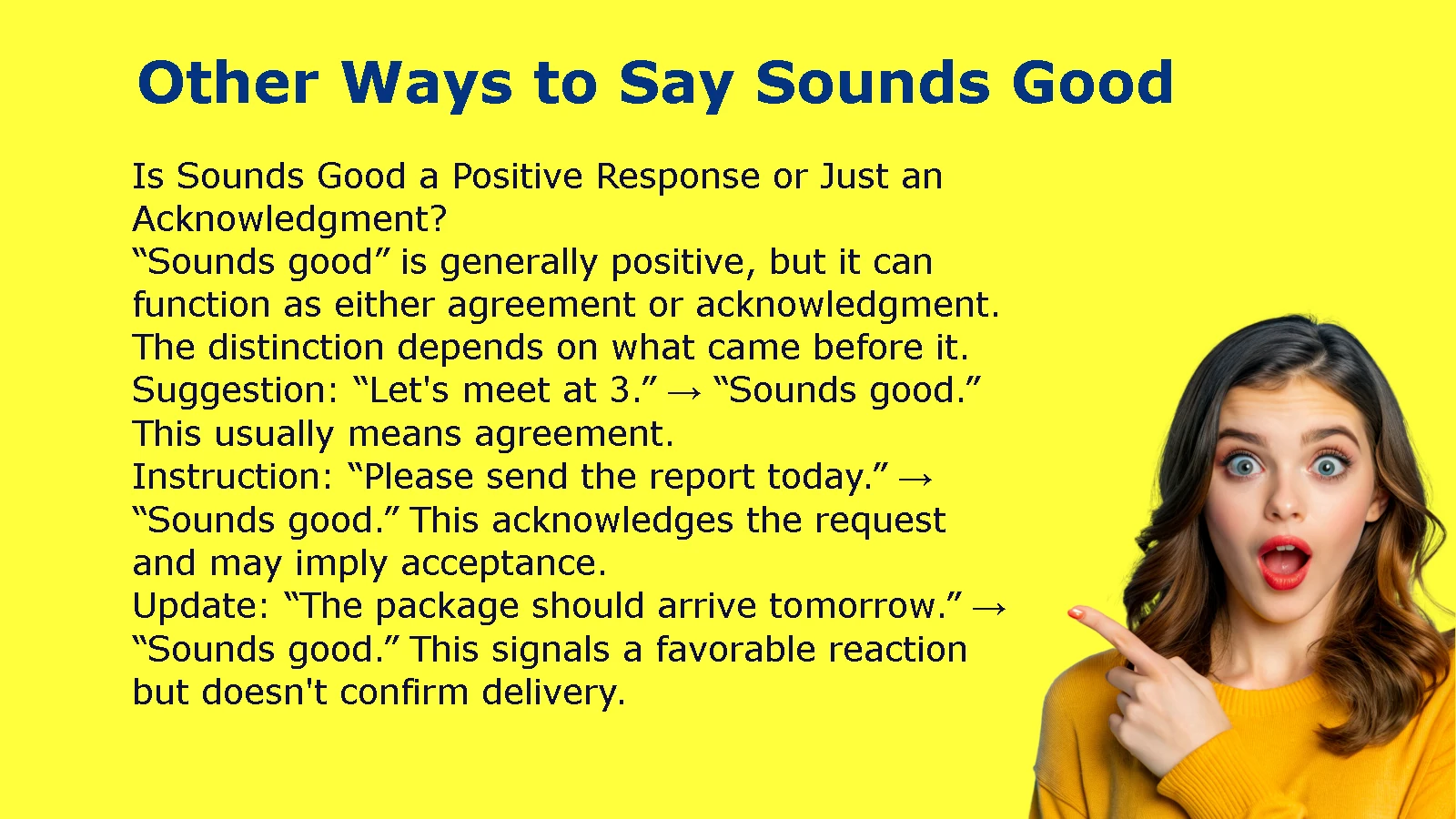
Is Sounds Good a Positive Response or Just an Acknowledgment?
“Sounds good” is generally positive, but it can function as either agreement or acknowledgment.
The distinction depends on what came before it.
- Suggestion: “Let’s meet at 3.” → “Sounds good.” This usually means agreement.
- Instruction: “Please send the report today.” → “Sounds good.” This acknowledges the request and may imply acceptance.
- Update: “The package should arrive tomorrow.” → “Sounds good.” This signals a favorable reaction but doesn’t confirm delivery.
When the message involves an important responsibility, clarify what you’ll do instead of relying on a vague acknowledgment.
Sounds Good vs. That Sounds Good: Is There a Difference?
Both expressions communicate a similar idea, but “that sounds good” can feel slightly more complete because it directly refers to the suggestion.
“Sounds good” is shorter and more conversational.
Examples:
- “Let’s try the new restaurant.” → “Sounds good.”
- “I found a better way to organize the project.” → “That sounds good.”
Neither expression is automatically more professional. Choose the one that feels natural for the conversation.
45+ Other Ways to Say Sounds Good
The best alternatives to “sounds good” express your actual intention. Some communicate simple agreement, while others show enthusiasm, politeness, or willingness to participate.
Best General Alternatives to Sounds Good
These phrases work in many everyday conversations, messages, and routine workplace exchanges.
| Alternative | Best use |
| That works for me. | Accepting a suggestion or arrangement |
| Sounds great. | Positive agreement |
| That works. | Simple acceptance |
| Absolutely. | Strong agreement or willingness |
| Perfect. | Confirming a suitable arrangement |
| I’m on board. | Supporting a plan or idea |
| I’m happy with that. | Expressing satisfaction |
| Works perfectly. | Confirming an ideal arrangement |
| That makes sense. | Acknowledging a reasonable idea |
| I’m good with that. | Casual agreement |
| Agreed. | Direct confirmation of agreement |
| Fair enough. | Accepting a reasonable point |
| That’s fine by me. | Accepting a suggestion |
| Let’s do it. | Agreeing to move forward |
| You’ve got a deal. | Accepting an offer or arrangement |
Polite and Friendly Alternatives
These expressions help you sound warm without making your reply overly formal.
- That sounds lovely.
- I’d be happy to.
- That would be great.
- I’m glad that works out.
- That’s a good idea.
- I like that plan.
- I’d love to.
- Thanks, that works for me.
- I’m happy to go with that.
- That sounds wonderful.
Example:
Friend: Would you like to join us for dinner on Saturday?
You: I’d love to. Thanks for inviting me!
This response feels warmer than a short acknowledgment because it shows appreciation as well as acceptance.
Enthusiastic Ways to Say Sounds Good
Use these alternatives when you genuinely feel excited about an idea, opportunity, or invitation.
- Love that idea.
- I’m all for it.
- Count me in.
- That sounds fantastic.
- Let’s do it.
- I’m excited about this.
- Absolutely, I’m in.
- That sounds amazing.
- I’m looking forward to it.
- You can definitely count me in.
Avoid using enthusiastic language automatically. If you’re only mildly interested, a simple “That works for me” may communicate your feelings more accurately.
Other Ways to Say Sounds Good Professionally
Professional alternatives to “sounds good” include “That works well for me,” “I agree with this approach,” and “That sounds like a good plan.” These phrases suit workplace conversations, client communication, project updates, and meeting arrangements.
The right expression depends on whether you want to confirm a schedule, support a decision, acknowledge instructions, or accept responsibility.
Professional Alternatives for Workplace Conversations
Choose one of these expressions when communicating with colleagues, managers, clients, or business partners.
That works for me.
Use this phrase when you agree with a practical arrangement.
Example: “The team can review the draft on Wednesday.”
Reply: “That works for me.”
I agree with that approach.
This works when someone suggests a strategy or solution.
Example: “We could reduce the number of approval steps.”
Reply: “I agree with that approach. It should help streamline the process.”
That sounds like a good plan.
Use it to support a proposal without sounding overly enthusiastic.
I’m aligned with this.
This phrase suits discussions about shared goals, priorities, and direction. However, use it only when you genuinely support the proposal.
That seems reasonable.
Choose this when you consider a suggestion practical or fair but don’t want to express strong enthusiasm.
Other professional options include:
- I support this direction.
- That approach makes sense.
- I’m comfortable with that arrangement.
- This looks good to me.
- I can work with that.
- I agree with the proposed changes.
Professional Ways to Confirm a Plan or Meeting
Scheduling messages benefit from specific replies. Instead of sending a vague acknowledgment, confirm the detail that matters.
| Situation | Professional reply |
| Confirming a meeting | The proposed time works well for me. |
| Accepting a new schedule | That schedule works on my end. |
| Confirming an appointment | I can confirm that time. |
| Accepting an arrangement | That arrangement works well. |
| Confirming a finalized plan | Confirmed. I’ll proceed as discussed. |
Example:
Original message: “Can we move our meeting to Thursday at 2 p.m.?”
Better reply: “Thursday at 2 p.m. works well for me. Thank you for the update.”
This response removes uncertainty and confirms the exact time.
Professional Ways to Accept a Request or Assignment
When someone gives you a task, your response should communicate both understanding and your intended action.
Consider these alternatives:
- Absolutely, I’ll take care of it.
- Understood. I’ll proceed.
- Happy to handle this.
- I can make that work.
- I’ll get started on it.
- I’ll review the details and follow up.
- I’ll prioritize this and share an update.
Use these expressions carefully.
“I’ll take care of it” signals a commitment. Don’t use it if you lack the authority, time, or resources to complete the task.
For complex assignments, include a deadline or next step.
Example:
“Understood. I’ll review the document and send my feedback by Thursday afternoon.”
How to Choose the Right Professional Alternative
Before replying, identify what the other person needs from you.
If they need agreement:
Use “I agree with this approach.”
If they need scheduling confirmation:
Use “That time works well for me.”
This distinction prevents a common workplace problem: a message that sounds positive but doesn’t clearly establish what happens next.
Other Ways to Say Sounds Good in an Email
Good email alternatives to “sounds good” include “That works well for me,” “I agree with this approach,” and “Thank you for confirming.” The strongest choice reflects the purpose of your reply and gives the recipient enough information to understand your response.
Professional Email Alternatives for Clients and Managers
Use these phrases when replying to a client, manager, supervisor, or business contact.
- That works well for me.
- I agree with this approach.
- That sounds like a good plan.
- Thank you for confirming.
- I appreciate the update.
- I’m happy to proceed with this.
- The proposed arrangement works for me.
- I look forward to moving ahead.
A brief email can still sound professional. You don’t need a long introduction or an elaborate closing for every routine exchange.
Email Phrases for Accepting a Meeting Invitation
Here are some natural examples:
Simple confirmation
“Tuesday at 10 a.m. works well for me. Thank you.”
Polite confirmation
“Thank you for the invitation. I’d be happy to attend.”
Confirmation with a time zone
“Thursday at 2 p.m. Eastern works for me. I look forward to speaking with you.”
When you need clarification
“The proposed date works for me. Could you please confirm whether the meeting will take place online or in person?”
Each response confirms the relevant detail while keeping the message focused.
Email Replies for Approving a Suggestion or Proposal
When responding to proposals, be precise about what you support.
Accepting an idea
“I agree with this approach. Let’s move forward with the proposed changes.”
Supporting a recommendation
“This looks good to me. I support the recommendation.”
Accepting a proposal subject to a condition
“The proposal looks promising. I’m happy to proceed once we finalize the budget.”
Acknowledging without giving final approval
“Thank you for sharing the proposal. I’ve reviewed it and will provide my decision by Friday.”
This last example matters because acknowledging a proposal doesn’t necessarily mean approving it.
Email Examples Using Alternatives to Sounds Good
Here are complete email replies you can adapt.
Email example for a manager
Subject: Re: Project Timeline
Hi Alex,
The revised timeline works well for me. I’ll adjust my tasks accordingly and share an update by Wednesday.
Best,
[Your Name]
Email example for a client
Subject: Re: Meeting Schedule
Hi Jordan,
Thank you for confirming the meeting time. Thursday at 11 a.m. works well for me.
I look forward to our discussion.
Best regards,
[Your Name]
Email example for a colleague
Subject: Re: Content Plan
Hi Sam,
I agree with this approach. The proposed structure should make the article easier to navigate.
Let’s proceed with this version.
Best,
[Your Name]
Short Email Replies vs. Complete Professional Responses
A short response works when the context is clear.
For example:
“Perfect, thank you!”
However, add detail when the conversation involves deadlines, money, approvals, deliverables, or multiple arrangements.
Compare:
Vague: Sounds good.
Clear: The revised deadline of November 6 works for me. I’ll send the completed draft by noon.
The second message establishes both agreement and an actionable expectation.
Is Sounds Good Professional?
Yes, “sounds good” is generally professional enough for routine workplace conversations, internal chats, and many business emails. It sounds friendly and efficient rather than formal. For sensitive decisions, contractual agreements, or important approvals, use more specific wording.
When Sounds Good Is Appropriate at Work
The expression works well in situations such as:
- Accepting a meeting time.
- Agreeing to a colleague’s suggestion.
- Acknowledging a routine update.
- Confirming a simple plan.
- Responding to an informal workplace message.
Example:
Manager: “Let’s review the report tomorrow morning.”
Employee: “Sounds good. I’ll have my notes ready.”
The reply feels professional because it adds a clear next step.
When You Should Avoid Sounds Good
Choose a more precise response when:
- The other person needs formal approval.
- The conversation involves legal or financial commitments.
- You’re discussing a complaint or sensitive issue.
- The proposal includes conditions you haven’t reviewed.
- Your response needs to establish a deadline or responsibility.
For example, replying “Sounds good” to a contract amendment might leave the other party unsure whether you acknowledge receipt, accept the terms, or approve the final version.
Use wording that clearly states your intention.
Does Sounds Good Sound Rude, Dismissive, or Too Casual?
“Sounds good” isn’t inherently rude. Most people interpret it as a friendly, neutral acknowledgment.
However, the phrase may feel dismissive when someone shares a difficult experience, raises a concern, or explains a serious problem.
For example:
Coworker: “I’ve been working late all week to fix the issue.”
Weak reply: “Sounds good.”
Better reply: “Thanks for putting in the extra effort. I appreciate your help.”
The second response recognizes the person’s contribution instead of treating the message like a routine plan.
How to Make Sounds Good More Professional
You can improve the phrase by adding context, appreciation, or a next step.
- Sounds good. Thank you for the update.
- Sounds good. I’ll review the document today.
- That works well for me. I appreciate your flexibility.
- That sounds like a good plan. Let’s proceed.
- Understood. I’ll follow up by Friday.
A useful principle: Professional communication values clarity more than formality.
What to Say Instead of Sounds Good in a Text
For casual texts, try “Works for me,” “I’m in,” “Perfect,” “Let’s do it,” or “Bet.” These short replies make conversations feel natural. Choose your response based on whether you’re accepting a plan, agreeing with an idea, or showing excitement.
Short Text Replies
Use these quick alternatives when the conversation doesn’t require much explanation.
- Perfect!
- Cool.
- Works for me.
- I’m in.
- Absolutely.
- Sounds great.
- Deal.
- Yep, let’s do it.
- Gotcha.
- For sure.
The right response depends on your relationship with the recipient. “Cool” may suit a friend, while “That works for me” feels more neutral.
Friendly Replies to Friends and Family
When texting people you know well, you can use warmer or more personal expressions.
Friend: “Want to watch a movie tonight?”
You: “I’m in!”
Sibling: “I’ll pick you up at 6.”
You: “Perfect, see you then!”
Friend: “Let’s try that new café.”
You: “I’m down. I’ve wanted to go there!”
These replies communicate agreement without making ordinary conversations feel formal.
Text Replies for Making Plans
When making arrangements, confirm the important detail.
Instead of replying:
“Sounds good.”
Try:
- “Perfect, see you at 7.”
- “Works for me. Send me the address.”
- “I’m in! I’ll meet you there.”
- “Deal. I’ll book the tickets.”
- “Great, let me know when you’re leaving.”
This small adjustment helps prevent misunderstandings, especially when several people are coordinating plans.
Text Replies That Show Excitement
Use these when you’re genuinely enthusiastic:
- Can’t wait!
- I’m so in!
- Love it!
- Yes! Let’s do this.
- That sounds amazing.
- I’m totally up for it.
Your reply should match your actual feelings. Overly enthusiastic responses can sound unnatural when the situation is routine.
Funny Ways to Say Sounds Good
Funny alternatives to “sounds good” add personality to relaxed conversations. Try expressions such as “Well, that’s a yes from me,” “You’ve got yourself a deal,” or “My calendar and I agree.” Use playful replies with people who understand your humor.
Funny and Witty Agreement Phrases
Try these lighthearted alternatives:
- I’m sold.
- Well, that’s a yes from me.
- Consider it enthusiastically approved.
- My calendar and I agree.
- You’ve got yourself a deal.
- Say no more.
- I’m suspiciously excited about this.
- Permission granted by my snack committee.
- This plan has my full potato-powered support.
- I accept these terms and conditions.
The last few options are intentionally silly. They’re better suited to friends, group chats, or informal conversations than business communication.
Example:
Friend: “Pizza and a movie tonight?”
You: “You’ve got yourself a deal.”
The response communicates agreement with a playful tone.
Sarcastic Alternatives (Use Carefully)
Sarcasm can make a reply funny, but it can also create confusion.
Examples include:
- Oh, absolutely. What could possibly go wrong?
- A plan involving snacks? I’m listening.
- Well, this should be interesting.
- Against my better judgment, I’m in.
These expressions work when both people understand the joke.
Avoid sarcastic agreement when someone discusses a serious issue, asks for help, or needs a dependable commitment.
Funny Replies for Text Messages and Group Chats
Group chats allow more playful responses.
Message: “Anyone want to organize a weekend road trip?”
Possible replies:
- My adventure department approves.
- I’ll bring snacks and questionable directions.
- The committee has voted yes.
- My weekend has officially found a purpose.
Humor works best when it supports the conversation instead of distracting from the actual plan.
Sounds Good Synonyms and Slang
Popular slang alternatives to “sounds good” include “bet,” “cool,” “say less,” “I’m down,” and “dope.” These expressions can communicate agreement, enthusiasm, or acceptance, but their meanings vary by context, region, age group, and relationship.
Popular Slang Alternatives to Sounds Good
| Slang expression | Meaning or tone | Example |
| Bet | Agreement or confirmation | “Meet at 8?” “Bet.” |
| Cool | Casual acceptance | “Cool, see you there.” |
| Say less | I understand; no more explanation needed | “I’ll bring food.” “Say less.” |
| I’m down | I’m willing or interested | “I’m down for that.” |
| Dope | That’s great or impressive | “That sounds dope.” |
| For sure | Definite agreement | “For sure!” |
| I’m game | Willingness to participate | “I’m game if you are.” |
| Word | Informal acknowledgment or agreement | “Word, I’ll be there.” |
Not every expression means exactly the same thing.
“I’m down” usually expresses willingness to participate. “Bet” often signals agreement or confirmation. “Dope” generally expresses approval or enthusiasm.
Choose slang that feels natural to you rather than forcing trendy expressions into every conversation.
What Does Bet Mean as a Reply?
“Bet” is an informal expression that can mean “okay,” “agreed,” or “you can count on it.”
Example:
Person A: “I’ll send you the details tonight.”
Person B: “Bet.”
In this exchange, the reply acknowledges the plan.
However, “bet” can also carry different meanings depending on context, including a literal wager. Its conversational meaning comes from how people use it.
For a client email or formal workplace exchange, choose a clearer expression such as “Understood” or “That works for me.”
Is Say Less the Same as Sounds Good?
Not exactly. “Say less” often means that you’ve understood enough and don’t need further explanation. It can also express enthusiastic agreement.
Example:
Friend: “There’s a new burger place, and we’re going tonight.”
You: “Say less.”
The reply suggests enthusiasm and understanding.
By contrast, “sounds good” expresses general approval without necessarily implying that you already understand all the details.
Slang Expressions to Avoid in Professional Messages
Some casual phrases can feel out of place in formal communication.
Avoid these in most client-facing or official emails:
- Bet.
- Say less.
- Word.
- Dope.
- Fire.
These expressions aren’t inherently inappropriate, but their tone may not suit the audience.
When in doubt, use plain English. “That works for me” communicates agreement clearly.
Sounds Good Reply: How to Respond When Someone Says It
When someone says “sounds good,” you can usually respond with “Great, thanks,” “Perfect, see you then,” or another brief acknowledgment. If the conversation has reached a clear agreement, you may not need to reply again.
Short Replies to Sounds Good
Use one of these responses when you want to keep the conversation moving:
- Great, thanks!
- Perfect. See you then.
- Awesome, I’ll send the details.
- Thanks for confirming.
- Looking forward to it.
- Excellent, talk soon.
- Appreciate it!
- See you there.
Choose a reply that adds value rather than repeating the same agreement.
For example:
Person A: “Thursday at 4 works for me.”
Person B: “Great, see you Thursday.”
This response closes the loop without unnecessary wording.
How to Reply to Sounds Good in a Professional Email
In a business email, your next response should depend on whether the other person confirmed a decision or simply acknowledged your message.
If a colleague confirms a meeting:
“Thank you for confirming. I’ll send the calendar invitation shortly.”
If a client approves a proposed schedule:
“Thank you. I’ll update the timeline and share the revised version.”
If your manager agrees with a suggestion:
“Great, I’ll move forward with the next steps.”
These replies keep the conversation productive.
How to Reply to Sounds Good in a Text
Casual conversations don’t always need another message.
If a friend says:
“Sounds good, see you at 7.”
You can reply:
“See you then!”
For simple plans, even a reaction emoji may be enough if that fits your usual communication style.
When logistics remain unresolved, ask a useful question instead.
Example:
“Great! Should I meet you outside the station?”
Should You Reply Again or End the Conversation?
You don’t need to send a reply after every message.
A final acknowledgment makes sense when:
- Someone confirms an important arrangement.
- You need to communicate the next step.
- The other person expects a response.
- The conversation still contains an unanswered question.
You can end the exchange when both people understand the plan and no action requires confirmation.
Avoid extending a conversation with repeated acknowledgments such as “Sounds good,” “Great,” and “Perfect” when each message adds nothing new.
Sounds Good vs. Similar Expressions
“Sounds good,” “works for me,” “got it,” and “I agree” can all appear in similar conversations, but they communicate different intentions. The best expression depends on whether you want to show approval, confirm suitability, acknowledge information, or express agreement.
Sounds Good vs. Works for Me
“Sounds good” usually communicates general approval or acceptance.
“Works for me” specifically indicates that something suits your needs, schedule, or preferences.
Example:
Proposal: “Let’s meet at 9 a.m.”
- “Sounds good.” = The suggestion seems acceptable.
- “Works for me.” = The time fits your schedule.
Both work well in professional communication.
Sounds Good vs. Got It
“Got it” primarily acknowledges understanding.
It doesn’t necessarily mean you agree with the suggestion.
Example:
Manager: “Please submit the report before noon.”
Employee: “Got it. I’ll submit it by 11:30.”
The reply confirms understanding and clarifies the action.
By comparison, “sounds good” may express acceptance, but it doesn’t always prove that the person understood every instruction.
Sounds Good vs. I Agree
“I agree” directly expresses agreement with an opinion, decision, or argument.
“Sounds good” often responds to a suggestion, arrangement, or plan.
Examples:
Opinion: “We should simplify the onboarding process.”
Reply: “I agree.”
Plan: “Let’s schedule the training for Friday.”
Reply: “Sounds good.”
Although both expressions can overlap, “I agree” is usually more precise in discussions involving ideas or decisions.
Sounds Good vs. Sounds Great
“Sounds great” generally communicates more enthusiasm than “sounds good.”
For example:
Friend: “We’re going on a weekend trip.”
Reply: “Sounds great!”
The response suggests stronger excitement.
However, tone matters. Someone can say “sounds good” enthusiastically or “sounds great” sarcastically. Words provide clues, but context shapes the meaning.
How to Choose the Best Alternative to Sounds Good
Choose the best alternative to “sounds good” by identifying what you want your reply to communicate. Consider your audience, the situation, and whether the message requires agreement, acknowledgment, approval, or a commitment.
Consider Your Audience and Relationship
Your relationship with the recipient influences how your response sounds.
| Audience | Suitable alternative |
| Close friend | I’m in! |
| Family member | Perfect, see you then. |
| Coworker | That works for me. |
| Manager | I agree with this approach. |
| Client | The proposed arrangement works well for me. |
| New business contact | Thank you. I can confirm that time. |
You don’t need to sound formal with everyone at work. Match your language to the person’s expectations and your organization’s communication style.
Match Your Reply to the Situation
Before choosing a phrase, ask yourself what the other person actually needs.
If someone suggests an idea, show agreement.
If someone shares an update, acknowledge it.
When someone proposes a schedule, confirm the timing.
If the person requests action, explain what you’ll do.
This simple distinction makes your messages more useful.
Avoid Implying a Commitment You Can’t Make
Some alternatives carry stronger promises than others.
Compare these expressions:
- “Sounds good.” General approval or acceptance.
- “I’ll take care of it.” A commitment to handle the task.
- “Consider it done.” A strong promise that the task will be completed.
- “I’ll review it and get back to you.” A commitment to review and respond.
Don’t use confident language simply to sound professional. Make promises you can fulfill.
Use Specific Replies When Details Matter
Specific responses reduce confusion.
For example:
Original: “Can you send the revised file by Friday?”
Vague reply: “Sounds good.”
Specific reply: “Yes, I’ll send the revised file by Friday afternoon.”
The second version confirms the responsibility and deadline.
This approach is especially helpful when coordinating projects, managing clients, or working across teams.
Practical Examples: Choosing the Right Sounds Good Alternative
These realistic scenarios show how small wording changes can improve everyday communication.
Scenario: A Client Proposes a New Deadline
Client: “Could we move the delivery date to November 10?”
Weak response: “Sounds good.”
Better response: “November 10 works for me. I’ll update the delivery schedule and share the revised timeline.”
Why it works: The reply confirms the date and communicates the next action.
However, only accept the revised deadline if your team can meet it.
Scenario: A Manager Suggests a Different Strategy
Manager: “Let’s focus on updating our highest-performing pages first.”
Better response: “I agree with this approach. We can start with pages that have strong impressions but low click-through rates.”
Why it works: The response confirms agreement and adds a practical direction.
Scenario: A Friend Suggests Weekend Plans
Friend: “Let’s get coffee on Saturday.”
Better response: “I’m in! What time works for you?”
Why it works: The reply sounds friendly and helps finalize the plan.
Scenario: A Coworker Shares a Completed Task
Coworker: “I’ve uploaded the revised document.”
Better response: “Thanks for the update. I’ll review it this afternoon.”
Why it works: The response acknowledges the update and identifies the next step without giving premature approval.
A Simple Phrase-Selection Framework
Use this four-step method whenever you’re unsure how to reply.
Identify the message type. Is it a suggestion, request, update, or invitation?
Choose your intention. Do you want to agree, acknowledge, approve, or commit?
Match the tone. Should the response sound professional, neutral, friendly, or playful?
Add necessary details. Confirm deadlines, dates, responsibilities, or conditions when needed.
This framework helps you communicate clearly without relying on the same phrase in every conversation.
Frequently Asked Questions
What Is the Best Professional Alternative to Sounds Good?
“That works well for me” is one of the best professional alternatives to “sounds good.” It communicates clear agreement without sounding overly formal. For a business proposal or strategy, “I agree with this approach” may be more appropriate.
What Is Another Way to Say Sounds Good in an Email?
You can write “That works well for me,” “Thank you for confirming,” or “I agree with this approach.” Choose a phrase that matches your purpose, whether you’re confirming a meeting, accepting a suggestion, or acknowledging an update.
Is Sounds Good Formal or Informal?
“Sounds good” is generally neutral to conversational. It works in many workplace conversations and routine business emails, but it may feel too casual for certain formal decisions, official approvals, or sensitive discussions.
What Is a Slang Word for Sounds Good?
“Bet,” “cool,” “say less,” and “I’m down” are common informal alternatives. Their meanings differ slightly. “Bet” often signals agreement, while “I’m down” usually expresses willingness to participate.
How Do You Reply to Sounds Good?
You can reply with “Great, thanks,” “Perfect, see you then,” or “Looking forward to it.” If the conversation has already established everything clearly, you may not need another response.
Is It Rude to Say Sounds Good?
No, “sounds good” isn’t inherently rude. It usually communicates friendly agreement. However, it may seem dismissive when someone shares a concern, emotional experience, or important problem that deserves a more thoughtful response.
Conclusion: Choose a Sounds Good Alternative That Fits Your Message
Finding the right alternative to “sounds good” isn’t about making every message sound formal or impressive. It’s about choosing words that communicate your intention clearly.
Use “That works for me” for everyday agreement, “I agree with this approach” for professional discussions, and “I’m in” for casual invitations. If you’re confirming a deadline or accepting a responsibility, add the details that matter.
Before sending your next message, consider what you want the other person to understand. A precise response can save time, prevent confusion, and make your communication more effective.