Other ways to say rest well include get some rest, take it easy, sleep peacefully, rest up, and have a peaceful night. The best expression depends on whether you want to comfort someone who is sick, encourage a tired friend to relax, send a sweet bedtime message, or honor someone who has passed away. Understanding the difference between rest well, sleep well, get well soon, and rest in peace helps you choose words that sound natural, caring, and appropriate for the situation.
A simple message can mean a lot when someone feels exhausted, struggles with an illness, or needs emotional support. However, the same phrase does not fit every situation. A casual “Get some rest” works well for a tired coworker, while “I hope you feel better soon” offers more encouragement to someone who is sick. For a memorial message, “May you rest in peace” expresses a different meaning altogether.
This guide explores the meaning of “rest well,” natural alternatives, messages for sick people, bedtime wishes, expressions of sympathy, and common grammar questions. You will also find ready-to-use examples for texts, cards, captions, and everyday conversations.
What Does “Rest Well” Mean?
“Rest well” means to relax, sleep peacefully, or recover your energy without disturbance. People use it to show care for someone who feels tired, needs a break, or is preparing for sleep. In some contexts, particularly memorial messages, it can also express a wish for someone who has died to be at peace.
The expression combines the verb rest, which means to relax or stop working, with well, which describes how someone rests. Its exact meaning depends on the situation and the relationship between the people speaking.
For example:
- Before bedtime: “Good night, Mom. Rest well.”
- After a tiring day: “You have worked hard today. Please rest well tonight.”
- During an illness: “Take your medicine as directed and rest well.”
- In a memorial message: “You will always be remembered. Rest well.”
Although the phrase sounds simple, it communicates more than a suggestion to stop working. It can express concern, affection, encouragement, or sympathy.
When Do People Say “Rest Well”?
People say “rest well” when they want someone to relax, sleep comfortably, or take enough time to recover. It suits everyday conversations, caring messages, and bedtime wishes. The phrase can also appear in tributes to someone who has died, although “rest in peace” remains the more established expression for condolences.
Here are the most common situations where you can use it.
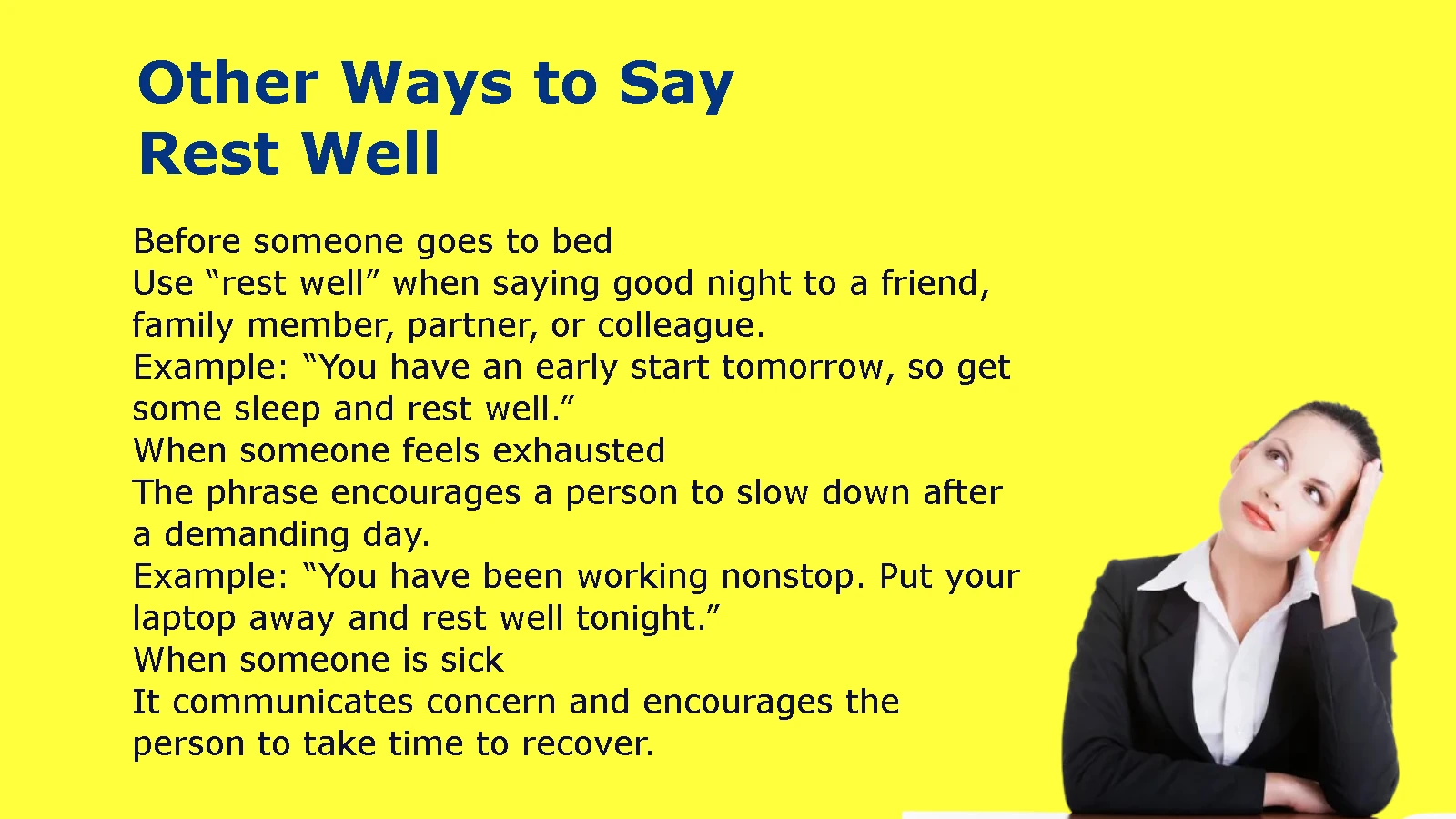
Before someone goes to bed
Use “rest well” when saying good night to a friend, family member, partner, or colleague.
Example: “You have an early start tomorrow, so get some sleep and rest well.”
When someone feels exhausted
The phrase encourages a person to slow down after a demanding day.
Example: “You have been working nonstop. Put your laptop away and rest well tonight.”
When someone is sick
It communicates concern and encourages the person to take time to recover.
Example: “I am sorry you are feeling unwell. I hope you can rest well and feel better soon.”
When someone has died
The expression can appear in a personal tribute, particularly when the writer wants to express peace or spiritual comfort.
Example: “Your kindness touched so many lives. Rest well, dear friend.”
Choose the wording based on the situation. A bedtime message should feel warm and natural, while a condolence message should show respect and sensitivity.
Is “Rest Well” the Same as “Sleep Well”?
“Rest well” and “sleep well” are similar, but they do not mean exactly the same thing. “Sleep well” specifically refers to sleeping comfortably through the night. “Rest well” has a broader meaning because it can include sleeping, relaxing, taking a break, or recovering from physical and emotional strain.
| Expression | Meaning | Example |
| Rest well | Relax or recover comfortably | “You have had a long day. Rest well.” |
| Sleep well | Enjoy comfortable, peaceful sleep | “Good night. Sleep well.” |
| Rest up | Take time to recover energy | “Rest up before your big game.” |
| Take it easy | Avoid unnecessary effort or stress | “You are exhausted, so take it easy today.” |
| Get some rest | Stop working or exerting yourself and relax | “You look tired. Get some rest.” |
Use “sleep well” when you are specifically wishing someone a good night’s sleep. Choose “rest well” when you want to express a broader wish for comfort, relaxation, or recovery.
35+ Other Ways to Say Rest Well
There are many alternatives to “rest well,” ranging from casual expressions to affectionate messages and professional wishes. The most natural choice depends on your tone, the person’s circumstances, and how closely you know them.
The following phrases help you communicate the same general idea without repeating the same words.
Simple and Everyday Ways to Say Rest Well
Everyday alternatives work best when you want to sound friendly without making your message overly emotional. They fit conversations with friends, relatives, classmates, and coworkers.
| Alternative | Best use | Example |
| Get some rest | Someone looks tired | “You have been studying all day. Get some rest.” |
| Take it easy | Someone needs to slow down | “You have a busy week ahead, so take it easy tonight.” |
| Have a good rest | General relaxation | “Enjoy your day off and have a good rest.” |
| Get some good sleep | Before bedtime | “Put your phone away and get some good sleep.” |
| Take a break | Someone has been working continuously | “You have finished the report. Take a break.” |
| Relax for a while | Someone feels tense | “You can handle the rest tomorrow. Relax for a while.” |
| Recharge your batteries | Someone needs to regain energy | “Spend Sunday relaxing and recharge your batteries.” |
| Get comfortable and unwind | After a demanding day | “Change into something comfortable and unwind.” |
“Get some rest” is one of the most versatile options because it works in many everyday situations. You can use it for physical exhaustion, mental fatigue, or general relaxation.
“Take it easy” sounds more casual. It may suggest reducing stress or effort rather than going to sleep immediately.
For example, if a friend tells you that they have been working for ten hours, you might say, “You deserve a break. Take it easy tonight.” If they mention feeling sleepy, “Get some rest” may sound more appropriate.
Warm and Caring Ways to Tell Someone to Rest Well
Sometimes, a basic phrase does not express enough concern. When someone you care about feels exhausted, overwhelmed, or emotionally drained, a warmer message can make your intention clearer.
Consider these alternatives:
- Please take good care of yourself and get some rest.
- Give yourself time to recharge.
- Don’t push yourself too hard.
- I hope you get the rest you need.
- Take a break and look after yourself.
- You deserve some time to relax.
- Put everything aside for a while and breathe.
- Be gentle with yourself and take things slowly.
- I hope you can relax and feel refreshed tomorrow.
- Take the time you need to feel like yourself again.
These expressions work because they recognize the person’s situation instead of simply telling them what to do.
For example, “You need to rest” can sound like an order, especially if someone already feels stressed. “Please don’t push yourself too hard. You deserve a break” communicates the same concern with greater warmth.
Ready-to-send example:
“I know you have had a lot on your plate lately. Please take some time for yourself, get some rest, and remember that you do not have to do everything at once.”
Use this style when you want to acknowledge someone’s effort and encourage them to slow down without making them feel guilty.
Sweet and Affectionate Ways to Say Rest Well
For a romantic partner, close friend, or family member, you may want a message that feels personal and affectionate. These alternatives work especially well in evening texts and good-night messages.
- Rest up, sweetheart.
- Sleep peacefully, my love.
- I hope you wake up feeling refreshed.
- Relax and let tomorrow take care of itself.
- Sending you love and wishing you a peaceful night.
- Close your eyes, relax, and leave today’s worries behind.
- I hope tonight brings you comfort and calm.
- Get some good sleep, and remember that you are loved.
- May your night be peaceful and your morning bright.
- Put your worries aside and give yourself time to recharge.
The best affectionate messages sound like something you would naturally say to that person. You do not need elaborate language to make someone feel appreciated.
For example, a partner who has had a stressful day might appreciate this message:
“Hey, love. You have done enough for today. Put your phone down, get comfortable, and rest. I hope you wake up tomorrow feeling lighter and happier.”
For a friend, you can keep the tone less romantic:
“You have had a rough week. Take tonight off, get some proper rest, and we can catch up tomorrow.”
Both messages express care, but they suit different relationships.
Professional and Polite Ways to Wish Someone Rest
In professional settings, your message should communicate concern without sounding overly familiar. This is especially important when writing to a manager, colleague, client, or employee who needs time away from work.
Here are some polite alternatives:
- I hope you get some well-deserved rest.
- Please take the time you need to recover.
- Wishing you a restful evening.
- I hope you have a chance to recharge.
- Take care and get some rest.
- I hope you can step away from work and relax.
- Please prioritize your well-being.
- Wishing you a comfortable and restorative break.
Choose the phrase based on the situation.
If a coworker has completed a difficult project, you might say, “Great work on the launch. I hope you get some well-deserved rest this weekend.”
If an employee has called in sick, a more considerate message would be, “I am sorry you are unwell. Please take the time you need to recover, and do not worry about work while you are away.”
Avoid making rest sound conditional on completing more tasks. A message that encourages genuine time off will usually feel more supportive than one that reminds someone of unfinished work.
How to Tell Someone to Rest Well in Different Situations
The right alternative depends on why the person needs rest. Someone who is sick may need reassurance, while a tired friend might simply appreciate a casual suggestion to relax. A person who has experienced a loss needs a different kind of message altogether.
Use the examples below to match your words to the situation.
How to Say Rest Well to a Sick Person
When someone is sick, combine a wish for rest with a message of care or encouragement. Expressions such as “I hope you get plenty of rest and feel better soon” acknowledge the person’s discomfort without pressuring them to recover immediately.
Here are several natural options:
- I hope you get plenty of rest and feel better soon.
- Take your time recovering. There is no need to rush.
- Get some rest and be gentle with yourself.
- Wishing you comfort and a smooth recovery.
- I hope each day brings you a little more strength.
- Please look after yourself and take it one day at a time.
- I am thinking of you and hoping you feel more comfortable soon.
- Focus on getting better. Everything else can wait.
- I hope you have a peaceful day and get the rest you need.
- Sending you lots of care. I hope you feel better soon.
The key is to show concern without assuming how serious the illness is or how quickly the person will recover.
For a mild cold, a short message may be enough:
“Sorry you are feeling under the weather. Get some rest, drink plenty of fluids if appropriate, and I hope you feel better soon.”
For a more serious illness, avoid overly cheerful expressions that might minimize the person’s experience. A message such as “I am thinking of you. I hope you are comfortable and getting the support you need” may feel more considerate.
Ready-to-send text for a sick friend:
“Hey, I am sorry you are not feeling well. Please take it easy and give yourself time to rest. I hope you feel a little better each day. Let me know if there is anything I can do to help.”
This message works because it offers emotional support without promising a quick recovery.
Other Ways to Say Get Well Soon
“Get well soon” expresses a wish for someone’s recovery, while “rest well” focuses on rest and comfort. You can use alternatives such as “I hope you feel better soon,” “Wishing you a smooth recovery,” or “Take all the time you need to heal.” The best choice depends on the person’s condition and your relationship.
Here are alternatives organized by tone.
| Tone | Alternative | Example |
| Simple | Hope you feel better soon | “Sorry about your cold. Hope you feel better soon.” |
| Warm | Sending you lots of care | “Sending you lots of care and hoping you feel better soon.” |
| Supportive | Take all the time you need to recover | “Do not rush back. Take all the time you need to recover.” |
| Professional | Wishing you a speedy recovery | “The team wishes you a speedy recovery.” |
| Gentle | I hope you find comfort and strength | “I hope you find comfort and strength during this difficult time.” |
| Encouraging | One day at a time | “Take things one day at a time. I am rooting for you.” |
| Personal | Let me know how I can help | “I hope you feel better soon. Let me know if you need anything.” |
| For a serious illness | Thinking of you and wishing you comfort | “I am thinking of you and wishing you comfort and support.” |
A useful distinction is that “get well soon” can sometimes feel like an expectation, particularly when a person is dealing with a long-term or serious illness. In those circumstances, “I hope you are comfortable” or “I am here for you” may offer better emotional support.
Example for a colleague:
“Sorry to hear that you are unwell. Please focus on your recovery and take the time you need. We look forward to seeing you when you are ready to return.”
Example for a close family member:
“I wish I could make this easier for you. Rest as much as you can, and remember that I am here whenever you need me.”
You can also read a related guide on other ways to say feel better or other ways to say take care for more supportive expressions.
How to Say “Take Rest” in Different Ways
In everyday American English, “get some rest,” “take a rest,” and “take a break” usually sound more natural than “take rest” on its own. “Take rest” may appear in some varieties of English, but many American speakers would choose one of the more common alternatives.
Here is how to use them.
When someone has been working too hard
- “You have been at your desk all day. Take a break.”
- “Step away from the computer for a while.”
- “You have earned some downtime.”
If someone feels physically exhausted
- “Sit down and catch your breath.”
- “Get some rest before you do anything else.”
- “Give your body time to recover.”
If someone is recovering from illness
- “Take it slow for a few days.”
- “Make sure you get enough rest.”
- “Give yourself time to recover fully.”
When someone feels stressed
- “Take a moment to clear your head.”
- “Give yourself a little breathing room.”
- “Step back and relax for a while.”
The expressions are related, but their meanings differ slightly. “Take a break” usually refers to a temporary pause in an activity. “Get some rest” suggests relaxation or recovery. “Take it slow” means reducing effort or pace, sometimes over a longer period.
For example, you might tell a student, “Take a break before you start the next chapter.” However, if your friend has a fever, “Get some rest and take it easy” would fit better.
How to Tell Someone to Rest Well Before Bed
When someone is going to sleep, use a phrase that sounds like a natural good-night wish. “Sleep well,” “have a peaceful night,” and “get some good sleep tonight” are familiar alternatives to “rest well.”
Try these options:
- Sleep well and wake up refreshed.
- Have a peaceful night.
- Get some good sleep tonight.
- Rest easy and sweet dreams.
- I hope you have a relaxing night.
- Wishing you a calm and restful night.
- Sleep tight and take care.
- May tomorrow bring you fresh energy.
- Put the day behind you and get some rest.
- Good night. I hope you sleep peacefully.
For someone who has had a difficult day, a more personal message may feel warmer.
For example:
“I know today was stressful. Try to switch off for the night and get some good sleep. Tomorrow is a fresh start.”
For a romantic partner:
“Good night, my love. I hope you sleep peacefully and wake up with a smile. Sweet dreams.”
For a friend who has an important day ahead:
“Get some good sleep tonight. You have a big day tomorrow, and I hope you wake up feeling ready for it.”
The goal is to wish someone comfort, not to make them feel obligated to fall asleep or stop worrying immediately.
How to Say Rest Well to a Friend or Loved One
When speaking to someone close to you, a personal message often works better than a formal phrase. Mentioning what the person has been dealing with makes your words feel sincere and relevant.
Here are some ready-to-send messages.
For a friend who feels exhausted
“You have been doing so much lately. Give yourself a break tonight, get some rest, and do something that makes you happy.”
For a family member
“Please take care of yourself and get enough rest. You do so much for everyone else, and you deserve time to recharge, too.”
For a romantic partner
“You have had a long day, sweetheart. Relax, get comfortable, and let yourself rest. I hope tomorrow feels a little easier.”
For someone who is emotionally overwhelmed
“You do not have to figure everything out tonight. Take a breath, rest for a while, and deal with things one step at a time.”
For someone who has been studying
“You have put in a lot of effort today. Close your books, get some sleep, and come back to it with a fresh mind tomorrow.”
A thoughtful message does not need to solve the person’s problem. Sometimes, acknowledging their effort and giving them permission to pause is enough.
What Does “Rest Well” Mean When Someone Dies?
When someone has died, “rest well” can express a wish for peace after death, but “rest in peace” is the more established phrase for condolences and memorial tributes. The appropriate wording depends on the relationship, the person’s beliefs, and the tone of the message.
In ordinary conversation, “rest well” usually refers to sleep or recovery. In a memorial context, it takes on a symbolic meaning. The writer is expressing the hope that the deceased is at peace and no longer experiencing pain or hardship.
For example:
“Your kindness and generosity will never be forgotten. May you rest in peace.”
Or:
“You brought so much happiness into our lives. Rest well, dear friend. You will always be remembered.”
These messages focus on remembrance and peace rather than physical rest.
Is “Rest Well” Appropriate for Someone Who Died?
Yes, “rest well” can be appropriate as a personal tribute to someone who has died. However, “rest in peace” and “may you rest in peace” are clearer and more widely recognized expressions of sympathy. If you choose “rest well,” add a respectful sentence that makes the memorial context clear.
For example:
- “Rest well, dear friend. Your memory will live on in our hearts.”
- “You touched so many lives. May you find eternal peace.”
- “Rest peacefully. You will never be forgotten.”
The phrase can work particularly well in a personal social media tribute or a message honoring someone’s memory.
However, if you are writing to a grieving family member, focus on their loss rather than making assumptions about the afterlife. A message such as “I am deeply sorry for your loss. I am thinking of you and your family” may be more suitable than a spiritual expression.
A useful rule: Use “rest well” when it reflects your natural way of expressing remembrance. Choose “rest in peace” when you want a familiar, unambiguous condolence.
Other Ways to Say Rest Well for a Death
Several expressions communicate peace, remembrance, or sympathy after someone’s death. Some have religious meanings, while others remain suitable across different beliefs.
| Expression | Meaning or tone | Best use |
| Rest in peace | A familiar wish for peace after death | General condolences and memorials |
| May you rest in eternal peace | Formal and solemn | Memorial posts and tributes |
| May your soul find peace | Spiritual or religious | When it fits the person’s beliefs |
| Gone but never forgotten | Emphasizes lasting remembrance | Memorial captions |
| You will always be remembered | Personal and respectful | Sympathy cards and tributes |
| May you find peace beyond this life | Reflective and spiritual | Personal memorial messages |
| Forever in our hearts | Expresses lasting love and connection | Tributes to family and loved ones |
| Your memory will live on | Focuses on the person’s legacy | Memorials and remembrance posts |
Consider the relationship before choosing a phrase.
For a close friend, you might write, “Gone but never forgotten. Thank you for all the beautiful memories.”
For a formal condolence card, you could say, “Please accept my heartfelt condolences. May your loved one rest in peace.”
For someone whose religious beliefs are important to their family, a spiritual expression may provide comfort if it reflects those beliefs.
Avoid assuming that everyone shares the same view of heaven, paradise, or the afterlife. Neutral expressions of remembrance are often the safest choice when you are unsure.
What Does “Rest Well in Paradise” Mean?
“Rest well in paradise” expresses the hope that someone who has died is at peace in a beautiful or heavenly place. The word “paradise” often carries spiritual or religious associations, so the phrase may communicate a belief in an afterlife rather than simply a wish for peaceful rest.
People may use it in memorial posts, tribute messages, or farewell captions for someone they loved or admired.
For example:
- “You brought light into so many lives. Rest well in paradise.”
- “Your time with us was precious, and your memory will stay with us forever. Rest well in paradise.”
- “You may be gone from our sight, but you will never leave our hearts. Rest well in paradise.”
The phrase can sound personal and affectionate, especially when the writer wants to express spiritual hope.
However, it is not universally appropriate. If you do not know the deceased person’s beliefs, “May you rest in peace” or “You will always be remembered” may be more inclusive.
Rest Well in Paradise: Message Examples
If you want to use “rest well in paradise” in a tribute, keep the wording sincere and respectful. A short message often carries more meaning than a long, elaborate paragraph.
For a close friend
“Rest well in paradise, my friend. I will always treasure the laughter, memories, and kindness you brought into my life.”
For a family member
“You will always be part of our family and our hearts. Rest well in paradise until we meet again.”
For a social media caption
“Your light will never fade from our memories. Rest well in paradise.”
For someone who inspired others
“Your kindness inspired everyone who knew you. Rest well in paradise, and may your legacy continue to touch lives.”
For a short, simple tribute
“Rest well in paradise. Forever loved, forever remembered.”
You can make a tribute more personal by adding a quality, memory, or contribution that made the person special. For example, mentioning their generosity, humor, or support creates a stronger message than relying only on a familiar phrase.
If you are writing to a grieving person rather than posting a tribute, consider adding a direct expression of support:
“I am so sorry for your loss. Your loved one made a lasting impact on so many people. I am thinking of you and your family.”
Is “Rest Well” Correct English?
Yes, “rest well” is grammatically correct English. It commonly works as an instruction, suggestion, or expression of goodwill. You can say “Rest well tonight” to someone who needs sleep or “I hope you rest well” when expressing a wish for comfortable rest.
The phrase does not require additional words to be grammatically complete when used as an imperative. The subject “you” is understood, just as it is in “Sleep well” or “Take care.”
Here are a few examples:
- “Rest well and enjoy your day off.”
- “I hope you rest well tonight.”
- “Please rest well before your appointment.”
- “She told her brother to rest well after his long journey.”
The phrase is correct, but context still matters. In everyday American English, “Get some rest” may sound more conversational when someone is exhausted, while “Sleep well” may sound more familiar as a bedtime wish.
“Rest Well” vs. “Rest Up”
Both expressions encourage someone to recover energy, but they have slightly different tones.
“Rest well” emphasizes the quality of someone’s rest. It often sounds gentle, thoughtful, or reassuring.
“Rest up” emphasizes taking enough rest to regain energy, often before returning to an activity.
| Expression | Typical meaning | Example |
| Rest well | Rest comfortably or peacefully | “You have had a busy day. Rest well tonight.” |
| Rest up | Recover energy for what comes next | “Rest up before your tournament.” |
| Get some rest | Stop working and relax | “You look exhausted. Get some rest.” |
| Take it easy | Reduce effort or stress | “You are still recovering, so take it easy.” |
Use “rest up” when someone needs to prepare for an upcoming event or regain strength after exertion.
For example, a coach might tell an athlete, “Rest up before Saturday’s match.” A friend who is going to bed might hear, “Sleep well and rest well tonight.”
“Rest Well” vs. “Sleep Well”
“Rest well” covers a wider range of situations, while “sleep well” refers specifically to sleep. Both expressions are correct and commonly understood.
Consider these examples:
Rest well: “You have been feeling worn out lately. I hope you get some time to rest well this weekend.”
Sleep well: “Good night. I hope you sleep well and wake up refreshed.”
You can also use both expressions in the same message, although it is not always necessary:
“Get comfortable, sleep well, and give yourself time to rest tomorrow.”
When writing a short good-night text, “Sleep well” may sound more direct. When encouraging someone to recover from a tiring period, “Rest well” may better express your intention.
“Rest Well” vs. “Get Well Soon”
These expressions serve different purposes.
“Rest well” encourages rest and comfort. “Get well soon” expresses hope that someone will recover from illness. You can combine them when you want to offer both encouragement and a wish for recovery.
| Feature | Rest well | Get well soon |
| Main purpose | Encourage rest | Wish someone a recovery |
| Common situation | Tiredness, bedtime, recovery | Illness or injury |
| Tone | Gentle and caring | Encouraging and supportive |
| Example | “Rest well and take care.” | “I hope you get well soon.” |
For example, if a friend has a cold, you could write, “Get some rest and feel better soon.”
If a coworker is taking a break after a demanding week, “I hope you get some well-deserved rest” would be more appropriate than “Get well soon,” unless the coworker is ill.
Can You Say “Rest Well” to Someone Who Is Sick?
Yes. “Rest well” is an appropriate expression for someone who is sick, especially when you want to encourage them to slow down and look after themselves. You can make it warmer by adding “I hope you feel better soon” or “Let me know if you need anything.”
For example:
“Sorry to hear you are not feeling well. Please get some rest and take care of yourself. I hope you feel better soon.”
For someone facing a more serious illness, avoid suggesting that rest alone will solve the problem. You can offer comfort without making assumptions:
“I am thinking of you and hoping you have the comfort and support you need. Please let me know if there is anything I can do.”
This approach keeps the message caring and respectful.
Rest Well Message Examples for Texts, Cards, and Captions
Ready-to-use messages help when you know what you want to express but cannot find the right words. The examples below cover everyday texts, illness, relationships, social media, and condolences.
Choose one that fits the situation, then personalize it if needed.
Short Rest Well Messages
Use these messages when you want to keep things simple.
- “Rest well and take care.”
- “Get some rest. You deserve it.”
- “Hope you have a peaceful night.”
- “Take it easy and recharge.”
- “Sleep well and wake up refreshed.”
- “Wishing you a restful evening.”
- “Get some good sleep tonight.”
- “Take a break and look after yourself.”
Short messages work well in text conversations because they communicate concern without demanding a long response.
For example, if a friend tells you that they are exhausted, you can simply reply, “Get some rest. We can talk tomorrow.”
Rest Well Messages for Someone Who Is Sick
When writing to someone who is sick, focus on comfort, patience, and support.
- “I hope you get plenty of rest and feel better soon.”
- “Take your time recovering. I am thinking of you.”
- “Please rest and take good care of yourself.”
- “Wishing you comfort and a smooth recovery.”
- “I hope you feel a little stronger each day.”
- “Do not worry about replying. Just focus on yourself.”
- “Sending you love and hoping you get the rest you need.”
- “I am here if you need anything while you recover.”
The message “Do not worry about replying” can be especially considerate when someone is tired or unwell. It removes the pressure to maintain a conversation when they need to focus on themselves.
Example text:
“Hey, I heard you have not been feeling well. I hope you can rest comfortably and take things slowly. No need to reply right away. Just focus on taking care of yourself.”
Rest Well Messages for Friends and Family
These expressions suit people you know well and want to support.
- “You have done so much today. Take some time to relax.”
- “Please remember to look after yourself, too.”
- “You deserve a quiet evening and a good night’s sleep.”
- “Put your worries aside for a while and recharge.”
- “I hope you wake up tomorrow feeling refreshed.”
- “Take it slow, and do not forget to give yourself a break.”
- “I hope tonight gives you the peace you need.”
- “Rest well. We will catch up when you feel ready.”
A message feels more personal when you refer to the person’s circumstances. If your sister has been working late, mention that. If your friend has been under stress, acknowledge it.
For example:
“You have been juggling so many things this week. Let yourself slow down tonight. You deserve some peace and rest.”
Rest Well Messages for Social Media Captions
Social media captions can be short, reflective, affectionate, or spiritual. Pick the tone that matches your post.
Peaceful evening
- “Slow down, breathe, and rest well.”
- “A quiet night and a fresh start tomorrow.”
- “Let today go. Welcome tomorrow with a rested mind.”
- “Rest is part of the journey, too.”
a recovery update
- “Taking it one day at a time and giving myself room to recover.”
- “Resting, recharging, and returning at my own pace.”
- “Healing takes patience. Today, I am choosing rest.”
For a memorial post
- “Rest in peace. Your memory will live on.”
- “Forever loved and never forgotten.”
- “Rest well in paradise. Your light will always remain with us.”
Remember that memorial captions may be seen by people with different beliefs and relationships to the deceased. Choose words that honor the person without assuming everyone shares the same spiritual outlook.
Rest Well Messages for Sympathy Cards
Sympathy cards require thoughtful, respectful wording. If you are writing to someone who has lost a loved one, express your condolences first. You can mention peace or remembrance afterward.
Here are some examples:
Simple and respectful
“I am deeply sorry for your loss. May your loved one rest in peace, and may you find comfort in the memories you shared.”
For a close friend
“My heart goes out to you and your family. I hope the love around you brings comfort during this difficult time.”
For a colleague
“Please accept my sincere condolences. Wishing you and your family strength and comfort in the days ahead.”
For a spiritual memorial
“May your loved one rest in eternal peace. Keeping you and your family in my thoughts and prayers.”
For someone who made a lasting impact
“The kindness and warmth they shared will not be forgotten. May their memory continue to bring comfort to everyone who knew them.”
A useful approach is to keep the first sentence focused on the grieving person. You can then add a memory, a respectful tribute, or an offer of practical help.
Avoid phrases that minimize grief, such as “Everything happens for a reason,” unless you know the recipient finds that belief comforting. A sincere expression of sympathy is often more helpful than trying to explain the loss.
How to Choose the Right Alternative to “Rest Well”
Choosing the right phrase becomes easier when you consider three things: the person’s situation, your relationship with them, and the message you want to communicate.
If they are sick, emphasize care and recovery. If they have lost someone, express sympathy or remembrance rather than using a routine bedtime phrase.
Choose Your Phrase Based on the Situation
Use this comparison to select a phrase quickly.
| Situation | Recommended phrase | Why it works |
| Someone is going to bed | Sleep well | Direct and familiar |
| Someone is exhausted | Get some rest | Natural and caring |
| Someone is sick | Rest up and feel better soon | Combines rest with recovery |
| Someone is stressed | Take it easy | Encourages a slower pace |
| A colleague needs a break | I hope you get some well-deserved rest | Polite and professional |
| Someone has died | May you rest in peace | Established condolence wording |
| A spiritual memorial | Rest well in paradise | Expresses a spiritual hope |
| A close friend feels overwhelmed | Give yourself time to recharge | Shows empathy without pressure |
| Someone is recovering from a difficult period | Take things one day at a time | Encourages patience |
Notice that the phrases do not simply replace one another. Each one emphasizes a different idea.
“Sleep well” is a direct bedtime wish. “Get some rest” is a practical suggestion. “Take it easy” encourages someone to reduce effort. “May you rest in peace” belongs to a memorial context rather than an ordinary conversation.
Tips for Making Your Message Sound Sincere
A thoughtful message does not require complicated vocabulary. The goal is to communicate care in a way that suits the recipient.
Match the wording to your relationship. A casual “Get some rest!” may suit a friend, while “I hope you get some well-deserved rest” may fit a colleague.
Keep it simple when someone is ill or grieving. People experiencing discomfort or loss may not have the energy to respond to long messages. A few sincere words can be enough.
Avoid promises about recovery. Instead of saying “You will be fine tomorrow,” try “I hope tomorrow feels a little easier.”
Respect the person’s beliefs. Use expressions such as “rest in peace” or “rest well in paradise” according to the context and the beliefs of the people involved.
Add a personal detail. Mentioning someone’s hard work, kindness, or recent struggle makes a message more meaningful.
Offer practical support when appropriate. “Can I bring you dinner?” or “Would you like me to help with anything?” may provide more comfort than a general wish to rest.
Consider this example:
Instead of writing, “Rest well,” to a friend who has been overwhelmed with responsibilities, you could say, “You have been carrying a lot lately. Please take some time for yourself tonight. I am here if you need help with anything.”
The second message feels more personal because it acknowledges the situation and offers support.
Frequently Asked Questions
What Is Another Way to Say “Rest Well”?
Other ways to say “rest well” include get some rest, take it easy, rest up, sleep peacefully, have a restful night, and take some time to recharge. Use “get some rest” for everyday situations, “sleep peacefully” before bedtime, and “rest up” when someone needs to regain energy.
How Do You Tell Someone to Rest Well?
You can tell someone to rest well by saying, “Please get some rest and take care of yourself,” or “I hope you have a peaceful night.” For a close friend, “You have done enough for today. Take it easy and recharge” sounds warm and natural.
How Do You Say “Rest Well” to a Sick Person?
Use a caring message such as, “I hope you get plenty of rest and feel better soon.” You can also say, “Take your time recovering, and let me know if there is anything I can do.” Avoid pressuring the person to recover quickly.
Is “Rest Well” Correct English?
Yes, “rest well” is grammatically correct English. It expresses a wish for comfortable rest or works as a gentle instruction to relax. “Sleep well” specifically refers to sleep, while “get some rest” is a common everyday alternative.
What Does “Rest Well” Mean When Someone Dies?
When someone dies, “rest well” can express a wish for peace after death. However, “rest in peace” is the more established expression for memorials and condolences. You can also write, “You will always be remembered” or “May you rest in eternal peace.”
Is “Rest Well in Paradise” Appropriate?
Yes, “rest well in paradise” can be appropriate for a memorial tribute when its spiritual meaning suits the context. It expresses the hope that the deceased is at peace in paradise or heaven. If you are unsure about the person’s beliefs, “May you rest in peace” or “Forever in our hearts” may be more suitable.
Final Thoughts on Other Ways to Say Rest Well
The best alternatives to “rest well” depend on what the other person needs to hear. “Get some rest” works in everyday conversations, “sleep well” suits bedtime messages, and “I hope you feel better soon” offers encouragement to someone who is sick. For condolences, “may you rest in peace” communicates remembrance and respect.
You do not need to choose the most elaborate phrase to make your message meaningful. Focus on the person’s situation, use natural wording, and add a personal detail when it helps.
Before sending your next message, consider what you want the recipient to feel: comfort, encouragement, affection, or peace. Then choose an expression that communicates that feeling clearly.
Try one of these thoughtful alternatives today: send a tired friend a message encouraging them to take a break, wish a loved one a peaceful night, or offer a sincere note of support to someone who is recovering. A few well-chosen words can show that you care.