The Black fatigue meaning refers to the physical, emotional, and psychological exhaustion that Black people may experience from repeated exposure to racism, racial discrimination, stereotypes, and systemic inequality. However, the phrase has also appeared in social media discussions with different and sometimes controversial meanings. Understanding its original definition, slang usage, and cultural context helps explain why people interpret the expression differently.
The term connects to several important concepts, including racial exhaustion, systemic racism, racial trauma, microaggressions, and intergenerational stress. It also relates to Mary-Frances Winters’ book Black Fatigue: How Racism Erodes the Mind, Body, and Spirit, which examines how racism affects Black people’s lives. In online conversations, particularly on Reddit and other social platforms, the phrase can carry a different meaning.
| Question | Answer |
| What does Black Fatigue mean? | It describes the cumulative mental, physical, and emotional exhaustion associated with experiencing racism and racial inequality. |
| What does Black Fatigue mean in slang? | Some social media users employ it to express frustration with Black people, a controversial usage that differs from the original meaning. |
| What is an example of Black Fatigue? | A Black employee repeatedly facing racial stereotypes, discrimination, and pressure to prove their professional abilities may experience racial exhaustion. |
| What is the Black Fatigue book about? | Mary-Frances Winters’ book explores how racism affects the minds, bodies, and spirits of Black people. |
| What does White Fatigue mean? | It describes exhaustion or frustration some White people experience when engaging with conversations about race and racism. |
What Does Black Fatigue Mean?
Black Fatigue describes the cumulative exhaustion that can result from experiencing racism repeatedly throughout life. It involves more than feeling tired after a difficult day. The experience can include emotional stress, mental strain, physical effects, and frustration caused by discrimination, racial stereotypes, and unequal treatment.
The concept recognizes that individual incidents of racism can accumulate. A seemingly small experience may become part of a much larger pattern when someone encounters similar treatment at work, school, in public, and online.
For example, imagine a Black professional who regularly receives comments about their appearance, faces unfair assumptions about their abilities, and gets overlooked for promotions despite strong performance. Each incident may create additional stress. Over time, dealing with these experiences can become emotionally exhausting.
The Original Meaning of Black Fatigue
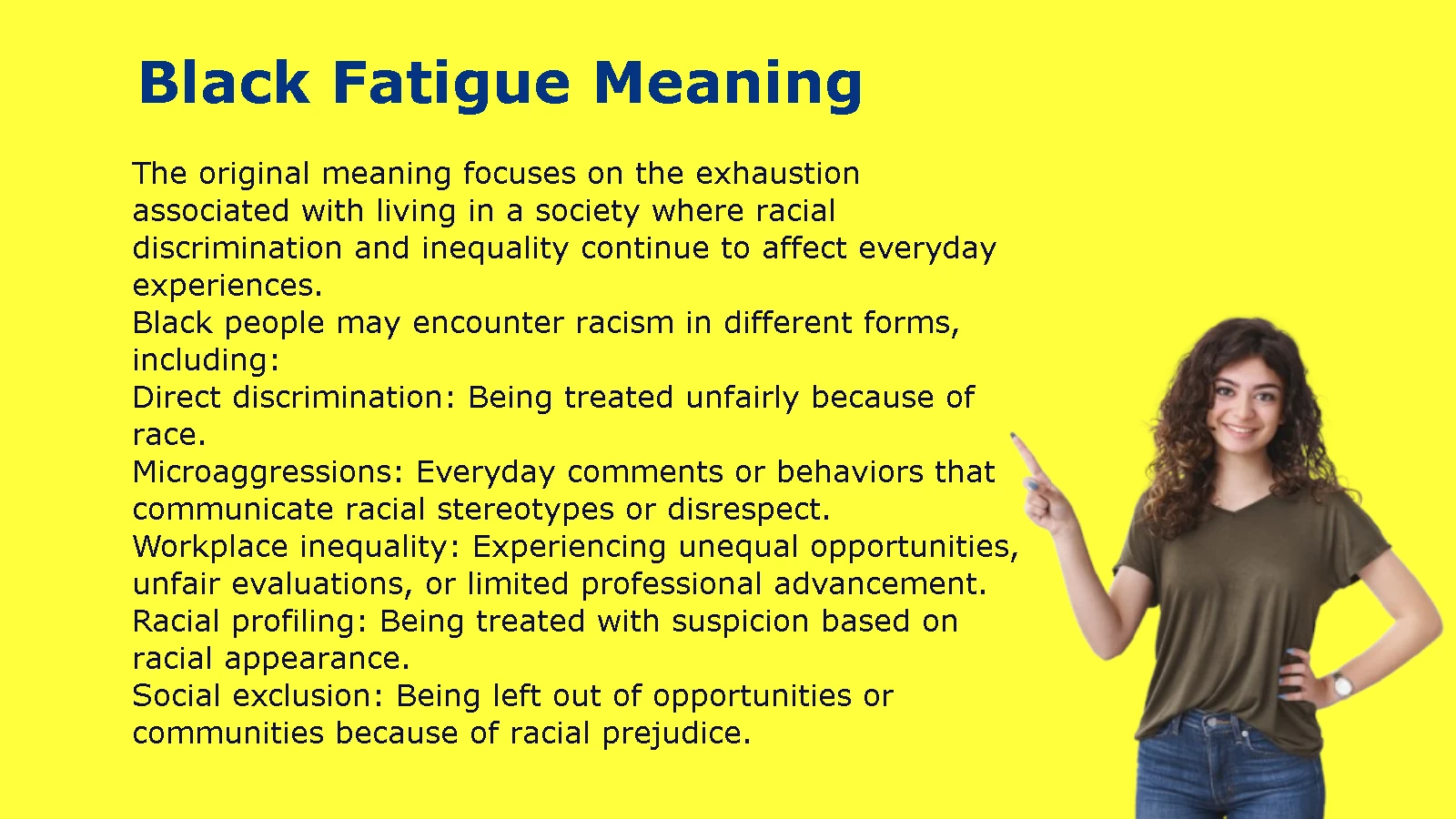
The original meaning focuses on the exhaustion associated with living in a society where racial discrimination and inequality continue to affect everyday experiences.
Black people may encounter racism in different forms, including:
- Direct discrimination: Being treated unfairly because of race.
- Microaggressions: Everyday comments or behaviors that communicate racial stereotypes or disrespect.
- Workplace inequality: Experiencing unequal opportunities, unfair evaluations, or limited professional advancement.
- Racial profiling: Being treated with suspicion based on racial appearance.
- Social exclusion: Being left out of opportunities or communities because of racial prejudice.
- Constant racial scrutiny: Feeling pressure to monitor one’s behavior to avoid negative stereotypes.
These experiences can create a repeated cycle of stress.
A single discriminatory incident may be upsetting, but repeated incidents can make someone feel that they must constantly prepare for the next uncomfortable interaction.
Black Fatigue is therefore connected to cumulative racial stress rather than one isolated experience.
It also highlights the fact that people should not have to repeatedly explain, challenge, or defend their basic dignity.
Who Coined the Term Black Fatigue?
Mary-Frances Winters, an author, educator, and diversity and inclusion expert, helped popularize the concept through her book Black Fatigue: How Racism Erodes the Mind, Body, and Spirit.
Her work examines the ways racism affects Black people’s experiences beyond individual discriminatory events.
Winters explores how repeated exposure to racial inequality can influence emotional well-being, physical health, professional opportunities, and everyday interactions.
The book helped bring attention to an important distinction: racism does not only affect people during obvious incidents of discrimination. Its effects can also accumulate through ordinary experiences that repeatedly communicate unequal treatment.
Her work has contributed to wider conversations about racial exhaustion, workplace inclusion, and the long-term effects of systemic inequality.
Why Is Black Fatigue More Than Just Being Tired?
Ordinary tiredness usually has an identifiable physical or mental cause, such as insufficient sleep, exercise, or a demanding work schedule.
Black Fatigue describes a different type of exhaustion. It can develop through repeated experiences that require emotional energy, vigilance, and coping.
Consider these situations:
- Someone must repeatedly explain why a racial joke is offensive.
- An employee has to demonstrate their competence more often than colleagues.
- A student experiences racial stereotypes in an educational environment.
- A person regularly encounters discriminatory comments online.
- A professional feels pressure to represent an entire racial community.
These experiences can create emotional and psychological strain.
The person may also feel frustrated because each new incident reminds them of previous experiences.
The central idea is accumulation: repeated exposure to racial stress can affect someone’s well-being even when individual incidents appear relatively minor to outsiders.
Black Fatigue Meaning in Slang and Social Media
The Black Fatigue meaning in slang can differ from its established social and cultural definition. Some internet users have repurposed the phrase to describe being tired of Black people, Black-related conversations, or certain behaviors they associate with Black communities.
This newer usage is controversial because it can turn a term describing the effects of racism into a generalized expression of frustration directed at a racial group.
Understanding the difference requires examining the context in which someone uses the phrase.
What Does Black Fatigue Mean as Slang?
In some online discussions, people use Black Fatigue as a provocative expression to communicate that they feel exhausted by Black people or Black-related social issues.
For example, someone might use the expression while complaining about discussions of racial discrimination, representation, or diversity.
This usage differs significantly from the original concept.
| Original meaning | Newer slang usage |
| Describes exhaustion associated with experiencing racism. | Describes frustration directed toward Black people or Black-related discussions. |
| Focuses on the effects of racial discrimination. | May express personal or political frustration. |
| Centers the experiences of people affected by racism. | Can generalize negative feelings toward a racial group. |
| Has an established connection to racial inequality and social research. | Appears in informal and sometimes provocative online discussions. |
Not every online appearance of the phrase carries the same meaning.
A person discussing Black Fatigue in an educational video may refer to racial exhaustion, while another person using the expression in a hostile comment may intend something entirely different.
Context determines the intended usage, but it does not make the two definitions interchangeable.
Why Did Black Fatigue Become a Social Media Trend?
Social media allows expressions to spread quickly across different communities.
A phrase that begins in academic, professional, or cultural discussions can acquire additional meanings when users repeat it in videos, memes, comments, and debates.
Several factors can contribute to this process:
- Short-form content: TikTok and Instagram encourage brief expressions that communicate complicated ideas quickly.
- Viral debates: Controversial statements often attract comments, reactions, and reposts.
- Political discussions: Conversations about racism and diversity can produce competing interpretations of terminology.
- Memes and satire: Users may turn serious expressions into jokes or provocative statements.
- Algorithmic exposure: Platforms can introduce users to content from communities they do not normally follow.
The result is that someone searching for Black Fatigue may encounter two very different explanations.
One may describe the psychological effects of racism. Another may present the phrase as an internet expression of frustration.
Readers should not assume that widespread online repetition establishes a new formal definition.
Is Black Fatigue Considered a Racist Expression?
The original concept is not a racist expression. It describes the exhaustion associated with experiencing racial discrimination and inequality.
However, the newer slang usage can become racist when someone uses it to express hostility toward Black people as a group.
Consider the difference:
Example 1: Discussion of racial exhaustion
“After repeatedly experiencing discrimination at work, she began discussing Black Fatigue and its effects on her mental well-being.”
This sentence uses the established meaning.
Example 2: Generalized racial hostility
“Someone used Black Fatigue to complain that they were tired of seeing Black people represented in advertisements.”
This sentence illustrates a controversial use that targets racial representation.
There is an important distinction between criticizing a particular person’s behavior and making negative generalizations about an entire racial group.
A person can disagree with an individual’s opinions, actions, or political positions without turning that disagreement into racial hostility.
Black Fatigue Examples in Everyday Life
Black Fatigue examples help explain how repeated experiences of racism can create cumulative exhaustion.
The concept does not require every incident to involve direct insults or openly discriminatory behavior. Sometimes, the strain comes from having to navigate repeated assumptions, unequal expectations, and uncomfortable interactions.
Black Fatigue in the Workplace
Workplaces provide several examples of situations that may contribute to racial exhaustion.
Imagine a qualified Black employee who consistently meets performance targets but receives less recognition than colleagues.
Their manager repeatedly questions their decisions, colleagues make comments about their communication style, and promotion opportunities seem less accessible.
Over time, the employee may experience:
- Frustration about unequal professional treatment.
- Emotional exhaustion from repeatedly explaining their abilities.
- Anxiety before important meetings.
- Reduced trust in workplace leadership.
- A feeling that professional success requires additional effort.
Example sentence:
“After years of dealing with racial stereotypes and unequal treatment at work, Marcus began experiencing Black Fatigue.”
This example demonstrates how repeated workplace experiences can affect someone’s emotional well-being.
Black Fatigue in Public and Everyday Situations
Racial exhaustion can also develop through ordinary public interactions.
Consider someone who regularly experiences the following situations:
- Store employees follow them more closely than other customers.
- Strangers make assumptions about their behavior.
- Security personnel question their presence in certain locations.
- People repeatedly ask intrusive questions about their background.
- Others make comments based on racial stereotypes.
One incident might seem insignificant to an outside observer. However, repeated experiences can create a sense of constant vigilance.
The person may start anticipating discrimination before entering certain environments.
That expectation itself can become stressful.
Example sentence:
“Repeated racial profiling during everyday shopping experiences contributed to her feelings of Black Fatigue.”
Black Fatigue on Social Media
Online environments can expose people to repeated racial hostility.
For example, a Black user might open a social media platform and encounter:
- Racist comments under a news article.
- Videos showing racial discrimination.
- Stereotypical jokes about Black communities.
- Arguments questioning the experiences of Black people.
- Pressure to educate strangers about racism.
The person may feel compelled to respond, correct misinformation, or defend their experiences.
However, constantly participating in these discussions can consume emotional energy.
Some people choose to limit their exposure to racial debates, mute certain accounts, or leave conversations altogether.
Taking a break does not mean they have stopped caring about racial equality. It may simply represent a decision to protect their emotional well-being.
Example sentence:
“She stopped reading the comments because the repeated racist discussions were contributing to her Black Fatigue.”
Black Fatigue Example in a Sentence
Here are additional examples showing how the phrase works in different contexts.
| Context | Example sentence |
| Workplace | Years of unequal treatment and racial stereotypes contributed to his Black Fatigue. |
| Education | Repeatedly challenging racial assumptions at school left her emotionally exhausted. |
| Social media | Constant exposure to racist comments made discussions about Black Fatigue more relevant to her. |
| Public life | Experiencing racial profiling during ordinary activities contributed to his sense of racial exhaustion. |
| Community | The discussion explored how repeated discrimination can create Black Fatigue across generations. |
| Social commentary | The speaker used the term Black Fatigue to explain the cumulative effects of racism. |
These examples show that the phrase generally describes an ongoing experience rather than a temporary feeling of annoyance.
Black Fatigue Meaning on Reddit: What Are People Discussing?
The Black Fatigue meaning on Reddit depends on the subreddit, discussion topic, and context of the post.
Reddit contains communities focused on social issues, race relations, books, politics, entertainment, and everyday experiences. Consequently, users may encounter different interpretations of the same phrase.
Some discussions focus on the original concept of racial exhaustion, while others debate its newer slang usage.
How Reddit Users Define Black Fatigue
In discussions about racism and social inequality, Black Fatigue generally refers to the emotional and psychological exhaustion associated with repeated racial discrimination.
For example, a Reddit user might describe feeling exhausted after repeatedly explaining racial stereotypes to colleagues.
Another user might discuss the term while reviewing Mary-Frances Winters’ book.
However, other discussions may use the expression differently.
A commenter might employ it sarcastically or critically when discussing racial representation, diversity initiatives, or online conversations about racism.
These interpretations should be evaluated separately.
When reading a Reddit post, consider:
- Is the author discussing the effects of racism?
- Are they referring to a book or academic concept?
- Are they using the phrase as internet slang?
- Does the surrounding discussion target an individual or an entire racial group?
- Is the expression being used seriously, sarcastically, or provocatively?
These questions help identify what the writer actually means.
Why Are Reddit Users Debating the Term?
Disagreements often arise when people encounter the same expression in different contexts.
Someone familiar with Winters’ work may understand Black Fatigue as a concept describing racial exhaustion.
Another user who encountered the phrase in a viral post may associate it with a completely different interpretation.
This creates several areas of disagreement:
Different definitions: People may assume that their first encounter with the phrase represents its only meaning.
Cultural context: Some users emphasize the historical experiences behind the original concept, while others focus on contemporary internet usage.
Appropriation and misuse: Discussions may question whether using the expression to criticize Black people distorts its established meaning.
Political disagreement: Conversations about race can become polarized, making neutral explanations difficult.
The best approach is to examine the actual wording and context rather than relying on a single comment.
Is the Reddit Meaning Different From the Original Definition?
It can be.
The original definition has a clear connection to racial exhaustion and the effects of racism.
A newer internet interpretation may use the same words to describe frustration with Black people or Black-related discussions.
For example:
- A post discussing the mental burden of repeated racial discrimination reflects the established meaning.
- A post reviewing Black Fatigue uses the term in its book-related context.
- A comment complaining about Black representation may reflect the newer controversial usage.
Reddit does not establish one universal definition of the phrase. Individual communities and users can interpret terminology differently.
Black Fatigue Meaning in 2026: Has the Definition Changed?
The Black Fatigue meaning in 2026 still centers on the cumulative exhaustion associated with racism, discrimination, and racial inequality. However, social media has introduced additional interpretations, making the phrase more visible in online discussions.
The important distinction is between an established concept and the informal ways people use the same expression.
The Original Meaning Remains Important
The underlying concept remains relevant because racial discrimination can affect everyday experiences.
Black people may continue to encounter unequal treatment in employment, education, housing, healthcare, public spaces, and online communities.
These experiences can influence emotional well-being and create ongoing stress.
For example, someone who experiences repeated workplace discrimination may become increasingly reluctant to participate in professional discussions.
Another person may avoid certain online communities because of repeated racial harassment.
These responses demonstrate why discussions about racial exhaustion extend beyond individual incidents.
The concept also encourages organizations to examine whether their policies and workplace cultures create unequal experiences.
How Social Media Has Changed the Conversation
Social media has expanded the number of contexts in which people encounter Black Fatigue.
A phrase once associated mainly with discussions of racial inequality and Winters’ work can now appear in:
- TikTok commentary.
- Instagram posts.
- Reddit discussions.
- Political debates.
- Workplace diversity conversations.
- Online discussions about race and representation.
Some creators use the phrase to explain racial exhaustion. Others use it provocatively or sarcastically.
This broader exposure can create confusion, especially for readers encountering the expression for the first time.
A viral definition does not automatically replace an established meaning.
When discussing the term in 2026, it is useful to identify whether someone is referring to racial exhaustion, the book, or newer social media slang.
Why Understanding Both Interpretations Matters
Understanding the different meanings helps prevent misunderstandings.
For example, a student researching racial inequality might encounter a social media post using Black Fatigue as a joke.
Without historical context, the student could mistake the joke for the established definition.
Similarly, someone discussing Winters’ book might be misunderstood by readers who only recognize the newer slang usage.
To avoid confusion:
- Use the original definition when discussing racism and racial exhaustion.
- Explain the context when describing internet slang.
- Avoid treating online interpretations as academic definitions.
- Recognize that racial experiences can differ between individuals.
- Consider the historical and social context of the expression.
The distinction matters because language can influence how people understand social issues.
What Is the Black Fatigue Book About?
The Black Fatigue book refers to Black Fatigue: How Racism Erodes the Mind, Body, and Spirit, written by Mary-Frances Winters.
The book explores how racism affects Black people’s physical health, emotional well-being, and everyday experiences.
Rather than focusing only on individual acts of discrimination, Winters examines how repeated exposure to racial inequality can produce cumulative effects.
It also encourages readers and organizations to recognize the consequences of racism instead of treating each incident as an isolated event.
Black Fatigue: How Racism Erodes the Mind, Body, and Spirit
The original book examines the relationship between racism and the well-being of Black people.
Its central argument is that racism can create long-term stress that affects multiple aspects of life.
The title highlights three connected dimensions:
Mind: Repeated racial discrimination can create emotional strain, anxiety, frustration, and psychological exhaustion.
Body: Chronic stress can affect physical well-being. Prolonged stress is associated with changes in sleep, blood pressure, and other health-related processes.
Spirit: Repeated experiences of disrespect and exclusion can affect a person’s sense of belonging, identity, confidence, and hope.
The book encourages readers to recognize the cumulative nature of these experiences.
For employers, educators, and community leaders, this perspective offers an opportunity to examine how institutional practices affect people beyond their immediate, visible consequences.
What Does the Black Fatigue Second Edition Cover?
The second edition, published in 2026, brings the book’s subject into a newer social and cultural context.
The updated edition is associated with Mary-Frances Winters and Mareisha N. Winters Reese.
Its relevance extends beyond the original publication because conversations about racial inequality, representation, workplace inclusion, and social responsibility continue to develop.
Readers interested in the second edition should look at the publisher’s edition details for its exact publication information and updated contents.
The central subject remains the relationship between racism and the experiences of Black people.
The updated publication also makes the book particularly relevant to people searching for the Black Fatigue meaning in 2026.
What Can Readers Learn From Black Fatigue?
The book offers several important lessons for readers.
Recognize cumulative discrimination.
Racism does not always appear as a single dramatic incident. Repeated everyday experiences can also affect well-being.
Understand the connection between racism and stress.
Social experiences can influence psychological and physical health.
Examine institutional practices.
Organizations should consider how hiring, promotion, evaluation, and leadership practices affect employees from different racial backgrounds.
Listen to lived experiences.
People should not have to repeatedly prove that discriminatory experiences have affected them before others take their concerns seriously.
Move beyond symbolic inclusion.
Meaningful progress requires changes in policies, behavior, accountability, and organizational culture.
The book is particularly useful for readers interested in diversity, equity, workplace culture, and the social effects of racism.
What Does White Fatigue Mean?
White Fatigue describes exhaustion, discomfort, or frustration that some White people experience when engaging in discussions about race, racism, and racial inequality.
The concept is associated with Joseph E. Flynn and his work on racial discourse.
Unlike Black Fatigue, which focuses on the exhaustion associated with experiencing racism, White Fatigue examines the responses of some White people to conversations about racial issues.
It is important to understand that these terms describe different experiences.
Definition of White Fatigue
White Fatigue can develop when discussions about racism become emotionally uncomfortable or demanding for people who are not accustomed to examining their own racial position or the effects of racial inequality.
For example, a person might feel frustrated when a workplace training session discusses historical discrimination or unequal opportunities.
They may feel that the conversation is repetitive, uncomfortable, or personally challenging.
Some people respond by withdrawing from the discussion or avoiding future conversations about race.
However, discomfort does not necessarily mean that a discussion is harmful or unfair.
Learning about racial inequality can involve confronting unfamiliar information and reconsidering previously held assumptions.
The concept encourages educators and organizations to understand why people disengage from these conversations.
Black Fatigue vs. White Fatigue: What’s the Difference?
Although the expressions share the word “fatigue,” they describe different experiences.
| Comparison | Black Fatigue | White Fatigue |
| Main meaning | Cumulative exhaustion associated with experiencing racism. | Exhaustion or frustration associated with engaging in discussions about race. |
| Primary focus | Effects of racial discrimination on Black people. | Responses to conversations about racism among some White people. |
| Main source | Repeated racial stress and unequal treatment. | Emotional discomfort, frustration, or disengagement during racial discussions. |
| Context | Everyday experiences, workplaces, institutions, and social environments. | Education, workplace training, social discussions, and racial dialogue. |
| Key concern | The cumulative effects of racism. | Difficulty sustaining engagement with conversations about racial inequality. |
The main distinction is that Black Fatigue concerns the effects of racism, while White Fatigue concerns responses to discussions about racism.
These concepts should not be treated as equivalent forms of racial disadvantage.
Black Fatigue vs. White Fragility
White Fragility is a concept associated with sociologist and author Robin DiAngelo.
It describes defensive reactions that some White people may display when their racial assumptions, privilege, or understanding of racism are challenged.
These reactions can include:
- Becoming defensive during conversations about race.
- Denying that racial privilege exists.
- Changing the subject when discrimination is discussed.
- Responding with anger or discomfort.
- Treating criticism of racial behavior as a personal attack.
White Fragility and White Fatigue are related because both can appear during discussions about racism.
However, they are not interchangeable.
| White Fatigue | White Fragility |
| Focuses on exhaustion or frustration. | Focuses on defensive reactions. |
| May result in disengagement. | May result in denial, anger, or resistance. |
| Concerns difficulty sustaining racial discussions. | Concerns responses to challenges about race and privilege. |
A person experiencing discomfort during a discussion does not automatically demonstrate White Fragility.
The terms describe different patterns and should be used carefully.
Black Fatigue vs. Racial Battle Fatigue
Racial Battle Fatigue is a concept developed by researcher William A. Smith to describe the psychological, physiological, and behavioral stress responses associated with repeated racial discrimination and hostility.
It is particularly relevant to discussions about the experiences of people of color in educational and institutional environments.
For example, a university student who regularly experiences racial hostility from classmates or faculty may develop ongoing stress.
The student might experience difficulty concentrating, frustration, sleep disturbances, or anxiety in situations connected to those experiences.
Both Black Fatigue and Racial Battle Fatigue address the effects of repeated racial stress.
However, they have different conceptual histories and areas of emphasis.
| Black Fatigue | Racial Battle Fatigue |
| Popularized through Mary-Frances Winters’ work. | Developed through William A. Smith’s research. |
| Examines how racism erodes the mind, body, and spirit. | Focuses on stress responses to repeated racial hostility and discrimination. |
| Includes individual and broader social experiences. | Often discussed in educational and institutional environments. |
| Highlights cumulative racial exhaustion. | Highlights psychological, physiological, and behavioral stress responses. |
Both concepts help explain why repeated discrimination can affect people’s well-being over time.
Does Black Fatigue Have a Clothing or Fashion Meaning?
The phrase Black Fatigue clothing can refer to a completely different subject from the established social meaning of Black Fatigue.
In fashion, the word “fatigue” often describes military-inspired garments, such as utility trousers, jackets, and shirts.
When someone searches for black fatigue clothing, they may be looking for black-colored garments in this military-inspired style.
This interpretation has no direct connection to racial exhaustion.
What Does Fatigue Mean in Clothing?
In fashion, fatigue clothing refers to garments inspired by military uniforms and utility workwear.
The style traditionally emphasizes practical design, durable materials, and functional pockets.
Common examples include:
- Fatigue pants.
- Military-inspired utility jackets.
- Fatigue shirts.
- Cargo trousers.
- Utility overshirts.
These garments often feature simple cuts, sturdy fabrics, and practical details.
Traditional military fatigue clothing frequently uses olive green, khaki, and other subdued colors. Modern fashion also includes black versions.
Is Black Fatigue a Recognized Clothing Term?
Not in the same established sense as the social concept.
The phrase can describe black-colored fatigue-style clothing, but it is not a recognized alternative definition of the original racial concept.
For example:
- “Black fatigue pants” may refer to black utility trousers.
- “Black fatigue jacket” may describe a military-inspired black jacket.
- “Black Fatigue meaning” usually refers to the social and cultural concept.
The surrounding words help identify the intended meaning.
Someone searching for the definition should focus on racial exhaustion and its social context, while someone shopping for utility clothing should look for military-inspired fashion terms.
Why Is Understanding Black Fatigue Important?
Understanding Black Fatigue helps people recognize how repeated discrimination can affect individuals beyond the immediate moment of an incident.
It also provides a framework for discussing racial inequality in workplaces, schools, public institutions, and communities.
The concept is valuable because it shifts attention from isolated events toward patterns of treatment.
Recognizing the Effects of Systemic Racism
Systemic racism refers to policies, institutional practices, and social structures that create or maintain racial inequalities.
It can influence access to education, employment, housing, healthcare, and other opportunities.
For example, a workplace may have no openly discriminatory policy but still produce unequal outcomes through biased hiring practices or inconsistent promotion standards.
When these patterns continue, affected employees may experience frustration and exhaustion.
Recognizing systemic racism requires looking beyond individual intentions.
Organizations must examine the actual effects of their policies and decisions.
Understanding Emotional and Physical Exhaustion
Repeated stress can affect both emotional and physical well-being.
People experiencing ongoing racial discrimination may report:
- Persistent frustration.
- Emotional exhaustion.
- Anxiety in certain environments.
- Difficulty sleeping.
- Reduced concentration.
- A diminished sense of belonging.
- Stress-related physical symptoms.
These effects can vary between individuals.
Black Fatigue is a social and cultural concept, not a standalone clinical diagnosis. It should not replace professional medical or psychological assessment.
Still, the experiences it describes deserve serious attention.
Building More Inclusive Workplaces and Communities
Organizations can reduce unnecessary racial stress by creating fairer systems and responding appropriately to discrimination.
Practical steps include:
- Establishing clear anti-discrimination policies.
- Applying consistent performance evaluation standards.
- Creating transparent promotion processes.
- Providing accessible reporting channels.
- Training managers to recognize racial bias.
- Taking employee complaints seriously.
- Holding leadership accountable for workplace culture.
Inclusion requires more than publishing a diversity statement.
Employees need to see fair treatment in everyday decisions.
Moving Beyond Awareness Toward Meaningful Action
Understanding a term is only the first step.
People and organizations should also consider what they can change.
For individuals, meaningful action may involve listening to experiences without becoming defensive, challenging racial stereotypes, and recognizing unequal treatment.
For educators, it may involve creating environments where students can discuss racial issues without fear of dismissal or ridicule.
The goal should be to reduce the conditions that produce racial exhaustion, not simply to become familiar with the terminology.
Frequently Asked Questions About Black Fatigue
What Is the Simple Meaning of Black Fatigue?
Black Fatigue means the emotional, mental, and physical exhaustion associated with repeated experiences of racism and racial discrimination. It describes how ongoing inequality, racial stereotypes, microaggressions, and unfair treatment can accumulate and affect a person’s overall well-being.
What Does Black Fatigue Mean on TikTok?
On TikTok, Black Fatigue can refer to the original concept of racial exhaustion or a newer controversial slang usage. Some creators discuss the effects of racism, while others use the phrase to express frustration with Black people or racial discussions. The meaning depends on the video’s context.
Is Black Fatigue a Real Psychological Condition?
Black Fatigue describes real experiences of cumulative racial stress and exhaustion, but it is not a standalone clinical diagnosis. Its effects may overlap with recognized psychological and physical responses to chronic stress and discrimination.
Who Wrote the Book Black Fatigue?
Mary-Frances Winters wrote Black Fatigue: How Racism Erodes the Mind, Body, and Spirit. The 2026 second edition is associated with Mary-Frances Winters and Mareisha N. Winters Reese. The book explores how racism affects Black people’s emotional, physical, and social well-being.
What Is the Difference Between Black Fatigue and White Fatigue?
Black Fatigue describes cumulative exhaustion associated with experiencing racism, while White Fatigue describes exhaustion or frustration some White people experience during discussions about race and racial inequality. The expressions address different experiences and should not be treated as interchangeable.
Why Is Black Fatigue Trending in 2026?
Interest in Black Fatigue in 2026 relates to continuing conversations about racial inequality, changing social media usage, and renewed attention to Mary-Frances Winters’ book through its second edition. Online discussions have also introduced competing interpretations of the expression.
Conclusion: Understanding the Real Meaning of Black Fatigue
The Black fatigue meaning goes beyond ordinary tiredness. It describes the cumulative emotional, mental, and physical exhaustion that can develop when Black people repeatedly experience racism, discrimination, stereotypes, and unequal treatment.
Mary-Frances Winters helped popularize the concept through Black Fatigue: How Racism Erodes the Mind, Body, and Spirit. Her work highlights how repeated racial stress can affect people’s lives in ways that extend beyond individual incidents.
The phrase also appears in newer social media discussions, where some users employ it as slang to express frustration with Black people or conversations about race. This controversial usage should not be confused with the original meaning.
Understanding related concepts such as White Fatigue, White Fragility, and Racial Battle Fatigue also helps clarify the different ways people experience and respond to racial issues.
If you encounter the expression online, consider its context before interpreting it. Understanding the original definition, recognizing misuse, and listening to people’s experiences can lead to more informed conversations about racism and its effects.
Start by understanding the term in its original context, then use that knowledge to recognize and challenge the conditions that contribute to racial exhaustion.