Other ways to say great job include excellent work, well done, fantastic effort, nicely done, outstanding performance, and you nailed it. The best phrase depends on whom you’re praising, what they accomplished, and the tone you want to convey. Professional appreciation, positive feedback, student encouragement, and funny compliments all call for slightly different wording.
Whether you’re writing a work email, congratulating a friend, encouraging a student, or recognizing an employee, the right words of appreciation can make your praise feel more personal. Instead of repeating “good job,” choose expressions that recognize hard work, achievement, creativity, teamwork, or progress.
| Question | Answer |
| What is another way to say great job? | Excellent work, well done, fantastic job, or nicely done. |
| How do you say well done professionally? | Say “Your work exceeded expectations” or “I appreciate your contribution.” |
| What can I say instead of good job to students? | Try “Your reasoning is clear” or “Your practice is paying off.” |
| What is another way to say keep up the good work? | Say “You’re making excellent progress” or “Keep building on this success.” |
| What is a funny way to say good job? | Try “Achievement unlocked!” or “Absolute legend behavior.” |
What Are Other Ways to Say Great Job?
Other ways to say great job include “excellent work,” “nicely done,” “outstanding effort,” “you nailed it,” and “fantastic performance.” These expressions communicate appreciation while adding variety to everyday conversations. Choose a phrase that matches the achievement, your relationship with the person, and the level of formality.
What Does Great Job Mean?
“Great job” is an expression of praise that recognizes someone for doing something well. It can communicate approval, appreciation, encouragement, or admiration.
People use it in many situations, such as:
- Completing a challenging assignment.
- Delivering an impressive presentation.
- Helping a colleague solve a problem.
- Improving a skill through practice.
- Organizing a successful event.
- Supporting someone during a difficult moment.
The phrase works because it’s short, friendly, and easy to understand. However, it can lose some impact when you use it repeatedly without explaining what the person did well.
For example:
Generic praise: “Great job!”
Specific praise: “Great job explaining the complicated parts so clearly. Everyone understood the plan.”
The second compliment gives the recipient a reason to feel proud and shows that you noticed their contribution.
What Is the Difference Between Great Job and Well Done?
“Great job” and “well done” both express approval, but they can create slightly different impressions. “Great job” often sounds friendly and conversational, while “well done” can feel a little more composed or formal, depending on the setting.
| Expression | Tone | Best use |
| Great job | Warm, casual | Everyday praise |
| Well done | Neutral, approving | Work, school, and achievements |
| Excellent work | Professional | Reports, projects, and presentations |
| You nailed it | Casual, enthusiastic | Successful performances |
| Outstanding achievement | Formal, strong | Major accomplishments |
| Nice effort | Encouraging | Recognizing an attempt or contribution |
Neither phrase is universally better. Use the expression that fits your relationship and the achievement.
25 Things to Say Instead of Good Job
If you want to replace “good job” with something more engaging, start with a phrase that reflects the person’s accomplishment. These 25 alternatives work across everyday conversations, professional settings, and personal messages.
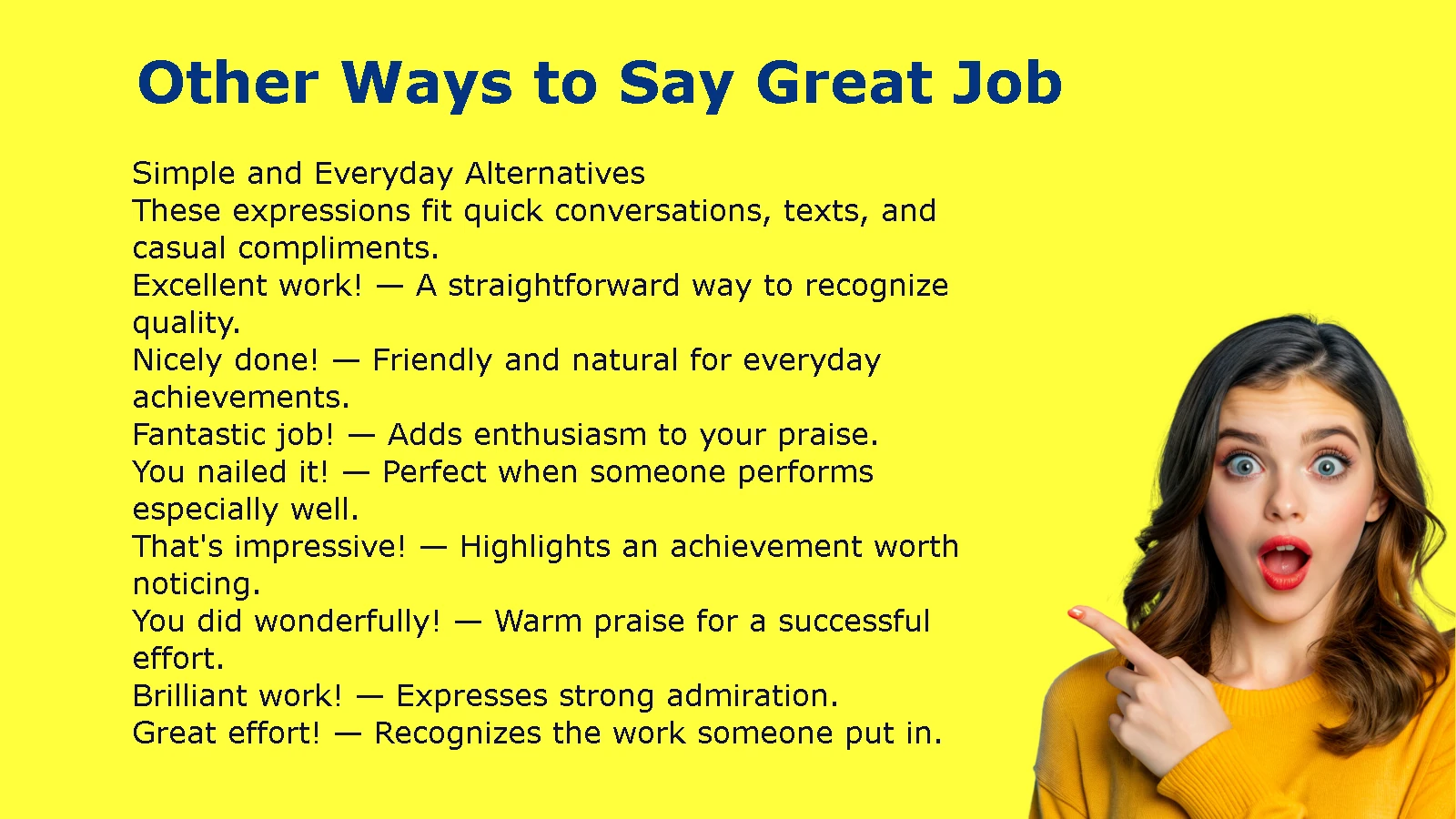
Simple and Everyday Alternatives
These expressions fit quick conversations, texts, and casual compliments.
- Excellent work! — A straightforward way to recognize quality.
- Nicely done! — Friendly and natural for everyday achievements.
- Fantastic job! — Adds enthusiasm to your praise.
- You nailed it! — Perfect when someone performs especially well.
- That’s impressive! — Highlights an achievement worth noticing.
- You did wonderfully! — Warm praise for a successful effort.
- Brilliant work! — Expresses strong admiration.
- Great effort! — Recognizes the work someone put in.
Stronger Ways to Praise Excellent Results
Use these expressions when someone produces outstanding results or handles a difficult task particularly well.
- Outstanding performance! — Suitable for a strong presentation or performance.
- Exceptional work! — Recognizes unusually high-quality work.
- That’s remarkable! — Highlights an achievement that stands out.
- You exceeded expectations! — Ideal for impressive professional results.
- This is top-notch! — A confident compliment for excellent quality.
- You should be proud of this! — Encourages ownership of an achievement.
Warm and Sincere Compliments
These phrases make praise feel personal rather than routine.
- I’m really impressed. — Expresses genuine admiration.
- You put together something special. — Recognizes thoughtful or creative work.
- Your hard work shows. — Connects the result to the person’s effort.
- I appreciate what you did. — Communicates gratitude.
- You made a real difference. — Recognizes meaningful contributions.
- You handled that beautifully. — Praises a thoughtful response.
- Your attention to detail paid off. — Recognizes care and accuracy.
- You made that look easy. — A casual compliment for skill.
- That’s something to celebrate. — Highlights an achievement worth enjoying.
- You really delivered. — Recognizes reliable execution.
100 Powerful Ways to Say Good Job
The following 100 phrases offer alternatives for different audiences and situations. Some recognize results, while others emphasize effort, creativity, or encouragement.
Choose the phrase that best reflects what actually happened. A compliment feels more sincere when it matches the person’s contribution.
Everyday Ways to Say Great Job
Use these expressions in conversations, messages, and casual situations.
- You did an amazing job!
- That was really well done.
- You absolutely crushed it!
- Fantastic work!
- You got it just right.
- That’s a job well done.
- You did a wonderful job.
- That turned out beautifully.
- You really pulled it off.
- I’m impressed with your work.
- You made it happen.
- That was excellent.
- You got everything right.
- What a great result!
- You should feel proud.
- That’s seriously impressive.
- You did a terrific job.
- Your work looks fantastic.
- You handled that perfectly.
- What a brilliant result!
Professional Ways to Praise Someone
These phrases work well in workplace emails, team meetings, performance feedback, and project discussions.
- Your work exceeded expectations.
- I appreciate your contribution to this project.
- You handled this exceptionally well.
- Your attention to detail is excellent.
- Your efforts made a real impact.
- You delivered outstanding results.
- Your approach was thoughtful and effective.
- You demonstrated excellent judgment.
- Your preparation really paid off.
- You made a valuable contribution.
- Your presentation was clear and compelling.
- You managed the challenge effectively.
- Your initiative helped move this forward.
- The quality of your work stands out.
- Your collaboration made a difference.
- You found an effective solution.
- Your professionalism really showed.
- You brought valuable ideas to the table.
- You delivered exactly what the team needed.
- I appreciate the care you put into this.
Encouraging Ways to Recognize Effort
These expressions are useful when someone is learning, recovering from a setback, or making steady progress.
- You’re making excellent progress.
- Your persistence is paying off.
- Keep building on this success.
- You’re getting better every day.
- Your dedication is inspiring.
- You made real progress here.
- Your hard work is noticeable.
- You handled a tough challenge well.
- I admire your determination.
- You’re moving in the right direction.
- That was a worthwhile effort.
- You kept going when it got difficult.
- Your improvement is impressive.
- You’re developing a great skill.
- I’m glad you stuck with it.
Ways to Say Great Job to Students
Teachers and parents can use these expressions to recognize learning, thoughtful decisions, and improvement.
- Your explanation is very clear.
- You showed strong understanding.
- I like how you solved that problem.
- Your practice is paying off.
- You asked a thoughtful question.
- You made an interesting connection.
- Your reasoning is strong.
- You approached that creatively.
- You learned from the mistake.
- Your progress deserves recognition.
- You supported your answer well.
- You explored several good ideas.
- You showed real curiosity.
- You worked through that carefully.
- Your confidence is growing.
Funny and Creative Ways to Say Great Job
Use these playful expressions with people who enjoy humor and understand your tone.
- Achievement unlocked!
- Absolute legend behavior.
- Somebody understood the assignment.
- Give yourself a standing ovation.
- Take a bow, superstar.
- You understood the assignment and added bonus points.
- Well, look at you being brilliant.
- Someone deserves the fancy coffee today.
- That was suspiciously impressive.
- Put that on your highlight reel.
- A round of applause for you.
- The excellence department called.
- You made that look ridiculously easy.
- Not to brag, but you crushed it.
- That deserves a victory dance.
Heartfelt and Memorable Praise
These phrases are suitable for meaningful accomplishments, personal milestones, and moments when you want your appreciation to feel sincere.
- I’m genuinely proud of what you achieved.
- Your effort means more than you know.
- You made this better for everyone.
- Your kindness made a difference.
- You brought out the best in the team.
- I admire the care you put into this.
- You turned a difficult situation around.
- Your work reflects real dedication.
- You accomplished something meaningful.
- I’m grateful for everything you contributed.
How to Say Well Done Professionally
Professional alternatives to “well done” include “excellent work,” “your contribution made a difference,” and “you exceeded expectations.” The strongest workplace praise identifies a specific achievement, explains its value, and expresses genuine appreciation without exaggerating the result.
Professional Alternatives to Great Job
The best professional compliments sound natural rather than overly formal.
Consider these options:
| Phrase | Best situation |
| Excellent work on this project. | Project completion |
| Your attention to detail really shows. | Careful, accurate work |
| You handled that exceptionally well. | Challenging situations |
| Your contribution made a difference. | Team achievements |
| You delivered exactly what we needed. | Successful execution |
| Your presentation was clear and persuasive. | Meetings and presentations |
| Your initiative helped us move forward. | Proactive problem-solving |
| You managed the deadline effectively. | Time-sensitive projects |
Practical tip: Match your praise to the achievement. If someone fixed a reporting error, mention the accuracy of their work. If they resolved a customer complaint, recognize their judgment and communication skills.
Specific recognition gives the recipient useful information about what they should continue doing.
How to Praise Someone in a Professional Email
A good appreciation email should explain what the person did and why it mattered. Keep the message concise, especially when you’re recognizing a routine contribution.
Here is a copy-ready example:
Subject: Excellent Work on the Project
Hi [Name],
I wanted to recognize the excellent work you did on the recent project. Your clear documentation and attention to detail helped the team complete the handover smoothly.
I appreciate the time and thought you put into this. Thank you for making such a valuable contribution.
Best,
[Your Name]
For a shorter message, try:
- Excellent work on today’s presentation. Your examples made the key points easy to understand.
- Thank you for handling that request so efficiently.
- Your analysis was thorough and helped us make a better decision.
- I appreciate your support in getting this project across the finish line.
Professional Ways to Praise a Team Member
Praise works best when it recognizes individual contributions without ignoring teamwork.
For example:
After a successful project:
“Your coordination helped everyone stay aligned and meet the deadline.”
After solving a technical problem:
“You identified the root cause quickly and helped us avoid further delays.”
When several people contributed, recognize the team collectively while mentioning specific contributions when appropriate.
This approach helps employees understand how their work supports shared goals.
How to Praise Your Boss or Manager
Compliments to managers should focus on decisions, leadership, support, or outcomes rather than personal flattery.
Natural examples include:
- “Your guidance helped me approach the project more effectively.”
- “I appreciated how clearly you communicated the priorities.”
- “Your feedback gave me a useful direction for improvement.”
- “The way you handled that discussion helped the team move forward.”
Avoid exaggerated language that sounds designed to gain favor. Sincere appreciation feels more professional than over-the-top admiration.
Other Ways to Say Keep Up the Good Work
Other ways to say “keep up the good work” include “you’re making excellent progress,” “keep building on this success,” and “your consistency is making a difference.” These expressions encourage someone to continue without repeating the same compliment or suggesting they must always perform perfectly.
Encouraging Alternatives for Everyday Use
Try these expressions when you want to motivate a friend, student, family member, or coworker.
- You’re making great progress.
- Keep building on this success.
- You’re heading in the right direction.
- I love the progress you’re making.
- Keep going; you’re doing well.
- You’re getting closer to your goal.
- Your steady effort is paying off.
- Stay curious and keep learning.
- You’re developing real momentum.
- Look how far you’ve come!
The right phrase depends on what the person needs. Someone celebrating a finished task may appreciate congratulations. A person still working toward a goal may benefit more from encouragement.
Professional Alternatives to Keep Up the Good Work
In workplace communication, encourage continued development without making your praise sound like another performance demand.
Useful phrases include:
- Your progress has been excellent.
- I look forward to seeing your next steps.
- Your consistency is making a difference.
- Please continue sharing your ideas.
- Your recent work has been valuable to the team.
- You’re building strong momentum.
- Your approach is working well.
- Keep applying the same thoughtful process.
For a manager, one particularly useful expression is:
“Your recent progress has been impressive. Let’s keep building on what’s working and identify any support you need.”
This acknowledges achievement while leaving room for realistic expectations.
How to Encourage Someone Without Creating Pressure
Encouragement should motivate rather than make someone feel that their value depends on constant achievement.
Consider these principles:
- Recognize progress: Improvement deserves appreciation even when the goal isn’t complete.
- Avoid unrealistic expectations: Don’t suggest someone must always outperform their previous results.
- Respect their circumstances: Acknowledge challenges when appropriate.
- Offer support: Ask what would help them continue.
- Celebrate sustainable effort: Consistency often matters more than short bursts of intense work.
Instead of “I expect even more from you next time,” try “You’ve made meaningful progress, and I’m happy to support your next step.”
Other Ways to Say Good Job to Students
Other ways to say good job to students include “your reasoning is clear,” “your practice is paying off,” and “you approached that problem thoughtfully.” Effective student praise identifies specific learning behaviors, improvement, and understanding rather than relying only on general compliments.
Praise for Effort and Persistence
When students face difficult work, recognize the strategies they use and the way they respond to challenges.
Examples include:
- You kept trying, even when it got difficult.
- Your practice is paying off.
- You approached that challenge thoughtfully.
- You tried a different strategy when the first one didn’t work.
- You showed patience with a difficult problem.
- You stayed focused and worked through the steps.
However, praise should remain truthful. If a student struggled with a task, don’t claim that the result was perfect. Recognize what they genuinely did well.
For example:
“You made a useful adjustment to your approach after checking your first answer.”
This gives the student a concrete behavior they can repeat.
Praise for Learning and Improvement
Students benefit from feedback that helps them recognize development.
Try these expressions:
- You’ve improved so much in this area.
- Your explanation shows real understanding.
- I can see how carefully you worked through this.
- Your latest draft is clearer than your previous one.
- You corrected that mistake independently.
- You’re using feedback effectively.
When comparing performance, focus on the student’s own progress rather than constantly comparing them with classmates.
A meaningful compliment might be:
“Your paragraph has a much clearer structure now. The topic sentence helps the reader understand your main idea.”
This praise combines recognition with a useful observation.
Praise for Creativity and Critical Thinking
Recognize how students think, not just whether they arrive at the expected answer.
Examples:
- That’s an interesting way to solve the problem.
- I like how you explored different ideas.
- Your reasoning is clear and thoughtful.
- You noticed a detail that others might overlook.
- You asked a question that helped us think more deeply.
- You explained why your approach makes sense.
These expressions encourage students to value curiosity and reasoning.
A useful distinction: praise the quality of the thinking you observed rather than labeling a student as naturally gifted. Specific feedback gives the learner a clearer idea of what worked.
Examples of Student Feedback in Sentences
Here are examples teachers and parents can adapt.
For an assignment:
“Your examples support your main argument well. Excellent work connecting your ideas.”
For classroom participation:
“Your question helped the class understand the topic from another angle.”
For group work:
“You listened to your classmates and helped bring everyone’s ideas together.”
Funny Ways to Say Good Job
Funny ways to say good job include “achievement unlocked,” “absolute legend behavior,” and “somebody understood the assignment.” These playful compliments can make praise more memorable among friends or familiar coworkers, but they work best when the recipient appreciates humor and the achievement deserves genuine recognition.
Funny Ways to Say Well Done to Friends
Try these expressions in casual conversations or text messages.
- Achievement unlocked!
- Absolute legend behavior.
- Somebody understood the assignment.
- Give yourself a standing ovation.
- Take a bow, superstar.
- You deserve your own highlight reel.
- The victory dance is mandatory.
- Look at you collecting wins.
- Excellence has entered the chat.
- That was a certified win.
You can also personalize the joke.
If a friend finally assembles a complicated piece of furniture, say:
“Against all odds, the instructions have been defeated.”
The humor works because it connects directly to the achievement.
Funny Praise for Coworkers
Workplace humor depends on familiarity and company culture. Choose expressions that won’t embarrass the recipient.
- Look at you making deadlines look easy.
- Someone deserves the fancy coffee today.
- That was suspiciously impressive.
- The spreadsheet wizard strikes again.
- A round of applause for the problem-solving department.
- You’ve officially earned bragging rights.
Use playful praise for ordinary wins, such as organizing files or solving a minor issue. For sensitive situations, major accomplishments, or formal recognition, sincere language is usually the safer choice.
When Funny Praise Is Appropriate
Humor can strengthen a compliment when both people share the same sense of humor. However, sarcasm can make praise sound like criticism.
Compare these examples:
Clear and playful: “You absolutely crushed that presentation. Someone deserves a victory lap.”
Potentially confusing: “Wow, you finally did something right.”
The second sentence may sound insulting even if you intend it as a joke.
When in doubt, give the sincere compliment first. Add humor only when you know the recipient will welcome it.
You Did a Great Job Meaning and Usage
“You did a great job” means someone performed a task, activity, or responsibility very well. The expression communicates praise and approval, often after a successful result or impressive effort. People use it in professional conversations, classrooms, family settings, and everyday interactions.
Is You Did a Great Job a Compliment?
Yes. “You did a great job” is a positive compliment that recognizes someone’s performance or contribution.
It can communicate several meanings:
- Approval: The result met or exceeded expectations.
- Appreciation: The speaker values the person’s contribution.
- Encouragement: The speaker wants to reinforce positive behavior.
- Admiration: The speaker recognizes skill or effort.
Tone matters. A sincere “You did a great job” can make someone feel appreciated, while a sarcastic delivery can reverse the meaning.
Context also shapes the message.
For example, after a colleague finishes a difficult report, the expression recognizes performance. After a child learns a new skill, it may communicate encouragement and pride.
When Should You Say You Did a Great Job?
Use this expression when someone accomplishes something worth recognizing.
Common examples include:
- Finishing a demanding assignment.
- Giving a clear presentation.
- Handling a difficult conversation.
- Helping someone through a challenge.
- Completing a creative project.
- Improving a skill.
If the accomplishment involved a team, consider whether your compliment should recognize the individual or the group’s contribution.
For instance:
“You did a great job coordinating the event.”
This is more precise than simply saying “Great job” because it identifies the person’s role.
How to Make You Did a Great Job More Specific
Specific praise makes a compliment easier to understand and more meaningful.
Compare these sentences:
| Generic praise | Specific praise |
| You did a great job. | You explained the proposal clearly and answered every question confidently. |
| Good work on the report. | Your accurate figures and clear headings made the report easy to review. |
| Great presentation. | Your opening example helped the audience understand the main problem. |
| Nice work with the team. | You listened to everyone’s ideas and helped resolve the disagreement. |
A simple formula can help:
Specific action + positive impact + appreciation
Example:
“Your organized meeting notes helped everyone understand their responsibilities. I appreciate the time you put into them.”
This structure works in emails, spoken feedback, and performance reviews.
Good Job in a Sentence: Examples for Different Situations
“Good job” works in everyday sentences when you want to praise someone’s effort, performance, or achievement. You can use it independently as an exclamation or within a longer sentence that explains what the person did well.
Good Job in Professional Sentences
- You did a good job presenting the findings to the team.
- Good job handling the client’s concerns so clearly.
- The team did a good job completing the project on time.
- You did a good job identifying the main issue.
- Good job organizing the meeting and keeping everyone focused.
- Your team did a good job responding to the unexpected changes.
In professional writing, you can often improve these sentences by replacing general praise with a specific contribution.
For example:
“You did a good job presenting the findings” becomes “Your presentation explained the findings clearly and helped us agree on the next steps.”
Good Job in Casual Conversations
- Good job fixing that so quickly!
- You did a good job choosing the perfect gift.
- Good job getting through that tough workout.
- You did a good job preparing dinner.
- Good job figuring out that puzzle.
- You did a good job planning the trip.
These expressions sound natural among friends and family.
Good Job in Student Feedback
- Good job showing your work step by step.
- You did a good job explaining your answer.
- Good job improving your writing this week.
- You did a good job checking your calculations.
- Good job contributing to the discussion.
- You did a good job using feedback in your revision.
Teachers can make these sentences more useful by naming the specific skill or behavior that deserves recognition.
For instance:
“Good job checking your calculations before submitting the assignment.”
This reinforces careful work without implying that mistakes are unacceptable.
How to Choose the Right Way to Say Great Job
Choose a great job alternative by considering the achievement, the recipient, your relationship, and the setting. Professional work often benefits from specific, measured praise, while casual conversations can accommodate enthusiastic or playful expressions. Effective compliments recognize something real and communicate why it matters.
Match Your Praise to the Achievement
Not every accomplishment needs the same level of praise.
| Achievement | Suitable phrase |
| Completing a routine task | Nicely done. |
| Finishing a challenging project | Excellent work on this project. |
| Solving a difficult problem | You found a really effective solution. |
| Supporting a colleague | Your help made a real difference. |
| Making steady progress | You’re moving in the right direction. |
| Delivering exceptional results | You exceeded expectations. |
Overpraising routine tasks can make recognition feel less meaningful. On the other hand, a major achievement deserves more than a quick, automatic compliment.
Match your response to the actual contribution.
Praise Effort, Results, or Specific Skills
Different types of praise serve different purposes.
Praise effort when you want to recognize persistence, preparation, or dedication.
Example: “You stayed patient and worked through a difficult problem.”
Praise results when someone achieves a meaningful outcome.
Example: “Your research helped us identify the most effective option.”
Praise skills when you want to reinforce a capability.
Example: “Your ability to explain technical details clearly is a real strength.”
Praise collaboration when teamwork made the difference.
Example: “You brought everyone’s ideas together and helped the group reach a decision.”
The most useful compliment identifies the quality that actually contributed to the success.
Choose the Right Tone for the Situation
Think about how your words will sound to the recipient.
- Formal: “Your contribution was excellent.”
- Professional but friendly: “Excellent work on this.”
- Casual: “You nailed it!”
- Encouraging: “You’re making real progress.”
- Heartfelt: “I’m genuinely proud of what you’ve achieved.”
- Funny: “Achievement unlocked!”
Consider the communication channel, too. A quick compliment in a team chat can be informal. A formal performance review requires more specific evidence.
Public praise can be motivating for some people, but others prefer private recognition. When possible, respect individual preferences.
A Simple Formula for Meaningful Praise
Use this practical framework to make compliments more specific:
Recognize the action → Explain the impact → Express appreciation
For example:
“Your clear project summary helped everyone understand the next steps. I really appreciate your work.”
Here’s how the formula works:
- Action: The person created a clear project summary.
- Impact: The team understood the next steps.
- Appreciation: You acknowledged the contribution.
This method also helps managers provide more useful feedback.
Practical Case Study: Turning Generic Praise Into Useful Recognition
Imagine a team member prepares a project handover before a tight deadline.
A generic response might be:
“Good job!”
That message is positive, but it doesn’t explain what made the work valuable.
A stronger response would be:
“Your organized handover notes made it easy for the next team to pick up the project without confusion. I appreciate how carefully you documented the open tasks.”
The second message identifies the contribution, its impact, and the reason for appreciation.
What makes this example effective?
- It focuses on observable work.
- It explains the benefit to others.
- It recognizes a repeatable skill.
- It sounds sincere without exaggeration.
This approach works for project updates, customer support, student feedback, and everyday appreciation.
Conclusion: Make Your Praise More Meaningful
Finding other ways to say great job helps you recognize people without relying on the same expression every time. Whether you choose excellent work, outstanding performance, you’re making great progress, or a playful phrase like achievement unlocked, your words should fit the person and the accomplishment.
The best praise goes beyond a generic compliment. Recognize the action, explain its impact, and express appreciation in a way that feels natural.