Other ways to say in addition include furthermore, moreover, additionally, also, besides, plus, and what’s more. The best alternative depends on your writing style, audience, and purpose. Some phrases strengthen an academic argument, while others introduce extra information in business emails, essays, reports, or everyday conversations.
Understanding synonyms for in addition, formal transition words, connecting phrases, and additive expressions helps you write more clearly without repeating the same words. Whether you need a professional alternative for an email, an academic transition for an essay, or a casual phrase for a conversation, this guide provides practical examples and explains when to use each option.
What Does In Addition Mean?
In addition means including something extra or adding another point to information already presented. Writers use this phrase to connect related ideas, introduce supporting details, and show that another fact contributes to the discussion. It usually signals that the next statement adds information rather than contradicting or replacing the previous one.
For example:
- The hotel offers free breakfast. In addition, guests can use the fitness center.
- She speaks English and Spanish. In addition, she understands French.
- The new software saves time. In addition, it reduces operating costs.
In each example, the phrase introduces another benefit or fact. It helps readers understand that the following information builds on what they already know.
How to Use In Addition in a Sentence
You can use in addition at the beginning of a sentence or within a sentence, depending on how you want to connect your ideas.
At the beginning of a sentence
Use a comma after the phrase when it introduces an independent sentence.
Example: In addition, the company provides free technical support to all customers.
This structure works well in reports, essays, presentations, and professional emails.
Within a sentence
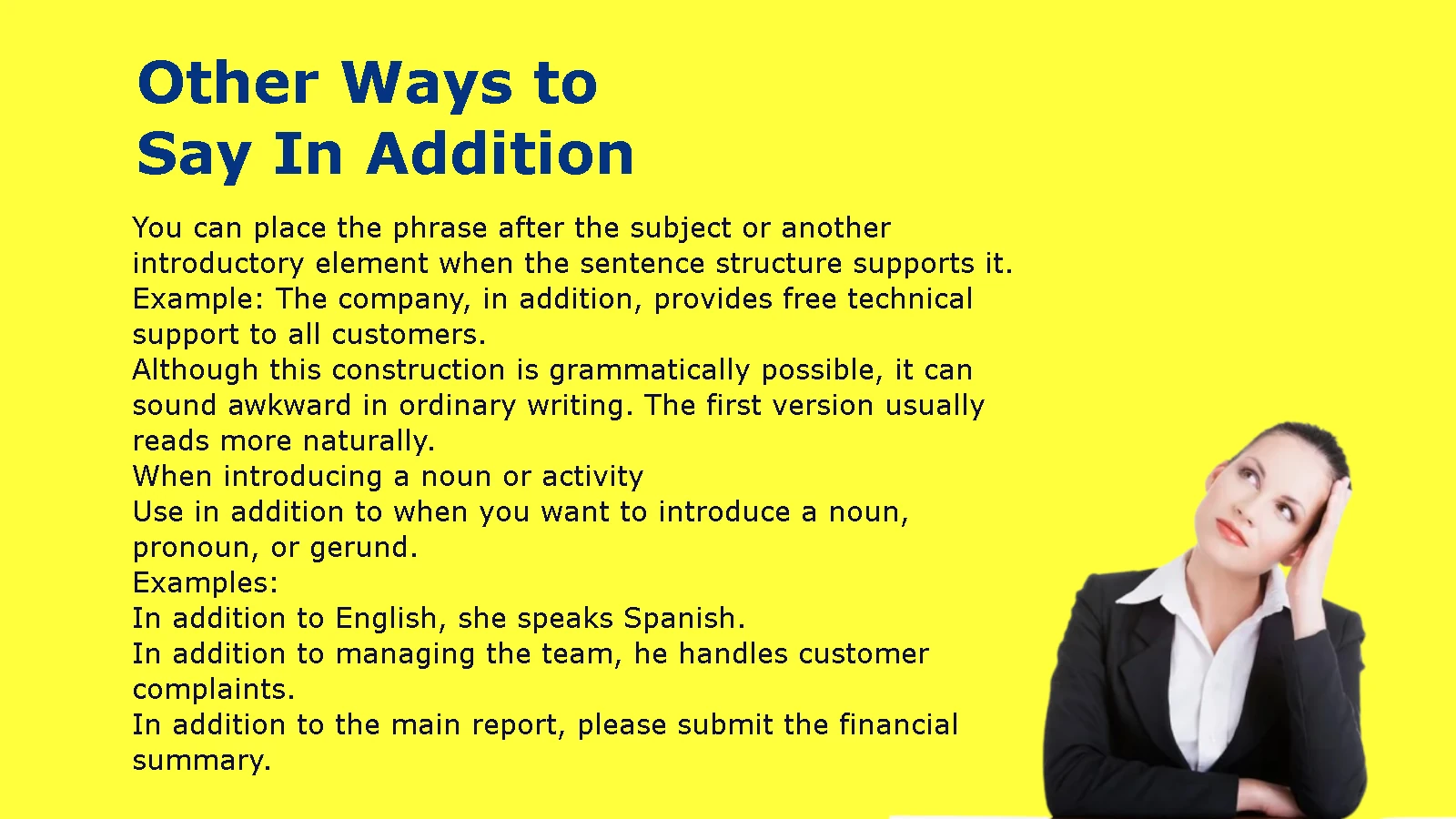
You can place the phrase after the subject or another introductory element when the sentence structure supports it.
Example: The company, in addition, provides free technical support to all customers.
Although this construction is grammatically possible, it can sound awkward in ordinary writing. The first version usually reads more naturally.
When introducing a noun or activity
Use in addition to when you want to introduce a noun, pronoun, or gerund.
Examples:
- In addition to English, she speaks Spanish.
- In addition to managing the team, he handles customer complaints.
- In addition to the main report, please submit the financial summary.
Remember the distinction: in addition often connects ideas or sentences, while in addition to connects an additional person, thing, or activity to the rest of the sentence.
Is In Addition Formal or Informal?
In addition is a neutral-to-formal expression. It works in academic essays, workplace communication, business reports, and everyday writing. However, some alternatives sound more formal, while others suit relaxed conversations better.
| Expression | Tone | Best use |
| Furthermore | Formal | Academic arguments and reports |
| Moreover | Formal | Emphasizing a supporting point |
| Additionally | Neutral to formal | Business writing and instructions |
| Also | Neutral | Everyday and professional writing |
| Plus | Casual | Conversations and informal messages |
| Besides | Conversational | Adding a reason or consideration |
| What’s more | Conversational | Emphasizing another point |
| On top of that | Informal | Casual stories and discussions |
Choose the expression that fits the situation. You do not need to replace in addition every time you use it. Clear, natural writing matters more than using a different transition in every sentence.
35+ Other Ways to Say In Addition
The best synonyms for in addition do more than replace two words with another phrase. They communicate a particular relationship between ideas, such as adding a fact, strengthening an argument, or highlighting another benefit.
The following alternatives are grouped by tone and purpose so you can find the right phrase quickly.
Formal Alternatives to In Addition
Formal alternatives work well in research papers, business proposals, reports, presentations, and official documents. They help connect related points while maintaining a professional tone.
1. Furthermore
Furthermore introduces additional information that supports or develops a previous point. It is especially useful when building a logical argument.
Example: The proposed system improves data security. Furthermore, it reduces the time employees spend on manual checks.
Best for: Academic essays, research papers, formal reports, and persuasive arguments.
2. Moreover
Moreover introduces another point that often strengthens the preceding statement. It can make a supporting fact feel especially relevant to the main argument.
Example: The training program improves employee productivity. Moreover, it increases job satisfaction and reduces staff turnover.
Best for: Formal arguments and reports where the next point reinforces the previous one.
3. Additionally
Additionally is a direct, flexible alternative to in addition. It introduces another fact, requirement, benefit, or consideration without necessarily emphasizing it.
Example: Applicants must submit a completed form. Additionally, they must provide proof of identity.
Best for: Instructions, business emails, policy documents, and informational articles.
4. In addition to this
This phrase explicitly connects new information to a previously mentioned point.
Example: The apartment includes two bedrooms. In addition to this, it has a private balcony and secure parking.
Best for: Property descriptions, product explanations, and reports.
5. Over and above
Over and above emphasizes something that exceeds an existing amount, expectation, or requirement. It does not work as a direct replacement in every sentence.
Example: The employee received a performance bonus over and above the standard annual increase.
Best for: Discussing extra benefits, payments, responsibilities, or achievements.
6. Alongside this
Alongside this introduces something that exists, happens, or operates together with another thing.
Example: The organization offers financial assistance. Alongside this, it provides career counseling.
Best for: Explaining complementary services, initiatives, and activities.
Professional Alternatives to In Addition
Professional communication should be clear, concise, and easy to follow. You can use the following alternatives in emails, reports, proposals, client messages, and workplace conversations.
7. Also
Also is one of the most versatile alternatives to in addition. It works in both professional and everyday contexts.
Example: The revised proposal includes a new budget. It also contains an updated project timeline.
Best for: General business communication when a simple transition is enough.
8. As well as
As well as connects related people, things, or activities. Unlike furthermore, it does not usually function as a sentence-opening transition on its own.
Example: The role requires communication skills as well as experience with data analysis.
Best for: Job descriptions, professional profiles, proposals, and lists of responsibilities.
9. Another point is
This expression introduces a new consideration without sounding overly formal.
Example: Another point is that the proposed deadline leaves little time for testing.
Best for: Meetings, presentations, discussions, and explanatory writing.
10. It is also worth noting that
Use this phrase to draw attention to an additional fact that readers should consider.
Example: It is also worth noting that the subscription includes customer support at no extra cost.
Best for: Reports, explanatory articles, product comparisons, and recommendations.
11. Beyond that
Beyond that introduces an additional point after the main information has been covered. It can also suggest that the next point goes further than the original discussion.
Example: The software handles invoicing and inventory. Beyond that, it generates monthly performance reports.
Best for: Presentations, project discussions, and business explanations.
12. On top of that
On top of that introduces another point, often one that makes a situation better, worse, or more significant.
Example: The delivery arrived late. On top of that, two items were missing from the order.
Best for: Conversational business communication, informal reports, and discussions.
Academic Alternatives to In Addition
Academic writing needs transitions that make the relationship between claims, evidence, and explanations clear. The following phrases help you develop an argument without relying on the same expression throughout an essay.
13. Furthermore
Furthermore works well when the next sentence adds evidence or reasoning that supports the previous claim.
Example: Regular exercise can improve cardiovascular fitness. Furthermore, it may support better sleep and mood regulation.
14. Moreover
Moreover is useful when an additional point strengthens the significance of the preceding argument.
Example: The study identifies a relationship between sleep duration and concentration. Moreover, its findings suggest that consistent sleep schedules deserve further investigation.
15. Additionally
Additionally introduces another relevant piece of evidence or a separate consideration.
Example: The researchers controlled for age and income. Additionally, they examined differences in participants’ education levels.
16. Equally important
Equally important signals that the next point deserves similar attention to the previous one.
Example: The policy must protect consumer information. Equally important, it must remain practical for small businesses to implement.
17. Another factor to consider is
This phrase introduces a new variable or issue that may influence the analysis.
Example: Another factor to consider is the difference in operating costs between urban and rural locations.
18. A related point is
Use this expression when the next idea connects closely to the previous discussion but introduces a distinct detail.
Example: The research examines student attendance. A related point is how classroom engagement affects academic performance.
Academic writing tip: Do not use moreover or furthermore simply to make an essay sound sophisticated. A plain transition such as also may communicate the relationship more clearly.
Casual and Conversational Alternatives to In Addition
Informal alternatives sound natural in conversations, text messages, social posts, and relaxed workplace communication.
19. Plus
Plus introduces another fact, reason, or advantage in a concise way.
Example: Let’s take the earlier train. Plus, we can grab breakfast before the meeting.
20. Besides
Besides can introduce an additional reason or consideration. It often suggests that the new point supports an opinion or decision.
Example: I don’t want to drive tonight. Besides, the weather forecast predicts heavy rain.
21. What’s more
What’s more highlights an additional point, often one that makes the situation more appealing or surprising.
Example: The restaurant has excellent food. What’s more, the prices are reasonable.
22. Not only that
Not only that emphasizes an additional fact, usually after a statement that already carries some weight.
Example: The laptop is lightweight. Not only that, its battery lasts through a full workday.
23. And another thing
This phrase introduces one more thought in a relaxed or emphatic way.
Example: And another thing: we should confirm the reservation before leaving.
It may sound abrupt or argumentative in a sensitive conversation, so use it with care.
24. Besides that
Besides that introduces another consideration connected to the previous point.
Example: The hotel is close to the airport. Besides that, it offers complimentary shuttle service.
25. To add to that
This expression introduces a further point that builds on what someone has already said.
Example: The first proposal is expensive. To add to that, it requires several months of preparation.
26. What’s even more
What’s even more introduces an additional point with stronger emphasis. In many sentences, what’s more or even better will sound more natural.
Example: The tickets are affordable. What’s even more appealing, children under five enter free.
Alternatives That Emphasize Extra Benefits or Information
Some phrases introduce an additional item rather than a whole new sentence. These expressions are especially useful when describing products, services, people, and activities.
27. In addition to
In addition to introduces a noun, pronoun, or gerund.
Example: In addition to offering free delivery, the store provides easy returns.
28. Along with
Along with connects items or activities that accompany one another.
Example: Along with the user manual, the package contains a charging cable.
29. Together with
Together with emphasizes that two or more things are included or considered as a group.
Example: The report, together with the supporting documents, was sent to the review team.
30. Coupled with
Coupled with highlights the combined effect of two factors.
Example: Lower production costs, coupled with stronger demand, improved the company’s outlook.
31. Added to that
Added to that introduces another factor that contributes to a situation.
Example: The project faces a tight deadline. Added to that, the team has limited resources.
32. In conjunction with
In conjunction with means working or operating together with something else. It sounds more formal than along with.
Example: The company launched the training program in conjunction with a local university.
33. Plus
Plus can also connect extra features or benefits in product descriptions.
Example: The membership includes unlimited storage, plus access to premium templates.
34. Not to mention
Not to mention introduces an additional point that the speaker considers significant or worth emphasizing.
Example: The new office reduces commuting time, not to mention the cost of daily parking.
35. As an added benefit
This expression emphasizes an extra advantage beyond the main benefit.
Example: The device uses less electricity. As an added benefit, it operates quietly.
36. In the same vein
In the same vein introduces a related thought or approach. It is not always a direct synonym for in addition because it emphasizes similarity as well as connection.
Example: The first initiative supports local businesses. In the same vein, the second encourages residents to shop locally.
37. Further to that
Further to that is used in some professional and especially British English contexts to refer to an earlier point or communication.
Example: Further to that, please review the revised delivery schedule.
For everyday US English, in addition, also, or on top of that may sound more natural.
Comparison Table: Which In Addition Synonym Should You Use?
The table below compares common alternatives by tone, purpose, and example. Use it to select a phrase that fits your sentence rather than choosing a synonym at random.
| Alternative | Tone | Best use | Example |
| Furthermore | Formal | Developing an argument | Furthermore, the findings support the proposal. |
| Moreover | Formal | Strengthening a point | Moreover, the approach reduces costs. |
| Additionally | Neutral/formal | Adding a fact | Additionally, the service includes free support. |
| Also | Neutral | General writing | The plan also covers maintenance. |
| Plus | Casual | Adding a benefit or reason | Plus, we can finish early. |
| Besides | Conversational | Adding a reason | Besides, we already have the equipment. |
| What’s more | Conversational | Emphasizing an extra point | What’s more, the tickets are refundable. |
| As well as | Neutral | Connecting items or actions | She manages sales as well as marketing. |
| Alongside this | Neutral/formal | Complementary activities | Alongside this, the team offers training. |
| Coupled with | Formal | Combined effects | Lower costs, coupled with higher demand, boosted sales. |
| Not to mention | Conversational | Emphasizing an extra detail | The location is convenient, not to mention affordable. |
| In addition to | Neutral/formal | Introducing a noun or activity | In addition to salary, the job offers benefits. |
Examples of In Addition and Its Alternatives in Sentences
Seeing alternatives in context helps you understand how they work. The same phrase may sound natural in one situation but awkward in another.
In Addition in Everyday Sentences
Everyday writing usually benefits from simple transitions. You rarely need a formal phrase when also, plus, or besides can express the same idea more naturally.
| Original sentence | Alternative version |
| In addition, we need milk. | We also need milk. |
| In addition, the park has a playground. | Plus, the park has a playground. |
| In addition, I have to finish my homework. | Besides, I have to finish my homework. |
| In addition, the store sells fresh bread. | The store sells fresh bread, too. |
| In addition, we can invite our neighbors. | We can invite our neighbors as well. |
Notice that the alternatives do not always belong in the same position. Also often fits naturally inside a sentence, while plus and besides can introduce a new conversational point.
In Addition in Academic Writing
Academic writing requires transitions that show how evidence and reasoning relate to one another.
Consider this example:
Basic version:
Online learning offers flexibility. In addition, students can access course materials at different times.
Revised version:
Online learning offers flexibility. Additionally, students can access course materials at different times, making it easier to study around work or family responsibilities.
The revision uses a formal transition and explains why the additional detail matters.
Here is another example:
Basic version:
The survey found that employees preferred flexible schedules. In addition, the results showed that flexible schedules reduced commuting stress.
Revised version:
The survey found that employees preferred flexible schedules. Moreover, the results suggested that these arrangements could reduce commuting stress.
The word moreover connects the second finding to the first. However, if the two findings are simply separate facts, additionally may be the more neutral choice.
In Addition in Business Writing
Business communication should make extra information easy to identify. Choose a transition based on whether you are adding a requirement, explaining a benefit, or introducing a related task.
Example: Client email
Original:
The proposal includes the project timeline. In addition, it contains a cost breakdown.
Improved:
The proposal includes the project timeline. It also contains a detailed cost breakdown.
The revised version is direct and professional without adding unnecessary formality.
Example: Project update
Original:
In addition, the team completed the initial testing phase.
Improved:
Additionally, the team completed the initial testing phase and documented the remaining issues.
This version introduces another accomplishment and provides useful context.
Example: Product description
Original:
The subscription includes cloud storage. In addition, customers receive priority support.
Improved:
The subscription includes cloud storage, plus priority customer support.
The shorter version works well in marketing copy because it highlights an extra benefit without interrupting the flow.
In Addition in Essays and Formal Documents
Formal documents often need several types of transitions. The important task is to match the transition to the relationship between ideas.
Consider these examples:
- Adding evidence: The initial results support the hypothesis. Additionally, follow-up observations show a similar pattern.
- Strengthening an argument: The policy could reduce waste. Moreover, it may lower long-term operating costs.
- Introducing a related consideration: The proposal addresses immediate expenses. Another factor to consider is its effect on future maintenance.
- Adding a comparable point: The first approach improves efficiency. Equally important, the second approach protects data quality.
Each transition does a slightly different job. Avoid switching between them just to create variety if the change makes your meaning less precise.
In Addition vs. Furthermore vs. Moreover vs. Additionally
These four expressions can all introduce extra information, but they differ slightly in emphasis and style.
In addition is a general expression for introducing another point. Furthermore often develops an argument, moreover frequently emphasizes a supporting point, and additionally adds information in a relatively neutral way.
| Phrase | Main function | Typical tone | Example |
| In addition | Adds another point | Neutral/formal | In addition, the course includes practical exercises. |
| Furthermore | Develops or supports an argument | Formal | Furthermore, the results support the proposed explanation. |
| Moreover | Reinforces a point | Formal and emphatic | Moreover, the approach saves time and money. |
| Additionally | Adds a fact or requirement | Neutral/formal | Additionally, applicants must submit two references. |
These differences are tendencies, not strict rules. In many sentences, the four phrases can replace one another without changing the basic meaning.
In Addition vs. Furthermore
Both expressions introduce extra information. However, furthermore often sounds more argumentative because it develops a point or adds support to an existing claim.
Example:
- In addition: The school offers evening classes. In addition, it provides weekend workshops.
- Furthermore: The school offers evening classes. Furthermore, its weekend workshops help working adults continue their education.
The first example simply lists two services. The second connects the additional service to a broader argument about accessibility.
In Addition vs. Moreover
Moreover often signals that the following information reinforces or increases the importance of the previous point.
Example:
- In addition: The new system reduces paperwork. In addition, it improves recordkeeping.
- Moreover: The new system reduces paperwork. Moreover, it improves recordkeeping by making documents easier to search and retrieve.
Both versions are correct. The second gives the added point greater argumentative weight.
In Addition vs. Additionally
These phrases are close in meaning and often interchangeable.
Example:
- In addition, employees receive paid training.
- Additionally, employees receive paid training.
Both sentences introduce an extra benefit. Additionally may feel slightly more compact in instructions or reports, while in addition works naturally in a wide range of contexts.
Choose whichever phrase fits your sentence rhythm and surrounding language.
Common Mistakes When Using In Addition
Although in addition is easy to use, writers sometimes choose it when a different transition would communicate the relationship more accurately.
Repeating the Same Transition Word
Starting several consecutive sentences with in addition can make an article or essay feel mechanical.
Weak example:
The product is affordable. In addition, it is durable.
Improved example:
The product is affordable and durable. It is also easy to use, and it comes with a warranty.
The improved version combines related ideas and removes unnecessary repetition.
Try these steps when editing a paragraph:
- Identify sentences that introduce similar information.
- Combine closely related points when doing so improves clarity.
- Replace repeated transitions with natural sentence structures.
- Remove transitions that do not help readers follow the argument.
You do not need a different transition in every sentence. Sometimes the best choice is no transition at all.
Confusing In Addition With In Addition To
The expressions look similar, but their grammatical functions differ.
In addition commonly introduces a complete sentence or another point.
Example: In addition, the company offers flexible payment plans.
In addition to usually introduces a noun, pronoun, or gerund.
Example: In addition to flexible payment plans, the company offers free delivery.
Another example:
- Correct: In addition to working full-time, she studies at night.
- Incorrect: In addition working full-time, she studies at night.
The word to matters because the complete expression is in addition to.
Using In Addition When You Mean As a Result
An additive transition introduces another point. A cause-and-effect transition explains a consequence. These functions are different.
| Transition | Meaning | Example |
| In addition | Adds information | The road was busy. In addition, visibility was poor. |
| As a result | Shows a consequence | Visibility was poor. As a result, drivers slowed down. |
| Therefore | Draws a logical conclusion | The evidence was incomplete. Therefore, the team delayed its decision. |
| In conclusion | Signals a closing summary | In conclusion, the findings support further research. |
| Overall | Summarizes the general picture | Overall, the project met its main objectives. |
Do not use as a result simply because you need another transition. Use it when the second statement follows from the first.
Overusing Formal Transition Words
Words such as moreover and furthermore can improve formal writing, but too many can make an article feel stiff.
Consider this sentence:
“Furthermore, the company offers free delivery. Moreover, it provides flexible payment options. Additionally, customers receive product support.”
A more natural version is:
“The company offers free delivery and flexible payment options. Customers also receive product support.”
The second version communicates the same information with fewer transitions. Readers can follow the list without a formal signal at the start of every sentence.
Related Transition Words and Synonyms
Several related searches involve phrases that add information, summarize a point, or explain a result. These expressions overlap in everyday usage, but they serve different grammatical and logical purposes.
Another Way to Say Furthermore
If you need another way to say furthermore, consider these options:
- Moreover: Adds a point that strengthens an argument.
- Additionally: Introduces another fact or consideration.
- What’s more: Emphasizes another point in conversational writing.
- Beyond that: Moves to another consideration.
- On top of that: Adds an emphatic or conversational point.
- Equally important: Signals that another point deserves similar attention.
Example:
“Furthermore, the program helps students build confidence.”
Possible alternatives:
- Moreover, the program helps students build confidence.
- Additionally, the program helps students build confidence.
- What’s more, the program helps students build confidence.
For formal essays, moreover and additionally are usually suitable. For informal writing, what’s more may sound more natural.
Another Way to Say As Well As
The phrase as well as connects related items, qualities, or actions. The right alternative depends on the sentence structure.
Useful alternatives include:
- Along with
- Together with
- In addition to
- Plus
- And
- Coupled with
Examples:
- Original: She manages sales as well as marketing.
- Alternative: She manages sales along with marketing.
- Original: As well as offering free shipping, the store provides easy returns.
- Alternative: In addition to offering free shipping, the store provides easy returns.
Remember that as well as does not always behave exactly like and. When the phrase connects subjects, the main subject generally determines the verb’s number.
Example: “The manager, as well as the employees, is attending the meeting.”
The main subject is the manager, which is singular. The added phrase does not automatically make the subject plural.
Another Word for Additional
Additional is an adjective, while in addition is a phrase. Therefore, their alternatives are not always interchangeable.
| Word | Meaning | Example |
| Extra | More than usual or expected | We need extra chairs. |
| Added | Included on top of something else | The package includes added protection. |
| Further | More or additional | Please provide further details. |
| Supplementary | Providing extra support or information | Students received supplementary materials. |
| Additional | Added to what already exists | The customer requested additional information. |
| Supplemental | Serving as an addition | The report includes supplemental data. |
For example, you can replace “additional information” with extra information or further information. However, you cannot usually replace the sentence-opening transition “In addition, the report includes new data” with “Extra, the report includes new data.”
The grammatical role matters as much as the meaning.
In Addition vs. In Conclusion, As a Result, and Overall
These transition phrases serve different purposes, so they should not be treated as interchangeable synonyms.
In conclusion signals that you are wrapping up an argument or discussion.
Example: In conclusion, the evidence supports expanding the program.
As a result introduces an outcome or consequence.
Example: The team completed testing early. As a result, the product launched ahead of schedule.
Overall summarizes the general picture after considering several details.
Example: Overall, the project met its targets despite a few delays.
In addition introduces another piece of information.
Example: The project met its targets. In addition, it finished under budget.
Use each phrase according to the relationship between the ideas. A well-chosen transition makes the meaning clear without forcing the reader to infer the connection.
How to Choose the Best Alternative to In Addition
Choosing the right synonym starts with understanding what you want the next sentence to do. Think about the audience, the relationship between the ideas, and the tone of the writing.
Match the Phrase to Your Audience
Different audiences expect different styles.
For a university essay, furthermore, moreover, and additionally can fit naturally when they support the argument.
For a business report, additionally and also are clear choices that do not draw too much attention to themselves.
In a casual message, plus, besides, or what’s more may sound more natural.
For example, compare these sentences:
- Formal: Furthermore, the proposed changes could improve long-term efficiency.
- Professional: The proposed changes also improve long-term efficiency.
- Casual: Plus, the changes could make everything easier.
All three communicate an additional benefit. The best version depends on who will read it and how you want to sound.
Match the Phrase to Your Meaning
Before choosing a synonym, ask yourself what relationship connects the two ideas.
| Your purpose | Suitable transitions |
| Add another fact | Also, additionally, in addition |
| Strengthen an argument | Furthermore, moreover |
| Introduce another reason | Besides, on top of that |
| Emphasize a benefit | What’s more, not to mention |
| Connect related items | Along with, as well as, in addition to |
| Explain a consequence | As a result, therefore |
| Summarize several points | Overall, in summary |
| Close an argument | In conclusion, to sum up |
This distinction prevents a common writing problem: choosing a phrase because it sounds polished rather than because it expresses the intended relationship.
Vary Your Transitions Without Changing Your Meaning
Variety can make your writing more engaging, but accuracy matters more than avoiding repetition at all costs.
Use this simple editing process:
- Read the paragraph: Identify where you add information, emphasize a point, explain a result, or summarize.
- Check the connection: Confirm that the transition reflects the relationship between the two ideas.
- Remove unnecessary wording: If the connection is obvious, you may not need a transition.
- Vary sentence structure: Start some sentences with the subject, combine related points, or use a connecting phrase within the sentence.
- Read aloud: Replace phrases that sound stiff or unnatural.
A cleaner version reads:
“The course includes instructional videos and practice exercises. Students also receive feedback on their work.”
The revised paragraph is shorter, easier to read, and more direct.
A Practical Editing Example: Choosing the Right In Addition Alternative
Imagine you are writing a product description for a project management tool. Your draft says:
“The tool organizes tasks. In addition, it tracks deadlines. In addition, it sends reminders.
The information is useful, but the repeated transition makes the paragraph monotonous.
Here is how you could revise it:
“The tool organizes tasks, tracks deadlines, and sends automatic reminders. It also generates progress reports that help teams monitor their progress.”
This revision makes two improvements:
- Better sentence structure: Related features appear together instead of being split into repetitive sentences.
- Clearer emphasis: The final feature receives attention without another formal transition.
Now consider a different context. If you are arguing that the software deserves investment, you might write:
“The tool organizes tasks and tracks deadlines. Furthermore, it generates reports that help managers identify delays before they affect the project.”
Here, furthermore works because the reporting feature strengthens the case for the product.
The lesson is simple: choose the transition based on the job it needs to do, not just its position in the sentence.
Frequently Asked Questions
What Is Another Way to Say In Addition?
Common alternatives include also, additionally, furthermore, moreover, besides, plus, and what’s more. Use additionally for neutral or formal writing, furthermore to develop an argument, and plus for casual communication.
What Is a More Formal Word for In Addition?
Furthermore, moreover, and additionally are common formal alternatives. Furthermore often develops an argument, moreover emphasizes a supporting point, and additionally introduces another fact without necessarily adding emphasis.
What Is the Difference Between In Addition and Furthermore?
Both expressions introduce extra information. However, in addition is a general way to add another point, while furthermore often connects the new information to an existing argument or explanation.
Can I Use In Addition at the Beginning of a Sentence?
Yes. Use a comma after the introductory phrase when it begins a sentence.
Correct: In addition, the company offers free training.
You can also place in addition elsewhere in a sentence when the structure supports it, although the sentence-opening position is often clearer.
Is In Addition the Same as As Well As?
No. In addition often introduces another sentence or point, while as well as connects related items, qualities, or activities within a sentence.
Example: “In addition, she manages the budget.”
Example: “She manages the budget as well as the project schedule.”
What Can I Use Instead of In Addition in an Essay?
Use furthermore, moreover, additionally, equally important, or another factor to consider is, depending on the relationship between your ideas. Choose the transition that reflects your reasoning instead of using formal words simply to make the essay sound academic.
Conclusion
The best alternatives to in addition depend on your purpose, audience, and writing style. Furthermore and moreover work well when developing formal arguments. Additionally provides a neutral way to introduce another fact, while also keeps sentences direct. For casual writing, plus, besides, and what’s more can sound more natural.
Remember that not every synonym serves the same grammatical function. Expressions such as in addition to, as well as, and along with connect items or activities, while as a result, overall, and in conclusion communicate different logical relationships.
Before publishing your next essay, email, report, or article, review each transition and ask whether it helps readers understand how your ideas connect. Replace repetitive phrases, keep your sentences clear, and choose words that fit the situation.