Other ways to say of course include certainly, absolutely, definitely, by all means, sure thing, and I’d be happy to. The best alternative depends on what you want to express, whether you’re agreeing with someone, granting permission, offering help, or confirming something obvious. Choosing the right phrase helps you sound natural in everyday conversations, professional emails, and academic writing.
Some expressions communicate warmth and willingness, while others emphasize certainty or agreement. For example, “I’d be happy to help” sounds welcoming in a workplace conversation, whereas “you bet” feels more casual. Funny alternatives such as “Is the sky blue?” can add humor among friends but may sound sarcastic in a formal setting.
This guide explains the meaning of of course, more than 35 useful synonyms, funny and slang alternatives, professional expressions, academic usage, and the difference between related phrases such as yes, you’re welcome, and as a matter of course. You’ll also learn whether “ofcourse” is correct and how to choose an alternative that fits your situation.
What Does “Of Course” Mean?
Of course is an expression used to show agreement, give permission, offer help, or emphasize that something is obvious or expected. Its meaning depends on the conversation. It can sound friendly and reassuring, but the same phrase may sound impatient or sarcastic when someone uses it with the wrong tone.
The Two Main Meanings of “Of Course”
The expression generally has two main uses.
Agreement, permission, or willingness: You use “of course” to accept a request, agree to something, or show that you’re happy to help.
Examples:
- “Could you send me the report?” “Of course. I’ll send it this afternoon.”
- “May I borrow your notes?” “Of course. Just bring them back tomorrow.”
- “Would you like me to explain the process?” “Of course, if you have time.”
Something obvious or expected: You can also use “of course” to introduce information that you consider natural, predictable, or already understood.
Examples:
- “Of course, the store gets busy on weekends.”
- “She was nervous before the interview, of course.”
- “Of course, regular practice improves your writing.”
These meanings overlap, but they aren’t identical. When you answer a request, “of course” often expresses willingness. When you introduce an obvious fact, it emphasizes how expected that fact seems.
Examples of “Of Course” in Everyday Conversations
The following examples show how the expression changes with the situation.
| Situation | Example | What it communicates |
| Accepting a request | “Of course, I’ll help you.” | Willingness |
| Giving permission | “Of course you can use my laptop.” | Approval |
| Agreeing with an idea | “Of course, that makes sense.” | Agreement |
| Confirming a fact | “Of course, water freezes under suitable conditions.” | An established fact |
| Responding to thanks | “Of course! Anytime.” | Warmth and reassurance |
| Expressing sarcasm | “Of course you forgot your keys again.” | Frustration or criticism |
The last example illustrates why context matters. The words themselves don’t always reveal the speaker’s intention. Tone, facial expression, punctuation, and the relationship between speakers can change the meaning.
Is “Of Course” Always Polite?
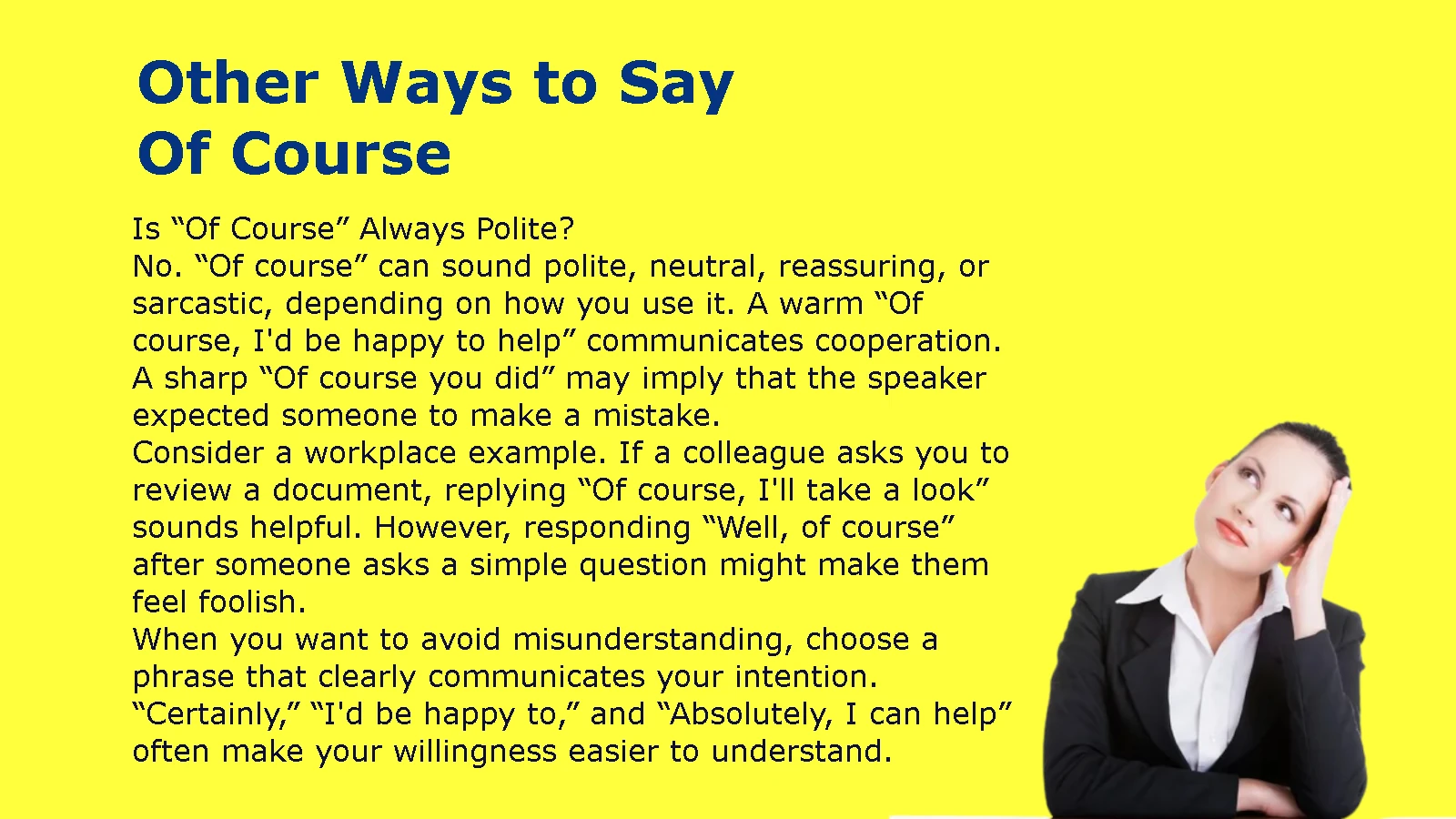
No. “Of course” can sound polite, neutral, reassuring, or sarcastic, depending on how you use it. A warm “Of course, I’d be happy to help” communicates cooperation. A sharp “Of course you did” may imply that the speaker expected someone to make a mistake.
Consider a workplace example. If a colleague asks you to review a document, replying “Of course, I’ll take a look” sounds helpful. However, responding “Well, of course” after someone asks a simple question might make them feel foolish.
When you want to avoid misunderstanding, choose a phrase that clearly communicates your intention. “Certainly,” “I’d be happy to,” and “Absolutely, I can help” often make your willingness easier to understand.
35+ Other Ways to Say “Of Course”
The best alternatives to “of course” express the same general idea without necessarily carrying the same tone. Certainly works well in formal conversations, sure thing sounds relaxed, and by all means often grants permission. Match the expression to the situation rather than replacing every instance of “of course” with the same synonym.
Polite Ways to Say “Of Course”
Use these expressions when you want to sound considerate, welcoming, and respectful.
| Alternative | Best use | Example sentence |
| Certainly | Polite requests and professional conversations | “Certainly, I’ll send you the details.” |
| Absolutely | Enthusiastic agreement | “Absolutely, I’d love to join.” |
| By all means | Granting permission | “By all means, take a seat.” |
| I’d be happy to | Offering assistance | “I’d be happy to review your application.” |
| Not a problem | Responding to a request | “Not a problem. I’ll handle it.” |
| It’s my pleasure | Responding warmly to thanks | “It’s my pleasure. I’m glad I could help.” |
| I’d be glad to | Willingly accepting a task | “I’d be glad to explain the process.” |
When should you use these alternatives?
Choose “certainly” when you need a polite, straightforward response. Use “by all means” when you want to give someone permission to proceed. If you want to show that you genuinely welcome a request, “I’d be happy to” often sounds warmer than a brief “of course.”
For example, a customer asking for help may appreciate this response:
“Certainly. I’d be happy to walk you through the next steps.”
The two sentences communicate both willingness and a clear intention to assist.
Professional Ways to Say “Of Course”
Professional communication benefits from clear, direct wording. You don’t need to make every response formal, but you should choose expressions that suit the task and relationship.
| Alternative | Tone | Example |
| Certainly | Polite and professional | “Certainly, I’ll prepare the summary.” |
| I’d be glad to | Cooperative | “I’d be glad to arrange the meeting.” |
| Absolutely | Confident and positive | “Absolutely, we can discuss that option.” |
| Consider it done | Assured and action-oriented | “Consider it done. I’ll update the file today.” |
| Without a doubt | Strong certainty | “Without a doubt, this deserves further review.” |
| I’m happy to help | Friendly and professional | “I’m happy to help with the onboarding process.” |
Not every expression suits every workplace. “Consider it done” implies that you can complete the task, so don’t use it when the deadline or requirements remain uncertain. Likewise, “without a doubt” emphasizes certainty rather than willingness to perform a task.
For a routine email, a simple response may be enough:
“Certainly. I’ll share the revised document by Thursday.”
This answer confirms the request and gives the recipient a clear expectation.
Casual Ways to Say “Of Course”
Casual alternatives work well in text messages, conversations with friends, and relaxed workplace chats.
- Sure: “Sure, I’ll meet you at six.”
- Sure thing: “Sure thing! I’ll bring the snacks.”
- Definitely: “Definitely, let’s watch that movie.”
- You bet: “Can you pick me up?” “You bet.”
- No worries: “No worries, I can help you.”
- For sure: “Are we still going?” “For sure.”
- Yep: “Did you get my message?” “Yep.”
- No problem: “Could you send that again?” “No problem.”
These phrases aren’t perfect substitutes for one another. “Yep” gives a quick confirmation, while “you bet” often sounds more enthusiastic. “No worries” reassures someone that their request or mistake hasn’t caused a problem.
For example, if a friend asks whether you can help them move, “Definitely!” conveys enthusiasm. “Sure” also works, but it may sound more neutral.
Stronger Ways to Express Agreement
Sometimes you want to communicate more than a simple yes. These alternatives emphasize confidence, certainty, or strong agreement.
- Without question: “Without question, she’s qualified for the role.”
- No doubt about it: “He’s the right person for the job, no doubt about it.”
- Most definitely: “I’ll most definitely be there.”
- Naturally: “Naturally, we want the project to succeed.”
- Indeed: “Indeed, that is a reasonable solution.”
- You can count on it: “I’ll finish the work. You can count on it.”
Use these expressions when the conversation calls for emphasis. “You can count on it” makes a commitment, so reserve it for situations where you can reasonably deliver. “Indeed” sounds more formal and often fits written communication better than casual texting.
Other Ways to Say “Of Course” When Something Is Obvious
When you want to emphasize an expected fact, choose an expression that fits the strength of your claim.
| Alternative | Meaning or tone | Example |
| Obviously | Something seems clear | “Obviously, we need more time.” |
| Clearly | Something is apparent from the evidence | “Clearly, the new schedule works better.” |
| As expected | An outcome was anticipated | “As expected, the team finished early.” |
| Naturally | Something follows from circumstances | “Naturally, customers want reliable service.” |
| That goes without saying | Something is assumed to be understood | “Quality matters. That goes without saying.” |
Be careful with “obviously.” Although it can express a clear conclusion, it can also make a listener feel that their question was unnecessary.
For instance, “Obviously, you need to save your work” may sound condescending. “It’s a good idea to save your work regularly” gives the same practical advice without judging the listener.
Quick Comparison: Which Alternative Should You Use?
Use this table when you need to choose a phrase quickly.
| If you want to… | Try this phrase | Why it works |
| Sound polite | Certainly | Respectful and direct |
| Show enthusiasm | Absolutely | Strong positive agreement |
| Grant permission | By all means | Clearly welcomes an action |
| Offer assistance | I’d be happy to | Emphasizes willingness |
| Reply casually | Sure thing | Relaxed and friendly |
| Confirm an expected outcome | As expected | Highlights predictability |
| Reassure someone | No worries | Reduces concern |
| Make a commitment | You can count on it | Signals reliability |
| Add humor | Is the sky blue? | Playfully treats the answer as obvious |
The important distinction is between agreeing, offering help, granting permission, and stating an obvious fact. Identify your purpose first, then choose the expression that communicates it.
Funny Ways to Say “Of Course”
Funny alternatives to “of course” add personality to conversations by treating the answer as obvious or exaggerating your enthusiasm. Expressions such as “Is the sky blue?” and “You don’t have to ask twice” work well among friends. However, sarcastic versions can sound rude when the listener expects a serious answer.
Funny and Playful Alternatives
Try these expressions when you want a lighthearted response.
| Funny alternative | Example |
| Is the sky blue? | “Do you want pizza?” “Is the sky blue?” |
| Does a bear live in the woods? | “Are you coming to the party?” “Does a bear live in the woods?” |
| You don’t have to ask twice | “Want to grab dessert?” “You don’t have to ask twice!” |
| Heck yes! | “Ready for the weekend?” “Heck yes!” |
| You bet your boots | “Will you be there?” “You bet your boots.” |
| In a heartbeat | “Would you travel there again?” “In a heartbeat.” |
| Do fish swim? | “Would you like a day off?” “Do fish swim?” |
| Is water wet? | “Are you excited?” “Is water wet?” |
Some of these expressions are rhetorical questions. Instead of saying “yes” directly, the speaker asks a question whose expected answer seems obvious. The humor comes from exaggerating how easy the decision is.
Example conversation:
“Would you like another slice of cake?”
“Does a bear live in the woods?”
The response playfully implies that the speaker would obviously accept more cake.
Sarcastic Ways to Say “Of Course”
Sarcasm uses words to communicate a meaning that may differ from their literal sense. These expressions can be funny among people who understand each other’s humor, but they may also communicate irritation.
- Well, obviously. “Well, obviously. We should check the figures first.”
- What gave it away? “You look tired.” “What gave it away?”
- Is that even a question? “Would you like a vacation?” “Is that even a question?”
- As if there were any doubt. “Are you excited about the concert?” “As if there were any doubt.”
- Tell me something I don’t know. “The traffic is terrible.” “Tell me something I don’t know.”
The last expression can sound dismissive, especially if someone is sharing information they consider important. Use it when the relationship supports teasing rather than in situations where the other person expects empathy.
When Funny Alternatives Can Backfire
Humor depends on context. A playful phrase that works in a group chat might sound disrespectful in a meeting or customer-service conversation.
Consider these examples:
With a close friend
“Want to get burgers after the game?”
“Is the sky blue?”
The response sounds playful because both people understand the casual tone.
With a manager
“Can you complete this report before noon?”
“Does a bear live in the woods?”
This response may seem flippant because the manager needs a clear commitment rather than a joke.
When the situation involves deadlines, conflict, sensitive topics, or unfamiliar people, use a direct response such as “Certainly” or “Yes, I can do that.”
“Of Course” Slang and Informal Alternatives
Slang alternatives to “of course” communicate agreement in a relaxed, conversational way. Expressions such as for sure, bet, facts, you already know, and no cap appear in informal speech and online conversations. Their meanings and popularity vary across communities, so choose language that feels natural for your audience.
Popular Slang Expressions for Agreement
Here are some informal options and how people commonly use them.
| Slang expression | Meaning | Example |
| For sure | Definitely or certainly | “Are you coming tonight?” “For sure.” |
| Bet | Agreement or confirmation | “Meet me at seven.” “Bet.” |
| Facts | Strong agreement with a statement | “That was the best meal.” “Facts.” |
| You already know | Suggests the answer is obvious to both people | “Are we getting coffee?” “You already know.” |
| No cap | Emphasizes sincerity or truthfulness | “That was amazing, no cap.” |
| Heck yeah | Enthusiastic agreement | “Want to go hiking?” “Heck yeah!” |
| Yup | Informal yes | “Did you finish?” “Yup.” |
Notice that not all these expressions mean exactly the same thing. “Bet” often confirms a plan or accepts a suggestion. “Facts” usually agrees with a statement rather than accepting a request. “No cap” emphasizes that a claim is genuine, so it doesn’t replace “of course” in every sentence.
Which Slang Expressions Work in Text Messages?
Text messages often favor short, familiar responses.
For example:
- Friend: “Movie night at my place?”
- Reply: “Bet.”
Or:
- Friend: “You’re joining us tomorrow, right?”
- Reply: “For sure!”
These responses feel natural in a casual exchange. However, a short reply can sometimes seem abrupt if the recipient expects more detail. “Absolutely! I’ll be there around seven” communicates both enthusiasm and a clear plan.
Slang also changes over time. A phrase that feels current in one social group may sound unfamiliar or forced in another. You don’t need to use every trending expression. Choose language that matches how you normally speak.
Slang to Avoid in Formal Writing
Expressions such as “bet,” “no cap,” and “you already know” usually don’t fit academic essays, formal reports, or official business correspondence.
Instead of writing:
“Of course, this method works better, no cap.”
Use:
“This method appears more effective based on the results.”
The revised sentence replaces slang with a specific, evidence-oriented statement. It also avoids presenting a claim as certain without supporting information.
Professional Alternatives to “Of Course” in Emails
Professional alternatives to “of course” help you communicate willingness, agreement, and reliability without sounding repetitive. Certainly, I’d be happy to, absolutely, and I’m glad to help work in many business situations. The best choice depends on whether you’re accepting a request, agreeing to a proposal, or offering assistance.
When Responding to a Request
When someone asks you to complete a task, your response should acknowledge the request and clarify what you’ll do.
Examples:
Instead of: “Of course.”
Try:
- “Certainly, I’ll send the revised file this afternoon.”
- “Absolutely, I’ll review the document before the meeting.”
- “I’d be happy to take care of that.”
- “No problem. I’ll update the spreadsheet today.”
A specific response often works better than a bare expression of agreement. It tells the recipient that you understand the request and gives them a clear expectation.
For example, “Certainly, I’ll send the report by 3 p.m.” is more useful than “Of course” when timing matters.
When Agreeing to a Proposal
Use alternatives that clearly communicate agreement with the idea or plan.
- “That works for me.”
- “I agree with that approach.”
- “Absolutely, let’s move forward.”
- “That sounds good to me.”
- “I’m on board with that plan.”
Each phrase carries a slightly different meaning. “That works for me” confirms that you accept the proposed arrangement. “I agree with that approach” expresses support for the idea itself. “I’m on board” signals willingness to participate.
Example:
Colleague: “Could we move the meeting to Thursday?”
Reply: “That works for me. Thursday morning is available on my calendar.”
This response confirms agreement and supplies useful scheduling information.
When Offering Assistance
Choose a phrase that makes your willingness clear without overpromising.
- “I’m happy to help.”
- “I’d be glad to assist.”
- “Please let me know what you need.”
- “I’d be happy to walk you through it.”
- “I can help with that.”
For customer service, “I’d be happy to help” sounds welcoming. For a coworker who needs a quick answer, “I can help with that” is direct and natural.
Avoid promising more than you can deliver. “I’ll handle everything” may create unrealistic expectations if you can only complete part of the task.
Before-and-After Email Examples
A small wording change can make an email clearer and more useful.
Example: Accepting a task
Before:
“Of course, no problem.”
After:
“Certainly. I’ll revise the document and send you the updated version by Thursday.”
Example: Agreeing to a meeting
Before:
“Of course, that’s fine.”
After:
“Thursday at 10 a.m. works for me. I’ll send a calendar invitation.”
Example: Helping a customer
Before:
“Of course, I can help.”
After:
“Absolutely. I’ll check your order details and explain the available options.”
The improved versions do more than replace a phrase. They confirm the next step, remove ambiguity, and help the recipient understand what will happen.
Other Ways to Say “Of Course” in an Essay
In academic writing, alternatives to “of course” can make arguments more precise and less conversational. Indeed, certainly, undoubtedly, naturally, and it is evident that may work in specific contexts. However, the best replacement depends on whether you’re presenting evidence, acknowledging an established fact, or drawing a logical conclusion.
Formal Synonyms for Academic Writing
Consider these alternatives when you want a more formal tone.
| Alternative | Best use | Example |
| Indeed | Reinforcing a previous point | “Indeed, the results support the proposed explanation.” |
| Certainly | Acknowledging a point | “Certainly, the policy requires careful evaluation.” |
| Undoubtedly | Expressing strong confidence | “Undoubtedly, the findings deserve further study.” |
| Naturally | Describing an expected consequence | “Naturally, higher demand can affect availability.” |
| It is evident that | Introducing a conclusion supported by evidence | “It is evident that the two groups responded differently.” |
| As expected | Describing an anticipated outcome | “As expected, the control group showed little change.” |
These phrases aren’t interchangeable in every sentence. “Indeed” often reinforces a point. “As expected” indicates that the result matches a prior prediction. “It is evident that” introduces an interpretation that should be supported by evidence.
How to Choose the Right Synonym for an Essay
Before replacing “of course,” ask what the sentence needs to communicate.
If you’re agreeing with an established argument, “indeed” may fit.
Original: “Of course, the findings support the original hypothesis.”
Revision: “Indeed, the findings support the original hypothesis.”
If you’re describing an expected result, use “as expected.”
Original: “Of course, the results changed after the second trial.”
Revision: “As expected, the results changed after the second trial.”
If you’re presenting a conclusion, state the evidence or reasoning directly.
Original: “Of course, the policy improved attendance.”
Revision: “Attendance improved after the policy took effect.”
The final version is often stronger because it focuses on the result instead of asking readers to accept the claim as obvious.
Academic Example Sentences
Here are more examples of how to revise conversational language for formal writing.
Conversational: “Of course, students need enough time to prepare.”
Academic: “Students need adequate preparation time to complete the assignment effectively.”
Conversational: “Of course, the experiment didn’t work as planned.”
Academic: “The experiment produced results that differed from the initial expectations.”
Conversational: “Of course, cost is an important factor.”
Academic: “Cost is an important factor in evaluating the proposal.”
Notice that the revised sentences often remove “of course” entirely. Academic writing doesn’t need a synonym for every conversational expression. Sometimes the clearest choice is to state the main point directly.
Why “Obviously” Is Not Always the Best Choice
“Obviously” can sound dismissive because it implies that a point should be clear to everyone. In academic writing, that implication may weaken your argument rather than strengthen it.
For example:
“Obviously, the results prove the theory.”
This sentence creates two problems. It assumes that the conclusion is self-evident, and it uses “prove” without explaining the evidence.
A more precise version would be:
“The results support the theory, although further testing is needed.”
This revision communicates the strength of the evidence without overstating the conclusion.
Is “Of Course” Another Way to Say “Yes”?
Yes, “of course” can mean yes, especially when someone asks for permission, requests help, or invites you to participate. However, it often sounds warmer or more emphatic than a simple “yes.” It can also imply that the answer should have been obvious, so context and tone matter.
When “Of Course” Means Yes
Consider these exchanges:
Request: “Can you help me with this assignment?”
Reply: “Of course!”
Here, the expression means that the speaker agrees to help.
Permission: “May I sit here?”
Reply: “Of course.”
In this situation, the speaker grants permission.
Invitation: “Would you like to join us for dinner?”
Reply: “Of course! That sounds lovely.”
Here, “of course” expresses enthusiastic acceptance.
However, a question about facts may call for a different response. If someone asks whether a package arrived, “Yes, it arrived this morning” communicates the information more clearly than “Of course.”
Other Ways to Say Yes
Choose one of these alternatives based on your intended tone.
- Absolutely: Strong agreement or enthusiasm.
- Certainly: Polite, professional agreement.
- Definitely: A confident confirmation.
- Sure: A neutral, casual response.
- I agree: Direct support for an opinion or proposal.
- That works for me: Acceptance of an arrangement.
- Sounds good: Informal agreement with a plan.
- I’d be happy to: Willingness to do something.
Each option emphasizes something different. “I agree” responds to an idea. “That works for me” accepts a practical arrangement. “I’d be happy to” focuses on willingness to help.
“Yes” vs. “Of Course” vs. “Absolutely”
| Expression | Main function | Example |
| Yes | Gives a direct answer | “Yes, the meeting starts at nine.” |
| Of course | Shows agreement, permission, or willingness | “Of course, you can borrow my notes.” |
| Absolutely | Emphasizes strong agreement or enthusiasm | “Absolutely, I’d love to participate.” |
Use “yes” when accuracy matters most. Choose “of course” when you want to sound reassuring or welcoming. Use “absolutely” when you want to emphasize a positive response.
Is “Of Course” Another Way to Say “You’re Welcome”?
Sometimes. “Of course” can respond to someone who thanks you, especially when you want to suggest that helping them was natural or no trouble. However, “you’re welcome” directly acknowledges gratitude, while “of course” emphasizes willingness or reassurance. The expressions overlap in conversation, but they don’t always serve the same purpose.
When “Of Course” Works as a Response to Thanks
Consider this exchange:
“Thank you for helping me prepare for the interview.”
“Of course! I’m glad I could help.”
The response sounds warm because it suggests that helping was an easy or welcome choice.
Another example:
“Thanks for sending me the notes.”
“Of course. I hope they help.”
This answer acknowledges the thanks while keeping the conversation friendly.
However, a direct “you’re welcome” may be more natural in situations where you simply want to acknowledge someone’s gratitude. “Of course” can sound dismissive if the speaker delivers it impatiently.
Other Ways to Say “You’re Welcome”
Try these alternatives when responding to thanks.
| Alternative | Tone | Example |
| My pleasure | Warm and courteous | “My pleasure. Happy to help.” |
| Happy to help | Friendly and professional | “Happy to help with the presentation.” |
| Anytime | Casual and generous | “Anytime! Just let me know.” |
| No problem | Relaxed and reassuring | “No problem at all.” |
| Don’t mention it | Modest and informal | “Don’t mention it. I’m glad it worked out.” |
| Glad I could help | Warm and direct | “Glad I could help you prepare.” |
| You’re very welcome | Polite and explicit | “You’re very welcome.” |
Use “my pleasure” when you want to sound courteous, particularly in customer service. “Anytime” suggests that you’re open to helping again. “No problem” reassures the person that their request wasn’t an inconvenience.
“Of Course” vs. “You’re Welcome”
The difference becomes clearer when you look at the purpose of each phrase.
“Of course” can express agreement, grant permission, or reassure someone that helping was natural.
“You’re welcome” directly responds to gratitude.
For example:
- “Could you help me?” — “Of course.”
- “Thank you for helping me.” — “You’re welcome.”
- “Thank you for helping me.” — “Of course! I’m glad I could help.”
The third exchange works because conversational expressions can overlap. Still, “you’re welcome” remains the more direct response to thanks.
What Does “As a Matter of Course” Mean?
“As a matter of course” means something happens routinely, normally, or as a standard part of a process. It often describes established practices, expected procedures, or actions that occur without needing special discussion. Unlike “of course,” it usually emphasizes routine rather than agreement or permission.
Definition and Usage
Use “as a matter of course” when describing an action that happens as part of normal practice.
Examples:
- “The company reviews its safety procedures as a matter of course.”
- “New employees receive an orientation as a matter of course.”
- “The school checks attendance records as a matter of course.”
- “The system backs up files as a matter of course.”
In each sentence, the action happens routinely. The expression doesn’t simply mean “yes” or “certainly.”
The phrase often appears in professional, administrative, and formal contexts because it describes regular procedures or expected practices.
Examples of “As a Matter of Course”
At work: “The finance team checks invoices as a matter of course before approving payments.”
This means invoice checks form part of the team’s normal process.
In education: “Teachers review assignment instructions as a matter of course before distributing them.”
This suggests that reviewing instructions is an established routine.
In everyday life: “She checks the weather forecast as a matter of course before planning a long drive.”
The action is habitual or routine.
“Of Course” vs. “As a Matter of Course”
| Feature | Of course | As a matter of course |
| Main meaning | Agreement, permission, willingness, or an obvious fact | A routine or standard procedure |
| Typical use | Conversations and general writing | Formal writing and descriptions of procedures |
| Example | “Of course, I’ll help you.” | “We inspect the equipment as a matter of course.” |
| Can answer a question directly? | Yes | Generally no |
| Emphasis | Acceptance or obviousness | Routine or established practice |
A useful way to remember the distinction is to focus on the action. If you’re accepting someone’s request, use “of course.” If you’re describing something that happens regularly, “as a matter of course” may be appropriate.
“Of Course” or “Ofcourse”: Which Is Correct?
The correct spelling is of course, written as two separate words. “Ofcourse” is a common spelling error and isn’t the standard form in English. You should use “of course” in essays, emails, text messages, professional documents, and other forms of standard writing.
The Correct Spelling Is “Of Course”
The expression consists of the preposition “of” and the noun “course.” Together, they form a conventional phrase with meanings that include agreement, permission, and obviousness.
Correct examples:
- “Of course, I’ll send the report.”
- “You can, of course, ask questions.”
- “Of course she remembered his birthday.”
- “The results were, of course, unexpected.”
Incorrect example:
- “Ofcourse, I’ll send the report.”
Even if readers understand the incorrect spelling, it may look careless in formal writing. Keep the two words separate.
Common Spelling Mistakes
Of course: The correct expression.
Example: “Of course, you’re invited.”
Ofcourse: An incorrect one-word spelling.
Example: “Ofcourse, you’re invited.”
Of coarse: A different phrase that means something related to rough texture or material, although “coarse” can also describe crude language or behavior.
Example: “The fabric feels coarse against the skin.”
The phrases “of course” and “of coarse” sound alike in many accents, but their meanings differ. If you’re confirming something, use “of course.” If you’re describing a rough texture, “coarse” may be the word you need.
Examples of Correct Usage
Here are several sentence patterns you can use:
- At the beginning: “Of course, I’ll attend the meeting.”
- In the middle: “We can, of course, discuss other options.”
- As a short reply: “Of course!”
- To emphasize an obvious fact: “Of course, practice takes time.”
When proofreading, search for “ofcourse” as one word. A quick spelling check can catch this mistake before you publish an article, submit an essay, or send a professional email.
How to Translate “Of Course” Naturally
Translating “of course” requires more than replacing the English words with a direct equivalent. The expression can mean agreement, permission, reassurance, or obviousness, and different languages may use different phrases for each meaning. A natural translation preserves the speaker’s intention and tone rather than copying the English wording mechanically.
Why Direct Translation May Not Always Work
Consider these two English sentences:
- “Of course, you can come with us.”
- “Of course, the road is busy at this time.”
The first sentence grants permission. The second emphasizes an expected fact. A translation that works naturally in one sentence may sound awkward in the other.
Tone also matters. A phrase that sounds warm in English might sound overly formal or blunt when translated literally into another language.
When translating, consider three questions:
- Is the speaker agreeing to a request?
- Is the speaker confirming something obvious?
- Is the speaker being sincere, playful, or sarcastic?
Answering these questions helps you choose wording that fits the conversation.
Using Google Translate for “Of Course”
Google Translate can help you explore possible translations of short expressions. However, you should evaluate the result in context rather than assuming that a direct translation always captures the intended meaning.
For a more reliable result:
- Enter the full sentence instead of only “of course.”
- Choose the correct source and target languages.
- Check whether the translated phrase expresses permission, agreement, or certainty.
- Compare the translation with how people naturally communicate in the target language.
- Review the final sentence for tone and formality.
For example, if you want to translate “Of course, I’d be happy to help,” include the complete sentence. The additional context gives the translation tool more information about the speaker’s intention.
How to Check a Translation
Use this simple process before publishing or sending translated text.
Step one: Identify the intended meaning. Decide whether “of course” expresses agreement, permission, willingness, or an obvious fact.
Step two: Consider the audience. A conversation with a friend may call for a different expression than a business email.
Step three: Review the entire sentence. Check whether the translation sounds natural rather than overly literal.
Step four: Verify the tone. Make sure the result doesn’t unintentionally sound sarcastic, impatient, or excessively formal.
The goal is not to preserve the English words at all costs. It’s to preserve what the speaker means.
How to Choose the Best Alternative to “Of Course”
Choosing the right alternative becomes easier when you identify your audience, purpose, and intended tone. Certainly often suits professional communication, sure thing works in casual conversations, and indeed may fit academic writing. When the expression adds no useful meaning, removing it can make your sentence clearer.
Match the Phrase to Your Audience
Different situations call for different language.
Workplace communication: Use “certainly,” “I’d be happy to,” or “that works for me” when accepting requests and discussing plans.
Academic writing: Consider “indeed,” “as expected,” or a direct statement supported by evidence.
Close friendships: Use “sure,” “you bet,” or playful expressions when the relationship supports an informal tone.
Customer service: Choose “I’d be happy to help,” “certainly,” or “my pleasure” to communicate courtesy and willingness.
Formal permission: Use “by all means” when you want to clearly welcome someone’s action.
The audience matters because people interpret the same expression differently. A casual phrase may build rapport with a friend but sound unprofessional in a formal email.
Consider Your Intended Meaning
Before choosing a synonym, identify the message you want to communicate.
| Your intention | Suitable alternative |
| Accept a request | Certainly |
| Show enthusiasm | Absolutely |
| Give permission | By all means |
| Offer assistance | I’d be happy to help |
| Confirm a plan | That works for me |
| Express strong certainty | Without a doubt |
| Describe an expected result | As expected |
| Respond to thanks | My pleasure |
| Add playful humor | You don’t have to ask twice |
This approach prevents a common mistake: choosing a synonym because it looks similar rather than because it means the right thing.
For example, “without a doubt” emphasizes certainty, but it doesn’t always communicate willingness. If a colleague asks you to prepare a report, “I’d be happy to prepare it” answers the request more directly.
Avoid Repeating the Same Expression
Using “of course” repeatedly can make your writing sound predictable. However, replacing every instance with a different synonym can feel forced.
Instead, vary your wording when the situation calls for it.
Repetitive version:
“Of course, I can help. Of course, I’ll review the file. Of course, we can discuss it tomorrow.”
More natural version:
“Absolutely, I can help. I’ll review the file this afternoon, and we can discuss it tomorrow.”
The revised version keeps the friendly tone while removing unnecessary repetition.
You can also remove the expression entirely when the main sentence already communicates your meaning.
Instead of:
“Of course, I agree that the deadline needs to change.”
Write:
“I agree that the deadline needs to change.”
The second sentence is more direct and doesn’t lose any essential information.
Frequently Asked Questions
What Is the Best Synonym for “Of Course”?
Certainly, absolutely, and sure are common alternatives to “of course.” Use “certainly” for polite or professional communication, “absolutely” to emphasize enthusiasm, and “sure” for a relaxed response. The best choice depends on whether you’re agreeing, granting permission, or offering help.
What Is a More Professional Way to Say “Of Course”?
Certainly, I’d be happy to, and I’d be glad to assist work well in professional settings. For example, you could write, “Certainly, I’ll send the revised document by Thursday.” This response sounds polite and gives the recipient a clear expectation.
What Is a Funny Way to Say “Of Course”?
Funny alternatives include “Is the sky blue?”, “Does a bear live in the woods?”, and “You don’t have to ask twice.” These expressions playfully suggest that the answer is obvious. Use them with people who understand your humor, and avoid them when a serious response is necessary.
What Is a Slang Word for “Of Course”?
For sure, bet, you bet, and heck yeah can express agreement in casual conversations. “Bet” often confirms a plan, while “for sure” means definitely. These expressions are informal, so choose more conventional alternatives for academic writing and formal business communication.
Does “Of Course” Mean Yes or You’re Welcome?
“Of course” can mean yes when someone requests permission, asks for help, or offers an invitation. It can also respond to thanks, suggesting that helping was no trouble. However, “you’re welcome” directly acknowledges gratitude, while “of course” often emphasizes willingness or reassurance.
Is “Ofcourse” One Word or Two?
“Of course” is always written as two words in standard English. “Ofcourse” is an incorrect spelling. For example, write “Of course, I’ll attend the meeting,” not “Ofcourse, I’ll attend the meeting.”
Conclusion: Choose an Alternative That Fits the Situation
The best alternatives to of course depend on what you want to communicate. Use certainly for polite agreement, absolutely for enthusiasm, by all means to grant permission, and I’d be happy to help when offering assistance. Casual expressions such as sure thing and you bet fit relaxed conversations, while funny alternatives work when the audience understands your humor.
Remember that related expressions aren’t always interchangeable. “Of course” can communicate agreement or willingness, “you’re welcome” responds directly to gratitude, and “as a matter of course” describes something that happens routinely. In essays, you may get better results by stating your point directly instead of replacing “of course” with another filler phrase.