Other ways to say “let’s discuss” include let’s talk about it, let’s go over this, let’s explore the topic, let’s review the details, and let’s talk it through. The best alternative depends on your audience, purpose, and tone. In professional emails, you might prefer “Could we discuss this further?” while casual conversations often call for “Let’s chat about it.”
Choosing the right phrase helps you communicate more clearly, whether you want to introduce a new topic, explain an idea, resolve a problem, review a proposal, or make a decision. Some expressions invite collaboration, while others suggest analysis, clarification, or debate.
This guide covers 35+ alternatives to “let’s discuss,” including professional phrases, casual expressions, email examples, synonyms for discussing, spelling rules, and translations into Tagalog and Spanish. You’ll also learn how similar words differ so you can choose an expression that fits your situation.
What Does “Let’s Discuss” Mean?
“Let’s discuss” means that the speaker wants two or more people to talk about a particular subject, exchange ideas, or consider an issue together. The phrase often introduces a conversation about a decision, concern, plan, or proposal. It can sound professional or conversational depending on the context.
For example, a manager might say, “Let’s discuss the new marketing strategy,” while a friend might say, “Let’s discuss what happened yesterday.”
The phrase combines “let’s,” a contraction of “let us,” with “discuss,” a verb that means to talk about something in detail.
When to Use “Let’s Discuss”
Use “let’s discuss” when you want to invite someone into a conversation rather than simply deliver information.
Common situations include:
- Workplace meetings: “Let’s discuss the project timeline before Friday.”
- Business emails: “Let’s discuss the revised proposal at our next meeting.”
- Problem-solving: “Let’s discuss how we can prevent this issue from happening again.”
- Academic settings: “Let’s discuss the main themes of the novel.”
- Personal conversations: “Let’s discuss our plans for the weekend.”
The phrase works especially well when a topic requires more than a quick answer. It suggests that participants may need to share opinions, ask questions, or consider different options.
However, “let’s discuss” can sound too direct in certain situations. If you’re contacting a client for the first time, “I’d welcome the opportunity to discuss your goals” may sound more considerate.
Is “Let’s Discuss” Formal or Informal?
“Let’s discuss” works in both formal and informal settings. Its tone depends on the subject, the relationship between speakers, and the surrounding words.
| Expression | Tone | Best situation |
| Let’s discuss this matter | Formal | Business meetings and official communication |
| Could we discuss this further? | Polite and professional | Emails and requests |
| Let’s talk about it | Neutral | Everyday and workplace conversations |
| Let’s chat about this | Casual | Friendly conversations |
| Let’s hash it out | Informal and direct | Resolving disagreements |
| Let’s examine the options | Analytical | Planning and decision-making |
If you want to sound professional without being stiff, choose phrases such as “Let’s review this together” or “I’d like to hear your thoughts.”
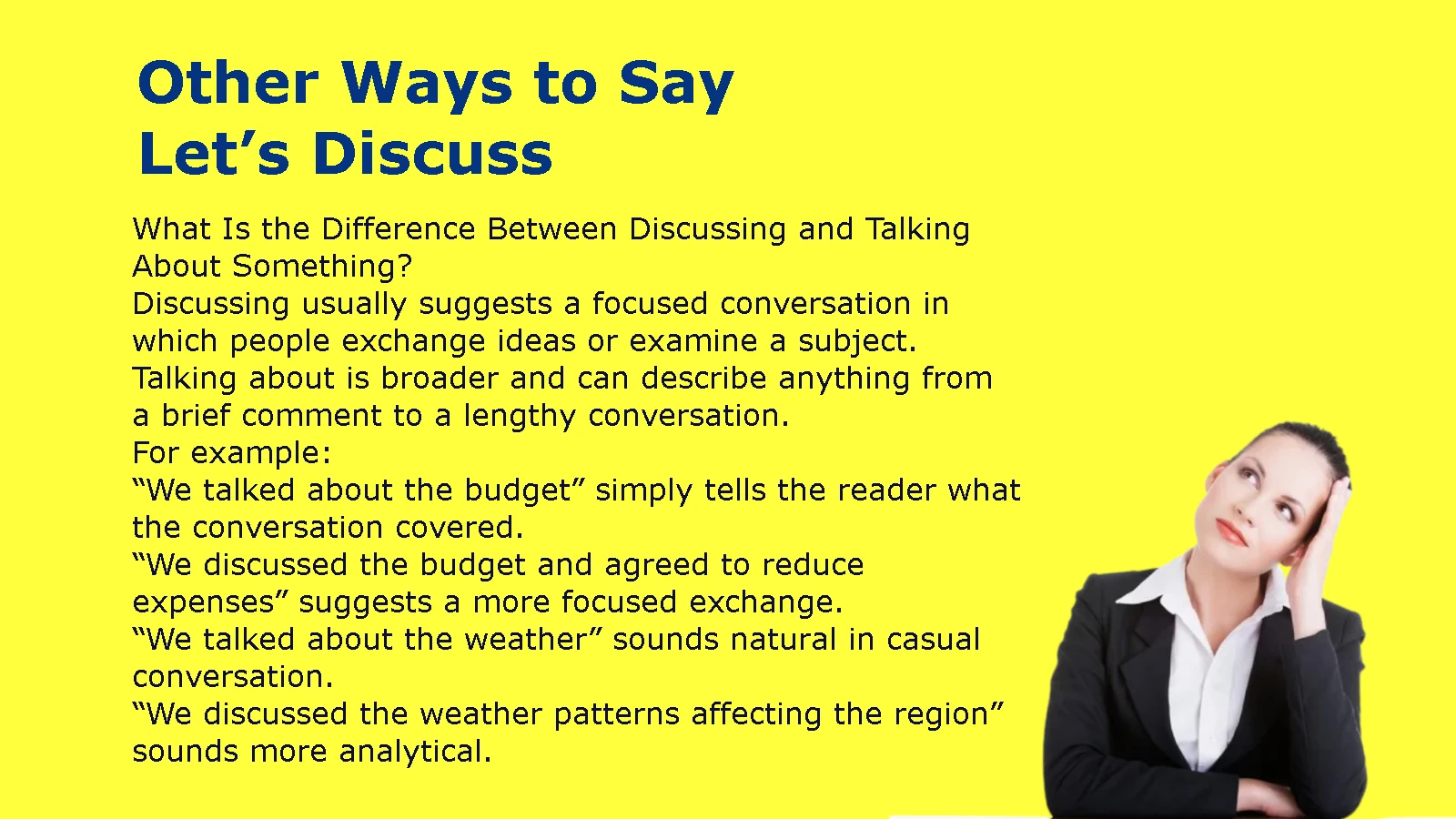
What Is the Difference Between Discussing and Talking About Something?
Discussing usually suggests a focused conversation in which people exchange ideas or examine a subject. Talking about is broader and can describe anything from a brief comment to a lengthy conversation.
For example:
- “We talked about the budget” simply tells the reader what the conversation covered.
- “We discussed the budget and agreed to reduce expenses” suggests a more focused exchange.
- “We talked about the weather” sounds natural in casual conversation.
- “We discussed the weather patterns affecting the region” sounds more analytical.
Neither expression is always better. Choose “discuss” when you want to emphasize a subject for consideration and “talk about” when you want a natural, flexible expression.
Other Ways to Say Let’s Discuss in Professional Settings
Professional alternatives to “let’s discuss” help you communicate clearly without sounding demanding. The best expressions invite collaboration, establish a purpose, and make the next step obvious.
Formal Alternatives to “Let’s Discuss”
Use formal alternatives when writing to clients, senior colleagues, business partners, or people you don’t know well.
| Alternative | Example sentence | Best use |
| Let us examine | Let us examine the results before making a decision. | Formal analysis |
| Let us consider | Let us consider the available options. | Evaluating possibilities |
| I would like to address | I would like to address the concerns raised in your report. | Raising an issue |
| Let us review | Let us review the contract before signing. | Checking details |
| May we explore | May we explore a few alternatives to the current plan? | Polite collaboration |
| I would welcome a discussion | I would welcome a discussion about the proposed changes. | Formal correspondence |
“I would like to address” works particularly well when you need to raise a specific issue. By contrast, “Let us consider” is useful when you want people to weigh different possibilities before reaching a decision.
For example, instead of writing, “Let’s discuss the contract,” you could write, “I would appreciate the opportunity to review the contract terms with you.”
The second version sounds more considerate and identifies a clear purpose.
Professional Alternatives for Emails and Meetings
Workplace communication benefits from expressions that explain what needs attention.
Consider these options:
- Let’s go over this: Use it when reviewing information, documents, or instructions.
- I’d like to talk through this: Choose it when a topic requires explanation or collaborative problem-solving.
- Let’s review the details: Use it before approving a proposal or finalizing a plan.
- Let’s arrange a discussion: Choose it when you need to schedule a conversation.
- I’d appreciate your thoughts on this: Use it when requesting feedback or another perspective.
- Let’s align on the next steps: Choose it when a team needs agreement about responsibilities or deadlines.
- Let’s evaluate the proposal: Use it when assessing the strengths, weaknesses, and feasibility of an idea.
Here’s how these phrases work in context:
Instead of writing:
“Let’s discuss the report tomorrow.”
You could write:
“Let’s review the report tomorrow and identify any changes needed before submission.”
The revised sentence tells the reader what the conversation should accomplish.
Polite Ways to Suggest a Discussion
Sometimes the phrase itself matters less than how you make the request. Polite alternatives help you invite participation without assuming the other person is available.
Examples include:
- “Could we discuss this further?”
- “Would you be available to talk about this?”
- “I’d welcome the opportunity to discuss this.”
- “Could we set aside some time to review this?”
- “Would you mind sharing your thoughts on this topic?”
- “Could we schedule a brief conversation to clarify the details?”
Use a question when you need the other person’s agreement or availability. Use a direct statement when you’re setting an agenda for a meeting that participants have already agreed to attend.
For example, “Could we schedule a time to review the proposal?” works well in an email to a client. “Let’s review the proposal during Thursday’s meeting” works better when the meeting is already scheduled.
Examples of Professional Alternatives in Sentences
Here are more ways to replace “let’s discuss” in everyday business communication.
| Original sentence | Improved alternative | Why it works |
| Let’s discuss the deadline. | Let’s review the deadline and confirm the delivery date. | Clarifies the objective |
| Let’s discuss your concerns. | I’d like to understand your concerns and explore possible solutions. | Sounds collaborative |
| Let’s discuss the budget. | Let’s evaluate the budget and identify areas for adjustment. | Focuses on analysis |
| Let’s discuss the proposal. | Could we schedule time to review the proposal together? | Makes a polite request |
| Let’s discuss the next steps. | Let’s align on responsibilities and next steps. | Emphasizes coordination |
The key is to select a phrase that reflects the conversation you actually need. A vague invitation can lead to an unfocused meeting, while a specific one helps participants prepare.
Casual and Friendly Alternatives to “Let’s Discuss”
Casual alternatives sound more natural when speaking with friends, family members, classmates, or colleagues you know well. They make a conversation feel less like a formal meeting.
Everyday Alternatives
These expressions work in ordinary conversations:
- Let’s talk about it. A straightforward alternative that fits most situations.
- Let’s chat about this. A relaxed way to suggest a conversation.
- Let’s talk it over. Useful when you want to consider a decision together.
- Let’s get into it. A lively way to begin discussing a topic.
- Let’s hash it out. Appropriate when people need to work through a disagreement.
- Let’s go through it. Useful when explaining steps or reviewing details.
- Let’s think this through. Best when a decision requires careful consideration.
The expressions have slightly different meanings. “Let’s chat about this” suggests a relaxed exchange, while “Let’s think this through” signals that the subject deserves careful thought.
“Let’s hash it out” can sound forceful, so avoid it when you want to keep a sensitive conversation calm.
Friendly Ways to Start a Conversation
If you want to invite another person to share an opinion, try one of these expressions:
- “What do you think about this?”
- “Want to talk it through?”
- “Let’s figure this out together.”
- “I’d love to hear your take on this.”
- “Can we talk about what happened?”
- “Let’s hear each other out.”
- “How about we sit down and talk?”
- “Can we bounce a few ideas around?”
Each phrase serves a different purpose. “I’d love to hear your take on this” emphasizes the other person’s perspective. “Let’s figure this out together” communicates teamwork. “Let’s hear each other out” is especially useful when both people have different opinions.
Examples for Conversations With Friends and Colleagues
Imagine that you and a friend disagree about where to travel.
Instead of saying, “Let’s discuss our vacation plans,” you might say, “Let’s talk it over and figure out what works for both of us.”
If a colleague seems uncertain about an assignment, try, “Want to talk it through?” This feels less formal than asking them to attend a discussion.
For a group brainstorming session, “Let’s bounce some ideas around” encourages people to contribute without worrying that every suggestion must be perfect.
Choose casual language based on your relationship, not just the setting. Coworkers who collaborate every day may prefer relaxed wording, while a first conversation with a new client may call for a more polished expression.
Other Ways to Say “Let’s Discuss” Based on Your Purpose
The most useful alternative depends on what you want the conversation to achieve. Instead of choosing a synonym at random, start with your goal: introduce a topic, clarify information, analyze a problem, find a solution, or reach a decision.
When You Want to Introduce a New Topic
Use these expressions when bringing an issue into a conversation or meeting:
- “Let’s talk about…”
- “I’d like to bring up…”
- “Let’s address…”
- “Let’s turn our attention to…”
- “I’d like to raise the topic of…”
- “Can we take a moment to consider…?”
Example: “I’d like to bring up our customer feedback before we finalize the product design.”
This phrasing introduces a topic without implying that anyone has made a mistake.
Use “address” when the issue needs attention. Choose “turn our attention to” when moving from one agenda item to another.
When You Want to Explain or Clarify Something
If your main goal is to make information easier to understand, choose an expression that signals explanation rather than general discussion.
- “Let’s go through this.”
- “Let me explain.”
- “Let’s break this down.”
- “Let’s clarify the details.”
- “Let’s walk through the process.”
- “Let’s look at what this means.”
Example: “Let’s walk through the registration process so everyone understands the requirements.”
“Let’s break this down” works well when a topic seems complicated. “Let’s clarify the details” is useful when people have different interpretations of the same information.
Keep in mind that explaining something doesn’t always require a two-way conversation. If you want feedback or questions, add an invitation such as, “Let me explain the process, and then we can discuss any concerns.”
When You Want to Review or Analyze an Issue
Choose analytical expressions when you need to examine evidence, compare options, or understand why something happened.
- “Let’s examine…”
- “Let’s evaluate…”
- “Let’s take a closer look at…”
- “Let’s weigh the options.”
- “Let’s analyze the results.”
- “Let’s assess the situation.”
Example: “Let’s analyze the campaign results before deciding where to invest next month’s budget.”
These expressions communicate more than a general invitation to talk. They establish that the conversation should involve careful thought or evaluation.
Use “evaluate” when comparing performance or quality. Choose “assess” when judging a situation, risk, or set of conditions.
When You Want to Solve a Problem
Problem-solving phrases help people focus on solutions rather than blame.
Useful alternatives include:
- “Let’s work through this.”
- “Let’s find a solution.”
- “Let’s figure out the next steps.”
- “Let’s tackle this together.”
- “Let’s identify what went wrong.”
- “Let’s explore our options.”
- “Let’s determine how to move forward.”
Example: “Let’s identify what caused the delay and determine how we can prevent it next time.”
This sentence separates the cause of the problem from the plan for addressing it. That distinction can help keep workplace conversations productive.
When emotions are high, avoid phrases that sound confrontational. “Let’s work through this together” usually feels more cooperative than “Let’s hash this out.”
When You Want to Make a Decision
Use decision-focused phrases when a conversation should end with a choice or agreed action.
- “Let’s consider our options.”
- “Let’s talk through the possibilities.”
- “Let’s reach an agreement.”
- “Let’s decide how to proceed.”
- “Let’s settle on a plan.”
- “Let’s agree on the next steps.”
- “Let’s determine the best course of action.”
Example: “Let’s compare the costs and benefits, then decide how to proceed.”
This wording establishes a sequence: review the options, compare them, and make a decision.
Avoid saying “Let’s reach an agreement” if participants still need time to explore the issue. “Let’s consider our options” leaves more room for discussion before anyone commits.
When You Want to Continue a Previous Conversation
Sometimes you don’t need to introduce a new subject. You need to return to something that remains unresolved.
Try these expressions:
- “Let’s revisit this.”
- “Let’s pick up where we left off.”
- “Let’s discuss this further.”
- “Let’s follow up on our earlier conversation.”
- “Let’s return to the original point.”
- “Let’s review what we agreed on.”
- “Let’s build on our previous discussion.”
Example: “Let’s revisit the launch timeline now that we have the updated supplier estimates.”
“Revisit” suggests returning to a topic with new information or another perspective. “Pick up where we left off” sounds more conversational and works when participants already share the background.
Best Alternatives to “Let’s Discuss” for Emails
Emails benefit from specific, courteous language. A strong opening tells the recipient why you want to communicate and what you expect to accomplish.
Alternatives for Starting a Work Email
Instead of opening with “Let’s discuss,” choose an expression that matches the message’s purpose.
To introduce a topic:
“ I’d like to discuss the proposed changes to our schedule.”
To request feedback:
“I’d appreciate your thoughts on the revised proposal.”
To review details:
“Could we review the project requirements before moving forward?”
To raise a concern:
“I’d like to discuss a concern regarding the current timeline.”
To suggest collaboration:
“I’d welcome the opportunity to explore this idea with you.”
These openings sound more purposeful because they identify the subject or explain why the conversation matters.
Alternatives for Requesting a Meeting
When you need to arrange a conversation, make the request clear and easy to answer.
Examples include:
- “Would you be available for a brief meeting to review the proposal?”
- “Could we schedule some time to go over the project details?”
- “I’d like to arrange a meeting to discuss the next steps.”
- “Would Thursday work for a conversation about the revised plan?”
- “Could we set up a call to clarify a few points?”
Whenever possible, provide a suggested date or time. A specific request reduces unnecessary back-and-forth messages.
For example, “Could we schedule some time to discuss this?” is polite but open-ended. “Would Thursday at 2 p.m. work for a 15-minute review?” gives the recipient a concrete option.
Alternatives for Following Up on an Unresolved Topic
Use follow-up phrases when an earlier conversation did not produce a final decision.
- “I’d like to follow up on our earlier conversation.”
- “Could we revisit the outstanding questions?”
- “I wanted to check in about the proposal we discussed.”
- “Can we review the remaining action items?”
- “I’d appreciate an update on the points we raised.”
For example:
“Hi Jordan, I’d like to follow up on our earlier conversation about the website redesign. Could we review the outstanding items and agree on a timeline?”
This message reminds the recipient of the context and identifies the next step without sounding impatient.
Alternatives for Discussing a Sensitive Issue
Sensitive topics require language that encourages understanding rather than defensiveness.
Consider these phrases:
- “I’d like to talk through a concern with you.”
- “Could we find a time to discuss something important?”
- “I’d appreciate the chance to understand your perspective.”
- “Can we work together to resolve this?”
- “I’d like to clarify a few things before we move forward.”
Avoid unnecessarily aggressive wording such as “We need to settle this now” unless the urgency genuinely calls for it.
Practical example: If a coworker misses a deadline, saying “I’d like to understand what affected the timeline and discuss how we can avoid similar delays” opens the door to problem-solving. It focuses on the situation and next steps instead of attacking the person.
“Let’s Discuss” vs. Similar Expressions
Several phrases look interchangeable but communicate different intentions. Understanding these differences helps you choose wording that fits the situation.
Let’s Discuss vs. Let’s Talk About
“Let’s talk about” is more conversational and works in nearly any everyday situation.
- Discuss: “Let’s discuss the proposed changes at tomorrow’s meeting.”
- Talk about: “Let’s talk about the proposed changes when you have a minute.”
Choose “discuss” when you want to emphasize a subject for consideration. Choose “talk about” when a relaxed tone feels more natural.
Let’s Discuss vs. Let’s Go Over
“Let’s discuss” can involve a wider exchange of opinions and ideas.
For example:
- “Let’s go over the application requirements before submitting the form.”
- “Let’s discuss whether the application process needs to change.”
The first sentence suggests checking details. The second invites a broader conversation about a possible improvement.
Let’s Discuss vs. Let’s Explore
“Let’s explore” suggests investigating an idea or considering possibilities, often before making a decision.
For example:
“Let’s explore different ways to reach new customers.”
Sec: Let’s Debate vs. Let’s Discuss
“Let’s debate” signals an exchange of opposing arguments.
Compare these sentences:
- “Let’s discuss the proposed policy and hear everyone’s concerns.”
- “Let’s debate whether the proposed policy will improve productivity.”
The first invites a general exchange of ideas. The second explicitly frames the conversation around competing positions.
Use “debate” when examining arguments from different sides. For a cooperative conversation, “discuss” or “talk through” may work better.
Let’s Discuss vs. Let’s Explain
“Discuss” focuses on talking about a subject, while “explain” focuses on making information clear.
For example:
- “Let’s discuss the new attendance policy.”
- “Let me explain how the new attendance policy works.”
The first invites an exchange of views. The second indicates that someone will provide an explanation.
If you need to explain something and then invite feedback, combine the two: “Let me explain the changes, and then we can discuss your questions.”
Let’s Discuss vs. Let’s Address
“Let’s address” means dealing with a particular issue, concern, or task. It often communicates that something requires attention.
For example:
“Let’s address the delivery delays before reviewing the next quarter’s goals.”
This phrase works well when a problem needs action. However, it can sound more direct than “let’s discuss,” especially if the topic involves criticism or an unresolved concern.
Another Word for Discussing: Useful Synonyms
The best synonym for discussing depends on whether you mean exchanging ideas, reviewing information, analyzing a problem, or working toward a solution.
Synonyms for Discussing Ideas
Use these words when people share perspectives or consider possibilities.
| Synonym | Meaning or emphasis | Example |
| Talking about | General conversation | We were talking about our summer plans. |
| Exploring | Considering possibilities | The team is exploring new product ideas. |
| Examining | Looking closely at a subject | The researchers are examining the evidence. |
| Considering | Thinking about an option | We are considering a different approach. |
| Deliberating | Carefully weighing choices | The committee is deliberating on the proposal. |
| Brainstorming | Generating ideas | We are brainstorming ways to improve service. |
These terms are related, but they are not identical. “Brainstorming” emphasizes generating ideas, while “deliberating” emphasizes careful consideration before a decision.
Synonyms for Discussing Problems
When a conversation centers on a difficulty, choose words that describe the action you want to take.
- Addressing: Dealing with an issue that needs attention.
- Tackling: Making an active effort to solve a problem.
- Working through: Handling a difficult situation step by step.
- Resolving: Finding a solution or settling a disagreement.
- Reviewing: Examining an issue or its details.
- Investigating: Trying to discover the cause or facts behind a problem.
Examples:
“The team is investigating the cause of the system failure.”
“We are working through the remaining issues with the supplier.”
“The manager is addressing concerns about the new schedule.”
Choose the word that accurately describes the activity. A team can discuss a problem without resolving it, so “resolving” is not always a direct substitute for “discussing.”
Synonyms for Discussing Something in Detail
When you need to communicate depth or careful examination, consider these alternatives:
- Analyzing: Examining information to understand patterns or relationships.
- Elaborating on: Adding detail to an existing explanation or point.
- Examining closely: Studying a subject carefully.
- Going over: Reviewing information, often step by step.
- Talking through: Explaining or considering something together.
- Reviewing in depth: Examining a subject thoroughly.
For example, “We discussed the survey results” provides a general description. “We analyzed the survey results to identify customer preferences” tells readers what the conversation involved.
How to Choose the Right Synonym for “Discussing”
Use this quick guide:
- Choose exploring when considering new possibilities.
- Choose reviewing when checking existing information.
- Choose analyzing when studying evidence or results.
- Choose clarifying when removing confusion.
- Choose deliberating when carefully weighing a decision.
- Choose resolving when settling an issue.
- Choose brainstorming when generating ideas.
A useful rule is to replace the general verb “discuss” with a more specific verb whenever it makes the purpose clearer.
Other Words for Explain and Related Expressions
Although “discuss” and “explain” often appear in similar sentences, they serve different purposes. The right word depends on whether you want to exchange ideas or make information understandable.
Synonyms for Explain
Common synonyms for explain include:
| Word | How it differs from explain | Example |
| Clarify | Removes confusion | Could you clarify the deadline? |
| Describe | Tells what something is like | She described the new process. |
| Illustrate | Makes a point clearer through an example | Let me illustrate the concept with a diagram. |
| Demonstrate | Shows how something works | The trainer demonstrated the software. |
| Elaborate | Adds more information | Could you elaborate on your recommendation? |
| Interpret | Explains the meaning of something | The analyst interpreted the results. |
| Define | States the meaning of a term | The instructor defined the key concept. |
Not every synonym works in every context. You might clarify an unclear instruction, demonstrate a technique, or define a technical term. Replacing each of these verbs with “explain” can remove useful distinctions.
Phrases That Mean “Explain in More Detail”
When a person needs more information, these expressions can sound natural and precise:
- “Could you elaborate on that?”
- “Could you walk me through the process?”
- “Can you clarify what you mean?”
- “Could you provide some additional context?”
- “Let’s break this down step by step.”
- “Could you give me a concrete example?”
- “Can you expand on that point?”
For professional communication, “Could you provide some additional context?” is polite and specific. In a classroom, “Could you walk me through the process?” may be more natural.
Discuss vs. Explain: Which Word Should You Use?
Use discuss when people need to exchange ideas, opinions, or information. Use explain when the main goal is to make something understandable.
Consider a product meeting:
- “Let’s discuss the new pricing model.” This invites opinions and questions about the pricing model.
- “Let me explain the new pricing model.” This introduces an explanation of how the model works.
- “Let’s discuss the pricing model after I explain the changes.” This combines both purposes.
The distinction matters because a request to explain does not automatically invite debate, and a request to discuss does not guarantee that anyone will provide a clear explanation.
Discussed or Discuss: Correct Spelling and Grammar
Discussed is the correct past-tense and past-participle form of discuss. The base verb is “discuss,” the third-person singular form is “discusses,” and the present participle is “discussing.”
Is “Discussed” the Correct Spelling?
Yes. Discussed is the standard spelling when referring to a conversation or examination that happened in the past.
Examples:
- “We discussed the proposal yesterday.”
- “The committee has discussed the matter several times.”
- “They discussed the budget before approving the project.”
A common spelling mistake is writing “discused” with only one s in the middle. The correct forms preserve the double s in the base verb: discuss, discusses, discussed, and discussing.
Discuss, Discusses, Discussed, and Discussing
| Verb form | Grammatical use | Example |
| Discuss | Base form; present with I, you, we, and they | We discuss priorities every Monday. |
| Discusses | Simple present with he, she, or it | She discusses the results with her team. |
| Discussed | Simple past or past participle | They discussed the changes yesterday. |
| Discussing | Present participle or gerund | We are discussing the proposal now. |
Remember subject-verb agreement. Write “She discusses the plan,” not “She discuss the plan.”
The same principle applies in longer sentences:
- “The manager discusses the results with the team.”
- “The managers discuss the results with the team.”
The verb changes to match the subject.
Common Grammar Mistakes With “Discuss”
One frequent mistake is adding an unnecessary preposition after “discuss.”
Incorrect: “We discussed about the new policy.”
Correct: “We discussed the new policy.”
The verb “discuss” normally takes a direct object, so you can place the topic directly after it.
Other examples:
- Incorrect: “They discussed about the budget.”
- Correct: “They discussed the budget.”
- Incorrect: “We need to discuss about this issue.”
- Correct: “We need to discuss this issue.”
However, the phrase “talk about” does require “about” in the usual construction.
Correct: “We talked about the budget.”
This difference explains why “discuss about” is usually incorrect even though “talk about” is perfectly natural.
Why “Discuss About” Is Usually Incorrect
The word “discuss” already expresses the idea of talking about a subject. Adding “about” before the object is generally unnecessary.
Compare:
- “We discussed the results.”
- “We talked about the results.”
Both sentences are correct, but they use different verb constructions.
You can also say “have a discussion about the results” because the noun “discussion” commonly takes “about.” The grammatical pattern changes when you use the noun rather than the verb.
How to Say “Discuss” in Other Languages
The best translation of “discuss” depends on the language, context, and intended tone. A word that works in a formal meeting may sound unnatural in an everyday conversation.
Discuss in Tagalog
In Tagalog, talakayin and pag-usapan are common equivalents of “discuss,” although their usage differs by context.
- Talakayin: To discuss or examine a topic, often in a formal, academic, or structured setting.
- Pag-usapan: To talk about or discuss something in a more general or conversational way.
Examples:
- “Let’s discuss the lesson.” — “Talakayin natin ang aralin.”
- “Let’s talk about it.” — “Pag-usapan natin ito.”
- “We need to discuss the problem.” — “Kailangan nating pag-usapan ang problema.”
The best choice depends on the situation. “Talakayin” fits a classroom presentation or formal agenda, while “pag-usapan” often sounds natural when inviting someone to talk about an issue.
Discuss in Spanish
In Spanish, discutir, hablar de, and tratar can express related meanings.
- Discutir: To discuss or debate; depending on context, it can also suggest arguing.
- Hablar de: To talk about a subject.
- Tratar: To address, cover, or deal with a topic.
Examples:
- “Let’s discuss the problem.” — “Hablemos del problema.”
- “Let’s talk about the project.” — “Hablemos del proyecto.”
- “We will discuss this topic tomorrow.” — “Trataremos este tema mañana.”
The phrase “Hablemos del problema” is often a natural way to invite a conversation. “Discutamos el problema” can also be appropriate, but the surrounding context matters because “discutir” can carry a more argumentative meaning.
How Context Changes the Translation of “Discuss”
Translations rarely work as simple word-for-word replacements in every situation.
For example, a teacher asking students to examine a topic may choose a formal equivalent of “discuss.” Two friends talking about weekend plans may use a more conversational phrase.
Before translating, identify the purpose:
- Academic discussion: Choose wording suitable for structured analysis.
- Friendly conversation: Use a natural expression for talking about a subject.
- Problem-solving: Choose a phrase that emphasizes finding a solution.
- Debate: Use wording that signals opposing views when that is the intended meaning.
Translating the whole sentence usually produces a more natural result than replacing one English word without considering the context.
Discuss vs. Disgust: Meaning and Spelling Differences
They are different words with different meanings. “Discuss” means to talk about a topic, while “disgust” refers to a strong feeling of revulsion or intense dislike.
What Does “Discuss” Mean?
To discuss means to talk about a subject, often by sharing information, asking questions, or considering different opinions.
Examples:
- “We discussed the new schedule.”
- “The students discussed the book.”
- “Let’s discuss the available options.”
The word is neutral. A discussion can be friendly, serious, analytical, or argumentative depending on the circumstances.
What Does “Disgust” Mean?
Disgust describes a strong feeling of revulsion or aversion toward something considered unpleasant, offensive, or repulsive. It can also function as a verb meaning to cause that feeling.
Examples:
- “The smell filled him with disgust.”
- “The dishonest behavior disgusted the audience.”
- “She expressed disgust at the unfair treatment.”
Unlike “discuss,” the word “disgust” expresses an emotional reaction rather than a conversation.
Synonyms for Disgust
The most suitable synonym depends on the intensity and context of the feeling.
| Synonym | Meaning or emphasis | Example |
| Revulsion | A strong feeling of repulsion | He felt revulsion at the cruelty. |
| Repugnance | Intense dislike or aversion | She felt repugnance toward the practice. |
| Aversion | A strong dislike or reluctance | He has an aversion to dishonesty. |
| Loathing | Deep hatred or intense dislike | She spoke with loathing about the abuse. |
| Abhorrence | Strong moral or emotional hatred | They expressed abhorrence of the violence. |
| Nausea | A sick feeling, sometimes associated with disgust | The spoiled food made him feel nauseated. |
These words are not perfect substitutes in every sentence. “Aversion” can describe a general dislike, while “loathing” and “abhorrence” usually convey stronger feelings.
Discuss vs. Disgust: Examples and Common Spelling Mistakes
| Word | Part of speech | Meaning | Example |
| Discuss | Verb | Talk about a subject | Let’s discuss the results. |
| Discussed | Verb form | Talked about something in the past | We discussed the results. |
| Discussion | Noun | A conversation about a subject | The discussion lasted an hour. |
| Disgust | Noun or verb | Strong revulsion; to cause revulsion | The behavior disgusted the audience. |
| Disgusted | Adjective or verb form | Feeling or causing disgust | She was disgusted by the dishonesty. |
To avoid confusion, remember that “discuss” relates to communication, while “disgust” relates to a feeling of revulsion.
How to Choose the Best Alternative to “Let’s Discuss”
The best phrase makes your purpose clear and suits the person you’re speaking to. You don’t need the most sophisticated synonym. You need the expression that accurately communicates what should happen next.
Consider Your Audience
Think about your relationship with the recipient before choosing a phrase.
- Client or senior colleague: “I’d welcome the opportunity to discuss this further.”
- Close coworker: “Let’s talk this through.”
- Friend: “Let’s chat about it.”
- Academic audience: “Let’s examine the evidence.”
- Project team: “Let’s align on the next steps.”
These are flexible suggestions, not rigid rules. Some workplaces favor conversational language, while others expect formal communication.
Match the Phrase to Your Goal
Start by asking what you want to accomplish.
If you want to share ideas, choose “let’s explore this.” If you need to review information, use “let’s go over the details.” When you want to resolve a disagreement, “let’s work through this together” may encourage a more constructive conversation.
A specific verb also helps participants prepare. “Let’s review the budget and identify unnecessary expenses” gives people a clearer task than “Let’s discuss the budget.”
Choose the Right Level of Formality
The same message can sound different depending on the wording.
| Situation | Recommended expression | Reason |
| Formal email | Could we schedule a time to discuss this? | Polite and professional |
| Team meeting | Let’s review the next steps. | Clear and action-oriented |
| Casual conversation | Let’s talk about it. | Natural and relaxed |
| Brainstorming session | Let’s explore a few ideas. | Encourages possibilities |
| Difficult conversation | Let’s work through this together. | Emphasizes cooperation |
| Decision-making | Let’s weigh the options. | Encourages comparison |
| Clarifying instructions | Let’s go through this step by step. | Focuses on understanding |
Avoid Phrases That Sound Too Aggressive or Vague
Some alternatives can unintentionally change the tone of your message.
For example, “We need to settle this” may sound confrontational. “Let’s hash it out” can imply disagreement. “Let’s talk sometime” sounds friendly but doesn’t establish a clear next step.
Choose language that matches your intention. If a topic is sensitive, explain your purpose before inviting a discussion.
Instead of saying, “We need to talk,” try, “Could we set aside a few minutes to talk about the project timeline? I’d like to understand the current challenges and agree on next steps.”
The second version gives the recipient useful context and reduces the chance of misunderstanding.
A Practical Example: Choosing the Right Phrase
Imagine that a project manager needs to address a delay in a product launch. The team has limited time, and several departments need to coordinate their work.
Here are three possible approaches:
Too vague: “Let’s discuss the delay.”
The team knows the subject but doesn’t know what the meeting should accomplish.
Too confrontational: “We need to hash out who caused the delay.”
This wording focuses on blame and may discourage people from sharing useful information.
Clear and collaborative: “Let’s review the causes of the delay, identify the remaining obstacles, and agree on a revised timeline.”
The final version gives the meeting a practical direction. It encourages the team to investigate the problem and decide what to do next.
This example illustrates a useful writing principle: the strongest alternative to “let’s discuss” often describes the action you want people to take.
Frequently Asked Questions
What Is Another Way to Say “Let’s Discuss”?
You can say “let’s talk about it,” “let’s go over this,” “let’s explore the topic,” “let’s review the details,” or “let’s talk it through.” Choose a phrase based on your goal. “Let’s explore” suits brainstorming, while “let’s review” works well when checking information.
What Is a More Professional Way to Say “Let’s Discuss”?
Professional alternatives include “Could we discuss this further?” “I’d welcome the opportunity to discuss this,” “Let’s review the details,” and “Could we schedule a time to discuss this?” For the clearest result, mention the subject or desired outcome.
What Is Another Word for Discussing?
Common synonyms for discussing include talking about, examining, reviewing, exploring, considering, analyzing, and deliberating. “Exploring” suggests considering possibilities, while “analyzing” emphasizes careful examination and “deliberating” focuses on weighing a decision.
Is It Correct to Say “Let’s Discuss About It”?
No. In standard English, write “Let’s discuss it” because “discuss” normally takes a direct object. However, “Let’s talk about it” is correct because “talk” commonly uses the preposition “about” to introduce a subject.
What Is the Difference Between Discuss and Explain?
Discuss means to talk about a subject, often by exchanging ideas or opinions. Explain means to make something clear or understandable. For example, you can explain how a process works and then discuss whether the process needs improvement.
How Do You Say “Discuss” in Tagalog and Spanish?
In Tagalog, common equivalents include talakayin and pag-usapan. In Spanish, you can use discutir, hablar de, or tratar, depending on context. “Hablar de” often works naturally for talking about a topic, while “discutir” can sometimes suggest an argument.
Conclusion
Finding the right alternative to “let’s discuss” can make your writing clearer, more natural, and more effective. Professional phrases such as “Could we discuss this further?” work well in emails, while “Let’s talk it over” suits casual conversations. When you need a more specific expression, choose “let’s review,” “let’s explore,” “let’s analyze,” or “let’s work through this together.”
The most effective choice depends on what you want to accomplish. Consider your audience, match your wording to the purpose, and avoid expressions that sound too formal, vague, or confrontational for the situation.