Other ways to say nice to meet you include pleased to meet you, lovely to meet you, delighted to meet you, great to connect with you, and it’s a pleasure meeting you. These expressions help you sound more natural, friendly, or professional when introducing yourself to someone for the first time.
The best alternative depends on the situation. You might use a formal greeting during a business meeting, a warm expression when meeting a friend, or a short phrase when chatting online. Knowing how to respond to nice to meet you, write it in an email, and use alternatives such as it was nice meeting you can also make your communication more effective.
| Question | Answer |
| What are other ways to say nice to meet you? | Pleased to meet you, lovely to meet you, glad to meet you, and delighted to meet you. |
| What is a formal alternative to nice to meet you? | It’s a pleasure to meet you or delighted to make your acquaintance. |
| How do you reply to nice to meet you? | You can say likewise, the pleasure is mine, or nice to meet you too. |
| What is the short form of nice to meet you? | NTMY is an informal abbreviation used in online chats. |
| How do you say nice to meet you in an email? | Use expressions such as it’s a pleasure to connect with you or I’m pleased to meet you. |
What Does Nice to Meet You Mean?
Nice to meet you is a polite expression people use when they meet someone for the first time. It communicates friendliness, respect, and a positive attitude toward the introduction. People commonly use it in professional meetings, social gatherings, interviews, online introductions, and everyday conversations.
The expression also helps establish a friendly atmosphere. Rather than simply exchanging names, you acknowledge the other person and show that you appreciate the introduction.
For example:
- “Hi, I’m Daniel. Nice to meet you!”
- “Nice to meet you, Sarah. I’ve heard great things about your work.”
- “It’s nice to meet you in person after our email conversations.”
When Do People Say Nice to Meet You?
People generally say nice to meet you when they encounter someone for the first time. The expression works in both formal and informal situations, making it one of the most versatile English greetings.
Here are some common situations:
- Business meetings: You can greet a new client, business partner, manager, or colleague.
- Job interviews: It creates a polite first impression when meeting an interviewer.
- Social gatherings: You can use it when a friend introduces you to someone new.
- Networking events: It helps establish a friendly connection with professionals.
- Online meetings: You can say it during your first video call with a new contact.
- Email introductions: You can use a written variation when someone introduces you through email.
The timing matters. Use nice to meet you when you first encounter someone. After spending time together, expressions such as “It was nice meeting you” sound more natural.
Is Nice to Meet You Formal or Informal?
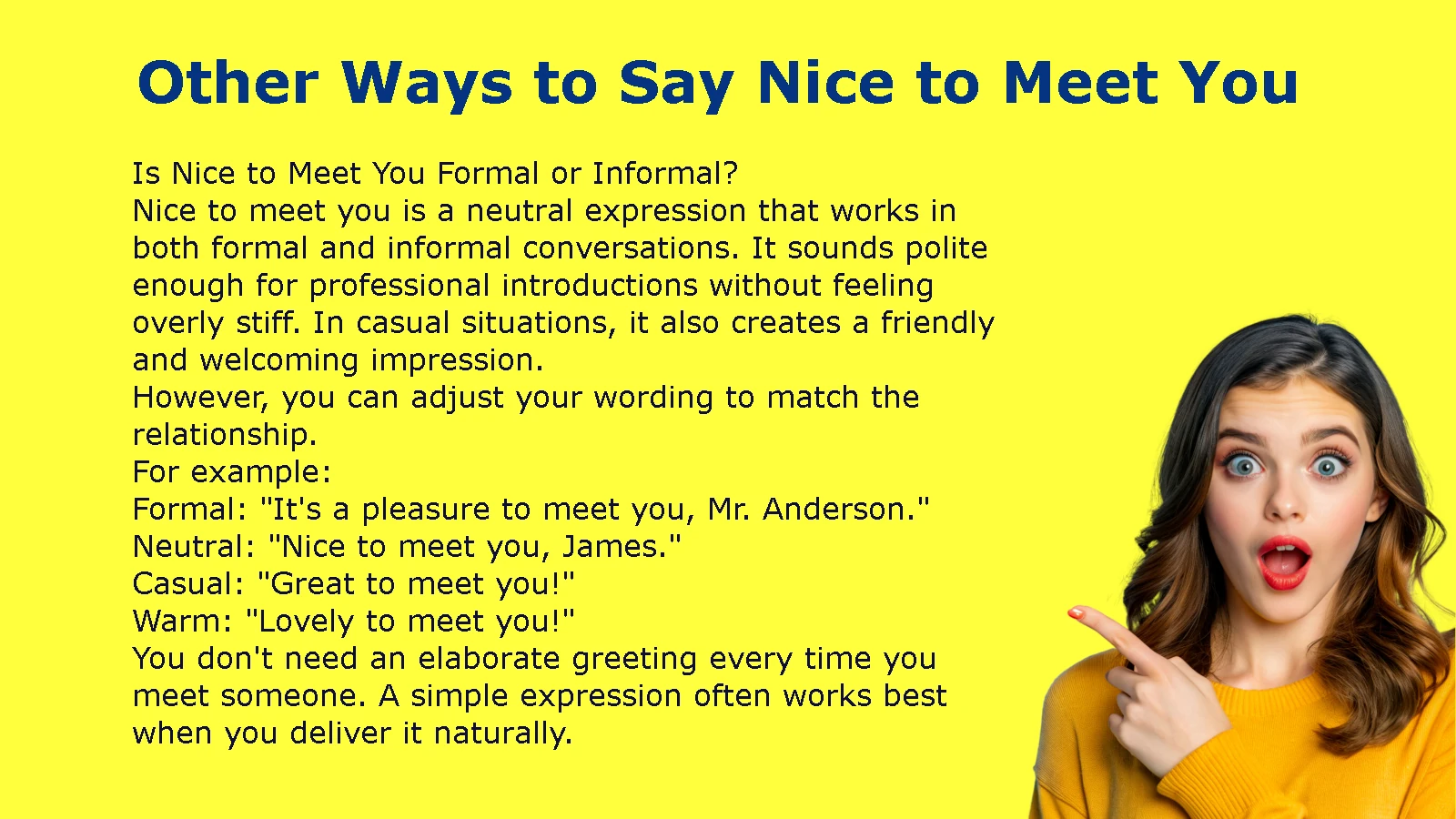
Nice to meet you is a neutral expression that works in both formal and informal conversations. It sounds polite enough for professional introductions without feeling overly stiff. In casual situations, it also creates a friendly and welcoming impression.
However, you can adjust your wording to match the relationship.
For example:
- Formal: “It’s a pleasure to meet you, Mr. Anderson.”
- Neutral: “Nice to meet you, James.”
- Casual: “Great to meet you!”
- Warm: “Lovely to meet you!”
You don’t need an elaborate greeting every time you meet someone. A simple expression often works best when you deliver it naturally.
15 Other Ways to Say Nice to Meet You
If you want to avoid repeating the same greeting, several alternatives can help you communicate the same feeling with a different tone. Some sound more professional, while others express warmth, excitement, or familiarity.
Here are 15 useful ways to say nice to meet you, along with their meanings and original examples.
Formal and Professional Alternatives
These expressions work particularly well in business introductions, interviews, conferences, and professional correspondence.
Pleased to Meet You
Pleased to meet you is a polite and professional alternative to nice to meet you. It communicates genuine satisfaction about meeting someone and works well in formal introductions.
You can use it when meeting a manager, client, interviewer, colleague, or business associate.
Examples:
- “I’m pleased to meet you, Mr. Carter. I’ve been looking forward to our conversation.”
- “Pleased to meet you, Jennifer. Thank you for taking the time to speak with me.”
- “It’s a pleasure to finally meet you. I’ve heard excellent things about your team.”
This expression sounds slightly more polished than the everyday greeting, but it doesn’t feel excessively formal.
It’s a Pleasure to Meet You
Use it when meeting clients, senior colleagues, business partners, or people you haven’t interacted with before.
Examples:
- “It’s a pleasure to meet you, Mr. Wilson. Thank you for inviting me.”
- “It’s a pleasure to meet you. I’ve been looking forward to discussing this project.”
- “It’s truly a pleasure to meet you in person after our previous conversations.”
You can also shorten the expression to the pleasure is mine when someone uses a similar greeting first.
Delighted to Make Your Acquaintance
Delighted to make your acquaintance is a formal alternative that expresses happiness about meeting someone. It has a traditional, polished tone and suits formal introductions or situations that require extra courtesy.
Examples:
- “I’m delighted to make your acquaintance, Professor Williams.”
- “It was wonderful speaking with you. I’m delighted to make your acquaintance.”
- “We’re delighted to make your acquaintance and look forward to working together.”
This phrase can sound old-fashioned in everyday conversation. Use it when its formal tone fits the setting.
Happy to Make Your Acquaintance
Happy to make your acquaintance is another courteous way to acknowledge a new introduction. It expresses friendliness while maintaining a respectful tone.
Examples:
- “I’m happy to make your acquaintance, Mr. Bennett.”
- “It’s wonderful to meet you. I’m happy to make your acquaintance.”
- “We’re happy to make your acquaintance and appreciate the opportunity to connect.”
This expression works best in formal or semi-formal situations. For casual conversations, “Glad to meet you” usually sounds more natural.
It’s an Honor to Meet You
It’s an honor to meet you expresses special respect or admiration toward someone. Unlike ordinary greetings, it suggests that meeting the person means something significant to you.
Use it when meeting a respected professional, influential person, mentor, author, or someone whose achievements you admire.
Examples:
- “It’s an honor to meet you. I’ve followed your research for several years.”
- “It’s truly an honor to meet you, Professor. Your work has inspired my career.”
- “I’m grateful for this opportunity. It’s an honor to meet you.”
Don’t use this expression for every introduction. It carries stronger emotional weight than a standard greeting.
Friendly and Casual Alternatives
When meeting friends, acquaintances, or new colleagues, a relaxed expression can make the conversation feel more comfortable.
Great to Meet You
Great to meet you is a friendly and natural alternative to nice to meet you. It communicates enthusiasm without sounding overly formal.
You can use it during social introductions, casual business conversations, networking events, or when meeting a new colleague.
Examples:
- “Hi, I’m Alex. Great to meet you!”
- “Great to meet you, Emma. I hope we get a chance to work together.”
- “It’s great to meet you after hearing so much about your photography.”
This phrase is particularly useful because it fits many situations without requiring a change in tone.
Lovely to Meet You
Lovely to meet you expresses warmth and friendliness when meeting someone for the first time. It sounds welcoming and slightly more personal than a neutral greeting.
Examples:
- “Lovely to meet you, Sophie. Thanks for coming today.”
- “It was lovely meeting you at the conference.”
- “You’re welcome! Lovely to meet you as well.”
This expression is common in British English and also works naturally in many other English-speaking settings.
Glad to Meet You
Glad to meet you communicates happiness about meeting someone. It’s simple, friendly, and easy to use in everyday conversations.
Examples:
- “I’m glad to meet you. I’ve heard a lot about your new business.”
- “Glad to meet you, Daniel. How do you know the host?”
- “We’re glad to meet you and excited to have you on the team.”
This alternative works well when you want to sound approachable without using a lengthy greeting.
Wonderful to Meet You
Wonderful to meet you expresses genuine excitement and appreciation about an introduction. It sounds warm and enthusiastic, making it suitable for social gatherings and friendly professional encounters.
Examples:
- “It’s wonderful to meet you, Olivia. I’ve heard so much about your work.”
- “Wonderful to meet you! I hope you enjoy the event.”
- “It was wonderful meeting you and learning about your experience.”
Use this phrase when you want to make a particularly positive impression.
So Nice Meeting You
So nice meeting you is a relaxed expression that communicates appreciation after meeting someone. Although people sometimes use it during casual introductions, it works especially well when ending a conversation.
Examples:
- “It was so nice meeting you today. Let’s keep in touch!”
- “So nice meeting you at the party. I hope we meet again.”
- “Thanks for the conversation. It was so nice meeting you.”
The expression feels warmer when you add a personal detail about the conversation or shared experience.
Modern and Context-Specific Alternatives
Some introductions happen after people have already communicated online or through other channels. These alternatives acknowledge that existing connection.
Good to Finally Meet You
Good to finally meet you works when you’ve communicated with someone before but haven’t met them face-to-face. It acknowledges the previous connection while expressing happiness about meeting in person.
Examples:
- “Good to finally meet you after all those emails!”
- “It’s great to finally meet you in person. We’ve been discussing this project for months.”
- “Good to finally meet you, James. I’ve enjoyed our online conversations.”
This phrase is particularly useful for remote teams, online networking, and professional meetings.
Nice Connecting With You
Nice connecting with you is a modern expression commonly used in professional networking and digital communication. It acknowledges a new connection without sounding overly formal.
Examples:
- “Nice connecting with you on LinkedIn. I look forward to following your work.”
- “It was great connecting with you during the webinar.”
- “Nice connecting with you. Let’s stay in touch about future opportunities.”
You can use this phrase after accepting a professional connection request or meeting someone through an online event.
Great to Put a Face to the Name
Great to put a face to the name is a friendly expression used when you’ve heard about someone or communicated with them before but haven’t met them in person.
Examples:
- “Great to put a face to the name! I’ve received several of your project updates.”
- “It’s wonderful to finally meet you. Great to put a face to the name.”
- “Great to put a face to the name after all those video calls.”
This expression works especially well in workplaces where employees communicate through email or messaging platforms before meeting physically.
Happy We Got to Meet
Happy we got to meet communicates appreciation for an opportunity to meet someone. It sounds relaxed, personal, and genuine.
Examples:
- “I’m happy we got to meet today. I really enjoyed our discussion.”
- “So glad we got to meet at the event!”
- “I’m happy we finally had the chance to meet in person.”
This expression is particularly useful after a planned introduction or an unexpected meeting.
It’s Been Wonderful Getting to Know You
It’s been wonderful getting to know you expresses appreciation for the time you’ve spent interacting with someone. Unlike a standard first-meeting greeting, it usually works better after a conversation, meeting, or social interaction.
Examples:
- “It’s been wonderful getting to know you during the training program.”
- “I’ve enjoyed our conversations. It’s been wonderful getting to know you.”
- “It’s been wonderful getting to know you, and I hope we stay connected.”
Choose this phrase when you’ve had enough interaction to genuinely get to know the person.
Formal vs. Casual Ways to Say Nice to Meet You
The best alternative depends on your relationship with the person and the environment. Formal expressions communicate courtesy and professionalism, while casual alternatives create a relaxed and welcoming atmosphere.
You don’t need to sound formal in every professional situation. A friendly greeting often works perfectly when meeting colleagues or people at networking events.
Best Formal Alternatives for Professional Situations
Use these expressions when introducing yourself to someone in a workplace, business meeting, interview, or formal event.
- Pleased to meet you: A safe, professional greeting for almost any business introduction.
- It’s a pleasure to meet you: A polished expression for clients, managers, and business partners.
- Delighted to make your acquaintance: A particularly formal way to acknowledge an introduction.
- It’s an honor to meet you: Suitable when meeting someone you genuinely admire or respect.
For example, during a job interview, you might say:
“Good morning, Ms. Taylor. It’s a pleasure to meet you. Thank you for giving me the opportunity to interview.”
This sounds professional without becoming unnecessarily complicated.
Best Casual Alternatives for Everyday Conversations
For everyday introductions, choose expressions that sound natural and friendly.
- Great to meet you: A versatile casual greeting.
- Lovely to meet you: A warm and welcoming expression.
- Glad to meet you: A straightforward way to express happiness.
- Wonderful to meet you: A more enthusiastic alternative.
- Good to finally meet you: Ideal when you’ve communicated before.
For example:
“Hey, I’m Rachel. Great to meet you! How do you know everyone here?”
The question after the greeting helps the conversation continue naturally.
Formal vs. Informal Comparison Table
| Expression | Tone | Best situation |
| Pleased to meet you | Formal | Business introductions |
| It’s a pleasure to meet you | Very polite | Professional meetings |
| Delighted to make your acquaintance | Very formal | Ceremonial introductions |
| Great to meet you | Casual | New colleagues |
| Lovely to meet you | Warm | Social introductions |
| Glad to meet you | Friendly | Everyday conversations |
| Good to finally meet you | Conversational | Meeting an online contact |
| Nice connecting with you | Professional and modern | Networking |
Practical tip: When you’re unsure which expression to choose, use “Pleased to meet you” in formal situations and “Great to meet you” in casual ones. Both sound natural and appropriate in a wide range of contexts.
Other Ways to Say Nice to Meet You in Chat
Online conversations often require shorter and more relaxed greetings. When introducing yourself through messaging apps, social media, or professional platforms, you can use friendly expressions that communicate the same meaning without sounding stiff.
The key is to match your language to the platform. A casual greeting works well in a personal chat, while a professional networking conversation deserves a slightly more polished response.
Casual Chat Alternatives
Here are some natural alternatives you can use in online conversations:
- Nice meeting you! – A simple and friendly greeting.
- Great to connect! – Useful when meeting someone through a digital platform.
- Glad we connected. – A warm expression after accepting a connection request.
- Good to meet you here. – Suitable for online communities and discussion groups.
- Likewise! – A short response when someone expresses happiness about meeting you.
Examples:
- “Hey! Great to connect with you. How’s your day going?”
- “Glad we connected. I saw your recent post about digital marketing.”
- “Nice meeting you here! Are you part of this group too?”
Adding a relevant question or comment makes the conversation feel more personal.
Nice to Meet You in Short Form
The abbreviation NTMY stands for Nice to Meet You. People sometimes use it in informal online conversations, instant messages, and digital communities.
For example:
- “Hey, I’m Sam. NTMY!”
- “NTMY too!”
- “Hi there! NTMY. Hope we can chat sometime.”
Other short expressions include:
| Short expression | Meaning | Usage |
| NTMY | Nice to Meet You | Informal texting |
| LTMY | Lovely to Meet You | Casual messaging |
| Likewise | Same feeling or response | Chats and conversations |
| You too | Nice to meet you too | Everyday replies |
Keep in mind that NTMY isn’t a standard choice for formal business communication. Writing the complete expression usually makes a better impression in professional emails, applications, and workplace introductions.
Examples of Nice to Meet You in Text Messages
You can adjust the greeting depending on whether you’re messaging a new friend, colleague, or online contact.
For a new friend:
“Hey, it was great meeting you today! Hope we can hang out again soon.”
For a new colleague:
“Hi, nice to meet you! Looking forward to working together.”
For an online contact:
“Glad we connected. I enjoyed reading your recent discussion about marketing.”
For a casual conversation:
“Hey! Lovely to meet you. How’s everything going?”
These examples show how a small change in wording can make your message sound more natural.
How to Say Nice to Meet You in an Email
When introducing yourself through email, use a greeting that sounds polite, professional, and appropriate to the recipient. Expressions such as It’s a pleasure to connect with you, I’m pleased to meet you, and I’m glad we have the opportunity to work together can make your message feel more polished.
Email introductions usually need a little more context than spoken greetings. Mention why you’re contacting the person, acknowledge the introduction, and explain what you hope to discuss or accomplish.
Professional Email Alternatives
Here are several expressions you can use instead of nice to meet you in professional emails:
It’s a pleasure to connect with you.
Use this when someone introduces you through email or when establishing a professional relationship.
Example: “It’s a pleasure to connect with you. I’ve been looking forward to discussing the upcoming project.”
I’m pleased to make your acquaintance.
This is a more formal alternative for professional correspondence.
Example: “I’m pleased to make your acquaintance and appreciate the opportunity to discuss your company’s services.”
I’m glad we have the opportunity to work together.
Choose this expression when starting a new professional relationship.
Example: “I’m glad we have the opportunity to work together. I look forward to contributing to the team’s goals.”
I look forward to getting to know you.
This works when you’ve been introduced to a new colleague, manager, or business partner.
Example: “Thank you for the introduction. I look forward to getting to know you and learning more about the department.”
How to Say Nice to Meet You in an Email After a Meeting
After meeting someone, your email should acknowledge the interaction and provide a reason to stay connected.
Follow these steps:
- Start with appreciation: Thank the person for their time.
- Mention the meeting: Refer to a topic you discussed.
- Add something personal: Highlight a useful point or shared interest.
- Close with a next step: Express interest in future communication or collaboration.
For example:
“Hi Michael,
It was a pleasure meeting you at the conference today. I especially enjoyed our discussion about content strategy and the challenges of growing an online business.
I’d be happy to continue our conversation and explore potential opportunities to collaborate.
Best regards,
Daniel”
This approach makes your message more memorable than a generic greeting.
Sample Nice to Meet You Email
Here is a copy-ready email you can adapt for a new professional contact.
Subject: Great Meeting You
Hi [Name],
It was a pleasure meeting you today. I enjoyed our conversation about [topic] and appreciated the opportunity to learn more about your work.
I look forward to staying in touch and exploring ways we might work together in the future.
Best regards,
[Your Name]
Why this email works:
- It acknowledges the meeting.
- It refers to a specific conversation topic.
- It expresses interest in maintaining the connection.
- It uses a professional but approachable tone.
Personalizing one sentence can make a significant difference. Mentioning something you actually discussed shows that you paid attention.
Other Ways to Say Nice to Meet You Too
When someone says nice to meet you, you don’t always need to repeat the exact phrase. You can respond with another expression that acknowledges their greeting and keeps the interaction friendly.
The best reply depends on the setting. In professional situations, choose a polite response such as “The pleasure is mine.” In casual conversations, “Likewise” or “You too” usually works perfectly.
Formal Replies to Nice to Meet You
These responses are suitable for business introductions, interviews, professional networking, and formal social occasions.
The pleasure is mine.
This is a polite and confident way to respond when someone says nice to meet you.
Example:
Person A: “It’s a pleasure to meet you.”
Person B: “The pleasure is mine.”
It’s a pleasure meeting you too.
This response directly acknowledges the other person’s greeting while maintaining a professional tone.
Example:
“Thank you. It’s a pleasure meeting you too. I’ve been looking forward to our discussion.”
I’m equally pleased to meet you.
This is a more formal response that communicates the same positive feeling.
Example:
“Thank you for the warm welcome. I’m equally pleased to meet you.”
Likewise, it’s wonderful to meet you.
This combines a polite acknowledgment with a warm expression.
Example:
“Likewise, it’s wonderful to meet you. I appreciate the opportunity to connect.”
Casual Replies to Nice to Meet You
When talking to friends, colleagues, or new acquaintances, simple responses often sound more natural.
Here are some good options:
- You too! – Short, friendly, and widely understood.
- Likewise! – A concise way to express the same feeling.
- Same here! – Casual and conversational.
- Great meeting you too! – Friendly and enthusiastic.
- Glad to meet you as well! – Warm and polite.
Examples:
Person A: “Hey, nice to meet you!”
Person B: “You too! How do you know Sarah?”
Person A: “It was great meeting you today.”
Person B: “Same here! Let’s keep in touch.”
Person A: “Lovely to meet you.”
Person B: “Likewise! I hope you enjoy the event.”
How to Respond to Nice to Meet You in a Professional Setting
A professional response should communicate appreciation without sounding overly familiar or rehearsed.
Use this simple approach:
Acknowledge the greeting + express appreciation + continue the conversation.
For example:
“Likewise. I’ve heard great things about your work. How long have you been with the company?”
This response does more than return the greeting. It also gives the other person an opportunity to continue the conversation.
Other useful examples include:
- “The pleasure is mine. I appreciate you taking the time to meet.”
- “Likewise. I’m looking forward to discussing the project.”
- “It’s great meeting you too. I’ve been eager to learn more about your experience.”
Avoid giving a one-word response if the situation calls for a longer professional exchange. A short follow-up question can help establish a stronger connection.
It Was Nice Meeting You Message Examples
It was nice meeting you is a useful expression for follow-up messages after an introduction, meeting, interview, conference, or social gathering.
Unlike “Nice to meet you,” which commonly appears during an introduction, this expression usually refers to an interaction that has already happened.
Professional Follow-Up Messages
Use these examples after meeting clients, colleagues, recruiters, or business contacts.
- “It was a pleasure meeting you today. I hope we have the opportunity to work together soon.”
- “I enjoyed our discussion and appreciated your insights. I look forward to staying in touch.”
- “Thank you for taking the time to meet with me. It was wonderful learning more about your company.”
- “It was great meeting you at the conference. I hope we can continue our conversation soon.”
- “I appreciated the opportunity to discuss the project with you. Looking forward to our next meeting.”
A specific reference to the meeting makes these messages more meaningful.
For instance, after discussing a marketing campaign, you could write:
“It was great meeting you today. I especially appreciated your ideas about improving customer engagement. I look forward to discussing the next steps.”
This message shows genuine interest rather than simply sending a routine thank-you.
Friendly Messages After Meeting Someone
When you’ve met someone socially, your message can be more relaxed and personal.
Try these alternatives:
- “It was so nice meeting you! Hope we get to hang out again.”
- “Really enjoyed talking with you today. Let’s catch up soon!”
- “I’m glad we finally got to meet. It was such a fun afternoon.”
- “Lovely meeting you at the party. Hope you had a great time!”
- “It was wonderful getting to know you. Let’s stay in touch.”
You can also mention something you enjoyed about the interaction.
For example:
“It was so nice meeting you yesterday! I loved hearing about your travel experiences. Hopefully, we can catch up again soon.”
Short Messages for Texting
Sometimes, a short message is enough to acknowledge a positive introduction.
Here are some concise options:
- “Great meeting you today!”
- “It was lovely meeting you!”
- “Really enjoyed our conversation.”
- “Had a great time chatting with you.”
- “Glad we finally met!”
- “Hope to see you again soon!”
Choose a message that matches the relationship. A professional contact may appreciate a polite follow-up, while a new friend might prefer something more relaxed.
Nice to Meet You vs. It Was Nice Meeting You
Nice to meet you and It was nice meeting you are both grammatically correct, but they usually appear at different points in an interaction. The first expression commonly appears during an introduction, while the second generally expresses appreciation after meeting someone.
Understanding this distinction helps you avoid awkward greetings and choose the right expression.
Difference in Meaning and Usage
| Expression | When to use it | Example |
| Nice to meet you | During a first introduction | Nice to meet you, Sarah. |
| It was nice meeting you | After an interaction | It was nice meeting you today. |
| Nice meeting you | Casual closing expression | Nice meeting you. Take care! |
| Nice to meet you too | Reply to an introduction | Nice to meet you too! |
| It was a pleasure meeting you | After a formal meeting | It was a pleasure meeting you at the conference. |
The main difference involves timing and context.
Consider these situations:
During an introduction:
“Hi, I’m Robert. Nice to meet you.”
After a conversation:
“It was nice meeting you, Robert. I hope we stay in touch.”
When responding to someone:
“Nice to meet you too. I’ve heard a lot about your work.”
The expressions are related, but they don’t always work as direct replacements for one another.
Which Expression Should You Use in Emails?
Your choice depends on whether you’re introducing yourself or following up after an interaction.
Before or during an introduction:
- “It’s a pleasure to connect with you.”
- “I’m pleased to meet you.”
- “I’m glad we’ve had the opportunity to connect.”
After a meeting:
- “It was a pleasure meeting you today.”
- “I enjoyed our conversation.”
- “It was wonderful speaking with you.”
In a professional follow-up:
- “Thank you for your time. I look forward to staying in touch.”
- “I appreciated our discussion and hope we can collaborate soon.”
A useful rule is to think about whether the meeting is beginning or ending. That usually makes the correct expression clear.
Common Mistakes When Using Nice to Meet You Alternatives
Even simple greetings can sound awkward when you use them in the wrong situation. Choosing an appropriate expression helps you communicate naturally and avoid misunderstandings.
Using Overly Formal Expressions in Casual Conversations
Expressions such as “delighted to make your acquaintance” can sound unnatural when you’re meeting a friend or chatting with someone your age.
For example:
Awkward: “I am delighted to make your acquaintance, buddy!”
More natural: “Great to meet you!”
Formal expressions aren’t incorrect, but they should match the situation.
Saying Nice to Meet You When You’ve Already Met Someone
The phrase nice to meet you usually refers to a first meeting. If you’ve met the person before, repeating it may sound confusing.
Instead, consider:
- “Nice to see you again.”
- “Great seeing you!”
- “Good to catch up with you.”
- “It’s lovely to see you again.”
These expressions acknowledge an existing relationship.
Using Chat Abbreviations in Professional Emails
Abbreviations such as NTMY may work in informal messages, but they can make a professional email seem rushed or overly casual.
Instead of writing:
“Hi David, NTMY!”
Try:
“Hello David, it’s a pleasure to connect with you.”
The complete expression creates a more polished impression.
Confusing Nice to Meet You With It Was Nice Meeting You
These expressions have different typical uses.
- Nice to meet you: A greeting during an introduction.
- It was nice meeting you: A polite expression after an interaction.
For example, say “Nice to meet you” when someone introduces you at a conference. At the end of the conversation, say “It was nice meeting you.”
Frequently Asked Questions
What Are 15 Other Ways to Say Nice to Meet You?
Here are 15 alternatives you can use in different situations:
- Pleased to meet you.
- It’s a pleasure to meet you.
- Delighted to make your acquaintance.
- Happy to make your acquaintance.
- It’s an honor to meet you.
- Great to meet you.
- Lovely to meet you.
- Glad to meet you.
- Wonderful to meet you.
- So nice meeting you.
- Good to finally meet you.
- Nice connecting with you.
- Great to put a face to the name.
- Happy we got to meet.
- It’s been wonderful getting to know you.
Choose a phrase based on the level of formality, your relationship with the person, and whether you’re speaking or writing.
How Do You Formally Reply to Nice to Meet You?
You can formally respond with The pleasure is mine, It’s a pleasure meeting you too, or I’m equally pleased to meet you.
For example:
Person A: “It’s a pleasure to meet you, Mr. Johnson.”
Person B: “The pleasure is mine. I’ve been looking forward to our conversation.”
These expressions sound respectful and appropriate in professional settings.
What Is Another Way to Say Nice to Meet You Too?
Some natural alternatives include:
- Likewise!
- The pleasure is mine.
- Same here!
- Great meeting you too!
- It’s wonderful to meet you as well.
- I’m equally pleased to meet you.
“Likewise” is particularly useful because it’s short, polite, and works in both professional and casual conversations.
What Is the Short Form of Nice to Meet You?
NTMY is an informal abbreviation for Nice to Meet You. People may use it in online chats, instant messages, and casual digital conversations.
Example:
“Hey, I’m Chris. NTMY!”
However, it’s better to write the complete phrase in professional emails, formal introductions, and business correspondence.
How Do You Say Nice to Meet You in an Email?
You can use expressions such as:
- “It’s a pleasure to connect with you.”
- “I’m pleased to meet you.”
- “I’m glad we have the opportunity to work together.”
- “I look forward to getting to know you.”
For example:
“Hello Sarah,
It’s a pleasure to connect with you. I look forward to learning more about your work and discussing potential opportunities.
Best regards,
Alex”
Is It Correct to Say It Was Nice Meeting You?
Yes. It was nice meeting you is grammatically correct and commonly used after spending time with someone.
The expression uses the past-tense verb “was” to describe your experience of meeting the person.
For example:
“It was nice meeting you at the networking event. I hope we get another opportunity to talk.”
You can also say “It was nice to meet you.” Both expressions are correct and natural.
Final Thoughts on Other Ways to Say Nice to Meet You
Knowing other ways to say nice to meet you helps you communicate with greater confidence in professional, social, and online situations. Although the original phrase works in almost any introduction, alternatives such as pleased to meet you, lovely to meet you, great to connect with you, and the pleasure is mine let you adjust your tone to the situation.
For professional introductions, choose polite expressions such as “It’s a pleasure to meet you.” When meeting friends or new acquaintances, “Great to meet you” or “Lovely to meet you” sounds more relaxed. In emails, add a personal detail to make your greeting feel genuine.
Remember that the best greeting isn’t necessarily the most sophisticated one. It’s the expression that fits the moment and makes the other person feel welcome.
Next time you meet someone new, choose an expression that matches the occasion, deliver it naturally, and use the opportunity to start a meaningful conversation.