Other ways to say in the meantime include meanwhile, in the interim, until then, for the time being, during this period, and while waiting. These expressions describe the time between two events, but each carries a slightly different meaning. Some work better in professional emails, while others sound more natural in everyday conversations.
Choosing the right alternative helps you communicate more clearly, avoid repetitive language, and match your tone to the situation. For example, in the interim sounds more formal in business writing, whereas meanwhile works well when two activities happen at the same time. Understanding the difference between in the meantime and for the meantime also helps you avoid common grammatical mistakes.
| Question | Answer |
| What is another way to say in the meantime? | Meanwhile, in the interim, until then, and for the time being. |
| What does in the meantime mean? | It refers to the period between two events or activities. |
| Is for the meantime grammatically correct? | It is used by some speakers, but in the meantime and for the time being are more natural. |
| What is a professional way to say in the meantime? | In the interim, during this period, or pending further updates. |
| What does in the interim mean? | It means during the period before something else happens. |
What Does In the Meantime Mean?
In the meantime means during the period between two events or while waiting for something else to happen. It connects activities that occur during a temporary period. People use it in everyday conversations, professional emails, academic writing, and formal communication to explain what happens before a planned event or final decision.
For example:
- The manager will return tomorrow. In the meantime, please continue with your regular tasks.
- Your application is under review. In the meantime, you can prepare the required documents.
- The repair team will arrive this afternoon. In the meantime, use the other entrance.
In the Meantime Meaning in Simple Words
Imagine that you order food at a restaurant. The waiter tells you that your meal will arrive in 20 minutes. You can say:
“I’ll read the menu again in the meantime.”
You are describing something you will do while waiting for your meal.
The expression can also describe two activities happening simultaneously.
For example:
“Sarah is preparing the presentation. In the meantime, John is checking the figures.”
Both activities happen during the same period, even though they involve different people.
How to Use In the Meantime in a Sentence
You can use in the meantime at the beginning or middle of a sentence. It usually acts as an introductory or transitional phrase that connects two related ideas.
Here are the common sentence structures:
At the beginning of a sentence:
- The results will arrive next week. In the meantime, we should review the available information.
- The office opens at nine. In the meantime, you can wait in the reception area.
In the middle of a sentence:
- We are waiting for the final approval and will continue with other tasks in the meantime.
- The technician is checking the equipment and, in the meantime, the staff are preparing another room.
After a previous statement:
- The new system will launch next month. In the meantime, employees should continue using the current platform.
A useful punctuation rule is to place a comma after in the meantime when it introduces a sentence.
25+ Other Ways to Say In the Meantime
There are several alternatives to in the meantime, including meanwhile, in the interim, until then, for the time being, and during this period. The best choice depends on whether you want to describe a waiting period, a temporary arrangement, or activities happening simultaneously.
Here are useful alternatives with their meanings and examples.
| Alternative | Meaning / Best Use | Example |
| Meanwhile | During the same period | Meanwhile, I’ll prepare the documents. |
| In the interim | During the period before something happens | In the interim, use the temporary system. |
| Until then | Before a specific future event | Until then, keep practicing. |
| For the time being | Temporarily | For the time being, work from home. |
| During this time | Throughout a particular period | During this time, we will review applications. |
| While waiting | During a waiting period | While waiting, organize your notes. |
| For now | At the present time | For now, use the existing arrangement. |
| Temporarily | For a limited period | Temporarily, the service will operate online. |
| Pending that | While waiting for a particular decision or event | Pending approval, the project remains on hold. |
| Until further notice | Until another announcement | The office will remain closed until further notice. |
| In the intervening period | Between two events | In the intervening period, demand increased. |
| While that happens | At the same time as another activity | While that happens, I’ll contact the supplier. |
| In the meantime period | During the waiting period | Use the temporary office during the waiting period. |
| As we wait | During a period of waiting | As we wait, let’s review the proposal. |
| In the gap | During a period between events | We completed the training in the gap between projects. |
| For the present | At the current time | For the present, the existing policy remains unchanged. |
| In the short term | During the near future | In the short term, we will retain the current system. |
| In the transition period | While moving from one stage to another | In the transition period, both systems will operate. |
| While this is underway | During an ongoing process | While this is underway, avoid changing the settings. |
| In the period between | Between two events | In the period between meetings, I reviewed the report. |
| Pending a response | While waiting for an answer | Pending a response, we will keep the request open. |
| In the waiting period | During the time spent waiting | In the waiting period, applicants can prepare their documents. |
| Meanwhile, back at… | A conversational transition to another situation | Meanwhile, back at the office, the team continued working. |
| As an interim measure | As a temporary arrangement | As an interim measure, we hired another assistant. |
| Until a decision is made | Before a final decision | Until a decision is made, the current rules apply. |
Not every alternative works in every situation. For example, meanwhile often emphasizes simultaneous activities, whereas until then points toward a specific future event.
Common and Everyday Alternatives
Everyday conversations usually benefit from short, familiar expressions. You don’t need a formal phrase when you are talking to friends, family members, or colleagues in a casual setting.
Here are some natural alternatives:
Meanwhile
Use this when another activity happens at the same time.
Example: “I’m going to the grocery store. Meanwhile, you can start preparing dinner.”
Until then
Use this when someone must wait for a specific future event.
Example: “Your new laptop will arrive on Friday. Until then, you can use mine.”
For now
Use this when describing a temporary situation.
Example: “For now, let’s keep the old arrangement.”
While waiting
Use this when someone is waiting for a particular event or response.
Example: “While waiting for the bus, I listened to a podcast.”
During this time
Use this when referring to a period already mentioned.
Example: “The building will undergo repairs. During this time, employees can work remotely.”
For the time being
Use this when an arrangement will continue temporarily.
Example: “For the time being, we will meet online instead of visiting the office.”
While that happens
Use this when describing an activity that takes place alongside another event.
Example: “The technician will update the software. While that happens, please save your work.”
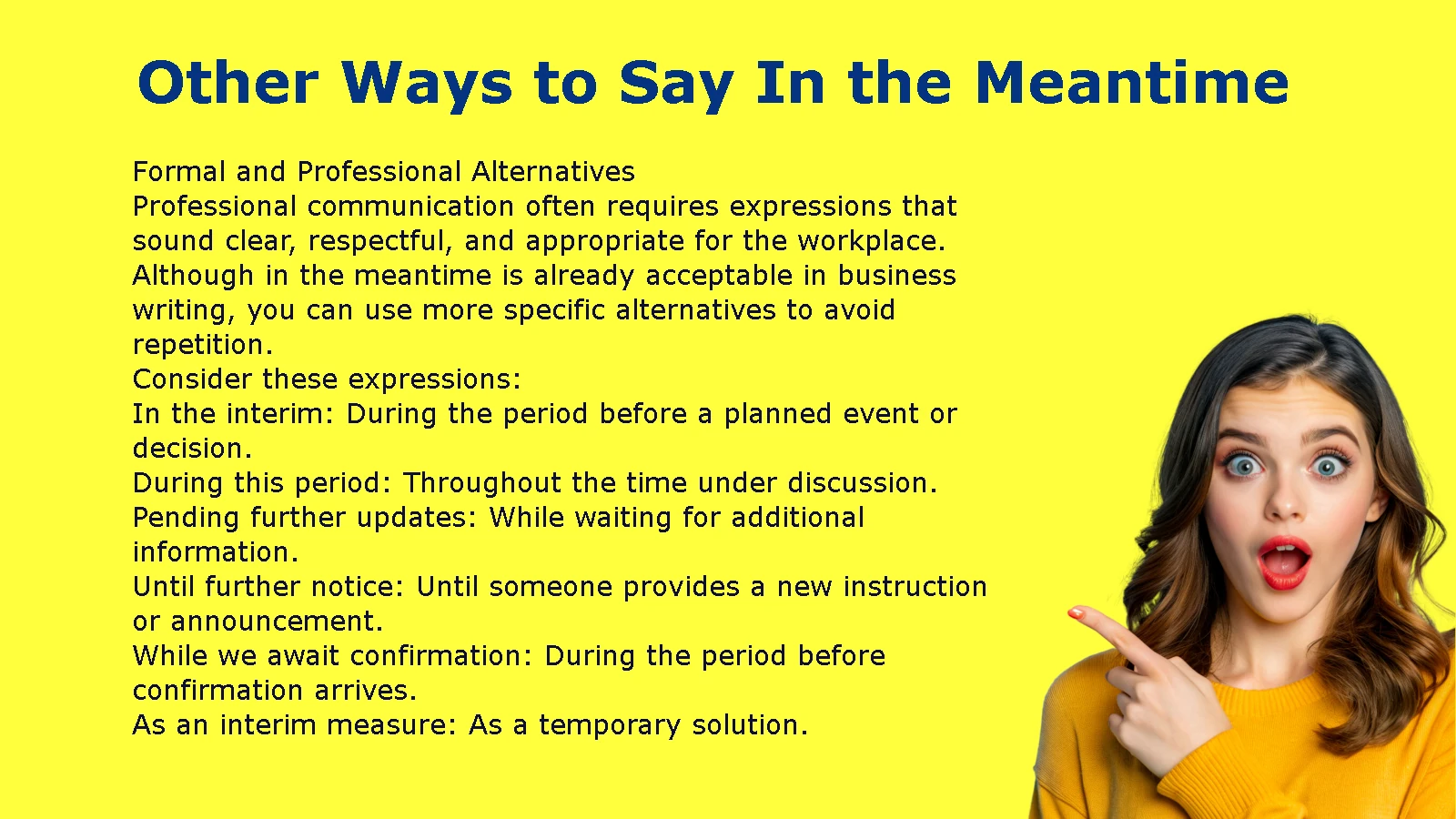
Formal and Professional Alternatives
Professional communication often requires expressions that sound clear, respectful, and appropriate for the workplace.
Although in the meantime is already acceptable in business writing, you can use more specific alternatives to avoid repetition.
Consider these expressions:
- In the interim: During the period before a planned event or decision.
- During this period: Throughout the time under discussion.
- Pending further updates: While waiting for additional information.
- Until further notice: Until someone provides a new instruction or announcement.
- While we await confirmation: During the period before confirmation arrives.
- As an interim measure: As a temporary solution.
- Pending final approval: Before receiving the required authorization.
- Until a final decision is reached: Before the relevant decision becomes official.
For example:
- In the interim, please continue using the existing software.
- Pending final approval, the team will maintain the current schedule.
- While we await confirmation, we will prepare the remaining documents.
- During this period, employees should follow the updated safety procedures.
These expressions work particularly well in business emails, reports, internal announcements, and formal correspondence.
Short and Conversational Alternatives
Sometimes a long expression makes a simple message sound unnecessarily complicated. Short alternatives can communicate the same general idea more naturally.
| Alternative | Example |
| For now | For now, let’s leave the arrangement unchanged. |
| Until then | Until then, keep your documents ready. |
| Meanwhile | Meanwhile, I’ll finish the other task. |
| For the moment | For the moment, we can use this solution. |
| While we wait | While we wait, let’s discuss the next step. |
| In the meantime | In the meantime, enjoy your break. |
Choose the expression that matches your intended meaning rather than replacing every instance mechanically.
Alternatives for Specific Situations
The most effective synonym often depends on what you want to communicate.
When waiting for a decision:
- Pending a decision
- Until a decision is made
- While awaiting approval
- Until further updates
Example: “Pending a decision, the department will continue following the existing policy.”
When waiting for a response:
- While awaiting your response
- Until we hear from you
- Pending your reply
- While we wait for confirmation
Example: “While awaiting your response, we will keep your application active.”
When something is being prepared:
- During the preparation period
- While preparations continue
- As preparations are underway
Example: “While preparations continue, employees should review the updated guidelines.”
When an arrangement is temporary:
- For the time being
- Temporarily
- For now
- As a temporary measure
Example: “For the time being, customers can place orders by phone.”
When another activity continues:
- Meanwhile
- At the same time
- While that happens
- Simultaneously
Example: “The manager is reviewing the proposal. Meanwhile, the finance team is checking the budget.”
Professional Ways to Say In the Meantime
Professional alternatives to in the meantime include in the interim, during this period, pending further updates, while we await confirmation, and until further notice. These expressions help make business communication more precise, especially when discussing temporary arrangements, pending decisions, ongoing projects, or future instructions.
However, the most formal expression isn’t always the best one. Choose wording that communicates the situation without making your message unnecessarily complicated.
In the Interim
In the interim is a formal alternative that describes the period between two events.
It works well in business correspondence, official announcements, project updates, and administrative communication.
Examples:
- In the interim, employees should continue using the current reporting system.
- We are recruiting a permanent manager. In the interim, the assistant manager will supervise the department.
- The company is reviewing its pricing structure. In the interim, existing rates will remain unchanged.
This expression is particularly useful when discussing temporary responsibilities or arrangements.
During This Period
During this period refers to a specific length of time. It works well when the reader already knows which period you mean.
Examples:
- During this period, our support team will remain available by email.
- The office will undergo renovations. During this period, employees can use the temporary workspace.
- During this period, the research team will collect additional information.
This phrase is straightforward and suitable for professional reports, instructions, and announcements.
Pending Further Updates
Pending further updates means that a situation will remain unchanged until someone provides new information.
It is useful when communicating about ongoing decisions, service interruptions, applications, and projects.
Examples:
- Pending further updates, the scheduled meeting will remain postponed.
- The application is under review. Pending further updates, no additional action is required.
- Pending further updates, customers should continue using the existing service.
Use this phrase when you expect additional information but don’t yet know when it will arrive.
Until Further Notice
Until further notice means that an instruction or arrangement will continue until someone announces a change.
Examples:
- The main entrance will remain closed until further notice.
- Employees should work remotely until further notice.
- The temporary payment arrangement will remain in place until further notice.
This expression is more definite than “in the meantime” because it communicates an ongoing instruction without giving a specific end date.
While We Await Confirmation
While we await confirmation is a polite and professional expression that describes what happens before receiving confirmation.
Examples:
- While we await confirmation, we will prepare the remaining documents.
- While we await confirmation from the supplier, the delivery schedule will remain unchanged.
- While we await your approval, our team will review the final proposal.
It works especially well in customer service emails, business correspondence, and project management updates.
In the Absence of a Final Decision
In the absence of a final decision explains what happens when an issue remains unresolved.
Examples:
- In the absence of a final decision, the existing policy will remain in effect.
- In the absence of formal approval, the team cannot proceed with implementation.
- In the absence of a final agreement, both parties will continue following the current arrangement.
This expression is more formal and specific than “in the meantime.” It emphasizes the lack of a decision rather than simply describing the passage of time.
Professional Alternatives to In the Meantime in Emails
Choosing the right expression can make your emails sound more polished and purposeful.
Here is a comparison of casual wording and professional alternatives.
| Casual wording | Professional alternative |
| In the meantime, I’ll wait. | I will await further instructions. |
| In the meantime, keep working. | Please continue with your current responsibilities during this period. |
| In the meantime, let me know. | Please share any updates as they become available. |
| In the meantime, we can use this. | We can use this as a temporary solution. |
| In the meantime, I’ll check. | I will review the details while we await confirmation. |
| In the meantime, don’t change anything. | Please maintain the current arrangement until further notice. |
Example Professional Email Sentences
Here are original examples you can adapt for different workplace situations.
When waiting for approval:
“While we await your approval, our team will review the remaining requirements.”
When providing temporary instructions:
“In the interim, please continue using the existing reporting procedure.”
When waiting for a response:
“Pending your response, we will keep the request open.”
When communicating a temporary arrangement:
“For the time being, all client meetings will take place online.”
When sharing a project update:
“During this period, we will monitor progress and address any issues that arise.”
When announcing a temporary change:
“Until further notice, the support department will operate from the second floor.”
Practical Case Study: Choosing the Right Professional Expression
Imagine that a company is replacing its customer management software. The new system will become available in three weeks, but employees must continue working during the transition.
Different messages communicate slightly different instructions.
| Situation | Recommended expression | Example |
| Describing the transition | In the interim | In the interim, employees should use the existing system. |
| Giving a temporary instruction | For the time being | For the time being, all records must be entered manually. |
| Announcing an indefinite arrangement | Until further notice | The old platform will remain available until further notice. |
| Describing simultaneous work | Meanwhile | Meanwhile, the IT team will configure the new platform. |
The lesson is simple: choose an expression based on the purpose of your message, not just its level of formality.
In the Meantime vs. For the Meantime
In the meantime is the standard and widely accepted expression for referring to the period between two events. For the meantime appears in some informal usage, but it is generally less idiomatic. In most situations, use “in the meantime” or “for the time being” instead.
The confusion occurs because both expressions seem to describe a temporary period. However, English normally uses different prepositions in these established expressions.
In the Meantime Meaning and Usage
“In the meantime” is a conventional expression that describes what happens between two events.
Examples:
- The doctor will see you shortly. In the meantime, please take a seat.
- Our new website launches next month. In the meantime, we will update the existing pages.
- The final results are not ready. In the meantime, students can review their notes.
Each example describes an activity during a waiting period.
For the Meantime Meaning and Usage
“For the meantime” is sometimes used to mean temporarily or during the current period.
However, it is not the usual idiomatic choice in standard written English.
For example:
Less natural: “For the meantime, we will continue using the old system.”
More natural: “For the time being, we will continue using the old system.”
You can also write:
“In the meantime, we will continue using the old system.”
The alternatives sound more natural and are better choices for professional writing.
Which Expression Is Grammatically Correct?
Use in the meantime when referring to the period between two events.
Use for the time being when describing a temporary situation or arrangement.
The difference becomes clearer in these examples:
| Expression | Status | Example |
| In the meantime | Standard and idiomatic | In the meantime, please finish the report. |
| For the meantime | Less idiomatic | For the meantime, please finish the report. |
| For the time being | Standard and idiomatic | For the time being, please use the old system. |
| In the interim | Standard and formal | In the interim, the assistant will manage the office. |
In the Meantime vs. For the Meantime Examples
Consider these common situations:
Example: Temporary work arrangement
Less natural: “For the meantime, employees will work from home.”
Better: “For the time being, employees will work from home.”
Example: Waiting for a delivery
Less natural: “For the meantime, we can prepare the remaining items.”
Better: “In the meantime, we can prepare the remaining items.”
Example: Temporary business decision
Less natural: “For the meantime, the company will maintain its current prices.”
Better: “For now, the company will maintain its current prices.”
Remember that the problem isn’t the idea of temporary time. The issue is choosing the conventional English expression for that meaning.
What Does For the Meantime Mean?
For the meantime is an expression some English speakers use to refer to a temporary period or an arrangement that applies until something changes. However, standard English generally favors “in the meantime” or “for the time being.” These alternatives sound more natural in conversations, professional emails, and formal writing.
Is For the Meantime Correct English?
People may use “for the meantime” in everyday speech, and readers can usually understand its intended meaning.
However, it is not the preferred expression in standard edited English.
The confusion likely comes from combining two familiar expressions:
- In the meantime
- For the time being
Both are established expressions, but they use different prepositions.
For example:
- Correct: “In the meantime, I’ll finish the report.”
- Correct: “For the time being, I’ll finish the report.”
- Less natural: “For the meantime, I’ll finish the report.”
For the Meantime in Example Sentences
Here are examples showing how to replace the less natural expression.
| Less natural wording | Better alternative |
| For the meantime, wait here. | In the meantime, wait here. |
| For the meantime, use this computer. | For the time being, use this computer. |
| For the meantime, we will keep the office open. | For now, we will keep the office open. |
| For the meantime, continue your studies. | In the meantime, continue your studies. |
| For the meantime, the arrangement will remain unchanged. | For the time being, the arrangement will remain unchanged. |
Better Alternatives to For the Meantime
If you want to express a temporary period, consider these alternatives:
In the meantime: Use it when describing what happens while waiting for another event.
Example: “The replacement parts will arrive tomorrow. In the meantime, we can inspect the equipment.”
For the time being: Use it when describing an arrangement that applies temporarily.
Example: “For the time being, the office will remain closed.”
For now: Use it in simple, conversational situations.
Example: “For now, let’s keep the current schedule.”
Temporarily: Use it when you want a direct description of a short-term arrangement.
Example: “The service is temporarily unavailable.”
Until further notice: Use it when an arrangement will continue until someone announces a change.
Example: “The road will remain closed until further notice.”
In the Interim Meaning and Synonyms
In the interim means during the period between two events, especially before a planned action, decision, or change takes place. It is a formal alternative to “in the meantime” and commonly appears in professional communication, business reports, legal documents, and official announcements.
For example:
“The permanent director will begin next month. In the interim, the deputy director will oversee daily operations.”
This sentence describes a temporary arrangement that applies before the permanent director takes over.
What Does In the Interim Mean?
The word interim refers to a temporary period or arrangement that exists until something permanent or final happens.
When you say “in the interim,” you refer to the time between the current situation and a future event.
Consider these examples:
- The new principal starts in September. In the interim, the vice principal will manage the school.
- The company is searching for a permanent supplier. In the interim, it will purchase materials from a local distributor.
- The final report is still being prepared. In the interim, the team will use the preliminary figures.
The expression often appears when an organization needs a temporary solution while preparing for a permanent change.
In the Interim Synonyms
Several expressions can replace “in the interim,” depending on the context.
| Synonym | Meaning | Example |
| Meanwhile | During the same period | Meanwhile, the team will review the proposal. |
| In the meantime | During the waiting period | In the meantime, employees should continue working. |
| For the time being | Temporarily | For the time being, the current manager will remain in charge. |
| Until then | Before a specified event | Until then, please follow the existing procedure. |
| During this period | Throughout the current period | During this period, the office will remain operational. |
| Temporarily | For a limited period | The department will temporarily use another office. |
| Pending approval | While waiting for authorization | Pending approval, the project will remain on hold. |
| As a temporary measure | As a short-term solution | As a temporary measure, we hired additional staff. |
| In the intervening period | Between two events | In the intervening period, the company expanded its operations. |
Although these expressions share similar meanings, they aren’t always interchangeable.
For example, pending approval specifically refers to waiting for authorization, while meanwhile can describe activities happening simultaneously.
In the Interim in a Sentence
Here are examples from different contexts.
Professional examples:
- The new department head will join in August. In the interim, the current supervisor will handle administrative duties.
- The company is reviewing its employment policies. In the interim, existing guidelines will remain in effect.
- The permanent office location has not been finalized. In the interim, employees will work remotely.
Academic examples:
- The research team is waiting for additional funding. In the interim, researchers will analyze the available data.
- The final examination schedule will be published next week. In the interim, students should continue preparing.
Everyday examples:
- My new phone will arrive tomorrow. In the interim, I’ll use my old one.
- The kitchen is being renovated. In the interim, we’re preparing meals outside.
In the Interim vs. In the Meantime
Both expressions describe a period between events, but they differ slightly in tone and typical usage.
In the meantime is more conversational and works naturally in almost any everyday situation.
In the interim sounds more formal and often emphasizes a temporary arrangement before a permanent change.
| Feature | In the meantime | In the interim |
| Meaning | During the period between events | During a temporary intervening period |
| Tone | Neutral and conversational | Formal |
| Common use | Everyday speech and writing | Business and official communication |
| Temporary arrangements | Yes | Yes |
| Simultaneous activities | Very common | Possible, but less conversational |
| Example | In the meantime, I’ll prepare lunch. | In the interim, the deputy will manage the office. |
You can use either expression in many situations. However, choose “in the interim” when discussing temporary professional responsibilities or arrangements.
In the Meantime in a Sentence: Examples
The expression in the meantime connects two events by explaining what happens during the period before the second event occurs. You can use it in everyday conversations, workplace communication, academic writing, and instructions. Its meaning remains the same, although the tone changes with the surrounding sentence.
Here are examples showing how the phrase works in different situations.
In the Meantime in Everyday Sentences
- My brother will arrive at six. In the meantime, I’ll prepare dinner.
- The rain should stop soon. In the meantime, let’s stay inside.
- Your favorite show starts in an hour. In the meantime, we can watch a movie.
- The bus is running late. In the meantime, I’ll grab a coffee.
- Mom is preparing lunch. In the meantime, help me set the table.
These examples describe ordinary activities that take place while someone waits for another event.
In the Meantime in Professional Sentences
- The manager will return on Monday. In the meantime, the assistant manager will oversee the department.
- We are waiting for the client’s feedback. In the meantime, our team will review the proposal.
- The new software is scheduled to launch next month. In the meantime, employees should continue using the existing platform.
- Your application is being processed. In the meantime, please prepare the supporting documents.
- The final budget has not been approved. In the meantime, all departments should follow the current spending limits.
These sentences show how the expression can maintain a professional tone without sounding overly formal.
Meantime in Academic Writing
- The researchers are collecting additional samples. In the meantime, they will analyze the existing results.
- The examination schedule will be announced shortly. In the meantime, students should continue reviewing their course materials.
- The university is updating its admission policy. In the meantime, applicants can consult the current guidelines.
- The laboratory equipment is being repaired. In the meantime, students will complete their practical work in another facility.
In academic writing, the phrase helps connect ongoing research, temporary arrangements, and future developments.
In the Meantime at the Beginning of a Sentence
Starting a sentence with “in the meantime” creates a clear transition from a previous idea.
Examples:
- The new store opens next month. In the meantime, customers can shop online.
- We are waiting for the final results. In the meantime, the team will review the available data.
- Your replacement card is on its way. In the meantime, you can access your account online.
- The road repairs will take several days. In the meantime, drivers should use the alternate route.
Place a comma after the introductory expression.
In the Meantime in the Middle of a Sentence
You can also place the expression in the middle of a sentence when it fits naturally.
Examples:
- The employees will continue, in the meantime, with their regular responsibilities.
- We can prepare the remaining documents in the meantime.
- The company will maintain its current prices in the meantime.
- Sarah will contact the supplier and, in the meantime, I’ll update the inventory.
The phrase often sounds more natural at the beginning or end of a sentence. However, middle placement can work when the sentence structure supports it.
On the Other Hand Synonyms and Related Expressions
On the other hand introduces a contrasting idea, viewpoint, or alternative consideration. Its synonyms include conversely, in contrast, alternatively, by comparison, and from another perspective. Unlike “in the meantime,” it does not describe a period of time.
This distinction matters because the two expressions serve different grammatical and logical purposes.
Best Synonyms for On the Other Hand
Here are useful alternatives with examples.
| Synonym | Meaning | Example |
| Conversely | In an opposite way | The first plan is expensive. Conversely, the second is affordable. |
| In contrast | Showing a difference | The old system was slow. In contrast, the new one is faster. |
| Alternatively | Presenting another option | We can travel by train. Alternatively, we can drive. |
| By comparison | Comparing two things | The first model is lightweight. By comparison, the second is heavier. |
| From another perspective | Looking at a different viewpoint | From another perspective, the decision makes sense. |
| On the contrary | Expressing the opposite of a previous statement | I am not disappointed. On the contrary, I am pleased. |
| Whereas | Introducing a direct contrast | Sarah prefers tea, whereas John prefers coffee. |
On the Other Hand vs. In the Meantime
These expressions are not interchangeable because they communicate different relationships between ideas.
On the other hand introduces a contrast.
In the meantime introduces a time relationship.
Compare these examples:
- On the other hand, working remotely can reduce commuting costs.
- In the meantime, employees can complete their tasks from home.
The first sentence introduces another perspective. The second explains what happens during a particular period.
Here is another comparison:
| Expression | Main purpose | Example |
| On the other hand | Contrast | The project is expensive. On the other hand, it offers long-term benefits. |
| In the meantime | Time relationship | The project starts next month. In the meantime, prepare the documents. |
Avoid using “on the other hand” as a synonym for “in the meantime.” They have different meanings.
Examples of On the Other Hand in Sentences
- The apartment is small. On the other hand, it is close to the office.
- Working from home saves commuting time. On the other hand, some employees miss face-to-face interaction.
- The first option costs less. Conversely, the second offers more features.
- The morning shift is convenient for some employees, whereas others prefer evening hours.
- We could hire an external consultant. Alternatively, we could train an existing employee.
These alternatives help you introduce contrasting ideas without repeatedly using the same transition.
For the Meantime in Tagalog
The English expression in the meantime can translate into Tagalog as samantala or habang naghihintay, depending on the context. The first often introduces something happening during the same period, while the second emphasizes what someone does while waiting. Pansamantala generally means temporarily.
In the Meantime Meaning in Tagalog
The most common Tagalog translation of “in the meantime” is samantala.
For example:
English: “The food will be ready soon. In the meantime, please sit down.”
Tagalog: “Malapit nang maluto ang pagkain. Samantala, maupo muna kayo.”
You can also use habang naghihintay when the sentence specifically describes an activity performed while waiting.
Example:
English: “In the meantime, you can read a book.”
Tagalog: “Habang naghihintay, maaari kang magbasa ng libro.”
For the Meantime Meaning in Tagalog
The expression “for the meantime” does not have a single fixed Tagalog translation because its intended meaning depends on context.
Possible translations include:
- Sa ngayon: For now.
- Pansamantala: Temporarily.
- Samantala: Meanwhile.
- Habang naghihintay: While waiting.
For example:
English: “For the time being, we will stay here.”
Tagalog: “Sa ngayon, mananatili muna kami rito.”
English: “In the meantime, continue studying.”
Tagalog: “Samantala, magpatuloy ka sa pag-aaral.”
Samantala vs. Pansamantala
Although these words look similar, they have different uses.
| Tagalog word | English meaning | Best use |
| Samantala | Meanwhile / in the meantime | Describing something happening during the same period |
| Pansamantala | Temporarily | Describing a temporary condition or arrangement |
| Sa ngayon | For now | Describing the present situation |
| Habang naghihintay | While waiting | Describing an activity during a waiting period |
| Hanggang doon | Until then | Referring to a point before a future event |
For example:
“Samantala, magpahinga muna tayo.”
This means, “Meanwhile, let’s take a break.”
“Pansamantala, sarado ang tindahan.”
This means, “The store is temporarily closed.”
Example Sentences in English and Tagalog
| English sentence | Tagalog translation |
| In the meantime, please wait here. | Samantala, maghintay ka muna rito. |
| You can study in the meantime. | Maaari kang mag-aral habang naghihintay. |
| In the meantime, I’ll prepare dinner. | Samantala, maghahanda ako ng hapunan. |
| For the time being, stay here. | Sa ngayon, manatili ka muna rito. |
| The office is temporarily closed. | Pansamantalang sarado ang opisina. |
The best translation depends on the complete sentence rather than the English expression alone.
How to Choose the Right Alternative to In the Meantime
Choose an alternative to in the meantime by identifying the relationship between the current activity and the future event. Use “meanwhile” for simultaneous activities, “in the interim” for formal temporary periods, “until then” for a specific future point, and “for the time being” for temporary arrangements.
The following guide can help you make the right choice.
When to Use Meanwhile
Use meanwhile when two activities happen during the same period.
Example:
“Maria is preparing the presentation. Meanwhile, James is organizing the financial records.”
Both activities take place at the same time.
You can also use it to shift attention from one situation to another.
Example:
“The sales team is contacting new customers. Meanwhile, the marketing department is preparing its next campaign.”
When to Use In the Interim
Use in the interim when discussing a temporary period before a planned event or permanent arrangement.
Example:
“The permanent director will join in December. In the interim, the deputy director will supervise the department.”
This expression works especially well in formal workplace communication.
When to Use Until Then
Use until then when referring to a specific future date, time, or event.
Example:
“The training session starts on Monday. Until then, please review the preparation materials.”
It points toward a clear future reference.
When to Use For the Time Being
Use for the time being when describing an arrangement that applies temporarily.
Example:
“For the time being, employees will continue working from home.”
This expression is useful when a situation may change but no specific end date has been established.
When to Use Pending Further Updates
Use pending further updates when you expect additional information before taking the next step.
Example:
“Pending further updates, the current delivery schedule will remain unchanged.”
This expression is common in business announcements, project communications, and administrative messages.
Quick Decision-Making Guide
| Your intended meaning | Best expression | Example |
| Two activities happen simultaneously | Meanwhile | Meanwhile, I’ll prepare the report. |
| A temporary period before a permanent change | In the interim | In the interim, the assistant will manage the office. |
| Waiting for a specific future event | Until then | Until then, keep your documents ready. |
| A temporary arrangement | For the time being | For the time being, work remotely. |
| Waiting for additional information | Pending further updates | Pending further updates, the policy remains unchanged. |
| Describing an activity during a wait | While waiting | While waiting, review your notes. |
| A short-term solution | As a temporary measure | As a temporary measure, use the backup system. |
Common Mistakes When Using In the Meantime and Its Alternatives
Understanding synonyms is only part of using them correctly. You also need to know which expressions fit particular sentence structures and meanings.
Here are some common mistakes to avoid.
Confusing In the Meantime With On the Other Hand
These expressions have different purposes.
Incorrect: “The office opens tomorrow. On the other hand, you can wait here.”
Better: “The office opens tomorrow. In the meantime, you can wait here.”
Use “on the other hand” to introduce a contrast, not a waiting period.
Using For the Meantime Instead of For the Time Being
The two expressions may appear similar, but “for the time being” is the more natural choice.
Less natural: “For the meantime, we will use the old system.”
Better: “For the time being, we will use the old system.”
Using In the Interim in Casual Conversations
“In the interim” is grammatically correct in everyday speech, but it may sound unnecessarily formal.
Overly formal: “In the interim, I’ll prepare some coffee.”
More natural: “Meanwhile, I’ll prepare some coffee.”
Match your vocabulary to your audience and situation.
Using Until Then Without a Clear Future Reference
“Until then” usually refers to a future event or point in time.
Unclear: “Until then, I’ll continue working.”
Clearer: “The manager will return on Friday. Until then, I’ll continue working.”
The second example gives the reader a clear reference point.
Replacing Every Instance With a Synonym
Not every synonym communicates exactly the same idea.
For example:
- “Meanwhile” emphasizes simultaneous activities.
- “In the interim” emphasizes a temporary intervening period.
- “For the time being” emphasizes a temporary arrangement.
- “Until then” emphasizes a future reference point.
Choose the alternative that preserves your original meaning.
Frequently Asked Questions
What Is Another Way to Say In the Meantime?
Other ways to say in the meantime include meanwhile, in the interim, until then, for the time being, during this period, while waiting, and for now. Choose “meanwhile” for simultaneous activities and “in the interim” for formal situations.
Is In the Meantime Formal or Informal?
“In the meantime” is a neutral expression that works in both formal and informal communication. You can use it in everyday conversations, professional emails, academic writing, business reports, and official announcements.
Is It Correct to Say For the Meantime?
“For the meantime” is used by some English speakers, but it is generally less idiomatic than “in the meantime.” If you mean temporarily, use “for the time being” or “for now” instead.
What Is the Difference Between In the Meantime and In the Interim?
Both expressions describe a period between two events. However, “in the meantime” sounds more conversational and works in everyday situations, while “in the interim” is more formal and often describes temporary professional arrangements.
Can I Use Meanwhile in a Professional Email?
Yes. “Meanwhile” is appropriate in professional emails when you want to describe activities happening during the same period. For example, “Meanwhile, our team will review the submitted documents.” It sounds natural and professional.
What Is Another Word for In the Interim?
Common alternatives to “in the interim” include meanwhile, in the meantime, during this period, for the time being, until then, and temporarily. The right choice depends on whether you are describing a waiting period or a temporary arrangement.
Conclusion
Finding the right alternative to in the meantime depends on what you want to communicate. Expressions such as meanwhile, in the interim, until then, during this period, and for the time being all describe related situations, but they are not completely interchangeable.
Use meanwhile when two activities happen simultaneously. Choose in the interim for formal communication about temporary arrangements. Use until then when referring to a specific future event, and choose for the time being when describing a situation that applies temporarily.
Remember that in the meantime is the standard expression, while “for the meantime” is generally less natural. In professional writing, clear and familiar alternatives will usually communicate your message more effectively than unnecessarily complicated wording.
Before sending your next email or writing your next report, consider whether you are describing a waiting period, a temporary arrangement, or simultaneous activities. That small distinction can make your English sound more precise and natural.
Explore more English expressions, grammar comparisons, and practical vocabulary guides to make your everyday and professional writing clearer.