Other ways to say no offense include “I mean this respectfully,” “please don’t take this the wrong way,” “I respectfully disagree,” and “I hope you understand where I’m coming from.” These expressions help you share criticism, disagree with someone, or express an uncomfortable opinion without sounding unnecessarily rude.
The right phrase depends on your relationship with the listener and the situation. Professional communication calls for diplomatic expressions, while casual conversations allow more relaxed alternatives such as “no shade” or “don’t get me wrong.” When you need to decline a request, expressions such as “I appreciate the offer, but I’ll have to pass” communicate your decision more clearly.
Understanding the difference between polite language, constructive criticism, slang expressions, and respectful refusals can make everyday conversations easier. You can also learn when to use “no offense” or “no offence” and how to respond when someone says “no offence taken.”
| Question | Answer |
| What are other ways to say no offense? | I mean this respectfully, don’t take this the wrong way, and I respectfully disagree. |
| How do you say no offense professionally? | Use expressions such as “I’d like to offer a different perspective” or “I hope you don’t mind my feedback.” |
| What is a slang synonym for no offense? | No shade, no disrespect, just keeping it real, and don’t get me wrong. |
| Is it no offense or no offence? | Both are correct. Offense is American English, while offence is British English. |
| What does no offence taken mean? | It means someone does not feel insulted or hurt by what another person said. |
What Does No Offense Mean?
No offense is an expression people use before making a potentially critical, disagreeable, or uncomfortable statement. It signals that the speaker does not intend to hurt the listener’s feelings. However, the phrase does not automatically make the following comment polite or acceptable.
For example:
- No offense, but I think your approach needs improvement.
- No offense, but I prefer the original design.
- No offense, but that suggestion might not work.
In each example, the speaker introduces a potentially negative opinion while attempting to soften its impact.
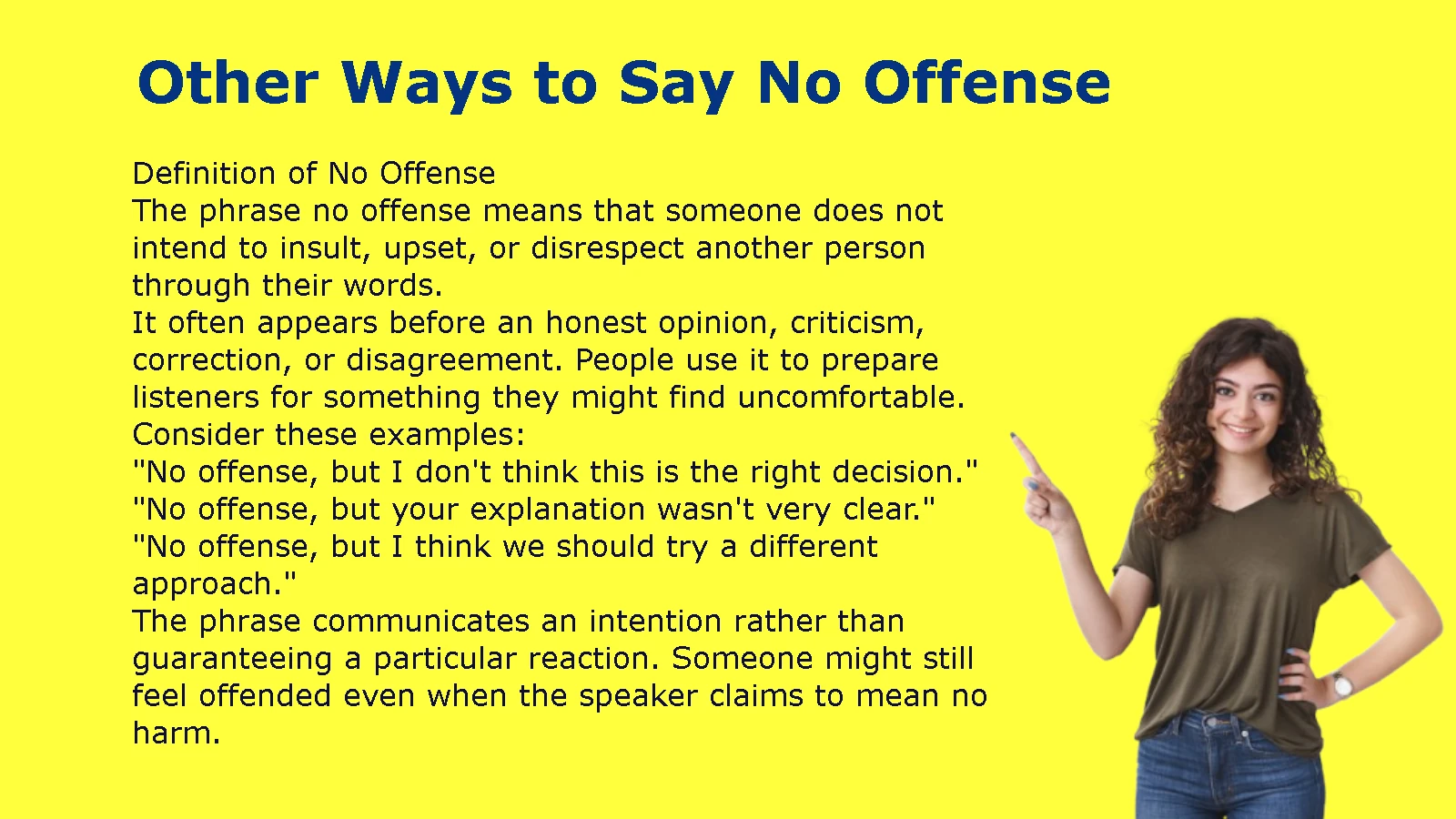
Definition of No Offense
The phrase no offense means that someone does not intend to insult, upset, or disrespect another person through their words.
It often appears before an honest opinion, criticism, correction, or disagreement. People use it to prepare listeners for something they might find uncomfortable.
Consider these examples:
- “No offense, but I don’t think this is the right decision.”
- “No offense, but your explanation wasn’t very clear.”
- “No offense, but I think we should try a different approach.”
The phrase communicates an intention rather than guaranteeing a particular reaction. Someone might still feel offended even when the speaker claims to mean no harm.
When Should You Use No Offense?
You can use no offense when you need to express a different opinion or discuss something sensitive without deliberately insulting someone.
Common situations include:
- Friendly disagreements: When you disagree with a friend’s opinion.
- Constructive criticism: When you want to identify an issue without attacking someone personally.
- Casual conversations: When discussing preferences, habits, or unpopular opinions.
- Sensitive discussions: When you need to approach a potentially uncomfortable subject.
- Honest feedback: When someone asks for your genuine opinion about their work or decisions.
For example, imagine a friend asks whether you like their new business idea. You could say, “No offense, but I think the pricing needs more thought.”
However, a more constructive version would be, “I like the idea. I think we could improve the pricing strategy.”
The second statement focuses on the problem rather than making the conversation unnecessarily defensive.
Is No Offense Always Polite?
No, no offense is not always polite. Although people use it to soften criticism, the words that follow can still sound insulting, dismissive, or disrespectful.
For example:
- “No offense, but you’re terrible at your job.”
- “No offense, but nobody likes your idea.”
- “No offense, but you don’t know what you’re talking about.”
These statements attack someone’s abilities or opinions. Adding “no offense” does not remove the negative impact.
A better approach is to focus on specific actions or ideas instead of criticizing someone’s personality.
| Potentially rude statement | More considerate alternative |
| No offense, but you’re wrong. | I see your point, but I have a different perspective. |
| No offense, but this is terrible. | I think we can improve this further. |
| No offense, but you’re too slow. | Could we work on completing this more efficiently? |
| No offense, but your idea won’t work. | I have some concerns about how this approach would work. |
The most respectful communication comes from thoughtful wording, not simply adding a disclaimer before criticism.
35+ Other Ways to Say No Offense
There are many alternatives to no offense, and each expression carries a slightly different tone. Some work well in professional discussions, while others sound more natural between friends.
The following phrases help you communicate honestly without making every disagreement feel personal.
Polite Ways to Say No Offense
Polite alternatives help you introduce criticism or a different opinion without sounding aggressive. They work particularly well when discussing sensitive topics or communicating with people you do not know very well.
Here are seven expressions to consider:
1. Please Don’t Take This the Wrong Way
Use this phrase when you want someone to understand that your comment is not intended as a personal attack.
Example: “Please don’t take this the wrong way, but I think we should reconsider the current plan.”
2. I Mean This Respectfully
This expression emphasizes that you want to maintain respect while sharing an honest opinion.
Example: “I mean this respectfully, but I don’t think the proposal addresses our main concern.”
3. I Hope You Don’t Mind Me Saying This
This phrase introduces a personal observation or suggestion in a gentle way.
Example: “I hope you don’t mind me saying this, but your presentation would benefit from a shorter introduction.”
4. I Don’t Mean to Upset You
Use this expression when you need to discuss something that could make another person uncomfortable.
Example: “I don’t mean to upset you, but I think we should talk about what happened yesterday.”
5. Please Understand Where I’m Coming From
This expression encourages someone to consider your perspective before reacting.
Example: “Please understand where I’m coming from. I appreciate your effort, but I think we need a different solution.”
6. I Hope You See What I Mean
Use this phrase to clarify your intention and invite understanding.
Example: “I hope you see what I mean when I say that the current approach needs more planning.”
7. With All Due Respect
This phrase introduces a disagreement while acknowledging another person’s position or authority.
Example: “With all due respect, I believe there is a better way to handle this situation.”
Be careful with this expression. Depending on your tone, it can sound confrontational or sarcastic rather than respectful.
Professional Ways to Say No Offense
Professional alternatives to no offense help you communicate disagreement, criticism, and suggestions without damaging workplace relationships.
These expressions are particularly useful in meetings, business emails, client conversations, and discussions with managers.
8. I Respectfully Disagree
This is a straightforward way to communicate a different opinion while acknowledging someone else’s viewpoint.
Example: “I respectfully disagree with the proposed timeline because it doesn’t account for the testing phase.”
9. I’d Like to Offer a Different Perspective
Use this phrase when you want to introduce another way of looking at a situation.
Example: “I’d like to offer a different perspective on our marketing strategy.”
10. I Hope You Don’t Mind My Feedback
This expression prepares someone for constructive criticism.
Example: “I hope you don’t mind my feedback, but the report could use more supporting information.”
11. Please Allow Me to Share Another Viewpoint
This phrase works well in formal meetings and structured discussions.
Example: “Please allow me to share another viewpoint before we finalize the proposal.”
12. I Say This With Respect
Use this expression when discussing a sensitive disagreement or pointing out a potential problem.
Example: “I say this with respect, but I believe the current process creates unnecessary delays.”
13. I’d Like to Raise a Concern
This is a professional alternative when you need to identify a problem without blaming anyone.
Example: “I’d like to raise a concern about the project’s delivery schedule.”
14. My Intention Is to Be Constructive
This phrase makes your purpose clear before you provide suggestions or criticism.
Example: “My intention is to be constructive, so I’d like to highlight a few areas where we can improve.”
Friendly and Casual Ways to Say No Offense
Casual alternatives work well when speaking with friends, relatives, classmates, and people you know comfortably.
They communicate honesty without making an ordinary conversation sound like a formal business meeting.
15. Don’t Get Me Wrong
Use this expression when you want to clarify that your criticism does not mean you dislike everything about something.
Example: “Don’t get me wrong, I love the design, but the colors could be better.”
16. Just Saying
This short expression introduces an opinion or observation, often in a relaxed conversation.
Example: “Just saying, we might save time if we leave earlier.”
17. No Hard Feelings
Use this phrase when you want to show that a disagreement or decision should not affect your relationship.
Example: “I know we have different opinions, but no hard feelings.”
18. I Hope You Get Where I’m Coming From
This expression encourages someone to understand your reasoning.
Example: “I don’t think we should spend that much on the trip. I hope you get where I’m coming from.”
19. Don’t Take It Personally
Use this phrase when you want someone to understand that your comment is not specifically directed against them.
Example: “Don’t take it personally, but I think we need someone with more experience for this particular task.”
20. Nothing Personal
This expression separates a decision or disagreement from someone’s personal worth.
Example: “I chose another candidate for the position. Nothing personal.”
21. Just Being Honest
Use this expression when you want to emphasize that you are sharing your genuine opinion.
Example: “Just being honest, I think the first version looked better.”
Remember that “just being honest” can sometimes sound like an excuse for unnecessary criticism. Use it carefully.
Funny and Slang Alternatives to No Offense
Slang expressions can make casual conversations sound more natural, playful, or direct. However, some expressions may sound disrespectful in professional or sensitive situations.
Here are seven informal alternatives:
22. Not Gonna Lie
This phrase introduces an honest opinion, often in a relaxed or humorous way.
Example: “Not gonna lie, that movie wasn’t as good as everyone said.”
23. No Shade
“No shade” is an informal expression that means the speaker does not intend to insult or disrespect someone.
Example: “No shade, but I preferred your previous hairstyle.”
24. No Disrespect
This phrase signals that the speaker wants to express an opinion without deliberately showing disrespect.
Example: “No disrespect, but I think we should reconsider that decision.”
25. Just Keeping It Real
Use this expression when you want to communicate honestly and directly.
Example: “Just keeping it real, you need to spend more time preparing for the interview.”
26. Don’t Come for Me
This playful expression asks others not to criticize or attack you for your opinion.
Example: “Don’t come for me, but I actually prefer pineapple on pizza.”
27. I Mean No Harm
This phrase communicates that you do not intend to hurt someone’s feelings.
Example: “I mean no harm, but I think you should consider another option.”
28. Don’t Hate Me for Saying This
Use this expression before sharing an unpopular opinion, usually among friends.
Example: “Don’t hate me for saying this, but I didn’t enjoy the concert.”
Gentle Ways to Disagree Without Sounding Rude
Sometimes you do not need a direct synonym for “no offense.” You simply need a better way to disagree.
These expressions help you communicate a different opinion while showing that you have considered the other person’s perspective.
29. I See Your Point, But…
Example: “I see your point, but I think the second option offers better long-term results.”
30. I Understand What You Mean; However…
Example: “I understand what you mean; however, we should consider the additional costs.”
31. I Look at It a Little Differently
Example: “I look at it a little differently because customer experience should come first.”
32. That’s One Way to See It
Example: “That’s one way to see it, although I think there are other factors worth considering.”
33. I Respectfully Have Another Opinion
Example: “I respectfully have another opinion about how we should organize the event.”
34. I Appreciate Your Perspective
Example: “I appreciate your perspective, but I think we should explore another solution.”
35. Let’s Look at This Another Way
Example: “Let’s look at this another way. What if we reduced the initial budget instead?”
How to Say No Offense Professionally
To say no offense professionally, replace potentially defensive expressions with language that focuses on ideas, decisions, and constructive feedback. Phrases such as “I’d like to offer another perspective” and “I have a concern about this approach” help maintain respect while communicating disagreement.
Professional communication does not require you to agree with everyone. It requires you to express your position clearly without making unnecessary personal remarks.
Professional Alternatives for Workplace Conversations
Workplace discussions often involve different opinions, competing priorities, and difficult decisions. Using diplomatic expressions can help you address disagreements without creating unnecessary tension.
Consider these examples:
| Situation | Professional expression |
| Disagreeing with a colleague | I see your point, but I have a different perspective. |
| Criticizing a report | I think we could strengthen this section with more evidence. |
| Suggesting a change | I’d like to suggest another approach. |
| Identifying a problem | I have a concern about this particular decision. |
| Giving constructive feedback | I believe there are a few areas we can improve. |
| Correcting a misunderstanding | I think there may be a slight misunderstanding here. |
The key is to discuss the work rather than attack the person.
For example, instead of saying, “No offense, but your report is confusing,” try:
“I think we could make the report easier to follow by organizing the information into clearer sections.”
This statement identifies the same problem but gives the other person a practical direction for improvement.
How to Say No Offense in a Business Email
Written communication requires extra care because readers cannot hear your voice or interpret your facial expressions.
A phrase that sounds harmless during a friendly conversation might seem harsh in an email.
Use these expressions when writing professional messages:
- I would like to share a small observation.
- I hope you don’t mind my suggestion.
- I have a slightly different perspective.
- I would appreciate the opportunity to clarify one point.
- I believe we may need to reconsider this approach.
- I’d like to suggest a possible improvement.
Example business email:
Subject: Feedback on the Proposed Project Plan
Hello,
Thank you for sharing the proposed project plan. I appreciate the time and effort you’ve invested in preparing it.
I’d like to offer a different perspective on the proposed timeline. I believe we may need additional time for testing and quality checks before the final delivery.
I hope you don’t mind my feedback. My intention is to help us create a realistic schedule and avoid unnecessary delays.
Best regards,
[Your Name]
This approach communicates disagreement without questioning the other person’s abilities or effort.
How to Disagree With Your Boss or Colleague Politely
Disagreeing with someone in a position of authority can feel uncomfortable. However, you can communicate your concerns without sounding defensive or dismissive.
Follow these steps:
Acknowledge their perspective.
Start by showing that you have considered their suggestion.
Example: “I understand why you prefer this approach.”
Explain your concern.
Focus on the issue rather than the person.
Example: “My concern is that the current timeline might affect the testing process.”
Provide a reason.
Support your opinion with relevant information or practical observations.
Example: “We still need to complete two stages of quality assurance.”
Suggest an alternative.
Offer a possible solution instead of simply rejecting the idea.
Example: “Could we consider extending the deadline by two days?”
This approach makes disagreement more productive because it moves the discussion toward solving a problem.
Professional Phrases to Avoid
Some expressions sound polite on the surface but can damage workplace relationships.
| Expression | Why to avoid it | Better alternative |
| No offense, but you’re wrong. | Sounds dismissive. | I see this differently. |
| With all due respect, you don’t understand. | Can sound confrontational. | Perhaps I can clarify my perspective. |
| No offense, that’s a terrible idea. | Attacks the suggestion harshly. | I have some concerns about this proposal. |
| Just being honest, your work is poor. | Criticizes without offering guidance. | I’d like to discuss a few areas for improvement. |
A useful professional rule is to criticize the process, evidence, or outcome rather than the individual’s character.
How to Say No Without Hurting Someone’s Feelings
You can say no without hurting someone’s feelings by acknowledging their request, expressing appreciation, and giving a clear but considerate response. A polite refusal does not require a long excuse. It simply needs to communicate your decision while showing that you respect the other person’s time and feelings.
Learning how to refuse requests is an important part of healthy communication. You cannot accept every invitation, complete every favor, or meet every expectation.
Start With Appreciation
Begin by recognizing the person’s effort or consideration.
Examples include:
- I appreciate you thinking of me.
- Thanks for asking.
- I’m grateful for the opportunity.
- That’s very kind of you to consider me.
- Thank you for inviting me.
This approach shows that you value the relationship even when you cannot accept the request.
For example:
“Thank you for inviting me to dinner. I really appreciate it, but I won’t be able to attend.”
The response remains warm without creating false expectations.
Give a Clear but Gentle Response
Once you acknowledge the request, communicate your decision directly.
Consider these alternatives:
- I’m afraid I can’t commit to that.
- Unfortunately, I won’t be able to help this time.
- I’d love to, but I have other commitments.
- I’ll have to pass on this opportunity.
- That doesn’t work for my schedule right now.
Avoid giving vague responses if you already know your answer.
For example, saying “Maybe next time” when you have no intention of accepting a similar invitation can create confusion.
A clear refusal is often kinder than a misleading promise.
Offer an Alternative When Possible
If you genuinely want to help, suggest another option.
Examples:
- Perhaps we could try another day.
- I can help you with a smaller part of the project.
- You might want to consider another person for this task.
- I won’t be available today, but I could help next week.
- Could we discuss another arrangement?
You do not need to offer an alternative every time. Only suggest one when you can realistically follow through.
Set Boundaries Without Feeling Guilty
Setting boundaries means communicating what you can and cannot accept.
You can remain considerate without agreeing to something that makes you uncomfortable or creates unnecessary pressure.
For example:
Situation: A colleague repeatedly asks you to take on additional work.
Unhelpful response: “Okay, I’ll do it, even though I’m already busy.”
Better response: “I’d like to help, but I need to prioritize my current responsibilities. I won’t be able to take on another task right now.”
Notice how the second response communicates a boundary without blaming anyone.
Keep these principles in mind:
- Do not apologize repeatedly for having reasonable limits.
- Avoid inventing excuses.
- Communicate your decision confidently.
- Do not promise something you cannot deliver.
- Remain respectful even if someone disagrees with your decision.
How to Say No in a Smart and Polite Way
A smart refusal is clear, confident, and considerate. Instead of making excuses or leaving someone uncertain, explain that you cannot accept the request and acknowledge the other person’s position. You can decline an invitation, reject an offer, or set a boundary without sounding dismissive.
Intelligent Ways to Decline a Request
Use these expressions when you want to sound thoughtful and self-assured:
- I won’t be able to take that on right now.
- That’s not something I can commit to.
- I’ll have to pass on this one.
- I appreciate the offer, but I’ll decline.
- Unfortunately, that won’t work for me.
- I need to focus on my existing commitments.
- I don’t think this is the right opportunity for me.
Example:
A friend asks you to join a weekend trip, but you already have personal commitments.
Instead of giving a long explanation, say:
“Thanks for inviting me. I’d love to join, but I’ll have to pass this time. I hope you have a great trip!”
The answer is friendly, direct, and easy to understand.
How to Say No Without Giving Too Many Reasons
You do not owe everyone a detailed explanation for every decision.
Long explanations can make a refusal sound uncertain. They may also encourage someone to negotiate with you when your decision is already final.
Try these approaches:
| Instead of saying | Try saying |
| I’m so sorry, but I have several things going on, and I’m not sure I’ll have time. | I won’t be available this time. |
| I don’t know if I can do that because my schedule is complicated. | I can’t commit to that right now. |
| Maybe I can help, but I’ll have to see how things go. | I’m afraid I won’t be able to help. |
| I feel terrible, but I really don’t think I can manage it. | Thank you for asking, but I’ll have to decline. |
A short response can communicate confidence without sounding cold.
Examples of Smart Responses in Everyday Situations
Declining an invitation:
“Thank you for inviting me, but I already have plans.”
Refusing additional work:
“I appreciate you considering me, but I need to focus on my current workload.”
Rejecting an offer:
“Thank you for the opportunity. However, I don’t think it’s the right fit for me.”
Disagreeing with a suggestion:
“I understand your reasoning, although I think another approach might work better.”
Turning down a favor:
“I wish I could help, but I’m not available right now.”
How to Say No Offense Politely in a Text
To say no offense politely in a text, use short, friendly expressions that communicate your intention without making the other person feel attacked. Phrases such as “I hope you understand,” “I mean this in the nicest way,” and “I see your point, but I feel differently” work well in everyday messages.
Text messages lack vocal tone and facial expressions. As a result, even a simple disagreement can sound harsher than intended.
Short Text Message Alternatives
Here are some natural expressions you can use in everyday messages:
- I hope you understand.
- Please don’t misunderstand me.
- I mean this in the nicest way.
- Nothing personal.
- I hope we’re good.
- Don’t take this the wrong way.
- I just wanted to be honest.
- I hope you see where I’m coming from.
- No hard feelings.
- I appreciate your understanding.
Example text exchange:
Friend: “Do you think I should buy this expensive phone?”
You: “I mean this in the nicest way, but I think your current phone is still working perfectly. Maybe save your money for now.”
The response gives an honest opinion without making the friend feel foolish.
How to Disagree With Someone Over Text
When disagreeing through messages, acknowledge the other person’s point before expressing your own.
Examples:
Instead of: “No offense, but that’s wrong.”
Write: “I see what you’re saying, but I have a different opinion.”
Instead of: “You’re not making sense.”
Write: “I’m not sure I understand that part. Could you explain it differently?”
Instead of: “That’s a bad decision.”
Write: “I’m not convinced that’s the best option. Have you considered another approach?”
These alternatives reduce the chances of unnecessary arguments.
How to Reject an Invitation Without Hurting Feelings
You can politely reject an invitation while making it clear that you appreciate being included.
Try these messages:
- “Thanks for inviting me, but I can’t make it this time.”
- “I’d love to join another time, but I’m unavailable today.”
- “I appreciate the invitation, but I’ll sit this one out.”
- “That sounds lovely! Unfortunately, I already have plans.”
- “Thanks for thinking of me. I hope you all have a wonderful time.”
If you genuinely want another invitation, say so. If you do not, a simple thank-you and clear refusal are enough.
Texting Mistakes That Can Make You Sound Rude
Even polite expressions can create misunderstandings when you use them carelessly.
Avoid these common mistakes:
- Sending one-word refusals: A simple “No” can sound dismissive when someone has made a thoughtful request.
- Using sarcasm: Written sarcasm can be difficult to interpret.
- Overusing punctuation: Repeated exclamation marks or question marks may make a message feel aggressive.
- Adding unnecessary criticism: Avoid turning a simple disagreement into a personal judgment.
- Leaving someone waiting: If you already know your answer, respond rather than creating false expectations.
- Using vague replies: Messages such as “We’ll see” can create confusion when you actually intend to decline.
A little context can make a short message feel much warmer.
No Offense Synonyms and Slang: What’s the Difference?
No offense synonyms and slang expressions may communicate similar intentions, but they do not always have identical meanings. Some expressions soften criticism, others signal respect, and some simply introduce an honest or unpopular opinion.
Understanding these differences helps you choose words that fit the situation.
No Offense vs. No Hard Feelings
No offense expresses an intention not to insult someone, while no hard feelings suggests that a disagreement, rejection, or conflict should not damage a relationship.
Examples:
- No offense, but I prefer a different design.
- We didn’t agree on the decision, but no hard feelings.
Use “no offense” before a potentially uncomfortable statement. Use “no hard feelings” when you want to move past a disagreement.
No Offense vs. No Disrespect
Both expressions introduce comments that could sound critical or confrontational.
However, no disrespect places more emphasis on showing respect toward another person, while “no offense” focuses on avoiding hurt feelings.
Examples:
- No offense, but I don’t think this is the right choice.
- No disrespect, but I think we should hear another opinion.
“No disrespect” often sounds more direct and informal.
No Offense vs. Don’t Take It Personally
These expressions both attempt to separate criticism from personal feelings.
However, don’t take it personally directly asks someone not to interpret a statement as a personal attack.
Examples:
- No offense, but I think the presentation needs improvement.
- Don’t take it personally, but I think we should choose someone else for this role.
The second expression can sound dismissive if the criticism is genuinely personal. Use it with care.
No Offense vs. No Shade
No shade is informal slang that generally means the speaker does not intend to insult or disrespect someone.
It often appears in casual conversations, social media posts, and humorous discussions.
Examples:
- No shade, but I liked your previous outfit better.
- No shade, but that restaurant wasn’t worth the price.
Unlike “no offense,” “no shade” has a more playful, informal tone. It is generally unsuitable for formal business communication.
No Offense vs. Just Being Honest
Just being honest emphasizes that someone is sharing their genuine opinion, even if it may be uncomfortable.
“No offense” focuses more directly on the intention not to hurt someone’s feelings.
Examples:
- No offense, but I don’t think this plan will work.
- Just being honest, I think we need more preparation.
Neither expression gives someone permission to be unnecessarily harsh. Honest communication should still show consideration.
No Offense or No Offence: Which Spelling Is Correct?
Both no offense and no offence are correct English expressions. The difference comes from regional spelling conventions. American English uses “offense,” while British English uses “offence.” Both spellings have the same meaning and pronunciation.
No Offense in American English
Offense is the standard American English spelling.
It appears in American writing, including professional emails, educational materials, books, and everyday communication.
Examples:
- No offense, but I think we should change the schedule.
- I hope you take no offense at my suggestion.
- He didn’t mean to cause any offense.
If your audience primarily uses American English, choose “offense.”
No Offence in British English
Offence is the standard British English spelling.
It also appears in other English varieties that follow British spelling conventions.
Examples:
- No offence, but I disagree with your decision.
- I hope you take no offence at my comments.
- She didn’t intend to cause any offence.
If you write for a British audience, use “offence” to maintain spelling consistency.
Is No Offense or No Offence More Common?
Both versions are widely understood, but their usage depends on the English variety.
| Feature | No offense | No offence |
| English variety | American English | British English |
| Spelling | Offense | Offence |
| Meaning | No intention to insult | No intention to insult |
| Pronunciation | Same | Same |
| Suitable for | US audiences | UK audiences |
Other related spelling differences follow the same regional pattern:
| American English | British English |
| Offense | Offence |
| Defense | Defence |
| License (noun) | Licence (noun) |
| Practice (noun and verb) | Practice (noun), practise (verb) |
The easiest way to choose is to consider your audience and remain consistent throughout your writing.
What Does No Offence Taken Mean?
No offence taken means that someone does not feel insulted, upset, or hurt by a comment that might otherwise sound offensive. It is a way of acknowledging another person’s words while communicating that the remark has not caused personal offense.
People commonly use this expression after someone says “no offense” or makes a potentially uncomfortable observation.
Meaning of No Offence Taken
When someone says “no offence taken,” they are telling the speaker that they are not personally offended.
For example:
Person A: “No offense, but I think you need more practice before the presentation.”
Person B: “No offence taken. I know I still have some work to do.”
In this conversation, Person B accepts the criticism without becoming defensive.
The expression can also communicate that someone understands the speaker’s intention, even if the comment was not particularly pleasant.
How to Respond When Someone Says No Offense
If someone says “no offense,” you can respond in different ways depending on whether you agree with their intention or feel uncomfortable.
Here are some natural responses:
- No worries: A casual response that indicates you are not upset.
- I understand: Shows that you recognize their intention.
- Thanks for being honest: Acknowledges their willingness to share an opinion.
- I appreciate your perspective: Keeps the conversation respectful.
- I didn’t mean to offend you: Reassures someone when your words may have sounded harsh.
- That’s okay: A simple way to move forward.
You can also respond honestly if their comment bothers you.
For example:
“I understand you didn’t mean to offend me, but I would appreciate it if we discussed the issue differently.”
You do not need to pretend that a comment did not hurt your feelings.
Example Conversations Using No Offence Taken
Conversation between friends
Alex: “No offense, but I think your team needs a better strategy.”
Sam: “No offence taken. We’ve been discussing that ourselves.”
Workplace discussion
Manager: “No offense, but I think the report needs more detail.”
Employee: “No offence taken. I’ll review the figures and update the report.”
Casual text exchange
Friend A: “No offense, but I didn’t really enjoy that movie.”
Friend B: “No worries! Everyone has different tastes.”
These examples show how the expression can keep a conversation relaxed when both people communicate respectfully.
Is No Offence Taken Formal or Informal?
“No offence taken” works in both casual and some professional conversations, although its tone is generally conversational.
| Situation | Suitability |
| Talking with friends | Very suitable |
| Casual workplace discussion | Suitable |
| Professional email | Usually better to use a more specific response |
| Formal business meeting | Acceptable, depending on tone |
| Academic writing | Generally unsuitable |
For a formal workplace response, consider “I understand your feedback and appreciate the clarification” instead.
How to Choose the Right Alternative to No Offense
The best alternative to no offense depends on your audience, the purpose of your message, and how sensitive the subject might be. A phrase that works between close friends may sound inappropriate in a business meeting.
Consider the relationship, setting, and intended message before choosing your words.
Choose Words Based on Your Audience
Different audiences respond to different communication styles.
Friends and family
Use natural, friendly expressions:
- Don’t get me wrong.
- No hard feelings.
- I hope you understand.
- Nothing personal.
Colleagues and managers
Choose diplomatic and constructive language:
- I respectfully disagree.
- I’d like to offer another perspective.
- I have a concern about this approach.
- I appreciate your feedback.
Clients and customers
Prioritize clarity, courtesy, and professionalism:
- Thank you for sharing your perspective.
- I understand your concern.
- I’d like to suggest another option.
- We appreciate your understanding.
Strangers and acquaintances
Use neutral and considerate expressions:
- I hope you don’t mind me saying this.
- Please don’t misunderstand me.
- I mean this respectfully.
Match Your Phrase to the Situation
The same phrase does not work equally well in every situation.
Use this guide to choose an appropriate alternative:
| Communication purpose | Recommended expression |
| Giving criticism | I hope you don’t mind my feedback. |
| Disagreeing with an opinion | I respectfully disagree. |
| Declining a request | I appreciate the offer, but I’ll have to pass. |
| Expressing an uncomfortable truth | I mean this respectfully. |
| Setting personal boundaries | I won’t be able to commit to that. |
| Giving an alternative suggestion | I’d like to offer another perspective. |
| Having a casual disagreement | Don’t get me wrong. |
| Responding to a sensitive comment | I understand where you’re coming from. |
Quick Comparison of No Offense Alternatives
The following comparison helps you identify the tone and best use of common expressions.
| Expression | Tone | Best situation |
| I respectfully disagree | Professional | Workplace discussions |
| Don’t get me wrong | Casual | Friendly conversations |
| I mean this respectfully | Polite | Sensitive discussions |
| No shade | Slang | Informal conversations |
| I hope you understand | Gentle | Declining requests |
| I’d like to offer another perspective | Diplomatic | Professional disagreements |
| Nothing personal | Casual | Personal disagreements |
| I appreciate your perspective | Respectful | Different opinions |
| No hard feelings | Friendly | Moving past disagreements |
| Just keeping it real | Informal | Honest conversations |
A Practical Case Study: Choosing the Right Words
Imagine a marketing team is discussing a new advertising campaign.
One employee believes the proposed campaign will attract more customers. Another employee thinks the budget is too high and the strategy needs improvement.
Here are three ways the second employee could respond.
Approach A: Direct but potentially rude
“No offense, but this campaign is a waste of money.”
This statement attacks the proposal without providing a useful explanation. The first employee may become defensive.
Approach B: Polite but vague
“I don’t mean to offend you, but I’m not sure about this.”
This sounds softer, but it does not explain the actual concern.
Approach C: Professional and constructive
“I appreciate the idea, but I have some concerns about the projected return on investment. Could we review the budget and consider a more targeted approach?”
This version communicates disagreement while identifying a practical next step.
The lesson: Good communication does more than soften criticism. It helps people understand the issue and work toward a solution.
Final Thoughts on Other Ways to Say No Offense
Learning other ways to say no offense can help you communicate more thoughtfully in professional settings, personal relationships, and everyday conversations.
Expressions such as “I mean this respectfully,” “I respectfully disagree,” and “I hope you understand where I’m coming from” allow you to share honest opinions without making unnecessary personal remarks. Meanwhile, casual alternatives such as “no shade,” “don’t get me wrong,” and “no hard feelings” work better in relaxed conversations.
Most importantly, being polite does not mean avoiding honesty. You can express your opinions, establish boundaries, and say no without disrespecting someone.
Start practicing these expressions in your everyday conversations. Choose words that match your audience, communicate your message clearly, and make respect part of the conversation rather than relying on the phrase “no offense” alone.