Other ways to say I disagree include I see your point, but…, I beg to differ, I have a different perspective, and I respectfully disagree. These expressions help you communicate opposing opinions without sounding rude, dismissive, or unnecessarily aggressive. The best phrase depends on your audience, situation, and level of disagreement.
Whether you’re participating in a workplace meeting, writing an academic essay, preparing for IELTS, debating an important issue, or having a casual conversation, choosing the right disagreement phrase can make your communication more effective. You can use polite disagreement expressions, professional alternatives, formal synonyms, or even funny responses to express your position naturally.
Quick Answers: Other Ways to Say I Disagree
| Question | Answer |
| What is a polite way to say I disagree? | I see your point, but I have a different perspective. |
| How do you say I disagree in a smart way? | I would challenge that perspective because the evidence suggests otherwise. |
| What is a professional alternative to I disagree? | I respectfully disagree with that assessment. |
| What is another word for strongly disagree? | Oppose, dispute, dissent, reject, or object. |
| How can you disagree in an essay without saying I? | Use phrases such as However, the evidence suggests otherwise, or This argument overlooks an important factor. |
What Are Other Ways to Say I Disagree?
Other ways to say I disagree are alternative expressions that communicate a different opinion, challenge an argument, or reject a suggestion. They range from gentle phrases such as “I see things differently” to stronger expressions such as “I fundamentally disagree.” Each phrase carries a different level of formality and intensity.
People use these alternatives to maintain respectful conversations, express professional concerns, and present opposing arguments. Instead of repeating “I disagree,” you can select language that reflects your actual position.
Why Should You Use Different Ways to Express Disagreement?
Using different disagreement expressions makes your communication more natural and precise. The phrase you choose can influence how someone receives your message.
For example, telling a colleague “You’re wrong” might create unnecessary tension. Saying “I see a potential issue with that approach” communicates a similar concern without making the conversation personal.
Here are several reasons to use alternative expressions:
- Maintain relationships: Polite language helps prevent unnecessary arguments.
- Sound professional: Appropriate expressions improve workplace communication.
- Show confidence: Clear disagreement demonstrates that you can defend your position.
- Improve academic writing: Formal alternatives make essays and research discussions more objective.
- Expand vocabulary: Learning synonyms helps you avoid repetitive language.
- Encourage discussion: Respectful disagreement allows people to examine different perspectives.
How to Choose the Right Disagreement Phrase
Consider three factors before choosing an expression: your audience, the situation, and how strongly you disagree.
For instance, a conversation with a close friend allows more casual language than a discussion with your manager. Similarly, an academic paper requires more objective wording than a friendly debate.
| Situation | Recommended expression | Tone |
| Casual conversation | I’m not sure I agree. | Friendly |
| Workplace meeting | I have a different perspective. | Professional |
| Academic essay | However, the evidence suggests otherwise. | Formal |
| Serious disagreement | I fundamentally disagree. | Strong |
| Friendly debate | I beg to differ. | Confident |
| Humorous conversation | My brain is filing an objection. | Funny |
10 Ways to Disagree Respectfully
You can disagree respectfully by acknowledging another person’s opinion before explaining your own. Expressions such as “I understand your perspective, but…” and “I see your point, although…” communicate opposition without dismissing the other person’s ideas.
Here are ten useful phrases for respectful disagreement.
I See Your Point, but…
This expression acknowledges another person’s argument before introducing a different opinion. It works particularly well when you understand their reasoning but reach another conclusion.
Example: “I see your point, but I think we should consider the long-term consequences before making a decision.”
I Respect Your Opinion, However…
Use this phrase when you want to recognize someone’s right to hold a particular view while presenting your own position.
Example: “I respect your opinion, however, I believe the available evidence supports a different conclusion.”
It works well in discussions involving personal beliefs, workplace decisions, and academic debates.
I Understand Where You’re Coming From, but…
This expression shows that you understand the reasoning behind someone’s opinion. It also creates room for a different interpretation.
Example: “I understand where you’re coming from, but reducing the budget could affect the quality of our services.”
I Have a Different Perspective
This is a professional and neutral way to introduce an opposing viewpoint. It avoids suggesting that the other person has made a mistake.
Example: “I have a different perspective on this project because customer feedback suggests another approach.”
I Beg to Differ
“I beg to differ” is a traditional expression that communicates disagreement politely but confidently. It often appears in formal discussions, debates, and thoughtful conversations.
Example: “I beg to differ. The results show that the original strategy produced better outcomes.”
Although polite, this phrase can sound firm depending on your delivery.
That’s an Interesting Point, Although…
Use this expression when someone presents an idea worth considering but you don’t completely agree with it.
Example: “That’s an interesting point, although I think the proposal overlooks the cost of implementation.”
It keeps the discussion open while allowing you to introduce another argument.
I Agree With Some Parts, but…
This phrase works when an argument contains both reasonable and questionable points. Instead of rejecting everything, you identify the part that needs reconsideration.
Example: “I agree with some parts of your proposal, but I don’t think the proposed timeline is realistic.”
I Appreciate Your View, but…
This expression recognizes another person’s contribution before explaining your disagreement.
Example: “I appreciate your view, but we should examine the financial risks before moving forward.”
It’s particularly useful when responding to suggestions from colleagues or clients.
I See Things Differently
This is a simple, natural alternative to “I disagree.” It works in everyday conversations and professional discussions.
Example: “I see things differently because the latest customer responses suggest a different trend.”
I Would Have to Disagree
This expression communicates a clear opposing opinion without sounding unnecessarily confrontational.
Example: “I would have to disagree with that conclusion because the report presents different findings.”
Use it when you want to express a firm but controlled position.
How to Say I Disagree in a Smart Way
To say I disagree in a smart way, challenge the reasoning behind an argument instead of criticizing the person who presented it. Phrases such as “I would challenge that perspective” and “The evidence doesn’t fully support that conclusion” make your response sound thoughtful, confident, and informed.
Smart disagreement doesn’t mean using complicated vocabulary. It means explaining your position clearly and supporting it with relevant reasoning.
I Would Challenge That Perspective
This expression politely questions another person’s interpretation. It works well in intellectual discussions, professional debates, and academic conversations.
Example: “I would challenge that perspective because it doesn’t account for the recent changes in consumer behavior.”
There’s Another Way to Interpret This
Use this phrase when the same information could support multiple conclusions.
Example: “There’s another way to interpret this data. The increase in sales may reflect seasonal demand rather than the success of the advertising campaign.”
I Don’t Think the Evidence Supports That
This is a strong expression when someone makes a claim without sufficient supporting information.
Example: “I don’t think the evidence supports that conclusion because the study included only a small sample.”
That Doesn’t Fully Align With My Understanding
This phrase communicates that someone’s statement differs from your knowledge or interpretation.
Example: “That doesn’t fully align with my understanding of the contract requirements.”
It sounds particularly natural in professional conversations.
I Would Offer a Different Interpretation
This expression introduces an alternative explanation without directly dismissing the original argument.
Example: “I would offer a different interpretation of the results. The improvement may come from better training rather than new technology.”
I Think There’s More to Consider Here
Use this phrase when someone reaches a conclusion without examining all the relevant factors.
Example: “I think there’s more to consider here, particularly the impact on smaller businesses.”
That Argument Doesn’t Convince Me
This expression communicates skepticism about someone’s reasoning.
Example: “That argument doesn’t convince me because it relies on assumptions rather than measurable results.”
It sounds firm, so use it when a direct response is appropriate.
I Would Look at This From Another Angle
This phrase encourages people to reconsider an issue from a different perspective.
Example: “I would look at this from another angle. Instead of focusing only on expenses, we should examine the potential return on investment.”
The Reasoning Behind That Claim Is Questionable
Use this expression when you want to challenge the logic behind a particular statement.
Example: “The reasoning behind that claim is questionable because the conclusion doesn’t follow from the available information.”
I Arrive at a Different Conclusion
This is a confident and analytical alternative that works well in professional and academic discussions.
Example: “After reviewing the financial statements, I arrive at a different conclusion regarding the company’s performance.”
How to Disagree Politely: Professional and Workplace Phrases
Professional disagreement requires a balance between honesty and respect. Instead of rejecting a colleague’s suggestion directly, acknowledge its purpose and explain your concerns. Expressions such as “I have some reservations about that approach” and “Could we consider another option?” help maintain productive workplace discussions.
With All Due Respect, I See It Differently
This phrase introduces a firm opposing opinion while recognizing the other person’s position.
Example: “With all due respect, I see it differently. The proposed schedule doesn’t account for the additional workload.”
I Appreciate Your Input, but…
Use this expression when responding to feedback, recommendations, or suggestions.
Example: “I appreciate your input, but I believe the marketing team needs more time to evaluate the campaign.”
May I Offer a Different View?
This polite question allows you to introduce another perspective without interrupting or dismissing someone.
Example: “May I offer a different view? We could reduce operating costs without changing the customer service process.”
I Understand Your Concern, However…
This expression acknowledges someone’s concerns while introducing an alternative position.
Example: “I understand your concern, however, delaying the launch could create additional expenses.”
I Would Like to Present an Alternative
This phrase works when you want to suggest a different solution rather than simply criticize an existing one.
Example: “I would like to present an alternative that could reduce production costs and improve delivery times.”
I See Some Potential Challenges With That Approach
Use this expression when you identify weaknesses in a proposal.
Example: “I see some potential challenges with that approach, particularly regarding employee training and implementation costs.”
I Respectfully Disagree With This Assessment
This is a direct and professional way to challenge someone’s evaluation or conclusion.
Example: “I respectfully disagree with this assessment because the latest performance figures show consistent improvement.”
Could We Consider Another Option?
This question shifts attention from disagreement toward problem-solving.
Example: “Could we consider another option that allows us to meet the deadline without increasing the budget?”
I Have Some Reservations About That
Use this phrase when you aren’t entirely comfortable with a decision or recommendation.
Example: “I have some reservations about that proposal because it depends on several uncertain factors.”
I Agree With the Goal, but Not the Proposed Method
This is useful when you support someone’s objective but believe their approach needs improvement.
Example: “I agree with the goal of increasing customer retention, but not the proposed method of raising subscription prices.”
Funny Ways to Say I Disagree
Funny ways to say I disagree use humor, sarcasm, or playful exaggeration to communicate an opposing opinion. Expressions such as “My brain is filing an objection” and “I love the confidence, not the conclusion” work well with friends and people who appreciate lighthearted conversations.
Use these phrases carefully. Humor can make disagreements entertaining, but sarcasm may offend someone who takes the discussion seriously.
We’ll Have to Agree to Disagree Before I Lose My Mind
This humorous expression suggests that continuing the argument won’t change either person’s opinion.
Example: “We’ll have to agree to disagree before I lose my mind over this pineapple-on-pizza debate.”
That’s One Way to Look at It!
Use this phrase when someone presents an unusual or unexpected opinion.
Example: “You think working without a weekend is relaxing? That’s one way to look at it!”
My Brain Is Filing an Objection
This playful expression treats your disagreement like a formal legal objection.
Example: “You want to finish the entire project tonight? My brain is filing an objection.”
I Respectfully Reject That Reality
This humorous alternative works when someone’s statement seems completely different from your understanding.
Example: “You think Monday is the best day of the week? I respectfully reject that reality.”
Let’s Put That Opinion Back in the Box
Use this expression jokingly when you strongly dislike someone’s suggestion.
Example: “You want to replace all our office chairs with exercise balls? Let’s put that opinion back in the box.”
I Love the Confidence, Not the Conclusion
This witty response separates someone’s confidence from the accuracy of their argument.
Example: “You believe coffee is better than sleep? I love the confidence, not the conclusion.”
That’s a Creative Interpretation of the Facts
This expression uses playful sarcasm to question someone’s explanation.
Example: “You call arriving an hour late being fashionably punctual? That’s a creative interpretation of the facts.”
My Opinion Would Like a Word
This phrase humorously introduces your opposing viewpoint.
Example: “You think that movie deserves ten stars? My opinion would like a word.”
We’re Definitely Not Reading the Same Page
Use this expression when two people have completely different interpretations.
Example: “You think that was a successful presentation? We’re definitely not reading the same page.”
I’ll Have to Disagree With a Smile
This phrase communicates disagreement in a friendly and lighthearted way.
Example: “I know you love that restaurant, but I’ll have to disagree with a smile.”
How to Say I Disagree in an Essay Without Saying I
To express disagreement in an essay without using “I,” replace personal statements with objective language, evidence-based claims, and analytical transitions. Expressions such as “However, the evidence suggests otherwise” and “This argument overlooks an important factor” help you challenge an idea while maintaining an academic tone.
Academic writing often prioritizes the argument over the writer’s personal feelings. You can make your position clear without repeatedly writing “I disagree” or “I believe.”
However, This Argument Overlooks…
Use this expression when an existing argument ignores an important detail.
Example: “However, this argument overlooks the financial difficulties faced by low-income households.”
Nevertheless, the Evidence Suggests…
This phrase introduces information that challenges a previous statement.
Example: “Nevertheless, the evidence suggests that smaller class sizes can improve student participation.”
This Perspective Fails to Consider…
Use this expression to identify a weakness in an opposing viewpoint.
Example: “This perspective fails to consider the environmental consequences of large-scale industrial production.”
An Alternative Interpretation Is…
This phrase introduces another explanation of the same information.
Example: “An alternative interpretation is that the increase in employment resulted from changes in government policy.”
The Available Evidence Contradicts This View
Use this expression when research or measurable information directly challenges an argument.
Example: “The available evidence contradicts this view, as the reported figures show a consistent decline in operating costs.”
This Claim Can Be Challenged on the Grounds That…
This is a formal expression for introducing a counterargument.
Example: “This claim can be challenged on the grounds that the research does not account for regional economic differences.”
Conversely, Research Indicates…
Use this transition when research supports an opposing conclusion.
Example: “Conversely, research indicates that regular physical activity can improve concentration among students.”
A Different Conclusion Can Be Drawn From…
This phrase explains that the same information may support another reasonable conclusion.
Example: “A different conclusion can be drawn from the survey results, particularly when age and income are considered.”
This Argument Does Not Account For…
Use this expression to highlight missing information or overlooked factors.
Example: “This argument does not account for the additional expenses associated with maintaining older equipment.”
Despite This View, There Is Evidence to Suggest…
This expression introduces evidence that challenges an existing position.
Example: “Despite this view, there is evidence to suggest that remote working can improve employee satisfaction.”
Academic writing tip: Avoid replacing every occurrence of “I disagree” with a complicated phrase. Choose a transition that accurately describes the relationship between the arguments. For example, use “However” for contrast and “Conversely” when presenting an opposing position.
Another Word for Strongly Disagree
Another word for strongly disagree includes oppose, dispute, reject, dissent, contest, and object. These expressions communicate different levels of opposition. Some challenge a statement, while others express direct resistance to a decision, proposal, or belief.
Choose the word according to the strength of your disagreement and the context.
Fundamentally Disagree
This expression communicates a deep difference in beliefs, principles, or basic assumptions.
Example: “The two researchers fundamentally disagree about the causes of climate change.”
Strongly Oppose
Use this phrase when you actively disagree with a proposal, action, or policy.
Example: “Several employees strongly oppose the proposed changes to the workplace schedule.”
Flatly Reject
This expression communicates an immediate and decisive refusal to accept an idea or suggestion.
Example: “The committee flatly rejected the proposal because it failed to meet the required standards.”
Categorically Disagree
This phrase expresses complete disagreement without leaving room for uncertainty.
Example: “The company categorically disagrees with the allegations made in the report.”
Take Strong Exception To
Use this expression when you find a statement, decision, or action unacceptable.
Example: “The manager took strong exception to the inaccurate claims in the presentation.”
Vehemently Disagree
This phrase describes intense and passionate disagreement.
Example: “The two political candidates vehemently disagreed about the proposed economic reforms.”
Firmly Object
Use this expression to communicate strong opposition to an action or decision.
Example: “Several residents firmly objected to the construction plan.”
Completely Reject
This phrase indicates that someone refuses to accept an argument, proposal, or explanation.
Example: “The board completely rejected the suggested changes after reviewing the financial risks.”
Dispute
To dispute something means to challenge its accuracy, validity, or truth.
Example: “The researcher disputed the findings because the original study contained several methodological weaknesses.”
Contest
To contest a statement or decision means to challenge it, often through formal arguments or procedures.
Example: “The organization decided to contest the decision through the appropriate legal process.”
Politely Disagree Synonyms and Alternatives
Polite disagreement synonyms include differ, dissent, dispute, challenge, object, diverge, and take issue with. However, these words aren’t interchangeable in every situation. Their meanings and levels of formality determine where they work best.
| Synonym | Meaning | Best context | Example |
| Differ | Hold another opinion | General conversation | We differ on the best solution. |
| Object | Express opposition | Formal discussions | Several members objected to the proposal. |
| Dispute | Challenge a claim | Academic or professional | The researcher disputed the findings. |
| Challenge | Question an idea | Debates | She challenged the original assumption. |
| Contest | Oppose a decision | Formal situations | The company contested the ruling. |
| Dissent | Hold a contrary opinion | Academic discussions | Several members expressed dissent. |
| Take issue with | Express disagreement | Professional communication | I take issue with that interpretation. |
| Diverge | Follow a different direction or opinion | Formal discussions | Their views diverge on this subject. |
| Contradict | Directly oppose a statement | Evidence-based arguments | The results contradict the earlier claim. |
| Oppose | Act against an idea | General and formal contexts | The committee opposed the changes. |
Difference Between Disagree, Dissent, Dispute, and Oppose
Although these words relate to disagreement, each describes a slightly different action.
| Word | Main meaning | Example |
| Disagree | Have a different opinion | I disagree with the recommendation. |
| Dissent | Express opposition to an accepted position | Two members dissented from the decision. |
| Dispute | Question whether something is accurate or valid | The expert disputed the report. |
| Oppose | Act against a proposal or position | Residents opposed the development plan. |
For example, you might disagree with a colleague’s opinion without actively opposing their decision. Similarly, a researcher might dispute a study’s findings by presenting contradictory evidence.
Which Synonym Sounds Most Polite?
The most polite alternatives usually acknowledge the other person’s perspective before introducing a different position.
Consider these expressions:
- “I see things differently.”
- “I have another perspective.”
- “I would suggest another approach.”
- “I understand your reasoning, but…”
- “I respectfully disagree.”
Words such as “reject,” “oppose,” and “contradict” sound stronger. They’re appropriate when the situation requires direct opposition rather than a gentle difference of opinion.
Disagree Synonyms for IELTS and Advanced English
IELTS candidates can use advanced disagreement synonyms such as dissent, dispute, oppose, challenge, contradict, and take issue with to demonstrate vocabulary range. However, the most important factor is accurate usage. A simple expression used correctly is better than an advanced word placed in the wrong context.
IELTS Writing Task 2 often requires candidates to evaluate arguments, discuss opposing viewpoints, and present their own positions. A varied vocabulary helps you express these relationships more precisely.
Advanced Synonyms for Disagree
Here are useful alternatives for learners who want to expand their formal English vocabulary.
| Word or expression | Meaning | Example |
| Dissent | Express an opposing opinion | Several experts dissent from this position. |
| Dispute | Challenge the validity of something | Researchers dispute the original findings. |
| Contradict | Present an opposing statement | These figures contradict the earlier claim. |
| Oppose | Act against a proposal | Many residents oppose the policy. |
| Contest | Challenge a decision or claim | The organization contested the ruling. |
| Refute | Prove that a claim is incorrect | The new evidence refutes the allegation. |
| Challenge | Question an established idea | The study challenges traditional assumptions. |
| Take issue with | Express disagreement | Critics take issue with this interpretation. |
| Diverge | Differ in opinion or direction | Their conclusions diverge considerably. |
| Object to | Express disapproval | Many citizens object to the proposed changes. |
Important distinction: “Refute” is stronger than “disagree.” It means to demonstrate that an argument or claim is wrong through evidence or reasoning. Don’t use it when you simply hold a different opinion.
Formal Expressions for IELTS Writing Task 2
These expressions can help you present counterarguments and introduce opposing positions in an academic essay.
- “This argument overlooks several important considerations.”
- “The available evidence challenges this assumption.”
- “An opposing viewpoint suggests that…”
- “This position is difficult to justify because…”
- “There are reasonable grounds to question this claim.”
- “Nevertheless, an alternative perspective deserves consideration.”
- “This interpretation fails to account for…”
- “The argument is not entirely convincing.”
- “A closer examination reveals several weaknesses in this position.”
- “The evidence points toward a different conclusion.”
These phrases are particularly useful when discussing topics such as education, technology, environmental protection, employment, and public policy.
Useful Disagreement Phrases for IELTS Speaking
IELTS Speaking requires natural communication rather than memorized academic language. Use expressions that sound conversational and allow you to explain your position.
Examples include:
- “I wouldn’t necessarily agree with that.”
- “I tend to see things differently.”
- “I’m not entirely convinced by that idea.”
- “That’s an interesting point, but…”
- “I have a slightly different opinion.”
- “I can understand that argument, although…”
- “Personally, I would look at it differently.”
- “I don’t think that’s always the case.”
For example:
Question: Do you think online education is better than traditional classroom learning?
Answer: “I wouldn’t necessarily agree with that. Online education offers flexibility, but traditional classrooms provide direct interaction with teachers and other students. I think both approaches have different advantages.”
This response demonstrates disagreement, explanation, and balanced reasoning.
Example IELTS Sentences Using Disagreement Vocabulary
Here are original examples showing how advanced disagreement expressions work in complete sentences.
Dissent: “Some education specialists dissent from the view that examinations provide an accurate measure of intelligence.”
Dispute: “Several researchers dispute the claim that technology always improves educational outcomes.”
Oppose: “Many environmental organizations oppose policies that encourage excessive industrial pollution.”
Challenge: “The findings challenge the assumption that longer working hours automatically increase productivity.”
Contradict: “The latest employment figures contradict the belief that automation eliminates every type of job.”
Take issue with: “Critics take issue with the proposal because it places an unfair financial burden on low-income families.”
Common Mistakes When Using Advanced Disagreement Words
IELTS candidates sometimes use formal vocabulary without understanding its grammatical structure.
Avoid these common mistakes:
| Incorrect usage | Correct usage | Explanation |
| I dissent this opinion. | I dissent from this opinion. | Use “dissent from.” |
| I oppose with this idea. | I oppose this idea. | “Oppose” takes a direct object. |
| I disagree to the proposal. | I disagree with the proposal. | Use “disagree with.” |
| I object this decision. | I object to this decision. | Use “object to.” |
| The evidence disputes the theory incorrect. | The evidence disputes the theory. | “Dispute” takes a direct object. |
| The results contradict with the claim. | The results contradict the claim. | “Contradict” doesn’t need “with.” |
Understanding these differences will help you use advanced vocabulary accurately in both speaking and writing.
Different Ways to Disagree Based on Situation
The best way to express disagreement changes with the situation. A conversation with a friend allows casual expressions, while workplace discussions require professional language. Academic writing needs objective reasoning, and debates often call for direct, evidence-based statements.
Here are practical examples for common situations.
How to Disagree With Someone in a Conversation
Everyday conversations benefit from simple and natural expressions. You don’t need complicated vocabulary to explain that you hold another opinion.
Try these phrases:
- “I’m not sure I see it that way.”
- “I think we have different opinions on this.”
- “I understand, but I don’t quite agree.”
- “That’s an interesting perspective.”
- “I would look at it differently.”
- “I see where you’re coming from, but…”
Example:
Friend: “I think living in a big city is always better.”
You: “I see where you’re coming from, but I think smaller towns offer a more peaceful lifestyle.”
How to Disagree With Your Boss Politely
Disagreeing with your manager requires tact. Focus on the potential consequences of a decision rather than criticizing the person who made it.
Useful expressions include:
- “I have a slightly different recommendation.”
- “Could we consider another approach?”
- “I see a potential concern with this plan.”
- “I understand the reasoning, but I would suggest…”
- “May I share another perspective?”
- “I believe there’s an opportunity to improve this proposal.”
Example:
Boss: “Let’s complete the entire project within three days.”
You: “I understand the urgency, but I have some concerns about the timeline. Could we consider an additional day to ensure the final work meets our quality standards?”
This response communicates disagreement while demonstrating responsibility.
How to Disagree With a Friend Without Hurting Their Feelings
Personal relationships benefit from honest but considerate communication. Avoid making someone feel that their opinions or experiences don’t matter.
Try these alternatives:
- “I get what you mean, but…”
- “I see it a little differently.”
- “That’s not quite how I see things.”
- “I respect your opinion, even though I disagree.”
- “We might have to see this differently.”
- “I understand your point, but I have another thought.”
Example:
Friend: “I think spending money on travel is a waste.”
You: “I understand your point, but I think traveling can be a valuable experience because it helps people learn about different cultures.”
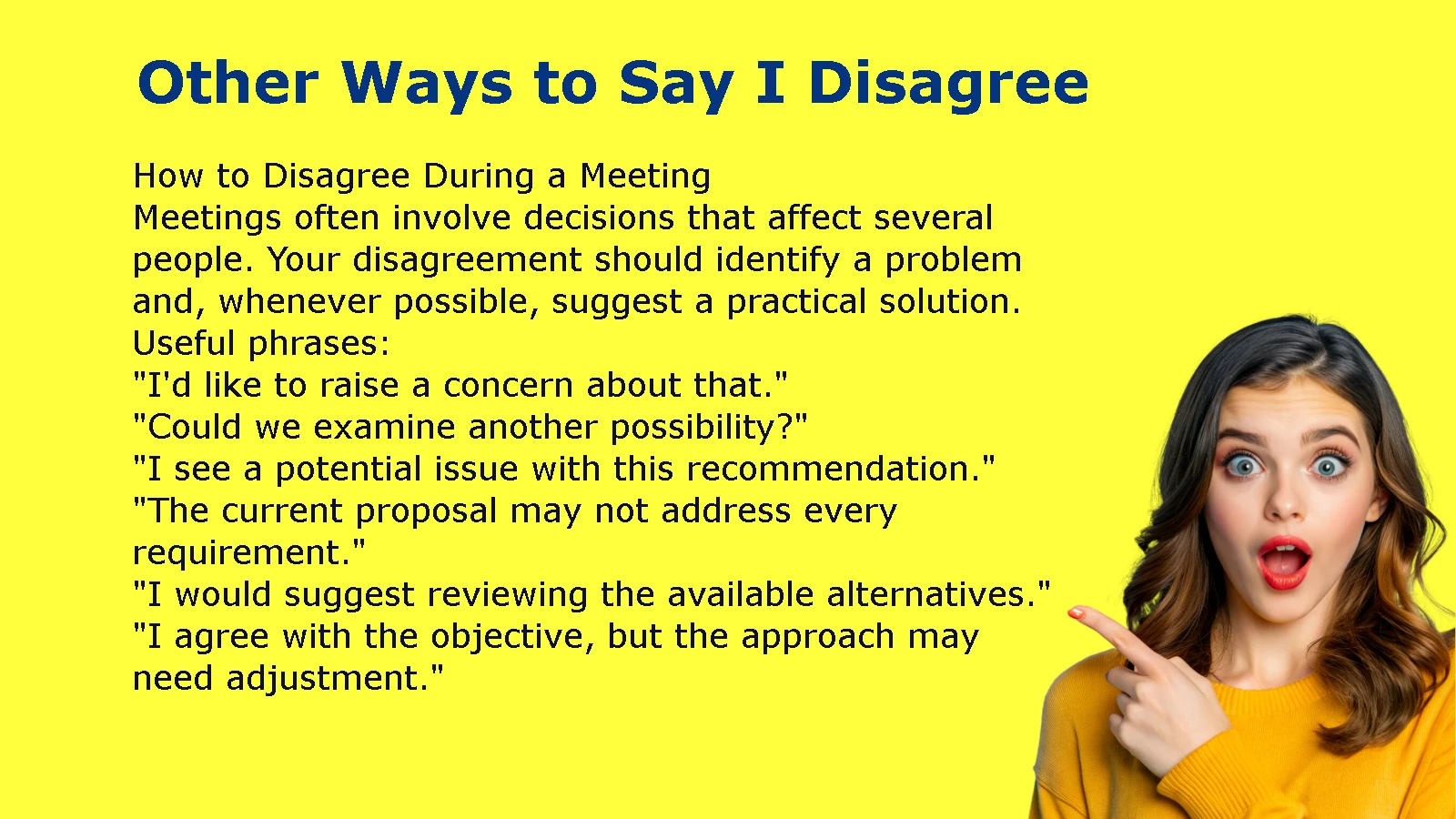
How to Disagree During a Meeting
Meetings often involve decisions that affect several people. Your disagreement should identify a problem and, whenever possible, suggest a practical solution.
Useful phrases:
- “I’d like to raise a concern about that.”
- “Could we examine another possibility?”
- “I see a potential issue with this recommendation.”
- “The current proposal may not address every requirement.”
- “I would suggest reviewing the available alternatives.”
- “I agree with the objective, but the approach may need adjustment.”
Example:
Colleague: “We should immediately switch to a new supplier.”
You: “I’d like to raise a concern about that. We haven’t completed the quality assessment, so changing suppliers now could create unnecessary risks.”
How to Disagree in an Email
Written disagreement requires careful wording because readers cannot hear your tone of voice. Avoid aggressive statements and explain your concerns with specific details.
Here are some professional email expressions:
- “Thank you for sharing your perspective. I have a slightly different view.”
- “I appreciate your suggestion, although I have some concerns.”
- “After reviewing the proposal, I would recommend another approach.”
- “I understand the reasoning behind this decision. However, the figures suggest otherwise.”
- “I would like to propose an alternative for consideration.”
Example email:
Subject: Feedback on the Proposed Project Timeline
Hello,
Thank you for sharing the proposed timeline. I understand the need to complete the project quickly. However, I have some concerns about whether the current schedule allows enough time for quality checks.
I would suggest extending the deadline by two days to reduce the risk of errors and ensure a better final result.
I’d be happy to discuss another approach if needed.
Best regards,
[Your Name]
How to Disagree During a Debate
Debates require clear arguments and strong supporting evidence. You should identify the opposing claim, explain its weaknesses, and present a more convincing position.
Useful expressions:
- “I strongly disagree with that interpretation.”
- “That argument doesn’t account for…”
- “The evidence points in another direction.”
- “I challenge the assumption that…”
- “There is insufficient evidence to support that claim.”
- “An opposing interpretation would suggest…”
Example:
Speaker: “Social media has no negative impact on young people.”
Response: “I strongly disagree with that interpretation. Excessive social media use can affect sleep patterns, concentration, and social relationships. The discussion should consider both its benefits and potential risks.”
How to Disagree With a Teacher or Professor
When questioning an academic explanation, focus on the subject matter and support your position with relevant information.
Try these expressions:
- “Could there be another interpretation?”
- “I understand the explanation, but I found different evidence.”
- “Would it be reasonable to consider another perspective?”
- “I have a question about that conclusion.”
- “The research I reviewed appears to suggest something different.”
Example:
Student: “I understand the explanation, but I found another study that suggests a different relationship between these variables. Could we consider that interpretation as well?”
How to Disagree Without Sounding Rude
You can disagree without sounding rude by acknowledging the other person’s opinion, focusing on the issue rather than the individual, and explaining your position calmly. Respectful disagreement doesn’t require you to hide your opinion. It requires you to communicate it without unnecessary personal criticism.
Use the following practical framework.
Acknowledge the Other Person’s Perspective
Start by recognizing the point someone has made. This doesn’t mean you must agree with them.
For example:
“I understand why you support this proposal. However, I think its long-term costs deserve more attention.”
This approach shows that you listened before responding.
Focus on the Idea, Not the Individual
Avoid personal statements that attack someone’s intelligence or judgment.
Instead of saying:
“You’re wrong about the budget.”
Try:
“I think the budget estimate needs another review.”
The second statement addresses the problem without insulting the person.
Use Evidence to Support Your Position
Evidence makes disagreement more productive because it moves the discussion away from personal opinions.
For example:
“Based on the latest sales figures, I don’t think the current strategy is producing the expected results.”
You can support your disagreement with:
- Research findings.
- Financial figures.
- Relevant examples.
- Customer feedback.
- Historical information.
- Logical explanations.
Choose Softer Language When Appropriate
Words such as “perhaps,” “possibly,” and “might” can soften a disagreement when you’re uncertain or discussing a sensitive subject.
Compare these examples:
| Direct expression | Softer alternative |
| That’s wrong. | I’m not sure that’s entirely accurate. |
| Your plan won’t work. | I see a few challenges with that plan. |
| I disagree. | I have a slightly different perspective. |
| That’s a bad idea. | Perhaps we should consider another option. |
| You’re mistaken. | There may be another way to interpret this. |
Don’t soften every disagreement, though. If you need to communicate an important concern, direct language can prevent misunderstandings.
Avoid Aggressive or Dismissive Expressions
Certain phrases can make people defensive and turn a discussion into an argument.
Avoid expressions such as:
- “That’s ridiculous.”
- “You have no idea what you’re talking about.”
- “Only an idiot would think that.”
- “That’s completely uninformed.”
- “I don’t care what you think.”
- “Your opinion makes no sense.”
Replace them with language that addresses the actual argument.
Polite vs. Strong vs. Formal vs. Funny Ways to Disagree
Different disagreement phrases communicate different levels of confidence, formality, and emotional intensity. A polite expression protects the tone of a conversation, while a strong phrase communicates firm opposition. Formal expressions suit academic and professional situations, and funny alternatives work best in relaxed settings.
Use this comparison to find the right expression quickly.
| Tone | Example phrase | Best situation |
| Polite | I see your point, but… | Everyday conversations |
| Respectful | I understand your perspective, however… | Sensitive discussions |
| Professional | I have a different perspective. | Workplace meetings |
| Academic | The evidence suggests otherwise. | Essays and research |
| Strong | I fundamentally disagree. | Serious disagreements |
| Very strong | I categorically reject that claim. | Formal opposition |
| Casual | I’m not sure I buy that. | Informal conversations |
| Funny | My brain is filing an objection. | Friendly exchanges |
| Diplomatic | Could we consider another approach? | Negotiations |
| Analytical | That conclusion isn’t supported by the evidence. | Debates and research |
Understanding Disagreement Intensity
Not every disagreement requires the same level of force. Consider this simple intensity scale:
| Level | Type | Example |
| 1 | Gentle uncertainty | I’m not entirely sure about that. |
| 2 | Mild disagreement | I see things differently. |
| 3 | Clear disagreement | I respectfully disagree. |
| 4 | Firm disagreement | I strongly disagree with that position. |
| 5 | Complete opposition | I categorically reject that argument. |
This scale helps you avoid using unnecessarily strong language in ordinary conversations.
For example, telling a friend “I categorically reject your opinion” might sound overly dramatic. However, the same expression could fit a formal statement responding to a serious allegation.
Real-Life Examples: Choosing the Right Way to Disagree
Understanding disagreement phrases becomes easier when you see how they work in realistic situations. The following examples demonstrate how the same underlying disagreement can sound different depending on the audience and purpose.
Workplace Example: Challenging a Business Decision
Situation: A manager wants to reduce the customer support budget.
Basic response: “I disagree with that decision.”
Better response: “I understand the need to control expenses, but reducing customer support could affect customer satisfaction and retention.”
Why it works:
- It acknowledges the business objective.
- It identifies a possible consequence.
- It explains the reason for disagreement.
- It encourages further discussion.
Academic Example: Challenging an Essay Argument
Situation: An essay claims that online learning is always more effective than classroom education.
Basic response: “I disagree with this statement.”
Better response: “However, this argument overlooks the importance of direct interaction, immediate feedback, and collaborative classroom activities.”
Why it works:
- It avoids unnecessary first-person language.
- It identifies weaknesses in the original argument.
- It introduces specific supporting points.
- It maintains an academic tone.
Personal Example: Disagreeing With a Friend
Situation: A friend believes that expensive products are always better.
Basic response: “That’s not true.”
Better response: “I see why you might think that, but price doesn’t always reflect quality. Some affordable products perform just as well.”
Why it works:
- It avoids personal criticism.
- It explains the disagreement.
- It provides a reasonable alternative interpretation.
Frequently Asked Questions About Other Ways to Say I Disagree
What Is a Polite Way to Say I Disagree?
A polite way to say I disagree is “I see your point, but I have a different perspective.” Other options include “I respectfully disagree,” “I understand where you’re coming from, but…” and “I see things differently.” These expressions communicate opposition without dismissing another person’s opinion.
How Do You Say I Disagree in a Smart Way?
You can say I disagree in a smart way by challenging the reasoning behind an argument. Try expressions such as “I would challenge that perspective,” “The evidence doesn’t support that conclusion,” or “There’s another way to interpret this.” Support your response with facts and clear reasoning.
What Is a More Professional Word for Disagree?
Professional alternatives include differ, dispute, dissent, object, challenge, and oppose. You can also use expressions such as “I have a different perspective” or “I respectfully disagree with this assessment.” Choose a word that matches the situation and strength of your disagreement.
How Do You Say I Strongly Disagree Without Being Rude?
Use firm but respectful expressions such as “I fundamentally disagree,” “I strongly disagree with that conclusion,” or “I take a different position on this matter.” Explain your reasoning instead of criticizing the person who holds the opposing opinion.
How Can I Disagree in an Essay Without Using I?
Replace personal statements with objective academic expressions. Examples include “However, the evidence suggests otherwise,” “This argument overlooks an important factor,” and “An alternative interpretation is…” These phrases help you present counterarguments without relying on first-person language.
What Are Some Funny Ways to Say I Disagree?
Funny alternatives include “My brain is filing an objection,” “I respectfully reject that reality,” “I love the confidence, not the conclusion,” and “That’s a creative interpretation of the facts.” Use these expressions with friends or people who appreciate humor.
Conclusion: Choose the Right Way to Say I Disagree
Finding other ways to say I disagree helps you communicate more clearly, confidently, and respectfully. Whether you’re discussing an idea with a friend, challenging a colleague’s recommendation, writing an academic essay, or preparing for IELTS, the right expression can make a significant difference.
For everyday conversations, try “I see your point, but…” or “I have a different perspective.” In professional settings, use “I respectfully disagree” or “I have some reservations about that approach.” Academic writers can choose objective expressions such as “However, the evidence suggests otherwise,” while stronger disagreements may require words such as “oppose,” “dispute,” or “categorically reject.”
Remember that effective disagreement focuses on the idea, not the person. You don’t have to change your opinion to show respect for someone else’s.
Start using these alternatives in your conversations and writing. Choose expressions that match your audience, explain your reasoning, and make your point without creating unnecessary conflict.