Share synonyms include words such as distribute, divide, give, provide, communicate, convey, contribute, exchange, and impart. However, the best alternative depends on what you want to share. You might distribute documents, communicate information, impart knowledge, express thoughts, recount experiences, or divide responsibilities. Choosing the right synonym makes your writing clearer, more natural, and more precise.
Whether you want to share information professionally, tell someone something casually, express your thoughts, describe a personal experience, or explain a shared responsibility, there are plenty of alternatives to choose from. This guide covers synonyms for share, professional expressions, casual slang, and context-specific phrases, with definitions and original example sentences.
| Question | Answer |
| What is the best synonym for share? | Distribute, give, provide, communicate, contribute, or exchange. |
| What is another way to say share information? | Communicate, convey, relay, disclose, or pass along information. |
| What is a professional word for share? | Communicate, disseminate, provide, convey, or circulate. |
| What is a slang word for share? | Spill the tea, give someone the scoop, or fill someone in. |
| What is the opposite of share? | Withhold, keep, retain, conceal, or hoard. |
What Are the Best Synonyms for Share?
The best synonyms for share include distribute, divide, provide, give, contribute, communicate, convey, exchange, and impart. Each word describes a slightly different action. For example, you distribute materials among several people, communicate information to a colleague, and contribute ideas to a team. The right replacement depends on your sentence and intended meaning.
Best Synonyms for Share by Context
Not every synonym works in every situation. Replacing share with an unrelated alternative can change the meaning of your sentence.
Consider these distinctions:
| Intended meaning | Best alternatives | Example |
| Give something | Give, offer, provide | I offered my notes to her. |
| Divide resources | Split, divide, allocate | We split the costs. |
| Communicate information | Relay, convey, inform | She relayed the update. |
| Transfer knowledge | Teach, impart, educate | He imparted valuable knowledge. |
| Exchange ideas | Discuss, exchange, contribute | They exchanged ideas. |
| Describe experiences | Recount, relate, narrate | She recounted her journey. |
| Work together | Collaborate, cooperate, contribute | We collaborated on the project. |
For example, “share the report” might mean giving someone access to a document. You could say “send the report,” “provide the report,” or “circulate the report.”
However, “share your opinion” means communicating a personal viewpoint. In that situation, express, voice, and articulate are better alternatives.
Other Ways to Say Share Information
The best alternatives to share information include communicate information, convey details, relay a message, disclose findings, disseminate information, and pass along updates. Professional writing often favors communicate, provide, and convey, while everyday conversations sound more natural with phrases such as let someone know or fill someone in.
Professional Ways to Say Share Information
In professional communication, the word share can sometimes sound too general. More precise verbs explain whether you’re informing colleagues, distributing documents, communicating findings, or making resources available.
Here are useful alternatives:
| Alternative | Best use | Example |
| Communicate information | General workplace communication | We need to communicate the changes to all employees. |
| Convey information | Delivering a message clearly | The presentation conveyed the findings effectively. |
| Disseminate information | Distributing information widely | The department disseminated the new guidelines. |
| Circulate information | Sending information around a group | Please circulate the updated schedule. |
| Relay information | Passing a message between people | I’ll relay the information to management. |
| Provide details | Giving specific information | Could you provide additional details? |
| Brief someone | Giving a concise professional update | The director briefed the project team. |
| Make information available | Providing access to information | We made the research available to employees. |
| Pass along information | Forwarding a message | Please pass along the announcement. |
| Issue an update | Formally communicating new information | The company issued an update yesterday. |
Example in a professional email:
Instead of writing:
“I want to share some information about the upcoming project.”
You could write:
“I’d like to provide an update about the upcoming project.”
The second sentence sounds more direct and professional because it identifies the purpose of the message.
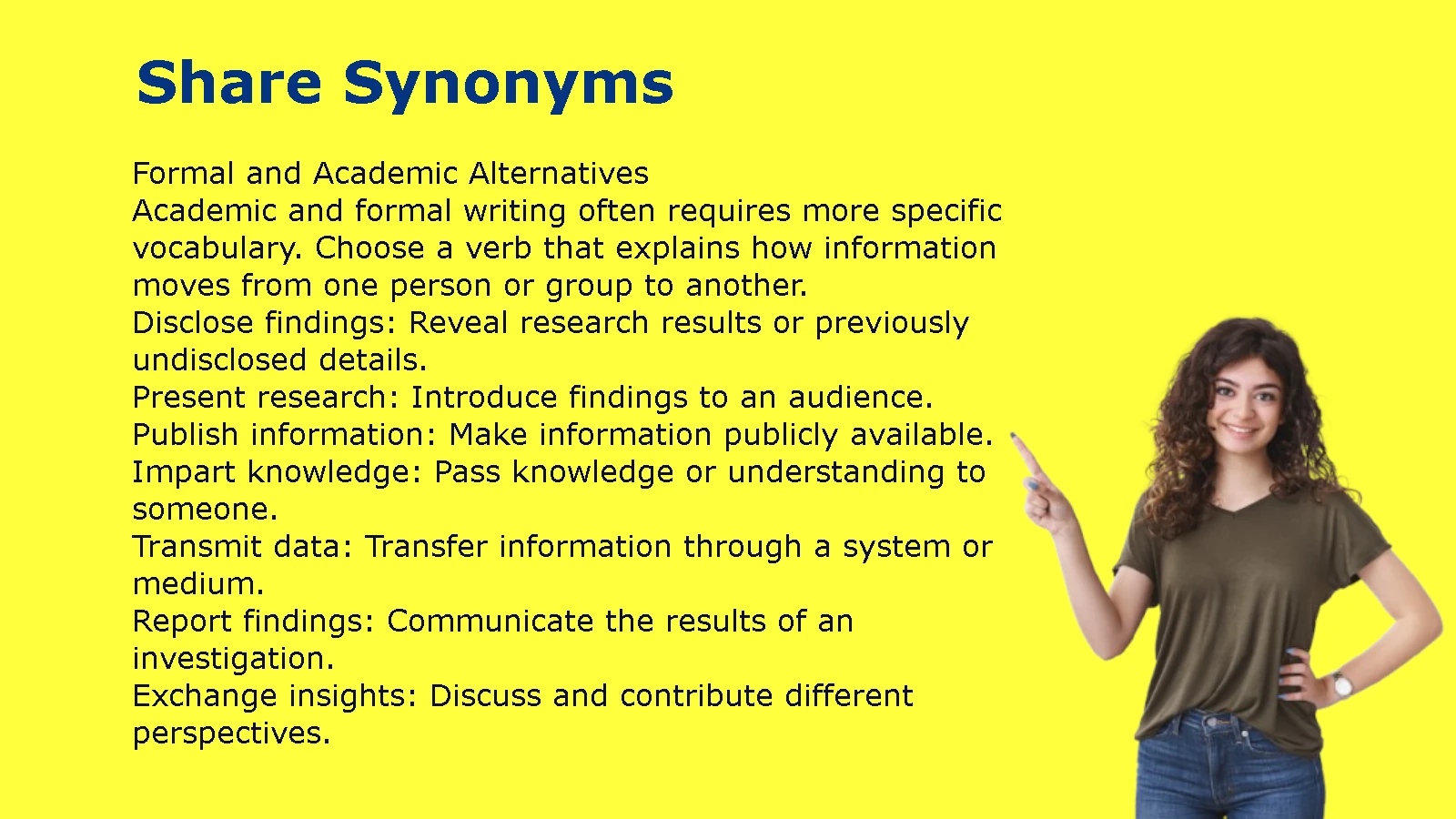
Formal and Academic Alternatives
Academic and formal writing often requires more specific vocabulary. Choose a verb that explains how information moves from one person or group to another.
- Disclose findings: Reveal research results or previously undisclosed details.
- Present research: Introduce findings to an audience.
- Publish information: Make information publicly available.
- Impart knowledge: Pass knowledge or understanding to someone.
- Transmit data: Transfer information through a system or medium.
- Report findings: Communicate the results of an investigation.
- Exchange insights: Discuss and contribute different perspectives.
- Disseminate research: Distribute research findings to a wider audience.
For example:
- The researchers presented their findings at the annual conference.
- The organization published information about its latest initiative.
- The professor imparted knowledge through practical demonstrations.
- The research team disseminated its results among participating institutions.
Casual Ways to Say Share Information
Everyday conversations don’t always need formal vocabulary. If you’re talking to friends, family, or coworkers, shorter expressions often sound more natural.
Try these alternatives:
| Casual expression | Example |
| Let someone know | I’ll let you know what happens. |
| Fill someone in | Can you fill me in on the meeting? |
| Pass it along | Please pass it along to your friends. |
| Give someone the details | I’ll give you the details later. |
| Spread the word | Let’s spread the word about the event. |
| Keep someone updated | I’ll keep you updated. |
| Clue someone in | Can you clue me in on the situation? |
| Give someone the scoop | She gave me the scoop about the new project. |
| Bring someone up to speed | I’ll bring you up to speed tomorrow. |
| Tell someone what’s happening | Let me tell you what’s happening. |
Example Sentences for Sharing Information
Here are some original examples showing how these expressions work in different situations.
At work:
- Please circulate the updated schedule before Friday.
- I’ll brief the management team about the changes.
- We should communicate the new policy to every department.
In academic writing:
- The study presents evidence supporting the proposed theory.
- Researchers disseminated their findings through academic publications.
- The professor conveyed important concepts through practical examples.
In everyday conversations:
- I’ll fill you in when we meet.
- Let me pass along the news.
- I wanted to let you know about something important.
Other Ways to Say Share Knowledge
The best synonyms for share knowledge include impart knowledge, transfer knowledge, teach, educate, disseminate information, exchange expertise, and pass on experience. These expressions describe how someone helps another person learn, understand, or apply information. Choose a phrase based on whether you’re teaching, mentoring, training, or exchanging professional expertise.
Professional Ways to Say Share Knowledge
In the workplace, sharing knowledge helps employees learn from one another, solve problems, and improve performance. However, different expressions emphasize different activities.
| Alternative | Meaning | Example sentence |
| Impart knowledge | Give knowledge or understanding | Experienced employees impart knowledge to new team members. |
| Transfer knowledge | Move expertise from one person to another | The senior engineer transferred knowledge to his replacement. |
| Exchange expertise | Share professional skills and insights | The consultants exchanged expertise during the workshop. |
| Disseminate knowledge | Spread knowledge among a wider group | The organization disseminates knowledge through training. |
| Provide guidance | Help someone understand what to do | The supervisor provided guidance to the interns. |
| Pass on expertise | Teach someone skills gained through experience | She passed on her expertise to younger colleagues. |
| Share insights | Communicate useful observations | The analysts shared insights from their research. |
| Communicate best practices | Explain effective methods | Managers communicated best practices across departments. |
| Mentor others | Guide someone through learning and development | Senior employees mentor junior staff. |
| Build collective knowledge | Develop understanding as a group | The workshop helped build collective knowledge. |
Academic and Educational Alternatives
When discussing education, teaching, or research, these alternatives can make your writing more precise:
- Educate others: Help people develop knowledge and understanding.
- Teach someone: Explain a subject or skill.
- Instruct learners: Give organized lessons or directions.
- Enlighten others: Help someone understand something more clearly.
- Exchange ideas: Discuss different viewpoints and information.
- Spread awareness: Help more people understand an issue.
- Contribute insights: Add useful observations to a discussion.
- Pass on lessons: Communicate knowledge gained through experience.
- Demonstrate a concept: Show how something works.
- Train others: Develop someone’s practical skills through instruction.
Example sentences:
- Teachers impart knowledge through lessons and classroom discussions.
- The research team exchanged ideas before publishing its findings.
- Experienced professionals mentor junior employees throughout their careers.
- The organization spread awareness about responsible technology use.
- The instructor demonstrated the technique before asking students to practice.
Examples of Sharing Knowledge in Different Situations
The phrase you choose should reflect the relationship between the people involved.
| Situation | Natural expression | Example |
| Workplace training | Transfer knowledge | The manager transferred knowledge to the new team. |
| Classroom teaching | Impart knowledge | Teachers impart knowledge through structured lessons. |
| Mentoring | Pass on expertise | She passed on her expertise to young designers. |
| Research collaboration | Exchange insights | Scientists exchanged insights about their discoveries. |
| Online education | Disseminate knowledge | The platform disseminates knowledge through free courses. |
| Team discussions | Contribute ideas | Everyone contributed ideas during the meeting. |
One important distinction: teaching usually involves helping someone learn, while exchanging knowledge suggests that both sides contribute information. Similarly, transferring knowledge often describes a more organized process, especially during employee training or a change in responsibilities.
Other Ways to Say Share Your Thoughts
The best alternatives to share your thoughts include express your opinion, voice your perspective, offer your input, speak your mind, provide feedback, and articulate your viewpoint. Professional situations call for expressions such as provide your perspective, while personal conversations often sound more natural with speak your mind or tell me what you think.
Professional Ways to Say Share Your Thoughts
In meetings, emails, and workplace discussions, choosing a professional alternative can make your request sound more confident and specific.
Consider these expressions:
| Alternative | Best context | Example sentence |
| Express your opinion | General professional discussions | Please express your opinion during the meeting. |
| Provide your perspective | Asking for someone’s viewpoint | I’d appreciate it if you could provide your perspective. |
| Offer your input | Requesting suggestions | We’d value your input on the proposal. |
| Voice your concerns | Discussing problems | Employees should feel comfortable voicing their concerns. |
| Contribute your ideas | Collaborative projects | Everyone can contribute ideas to the campaign. |
| Present your viewpoint | Formal discussions | She presented her viewpoint to the committee. |
| Give your feedback | Reviewing work | Please give your feedback on the draft. |
| Articulate your position | Explaining a clear stance | He articulated his position during negotiations. |
| Share your insights | Discussing expertise | We’d like you to share your insights with the team. |
| State your thoughts | Direct communication | Please state your thoughts clearly. |
Casual Ways to Say Share Your Thoughts
When speaking with friends or people you know well, informal expressions can make a conversation feel more relaxed.
- Speak your mind: Say what you genuinely think.
- Tell me what you think: Ask someone for an honest opinion.
- Let me know your thoughts: Invite someone to respond.
- Give me your take: Ask for a personal interpretation.
- Put your ideas out there: Express ideas openly.
- Say what’s on your mind: Encourage someone to speak honestly.
- Give me your two cents: Ask for someone’s opinion.
- Talk it through: Discuss an issue together.
- Sound off: Express an opinion, often strongly or publicly.
- Tell me where you stand: Ask someone to explain their position.
Examples for Emails, Meetings, and Conversations
Professional email:
“Please share your thoughts on the revised marketing strategy.”
Alternative:
“We’d appreciate your feedback on the revised marketing strategy.”
Team meeting:
“Everyone should share their ideas before we make a decision.”
Alternative:
“Let’s hear everyone’s perspective before making a decision.”
Personal conversation:
“I’d love you to share your thoughts about my new business idea.”
Alternative:
“I’d love to hear your take on my new business idea.”
The difference is subtle but useful. Feedback often implies an evaluation, while perspective emphasizes someone’s viewpoint. Input usually suggests a contribution that can help shape a decision.
Other Ways to Say I Want to Share
If you want to introduce information, a personal story, or an important announcement, you can replace I want to share with phrases such as I’d like to tell you, I wanted to let you know, I’d like to bring something up, or I have something to show you. The most suitable expression depends on your relationship with the listener and the purpose of your message.
Professional Alternatives
Use these expressions in emails, presentations, workplace announcements, and formal conversations.
| Alternative | Example |
| I’d like to bring something to your attention. | I’d like to bring an important issue to your attention. |
| I’d like to inform you about something. | I’d like to inform you about a change in the schedule. |
| I wanted to provide an update. | I wanted to provide an update on the project. |
| I’d like to pass along some information. | I’d like to pass along some information from management. |
| I’d like to discuss something with you. | I’d like to discuss a new opportunity with you. |
| I have an announcement to make. | I have an announcement to make about our upcoming event. |
| I’d like to highlight something. | I’d like to highlight an important improvement. |
| I wanted to bring up a point. | I wanted to bring up a point about the proposal. |
| I’d like to present an idea. | I’d like to present an idea for our next campaign. |
| I have an update regarding… | I have an update regarding the recruitment process. |
Friendly and Casual Alternatives
For everyday conversations, use expressions that sound natural rather than overly formal.
- I have something to tell you.
- I wanted to let you know.
- There’s something I’d like you to hear.
- I thought I’d tell you about this.
- Let me tell you something.
- I’ve got something to show you.
- I have some news for you.
- Guess what I found out?
- There’s something on my mind.
- I thought you might find this interesting.
Examples of How to Introduce Something You Want to Share
The following examples show how to adjust your opening phrase to match the situation.
When announcing good news:
“I have some exciting news to tell you.”
When discussing a problem:
“I’d like to bring something to your attention.”
When telling a personal story:
“There’s something that happened recently that I’d like to tell you about.”
When giving a workplace update:
“I wanted to provide an update on our progress.”
When introducing an idea:
“I’d like to propose a different approach.”
A useful writing tip: Avoid beginning every message with “I want to share.” Vary your opening according to the message’s purpose. This makes emails and conversations sound more natural.
Synonyms for Share With Someone
The best synonyms for share with someone include give to, provide with, offer, tell, inform, discuss, reveal, show, and confide in. The correct expression depends on whether you’re giving someone an object, communicating information, discussing an idea, or revealing something personal.
Alternatives for Giving Something to Someone
When you share physical items, documents, resources, or opportunities, use verbs that describe the transfer.
| Alternative | Example sentence |
| Give someone | She gave her notes to a classmate. |
| Offer someone | He offered his assistance to the new employee. |
| Provide someone with | The company provided employees with new equipment. |
| Present someone with | They presented the winner with an award. |
| Pass something to someone | Please pass the document to Sarah. |
| Supply someone with | The organization supplied families with food. |
| Lend someone | I lent my friend a book. |
| Make available to someone | We made the training materials available to everyone. |
| Grant someone access | The administrator granted the team access to the files. |
Alternatives for Telling Someone Something
When the thing being shared is information, news, or a message, these expressions work better:
- Tell someone: Communicate information directly.
- Inform someone: Give someone important information.
- Let someone know: Provide an update in a natural way.
- Confide in someone: Reveal private thoughts or feelings to someone you trust.
- Open up to someone: Talk honestly about personal matters.
- Fill someone in: Explain information they may have missed.
- Notify someone: Formally communicate an update.
- Brief someone: Give a concise explanation.
- Alert someone: Warn someone about an important situation.
Alternatives for Sharing Something Personally
Some forms of sharing involve emotional connection rather than transferring information or objects.
Useful expressions include:
- Discuss with someone: Talk about a subject together.
- Exchange with someone: Give and receive ideas or information.
- Show someone: Let another person see something.
- Reveal something to someone: Make previously unknown information known.
- Connect with someone: Develop a personal or emotional relationship.
- Open up to someone: Discuss personal feelings honestly.
- Relate to someone: Establish a connection through similar feelings or experiences.
For example:
- “She confided in her sister about her worries.”
- “I discussed the proposal with my manager.”
- “He opened up to his friends about his experience.”
- “They exchanged ideas during the conversation.”
The expression confide in carries a stronger emotional meaning than simply sharing. It suggests trust and personal disclosure, so it isn’t suitable for every situation.
Share Experience Synonyms and Other Ways to Say Shared Experience
Useful share experience synonyms include recount, describe, relate, narrate, discuss, and reflect on. These alternatives help communicate personal stories, lessons, and memories. When several people experience something together, expressions such as common experience, collective experience, mutual experience, and shared journey describe that connection.
Synonyms for Sharing a Personal Experience
When telling someone about something you’ve experienced, choose a verb that reflects how you communicate the story.
| Synonym or phrase | Meaning | Example |
| Recount an experience | Tell someone what happened | She recounted her experience abroad. |
| Describe an experience | Explain what something was like | He described his first day at work. |
| Relate a story | Tell a personal or memorable story | The traveler related a fascinating story. |
| Tell your story | Explain something from your own life | She told her story to the audience. |
| Open up about an experience | Discuss something personal | He opened up about his difficult childhood. |
| Reflect on an experience | Think about something that happened | We reflected on our time together. |
| Narrate an experience | Tell events in a structured way | The author narrated her childhood experiences. |
| Talk about something | Discuss an event or situation | They talked about their trip. |
| Recall an experience | Remember and describe something | I recalled an unforgettable moment. |
| Discuss an incident | Talk about a particular event | The team discussed the incident. |
Other Ways to Say Shared Experience
A shared experience describes something that two or more people have experienced together or something that creates a sense of connection between them.
Here are useful alternatives:
- Common experience: Something several people have experienced.
- Collective experience: An experience involving a group.
- Mutual experience: Something experienced by two or more people.
- Joint experience: An activity or event experienced together.
- Experience together: A straightforward everyday expression.
- Shared journey: A common process or period of development.
- Common ground: Similar experiences, interests, or beliefs that connect people.
- Collective memory: Memories held by a group or community.
- Bonding experience: An event that strengthens relationships.
- United experience: An experience that brings people together.
Example Sentences for Sharing Experiences
- The employees recounted their experiences during the annual meeting.
- Traveling together created a shared experience that strengthened their friendship.
- The workshop gave participants an opportunity to exchange personal stories.
- Our team developed a strong connection through a common experience.
- She decided to open up about her journey to encourage others.
- The event created a collective memory that the community still celebrates.
Practical example: Imagine a group of employees completing a challenging project. Each person has a different role, but they experience the same deadlines, obstacles, and achievements. You could describe this as a shared experience, a collective journey, or a common professional experience. Each phrase emphasizes a slightly different aspect of the situation.
Other Ways to Say Share the Load
The best alternatives to share the load include divide the workload, split the burden, distribute responsibilities, pitch in, lend a hand, collaborate, and work together. These expressions describe situations where people divide tasks or contribute effort to achieve a common result without placing the entire burden on one person.
Professional Alternatives for Sharing the Load
In a workplace, sharing the load often means distributing tasks fairly among employees or departments.
| Alternative | Meaning | Example |
| Divide the workload | Separate tasks among people | Let’s divide the workload equally. |
| Distribute responsibilities | Assign duties across a group | Management distributed responsibilities among departments. |
| Delegate tasks | Assign tasks to other people | The supervisor delegated tasks to the team. |
| Divide the responsibilities | Give different duties to different people | We divided the responsibilities before starting. |
| Collaborate on tasks | Work together on activities | The designers collaborated on the project. |
| Pool our efforts | Combine everyone’s contributions | We pooled our efforts to finish early. |
| Work collectively | Complete something as a group | The departments worked collectively toward the target. |
| Split the workload | Divide the amount of work | We split the workload between three employees. |
| Share the burden | Distribute pressure or responsibility | The partners shared the burden of running the business. |
| Contribute equally | Give a fair amount of effort | Everyone contributed equally to the project. |
Casual Alternatives
For everyday situations, these expressions sound more relaxed:
- Pitch in: Help with a task or responsibility.
- Lend a hand: Offer practical assistance.
- Help each other out: Provide mutual support.
- Pull your weight: Do your fair share of the work.
- Split the work: Divide tasks between people.
- Do your fair share: Contribute an appropriate amount.
- Team up: Work with someone toward a goal.
- Take some pressure off: Reduce another person’s workload.
- Chip in: Contribute money, effort, or assistance.
- Carry your share: Accept responsibility for your part.
Examples in Workplace and Everyday Situations
At work:
- We should divide the workload before the deadline approaches.
- Everyone needs to pull their weight during the project.
- Let’s pool our efforts and finish the presentation together.
At home:
- Everyone should pitch in with household chores.
- We can split the responsibilities for organizing the event.
- I’ll cook if you lend a hand with cleaning.
In a business partnership:
- Both partners share the burden of managing the company.
- The founders divide responsibilities according to their expertise.
- Each department contributes equally to the overall objective.
An important distinction: delegate means assigning responsibility to someone else, usually by someone with authority. It doesn’t necessarily mean that everyone contributes equally. By contrast, divide the workload directly emphasizes distributing tasks.
Other Ways to Say Shared Responsibility
The best alternatives to shared responsibility include joint responsibility, collective responsibility, mutual accountability, shared accountability, joint ownership, and common obligation. These expressions describe situations in which multiple people accept duties or remain accountable for an outcome, decision, or task.
Professional Alternatives
| Alternative | Meaning | Example |
| Joint responsibility | Responsibility held by multiple people | Both directors have joint responsibility for the decision. |
| Collective responsibility | A group accepts responsibility together | The committee accepted collective responsibility. |
| Mutual accountability | People hold one another accountable | The partnership depends on mutual accountability. |
| Shared accountability | Multiple parties answer for an outcome | The departments have shared accountability for performance. |
| Joint ownership | Multiple people own or manage something | The founders maintain joint ownership of the business. |
| Common obligation | A duty accepted by several people | Environmental protection is a common obligation. |
| Collective ownership | Ownership held by a group | The cooperative operates through collective ownership. |
| Collaborative responsibility | Duties handled through cooperation | The project requires collaborative responsibility. |
| Joint commitment | A promise or obligation shared by people | The partners made a joint commitment to quality. |
| Mutual duty | An obligation between two or more parties | Respect is a mutual duty in any partnership. |
Examples of Shared Responsibility in Different Contexts
Workplace projects:
“Successful project management requires shared accountability between the department heads.”
Parenting and household duties:
“Maintaining a comfortable home is a shared responsibility between family members.”
Team management:
“The leadership team accepted collective responsibility for the company’s performance.”
Community initiatives:
“Keeping public spaces clean is a common obligation for residents.”
Business partnerships:
“Both founders have joint responsibility for major financial decisions.”
A useful distinction is that responsibility refers to having a duty to do something, while accountability emphasizes answering for the result. For example, two employees may share responsibility for completing a project, but a manager may remain accountable for its overall outcome.
Other Ways to Say Share the Love
The best alternatives to share the love include spread kindness, show affection, spread positivity, give back, pay it forward, show appreciation, and spread joy. These expressions communicate generosity, emotional support, and positive feelings. Use them when encouraging people to care for others, celebrate relationships, or make someone feel appreciated.
Heartwarming Alternatives
Here are expressions that communicate affection, generosity, and kindness.
| Alternative | Meaning | Example |
| Spread kindness | Encourage kind actions | Let’s spread kindness wherever we go. |
| Show some love | Express affection or support | Show some love to your friends. |
| Pass on the kindness | Continue a generous action | She passed on the kindness to another family. |
| Spread the joy | Help others experience happiness | The volunteers spread joy throughout the community. |
| Show appreciation | Express gratitude | Take a moment to show appreciation for your team. |
| Share the happiness | Let others participate in something positive | We wanted to share the happiness with everyone. |
| Give back | Help people or communities | The business gives back to the local community. |
| Make someone’s day | Do something that makes another person happy | A simple compliment can make someone’s day. |
| Pay it forward | Return kindness by helping someone else | Someone helped me, so I decided to pay it forward. |
| Offer encouragement | Give someone emotional support | We should offer encouragement to people facing challenges. |
Casual and Social Media Expressions
If you’re writing a caption, social media post, or friendly message, these expressions can sound more engaging:
- Spread good vibes.
- Send some love.
- Pay it forward.
- Spread positivity.
- Show your support.
- Keep the love going.
- Make someone’s day.
- Be someone’s reason to smile.
- Pass along a little happiness.
- Celebrate the people around you.
- Give kindness freely.
- Keep spreading smiles.
Example Sentences for Sharing Love and Kindness
- Let’s spread kindness by helping people who need support.
- Don’t forget to show some love to those who encourage you.
- The community came together to spread joy during the holidays.
- A small act of generosity can make someone’s day.
- When someone helps you, consider paying it forward.
These expressions aren’t always direct synonyms for share. For example, “pay it forward” describes continuing a chain of generosity rather than simply giving something to another person.
Other Ways to Say Sharing Is Caring
Sharing is caring means that giving, helping, and including others demonstrate kindness and consideration. Alternative expressions include sharing shows you care, kindness grows when shared, generosity brings people together, and a little kindness goes a long way. These sayings work well in conversations, classroom activities, community messages, and social media captions.
Alternative Expressions and Sayings
| Alternative saying | Meaning |
| Sharing shows you care. | Giving something demonstrates consideration for others. |
| Kindness grows when shared. | Generosity can inspire more generous actions. |
| Giving makes a difference. | Helping others can improve their lives. |
| Generosity brings people together. | Giving strengthens relationships and communities. |
| Caring means giving. | Kindness often involves helping others. |
| What goes around comes around. | Actions can have consequences that return to you. |
| A little kindness goes a long way. | Small gestures can have a meaningful impact. |
| Together, we can make a difference. | Collective efforts can produce positive results. |
| It’s better to give than to receive. | Giving can be deeply rewarding. |
| Good things are better when shared. | Enjoyment can increase when people experience something together. |
Short and Catchy Alternatives for Captions
For social media, posters, and short messages, use concise expressions:
- Kindness is meant to be shared.
- Spread love, not negativity.
- Give more, care more.
- Together is better.
- Happiness grows when shared.
- Make kindness contagious.
- Sharing creates connections.
- A little generosity goes a long way.
- Pass on the good.
- Give freely and care deeply.
Example for a community campaign:
“Kindness is meant to be shared. A small gesture today can make a lasting difference tomorrow.”
This expression preserves the message of “sharing is caring” without repeating the original saying.
Other Ways to Say Shared Purpose
The best alternatives to shared purpose include common goal, collective mission, unified objective, mutual vision, joint ambition, common objective, and shared vision. These phrases describe an aim that connects people and guides their efforts toward a common result.
Professional Alternatives
In business and organizational writing, shared purpose often describes the central goal that brings employees, leaders, or partners together.
| Alternative | Meaning | Example |
| Common goal | An objective pursued by several people | The team worked toward a common goal. |
| Collective mission | A mission accepted by a group | The organization has a collective mission to improve education. |
| Unified objective | A clearly aligned target | Both departments have a unified objective. |
| Mutual vision | A future goal supported by multiple people | The partners developed a mutual vision for growth. |
| Common objective | A result several people want to achieve | The project has one common objective. |
| Joint ambition | An aspiration shared by people | The founders have a joint ambition to expand globally. |
| Shared vision | A common understanding of a desired future | The company built its strategy around a shared vision. |
| Collective aim | A purpose pursued by a group | Their collective aim is to improve customer service. |
| Common mission | A mission that unites different individuals | The volunteers share a common mission. |
| Aligned priorities | Goals or interests that support one another | The departments established aligned priorities. |
Examples of Shared Purpose in Teams and Organizations
- The company developed a shared vision for its long-term growth.
- Every department worked toward a common objective.
- The nonprofit’s collective mission focused on improving access to education.
- The business partners established a mutual vision for the future.
- Strong leadership helped the team maintain a unified objective.
Shared purpose and common goal are closely related, but they aren’t always interchangeable. A common goal usually describes a specific result. Shared purpose can describe the broader reason people work together.
For example, increasing annual sales by 15% is a common goal. Building a company that delivers better customer experiences is a broader shared purpose.
Share Synonyms Slang and Casual Expressions
Popular slang alternatives for share include spill the tea, give someone the scoop, fill someone in, clue someone in, pass it on, and let someone in on something. These expressions are particularly useful when sharing news, gossip, personal information, or interesting details with friends. Their tone is informal, so avoid using them in formal business documents.
Popular Slang Expressions for Sharing Information
Here are common expressions and their meanings.
| Slang expression | Meaning | Example |
| Spill the tea | Reveal gossip or interesting information | Come on, spill the tea! |
| Give me the scoop | Tell me the latest news | Give me the scoop about the new manager. |
| Put someone on | Introduce someone to something useful, interesting, or worthwhile | My friend put me on to a great podcast. |
| Let someone in on it | Reveal information to someone | I’ll let you in on a little secret. |
| Drop the details | Provide specific information | Drop the details when you get a chance. |
| Fill me in | Explain what someone has missed | Fill me in on what happened yesterday. |
| Pass the word | Communicate information to others | Pass the word about the event. |
| Dish the details | Reveal interesting or juicy information | She’s ready to dish the details. |
| Give someone the lowdown | Explain the important facts | Give me the lowdown on the new project. |
| Keep me posted | Continue providing updates | Keep me posted about your plans. |
| Let the cat out of the bag | Reveal a secret accidentally | He let the cat out of the bag about the surprise. |
| Spread the word | Tell more people about something | Help us spread the word about the fundraiser. |
Casual Ways to Say Share Something With Friends
When you’re talking to friends, you can use short, natural expressions instead of formal synonyms.
- Check this out.
- You’ve got to hear this.
- I have something to show you.
- Let me tell you what happened.
- Take a look at this.
- You’ll want to hear about this.
- Guess what I found?
- I’ve got some news.
- Here’s something interesting.
- I thought you’d like to see this.
When to Use Slang Instead of Formal Synonyms
Slang can make your communication sound friendly and relaxed. However, it doesn’t fit every situation.
| Situation | Better expression | Avoid |
| Professional email | I’d like to provide an update. | Spill the tea. |
| Conversation with friends | Give me the scoop. | Disseminate information. |
| Academic presentation | Present the findings. | Drop the details. |
| Social media caption | Spread the word. | Circulate the information. |
| Private conversation | Let me in on the secret. | Disclose the matter. |
Remember that some slang expressions have specific meanings. Spill the tea generally refers to gossip or interesting personal information, not sharing ordinary documents or resources. Similarly, put someone on often means introducing someone to a useful person, opportunity, trend, or recommendation.
Share Synonym and Antonym: What’s the Difference?
A synonym is a word with the same or a similar meaning, while an antonym expresses an opposite meaning. Common synonyms for share include distribute, divide, give, provide, and contribute. Common antonyms include withhold, keep, retain, conceal, and hoard. The correct choice depends on whether share refers to giving, dividing, or communicating.
Common Synonyms of Share
These alternatives cover the major meanings of share.
| Synonym | Meaning | Example |
| Distribute | Give to several people | Distribute the documents. |
| Divide | Separate into portions | Divide the costs equally. |
| Give | Transfer something to another person | Give your colleague the file. |
| Contribute | Add something to a common effort | Contribute your ideas. |
| Communicate | Convey information | Communicate your concerns. |
| Exchange | Give and receive | Exchange opinions. |
| Provide | Make something available | Provide additional resources. |
| Reveal | Make something known | Reveal the results. |
| Convey | Express or communicate | Convey your message clearly. |
| Impart | Pass on knowledge | Impart valuable lessons. |
Common Antonyms of Share
An antonym of share describes an action that prevents others from receiving, accessing, or participating in something.
| Antonym | Meaning | Example |
| Keep | Retain something for yourself | He decided to keep the information private. |
| Withhold | Refuse to give or provide something | The company withheld important details. |
| Retain | Continue possessing something | She retained control of the document. |
| Hoard | Collect and keep things rather than distribute them | He hoarded supplies during the shortage. |
| Conceal | Hide something from others | They concealed the truth. |
| Hide | Keep something out of sight or knowledge | She hid the message. |
| Reserve | Keep something for a particular person or purpose | We reserved the seats for guests. |
| Hold back | Avoid giving or revealing something | He held back his opinion. |
| Keep to yourself | Avoid telling others personal information | She kept her feelings to herself. |
| Exclude | Prevent someone from participating | They excluded him from the discussion. |
Examples Showing the Difference Between Synonyms and Antonyms
Understanding these words becomes easier when you compare them in complete sentences.
Using synonyms:
- She decided to share her notes with the class.
- She decided to distribute her notes to the class.
- She decided to provide the class with her notes.
All three sentences describe giving access to the notes, although the emphasis changes slightly.
Using antonyms:
- He decided to share the information with everyone.
- He decided to withhold the information.
- He decided to keep the information private.
The first sentence describes communicating information, while the other two describe restricting access to it.
One important point: antonyms depend on context. The opposite of sharing expenses might be paying for everything yourself. The opposite of sharing information might be withholding it. There isn’t one universal antonym for every meaning of share.
How to Choose the Right Synonym for Share
Choosing the right synonym for share requires understanding what you’re communicating, who will receive it, and the tone you want to establish. Use provide or offer when giving something, divide or allocate when separating resources, convey or communicate when delivering information, and impart or teach when transferring knowledge.
Choose Based on Meaning
Start by identifying the action behind the word share.
| If you mean… | Choose these alternatives |
| Giving something to another person | Give, offer, provide, present |
| Dividing something | Split, divide, allocate, distribute |
| Communicating information | Convey, inform, relay, communicate |
| Sharing knowledge | Teach, impart, educate, instruct |
| Describing experiences | Recount, narrate, relate, describe |
| Expressing feelings | Express, reveal, open up, confide |
| Working together | Collaborate, cooperate, contribute |
| Distributing resources | Supply, circulate, allocate, distribute |
| Sharing responsibilities | Delegate, divide, distribute, cooperate |
| Building connections | Connect, bond, relate, interact |
For example, if you’re writing about sharing a business report, “circulate” or “distribute” might be appropriate. If you’re describing how a teacher shares knowledge, “impart” or “teach” is more accurate.
Choose Based on Tone
Your audience also influences your word choice.
Formal alternatives:
- Disseminate
- Convey
- Disclose
- Impart
- Circulate
- Communicate
Professional alternatives:
- Provide
- Contribute
- Present
- Exchange
- Coordinate
- Collaborate
Casual alternatives:
- Tell
- Pass along
- Fill in
- Let someone know
- Give someone the scoop
Emotional alternatives:
- Open up
- Connect
- Express
- Confide
- Show affection
A formal word isn’t automatically better. For instance, “disseminate” may be suitable in an academic report, but “pass along” is more natural when asking a coworker to forward a quick message.
Common Mistakes When Using Share Synonyms
Even words with similar meanings can create confusing sentences when you use them in the wrong context.
| Common mistake | Why it doesn’t work | Better choice |
| Using disclose for ordinary information | Disclose often suggests revealing something previously hidden or restricted. | Communicate or provide |
| Using distribute for personal feelings | Distribute usually refers to spreading items or information. | Express or share |
| Using divide when you mean communicate | Divide suggests separating something into portions. | Convey or communicate |
| Using delegate when you mean cooperate | Delegate means assigning tasks or authority. | Collaborate or contribute |
| Using exchange when only one person gives something | Exchange generally suggests giving and receiving. | Provide or offer |
| Using confide for public announcements | Confide suggests private or personal communication. | Announce or inform |
| Using hoard as a general antonym | Hoard suggests keeping or accumulating something excessively. | Withhold or retain |
A Practical Case Study: Choosing the Right Word in a Workplace Email
Imagine a project manager writing an email to employees about a new company initiative.
The original message reads:
“I want to share information about the project, share our responsibilities, and share our ideas before the deadline.”
Although the meaning is understandable, repeating share makes the email sound less polished.
A more precise version would be:
“I’d like to provide an update about the project, divide responsibilities among the team, and exchange ideas before the deadline.”
Notice what changed:
- Provide an update communicates information.
- Divide responsibilities describes the allocation of tasks.
- Exchange ideas explains a collaborative discussion.
The revised sentence uses three different expressions because each describes a different action.
This is the main principle behind effective synonym selection: choose the word that communicates the intended action rather than replacing share with the first similar word you find.
Frequently Asked Questions About Share Synonyms
What Is the Best Synonym for Share?
The best synonym for share depends on the context. Common alternatives include distribute, give, provide, communicate, contribute, exchange, and convey. Use distribute when giving something to several people, communicate when delivering information, and contribute when adding something to a common effort.
What Is Another Word for Share Information?
Another word for share information is communicate, convey, relay, disclose, disseminate, or inform. In casual conversations, you can use let someone know, fill someone in, or pass along the information. For professional writing, communicate and provide are particularly versatile choices.
How Do You Say Share Information in a Professional Way?
You can say communicate information, provide an update, convey details, circulate information, disseminate findings, or relay a message. For example, instead of saying “I want to share some information,” write “I’d like to provide an update on the project.”
What Is a Slang Word for Share?
Popular slang expressions for share include spill the tea, give someone the scoop, fill someone in, clue someone in, dish the details, and pass it on. These phrases work best in informal conversations, particularly when discussing news, gossip, or interesting information.
What Is Another Way to Say Share Your Thoughts?
You can replace share your thoughts with express your opinion, voice your perspective, offer your input, provide feedback, articulate your viewpoint, or speak your mind. In professional settings, provide your perspective and offer your input sound particularly natural.
What Is the Opposite of Share?
Common opposites of share include withhold, keep, retain, conceal, hoard, hide, and hold back. The best antonym depends on the meaning. Withhold works when someone refuses to provide information, while keep or retain describes maintaining possession of something.
Conclusion: Choose the Best Share Synonym for Your Context
Finding the right share synonym isn’t simply about replacing one word with another. It’s about communicating your intended meaning clearly and choosing expressions that fit your audience, situation, and tone.
For general writing, alternatives such as give, provide, distribute, contribute, and exchange work well. When communicating information, consider convey, relay, disclose, and disseminate. For personal conversations, expressions such as open up, speak your mind, fill someone in, and let someone know sound more natural.
Use these quick guidelines when choosing an alternative:
- For sharing information, use communicate, convey, or relay.
- For sharing knowledge, use impart, teach, or educate.
- For sharing thoughts, use express, articulate, or voice.
- For sharing experiences, use recount, describe, or relate.
- For sharing responsibilities, use divide, delegate, or collaborate.
- For sharing affection, use spread kindness, show love, or express appreciation.
The best word is the one that makes your sentence clearer without changing its meaning. Explore these alternatives, practice them in your writing, and choose expressions that make your communication more precise and engaging.