Other ways to say “While We Resolve the Issue” include “While We Work Toward a Solution,” “As We Address the Matter,” “While We Investigate the Situation,” and “During the Resolution Process.” These alternatives help you communicate professionally, reassure customers, and explain that your team is actively working to fix a problem.
Choosing the right expression depends on the situation. In customer service, you might want to sound reassuring and approachable. In a formal business email, a more polished expression may work better. When handling workplace disagreements, phrases such as “While We Work to Reach an Agreement” can communicate cooperation without assigning blame.
Understanding related expressions such as resolve the issue, rectify the problem, address the concern, settle a dispute, and find a solution also helps you write clearer emails and workplace messages.
| Question | Answer |
| What is another way to say “While We Resolve the Issue”? | While We Work Toward a Solution or As We Address the Matter. |
| What is a professional synonym for resolve the issue? | Address, rectify, remedy, fix, or settle the matter. |
| What does resolve the issue mean? | It means taking action to solve a problem or bring an unwanted situation to an end. |
| What is another word for resolving a conflict? | Settle, mediate, reconcile, negotiate, or reach an agreement. |
| How do you politely request a quick resolution? | Please look into this matter at your earliest convenience. |
30+ Other Ways to Say “While We Resolve the Issue”
The best alternatives to “While We Resolve the Issue” communicate progress without making unnecessary promises. Some expressions emphasize investigation, while others focus on finding a solution or correcting a problem. Choose wording that accurately describes what your team is doing and matches the formality of your communication.
Professional Alternatives
Professional alternatives work well in business emails, project updates, workplace discussions, and formal customer correspondence. They communicate responsibility while maintaining a respectful tone.
| Alternative phrase | Best context | Example sentence |
| While We Work to Resolve the Matter | Formal business emails | While we work to resolve the matter, please continue using the temporary service. |
| As We Address the Issue | Workplace communication | As we address the issue, we will keep all affected departments informed. |
| While We Investigate the Situation | Complaints and technical problems | While we investigate the situation, we appreciate your patience. |
| As We Work Toward a Solution | General business communication | As we work toward a solution, our team will review the available options. |
| While We Find a Suitable Resolution | Complex problems | While we find a suitable resolution, we will provide regular updates. |
| During the Resolution Process | Formal reports | During the resolution process, we will document each corrective action. |
| While We Review the Matter | Administrative communication | While we review the matter, please share any additional information that may help. |
| As We Take the Necessary Steps | Operational updates | As we take the necessary steps, we will monitor the situation closely. |
Example in context:
Original: “While we resolve the issue, please wait for further instructions.”
Improved: “While we work toward a solution, please follow the temporary instructions provided by our support team.”
The revised sentence sounds more collaborative and explains what the organization is doing.
Polite and Customer-Friendly Alternatives
Customer-facing messages should reassure readers without sounding defensive or overly formal. These alternatives show that someone has acknowledged the customer’s concern and intends to take appropriate action.
| Alternative phrase | Example sentence |
| While We Look Into This for You | While we look into this for you, we appreciate your understanding. |
| As We Work to Make Things Right | As we work to make things right, our support team will keep you informed. |
| While We Take Care of the Matter | While we take care of the matter, you can contact us with additional questions. |
| As We Review Your Concern | As we review your concern, we will examine the information you provided. |
| While We Work on a Solution for You | While we work on a solution for you, thank you for giving us the opportunity to help. |
| Until We Have This Sorted Out | Until we have this sorted out, we will provide an alternative arrangement. |
Practical tip: Use “While We Look Into This for You” when you have not identified the cause of a problem. Choose “As We Work to Make Things Right” when you have already acknowledged a customer’s dissatisfaction and want to emphasize corrective action.
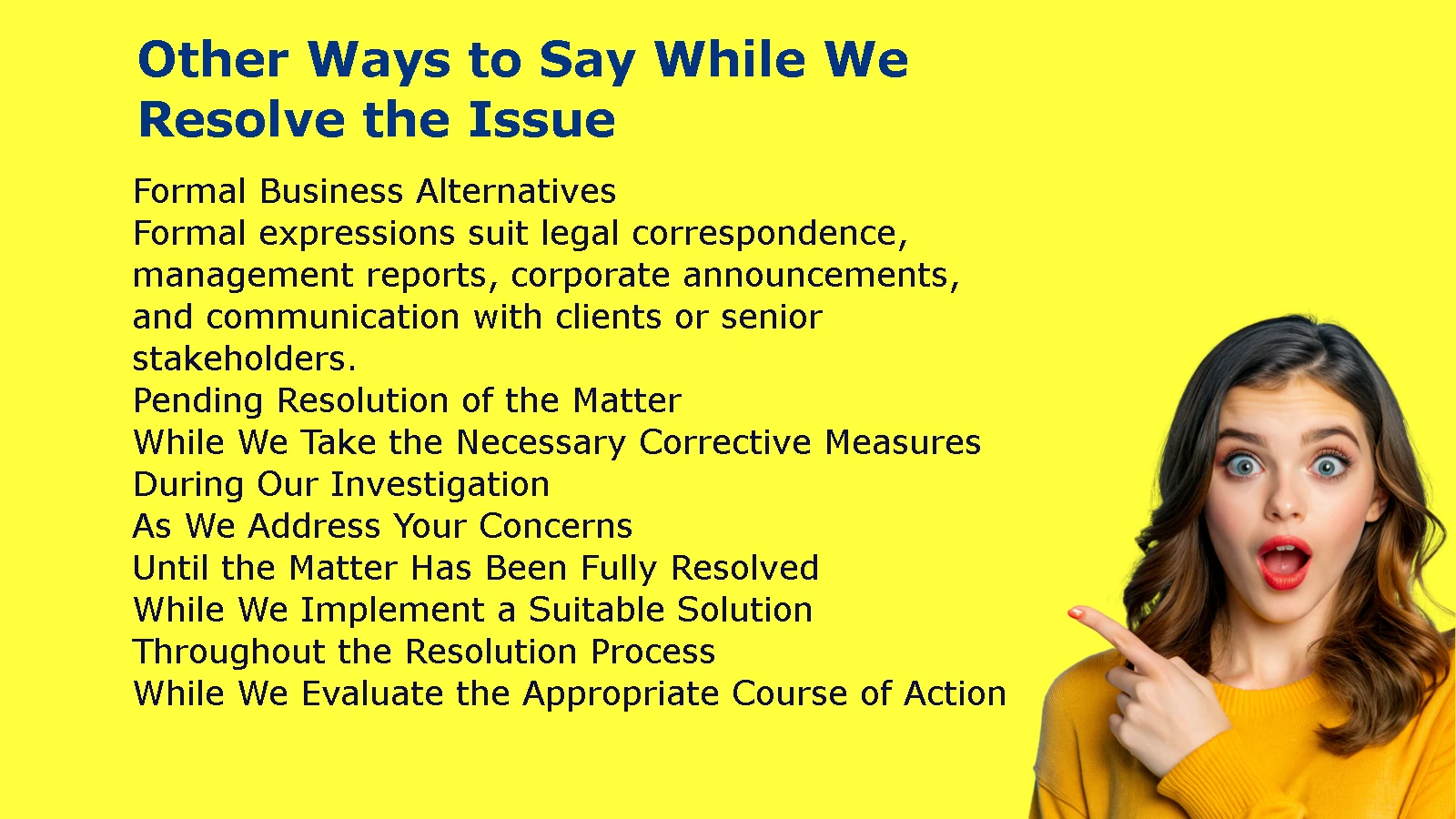
Formal Business Alternatives
Formal expressions suit legal correspondence, management reports, corporate announcements, and communication with clients or senior stakeholders.
- Pending Resolution of the Matter
- While We Take the Necessary Corrective Measures
- During Our Investigation
- As We Address Your Concerns
- Until the Matter Has Been Fully Resolved
- While We Implement a Suitable Solution
- Throughout the Resolution Process
- While We Evaluate the Appropriate Course of Action
Example:
“Pending resolution of the matter, all related transactions will remain under review.”
This construction works particularly well in formal notices because it communicates that a decision or action remains outstanding.
However, do not use formal language simply to sound important. A straightforward sentence often communicates more effectively than a complicated one.
Reassuring Alternatives for Customer Support
Customer support teams often need to explain that a problem remains under investigation. The right expression can reduce frustration and establish realistic expectations.
Consider these options:
- We Are Working to Resolve This.
- Our Team Is Looking Into the Matter.
- We Are Taking Steps to Address the Problem.
- We Appreciate Your Patience While We Investigate.
- We Will Keep You Updated as We Work Toward a Resolution.
- Our Support Team Is Reviewing Your Concern.
- We Are Exploring the Best Way to Resolve This Matter.
- We Have Escalated the Issue for Further Review.
Example:
“Thank you for bringing this to our attention. Our technical team is investigating the problem, and we will share an update as soon as we have more information.”
This message works because it acknowledges the customer’s concern, identifies the action being taken, and establishes a reasonable expectation without promising an immediate fix.
Short and Simple Alternatives
Sometimes, a short expression communicates better than a formal business phrase. These alternatives work well in internal chats, quick email updates, and everyday workplace communication.
- While We Fix the Problem
- As We Sort This Out
- While We Work on It
- Until We Fix the Issue
- As We Handle the Situation
- While We Find a Fix
- As We Work Through This
- Until We Find an Answer
For example:
“While we sort this out, please use the backup system.”
This sentence is direct, natural, and easy to understand. It works especially well when colleagues already understand the situation.
Comparison Table of the Best Alternatives
Not every synonym communicates the same action. Some expressions describe investigation, others indicate correction, and a few suggest that a final decision has already been reached.
| Phrase | Tone | Best use | Formality |
| While We Investigate | Professional | Unidentified problems | High |
| As We Address the Matter | Formal | Business correspondence | High |
| While We Work Toward a Solution | Reassuring | Customer communication | Medium |
| During the Resolution Process | Neutral | Reports and updates | High |
| While We Fix the Problem | Direct | Technical support | Low |
| As We Review Your Concern | Polite | Customer complaints | High |
| While We Find a Suitable Resolution | Professional | Complex situations | High |
| As We Sort This Out | Friendly | Internal conversations | Low |
How to Choose the Right Alternative for “While We Resolve the Issue”
The right alternative depends on what has happened, what action you are taking, and who will receive your message. A customer with a billing complaint needs reassurance, while a colleague waiting for a technical repair may prefer a direct progress update.
Consider these factors before selecting an expression:
- Audience: Are you writing to a customer, colleague, manager, or business partner?
- Problem type: Does the situation involve an error, complaint, disagreement, or technical failure?
- Progress: Are you investigating the issue, correcting it, or implementing a solution?
- Urgency: Does the recipient need an immediate update or simply an explanation?
- Tone: Should your message sound formal, friendly, apologetic, or reassuring?
When Writing Professional Emails
Professional emails should explain the situation without unnecessary detail. Use expressions that communicate progress and responsibility.
For example:
“While we review the matter, please provide the requested documentation so we can proceed.”
This sentence identifies the next action and explains why the recipient may need to wait.
Other useful expressions include:
- As We Address Your Request
- While We Review the Situation
- During Our Assessment
- As We Work on the Necessary Corrections
- While We Determine the Best Course of Action
Avoid vague statements such as “We are handling things.” They do not tell the recipient what is happening or what to expect.
When Responding to Customer Complaints
Customer complaints require acknowledgment and empathy. A customer wants to know that someone understands the problem and will take responsibility for reviewing it.
A useful response might say:
“We understand your concern. While we investigate the issue, our team will review your account and identify the next steps.”
This approach has three parts:
- Acknowledge the concern.
- Explain the action being taken.
- Set a realistic expectation for the next update.
Avoid saying “Your issue will be resolved immediately” unless you can genuinely guarantee that outcome.
When Communicating About Technical Problems
Technical problems often require investigation before a team can identify the cause. Expressions such as “While We Troubleshoot the Problem” and “As Our Technical Team Investigates” describe this stage accurately.
For example:
“While our engineers investigate the connection problem, please use the alternative network.”
You can also write:
- While We Diagnose the Problem
- As We Test the System
- During the Technical Review
- While We Identify the Root Cause
- As We Implement a Fix
The distinction matters. Investigating a technical failure does not necessarily mean the team has already found its solution.
When Handling Workplace Disagreements
Workplace disagreements need neutral language. Avoid expressions that suggest one person is responsible before the facts are clear.
Useful alternatives include:
- While We Work Toward an Agreement
- As We Discuss a Way Forward
- While We Address the Disagreement
- As We Seek Common Ground
- During the Mediation Process
- While We Review Both Perspectives
For example:
“While we work toward an agreement, both departments should continue sharing the information needed to complete the project.”
This wording encourages cooperation instead of making the disagreement more personal.
When You Need to Communicate Urgency
Urgent situations require clear language. A vague expression can make recipients wonder whether anyone is taking action.
Use phrases such as:
- While We Prioritize This Matter
- As We Work to Resolve This Promptly
- While We Take Immediate Corrective Action
- As We Address This Without Further Delay
- While We Expedite the Review
Example:
“We have prioritized your request and are working to address the problem as quickly as possible.”
Use words such as “immediately” and “without delay” only when the organization can support that level of urgency.
When You Want to Reassure Someone Without Making Promises
Sometimes, you cannot provide a completion date because the investigation remains open. Your message should communicate commitment without guaranteeing an outcome you cannot control.
For example:
“Our team is reviewing the situation and will share an update once we confirm the next steps.”
Other suitable expressions include:
- We Are Actively Reviewing the Matter.
- Our Team Is Assessing the Available Options.
- We Are Working to Identify an Appropriate Solution.
- We Will Keep You Informed of Any Progress.
These phrases protect trust because they describe actual work rather than making unsupported promises.
Professional Email Examples Using Alternatives to “While We Resolve the Issue”
A phrase becomes more useful when you understand how it works in a complete message. The following examples show how to use alternatives in customer service, workplace communication, technical support, and urgent requests.
Customer Service Email Examples
Example: A delayed order
Subject: Update Regarding Your Order
“Thank you for contacting us about your delayed order. Our team is reviewing the shipment details, and we are working to identify the cause of the delay. While we investigate the matter, we appreciate your patience and understanding.”
Example: A billing concern
Subject: Your Billing Inquiry
“We understand your concern about the recent charge. While we review your account, please share any relevant transaction details that may help us investigate the matter.”
Example: A service complaint
“Thank you for sharing your feedback. As we work to make things right, our customer support team will review your experience and determine the appropriate next steps.”
Formal Workplace Email Examples
Example: A project delay
Subject: Project Status Update
“While we address the scheduling issue, please continue working on the tasks that do not depend on the delayed deliverable. We will communicate any changes to the timeline once we complete our review.”
Example: A departmental disagreement
Subject: Coordination and Next Steps
“As we work toward a solution, both departments should review their current responsibilities and identify areas where better coordination may help.”
Example: An administrative matter
“Pending resolution of the matter, please retain all relevant documents for further review.”
Technical Support Email Examples
Example: Website downtime
“Our technical team is investigating the website outage. While we identify the root cause, please use the alternative access link provided below.”
Example: Software malfunction
“While we troubleshoot the software issue, we recommend saving your work regularly to prevent data loss.”
Example: Account access problem
“As we review your account access concern, please confirm whether you can receive verification messages at your registered email address.”
Apology and Complaint Response Examples
Example: An unsatisfactory customer experience
“We apologize for the inconvenience. Our team is reviewing your feedback, and we are taking steps to address the problem.”
Example: A missed delivery
“We are sorry that your delivery did not arrive as expected. While we investigate the situation with our delivery partner, we will keep you informed of any updates.”
Example: An incorrect invoice
“Please accept our apologies for the billing error. We are reviewing the invoice and will correct any confirmed discrepancies.”
Urgent Issue Resolution Email Examples
Example: An urgent workplace request
“Could you please prioritize this matter? We need to address the problem promptly to prevent further delays.”
Example: A time-sensitive customer complaint
“We have escalated your concern to the relevant team and are working to resolve it as quickly as possible.”
Example: An operational problem
“Please take the necessary corrective action as soon as possible. The delay is affecting our ability to complete the scheduled work.”
What Does “Resolve the Issue” Mean?
“Resolve the issue” means to take the necessary steps to solve a problem, address a concern, or bring an unwanted situation to an end. The expression appears frequently in business emails, customer service conversations, technical support, and workplace discussions. It generally suggests that someone intends to reach a satisfactory outcome.
The phrase contains two important words:
- Resolve: To find an answer, solution, or satisfactory outcome.
- Issue: A problem, concern, difficulty, or matter that requires attention.
Together, they describe the process of dealing with a problem until it reaches an acceptable outcome.
Meaning of Resolve in Different Contexts
The meaning of resolve can change slightly depending on the situation.
Technical problems: Resolving a technical issue means identifying the cause and restoring normal operation.
Example: “The development team resolved the login problem by correcting the authentication settings.”
Customer complaints: Resolving a complaint means addressing the customer’s concern and reaching an acceptable outcome.
Example: “The support representative resolved the complaint by arranging a replacement.”
Workplace disagreements: Resolving a disagreement means finding common ground or reaching an agreement.
Example: “The department managers resolved their disagreement through a joint discussion.”
Legal and business matters: Resolving a matter can involve negotiation, settlement, or a formal decision.
Example: “Both parties resolved the contractual dispute through negotiation.”
Resolve the Issue Meaning in Professional Communication
In professional communication, “resolve the issue” signals that someone accepts responsibility for addressing a problem.
However, it does not always mean the problem has already been fixed.
Compare these expressions:
| Expression | Meaning |
| We will resolve the issue. | A commitment to find a solution. |
| We are resolving the issue. | Work is currently underway. |
| We have resolved the issue. | The problem has been solved. |
| We are investigating the issue. | The cause or details are still being examined. |
| We have addressed the issue. | Action has been taken, but the final outcome may need confirmation. |
These distinctions help prevent misunderstandings in professional emails.
Examples of Resolve the Issue in Sentences
- Our support team will resolve the issue after reviewing your account.
- We need to resolve the issue before the next project deadline.
- The technician resolved the connection problem within an hour.
- Management arranged a meeting to resolve the disagreement.
- Please contact the service department if we have not resolved the matter by Friday.
- Both companies agreed to resolve the issue through negotiation.
Resolve the Issue Synonyms: What Other Words Can You Use?
Synonyms for “resolve the issue” include fix, address, rectify, remedy, settle, correct, handle, and sort out. Although these expressions share a similar purpose, they do not always describe the same action.
Choosing the right word makes your writing more precise.
Fix
Fix means to repair something or make it work correctly.
It is common in everyday English, technical support, and informal workplace conversations.
Examples:
- We need to fix the problem before launching the website.
- The technician fixed the faulty connection.
- Our team is working to fix the billing error.
Use “fix” when the problem has a clear and practical solution.
Address
Address means to give attention to a problem or take steps to deal with it.
It is especially useful in professional communication because it does not suggest that the issue has already been solved.
Examples:
- We are addressing your concerns.
- Management will address the scheduling problem.
- The company introduced new procedures to address customer complaints.
Important distinction: Addressing a problem does not necessarily mean resolving it completely.
Rectify
Rectify means to correct something that is wrong, inaccurate, or unsatisfactory.
It works well when discussing mistakes, incorrect information, administrative errors, and procedural problems.
Examples:
- Please rectify the error in the invoice.
- The company took steps to rectify the incorrect information.
- We will rectify the problem as soon as we identify its cause.
Remedy
Remedy means to correct a problem or provide a solution that improves an unsatisfactory situation.
It often appears in formal business, legal, and technical communication.
Examples:
- The company introduced new procedures to remedy the problem.
- We need to remedy the situation before it affects other customers.
- Management approved additional resources to remedy the delays.
Settle
Settle means to bring a disagreement, dispute, or unresolved matter to an agreement or conclusion.
Examples:
- The two companies settled their contractual dispute.
- We hope to settle the disagreement through discussion.
- Both parties agreed to settle the matter privately.
Use “settle” when the situation involves competing interests, disagreements, or disputes.
Handle
Handle means to manage or deal with a situation.
It is broader than “resolve” because someone can handle a problem without necessarily solving it.
Examples:
- Our support team will handle your request.
- The manager handled the complaint professionally.
- We have assigned an employee to handle the matter.
Correct
Correct means to remove an error or make something accurate.
Examples:
- Please correct the spelling mistake.
- The accounting department corrected the invoice.
- We need to correct the information in the customer record.
Sort Out
Sort out means to organize, clarify, or solve a problem.
It sounds more conversational than “rectify” or “remedy.”
Examples:
- We will sort out the scheduling problem.
- Let us sort out the misunderstanding before moving forward.
- The support team is trying to sort out the payment issue.
Resolve Synonyms Comparison Table
| Synonym | Core meaning | Best usage | Formality |
| Fix | Repair or make right | Technical problems | Informal |
| Address | Deal with a concern | Business communication | Formal |
| Rectify | Correct an error | Administrative mistakes | Formal |
| Remedy | Correct an undesirable situation | Business and legal contexts | Formal |
| Settle | Reach an agreement | Disputes and disagreements | Formal |
| Handle | Manage a situation | General workplace communication | Neutral |
| Correct | Remove an error | Documents and records | Neutral |
| Sort out | Find a practical solution | Everyday communication | Informal |
| Resolve | Bring a problem to an acceptable outcome | General use | Neutral |
What Is Another Word for Resolve a Conflict?
Another word for resolving a conflict includes settling a dispute, mediating a disagreement, reconciling differences, negotiating a solution, and reaching an agreement. These expressions describe different approaches to ending disagreements and helping people find a workable outcome.
Conflict resolution is common in workplaces, business negotiations, customer relationships, and personal communication.
Settle a Dispute
To settle a dispute means to bring a disagreement to an agreed conclusion.
Example: “The two business partners settled their dispute after reviewing the contract.”
This expression works well in formal discussions involving money, responsibilities, or contractual obligations.
Mediate a Disagreement
To mediate means to help people resolve a disagreement through the involvement of a neutral third party.
Example: “The HR manager mediated the disagreement between the two employees.”
Mediation does not require the mediator to make the final decision. Instead, the mediator helps both parties communicate and explore possible solutions.
Reconcile Differences
To reconcile differences means to reduce disagreements and find areas of agreement.
Example: “The project leaders reconciled their differences before approving the final plan.”
This phrase is useful when people have different opinions but share a common objective.
Reach an Agreement
To reach an agreement means to find a decision or arrangement that the involved parties accept.
Example: “Both departments reached an agreement about the revised project schedule.”
It is one of the clearest alternatives when the conflict ends through mutual understanding.
Negotiate a Solution
To negotiate a solution means to discuss different positions and work toward an acceptable arrangement.
Example: “The supplier and retailer negotiated a solution to the delivery dispute.”
This expression works particularly well in business and commercial communication.
Find Common Ground
Finding common ground means identifying shared interests or points of agreement.
Example: “The managers found common ground by focusing on their shared goal of completing the project.”
It encourages cooperation without requiring everyone to agree on every detail.
Defuse Tensions
To defuse tensions means to reduce anger, hostility, or emotional pressure before a disagreement becomes worse.
Example: “The supervisor addressed the misunderstanding early to defuse tensions between the employees.”
Conflict Resolution Expressions at a Glance
| Expression | Meaning |
| Settle a dispute | Bring a disagreement to an agreement |
| Mediate a disagreement | Help conflicting parties communicate |
| Reconcile differences | Find ways to overcome disagreements |
| Reach an agreement | Arrive at a mutually accepted decision |
| Negotiate a solution | Discuss options to find an acceptable outcome |
| Find common ground | Identify shared interests |
| Defuse tensions | Reduce hostility or anger |
What Does Rectify Mean?
Rectify means to correct something that is wrong, inaccurate, or unsatisfactory. People commonly use it when discussing mistakes, errors, incorrect records, and problems that require corrective action. Unlike “resolve,” which can describe solving a broader situation, “rectify” focuses more specifically on making something right.
Rectify Meaning in Simple English
In simple English, rectify means to put something right.
For example, if a company sends you an invoice with an incorrect amount, it may rectify the mistake by issuing a corrected invoice.
Other examples include:
- Rectifying a spelling error.
- Rectifying incorrect customer information.
- Rectifying a payment discrepancy.
- Rectifying an administrative mistake.
- Rectifying a procedural problem.
The word is more formal than “fix” and often appears in professional writing.
Rectify vs. Resolve: What’s the Difference?
Although rectify and resolve have similar meanings, they emphasize different aspects of problem-solving.
| Feature | Rectify | Resolve |
| Main meaning | Correct something wrong | Solve or settle a problem |
| Focus | Correction | Final outcome |
| Common use | Errors and inaccuracies | Problems and disputes |
| Tone | Formal | Neutral to formal |
| Example | Rectify the invoice error | Resolve the billing dispute |
Consider a billing complaint.
A customer receives an invoice containing the wrong amount. The accounting team can rectify the invoice by correcting the figure. However, it may need to resolve the billing issue by investigating why the incorrect charge occurred and confirming the customer’s account balance.
The two actions may happen together, but they are not identical.
Rectify vs. Correct vs. Remedy
These three words describe corrective action, but each has a slightly different emphasis.
- Rectify: Make an existing mistake or unsatisfactory situation right.
- Correct: Remove an error or make something accurate.
- Remedy: Provide a solution to an undesirable situation.
Examples:
- The editor rectified the formatting problems.
- The accountant corrected the transaction record.
- The company introduced a new policy to remedy recurring delays.
Examples of Rectify in Sentences
- We will rectify the mistake in your account.
- The company must rectify the safety concerns before reopening the facility.
- Please rectify the errors in the submitted report.
- Our team is taking steps to rectify the situation.
- Management introduced a new process to rectify communication problems.
- The supplier agreed to rectify the defective products.
When Should You Use Rectify in Professional Emails?
Use “rectify” when you want to communicate that a specific mistake or deficiency needs correction.
For example:
“Please rectify the discrepancies in the attached financial statement before submitting the final version.”
This sentence sounds professional because it identifies the required action.
However, if you are discussing a broader complaint or disagreement, “resolve” or “address” may be more appropriate.
Resolve Synonyms and Antonyms
Resolve has several synonyms and antonyms depending on its grammatical role and meaning. When it functions as a verb meaning to solve a problem, synonyms include fix, settle, remedy, address, and rectify. Antonyms include complicate, worsen, aggravate, and prolong.
However, resolve can also mean to make a firm decision. In that context, its synonyms and antonyms change.
Synonyms of Resolve
| Synonym | Meaning | Example |
| Fix | Repair a problem | We need to fix the software error. |
| Settle | Bring a dispute to an end | They settled the disagreement. |
| Address | Deal with a concern | Management addressed the complaint. |
| Remedy | Correct an undesirable situation | The new process remedied the delay. |
| Rectify | Correct an error | The team rectified the mistake. |
| Determine | Make a firm decision | She determined to complete the project. |
| Decide | Reach a conclusion | They decided to change the schedule. |
Antonyms of Resolve
Antonyms are words with opposite meanings. When resolve means to solve a problem, the following expressions can communicate the opposite idea.
| Antonym | Meaning | Example |
| Complicate | Make something more difficult | The additional requirements complicated the process. |
| Worsen | Make a situation worse | The delay worsened the problem. |
| Aggravate | Make an existing problem more serious | The incorrect response aggravated the complaint. |
| Prolong | Make something last longer | Poor communication prolonged the dispute. |
| Disrupt | Interrupt normal progress | The system failure disrupted operations. |
| Unsettle | Cause uncertainty or disturbance | The announcement unsettled the employees. |
Resolve Synonym and Antonym Comparison
The meaning of the sentence determines which opposite word fits best.
For example:
- Resolve the conflict → Aggravate the conflict.
- Resolve the problem → Complicate the problem.
- Resolve the complaint → Prolong the complaint.
- Resolve the disagreement → Worsen the disagreement.
When resolve means making a firm decision, antonyms can include hesitate, waver, or remain undecided.
This distinction matters because a single word can have multiple meanings, and its opposite depends on the context.
What Is Another Word for Resolved?
Another word for resolved depends on whether you mean that a problem has been solved or that someone has made a firm decision. For a completed problem, alternatives include settled, fixed, addressed, corrected, remedied, and concluded. For a determined person, use decided, committed, or determined.
Alternatives for Resolved When a Problem Is Fixed
These expressions work when describing a completed task, technical repair, customer complaint, or business matter.
| Alternative | Example sentence |
| Settled | The payment dispute has been settled. |
| Fixed | The technical problem has been fixed. |
| Addressed | Your concern has been addressed. |
| Corrected | The incorrect information has been corrected. |
| Remedied | The situation has been remedied. |
| Concluded | The investigation has concluded. |
| Cleared Up | The misunderstanding has been cleared up. |
| Sorted Out | The scheduling problem has been sorted out. |
Be careful with “addressed.” A company may have addressed a complaint without fully resolving the customer’s dissatisfaction.
Alternatives for Resolved When Someone Makes a Decision
Resolved can also describe a person’s determination to do something.
For example:
“She was resolved to complete the project despite the challenges.”
In this context, the following alternatives may work:
- Determined
- Decided
- Committed
- Firm
- Unwavering
- Purposeful
- Dedicated
Examples:
- He was determined to improve the department’s performance.
- The management team remained committed to its original objective.
- She made a firm decision to pursue the opportunity.
Examples of Resolved and Its Alternatives in Sentences
- The customer complaint has been settled.
- Our technical team has fixed the connection problem.
- The billing discrepancy has been corrected.
- The disagreement has been cleared up.
- The investigation has concluded.
- Both parties have reached an agreement.
- The manager remained determined to complete the project.
What Is Another Word for Issues?
Another word for issues includes problems, concerns, matters, difficulties, complications, challenges, and obstacles. The best alternative depends on whether you are discussing a serious problem, a customer complaint, a technical difficulty, or a subject that requires attention.
In professional writing, choosing the right replacement can make a message sound more specific and natural.
Synonyms for Issues in Professional Communication
| Synonym | Meaning | Example |
| Problems | Situations that require solutions | We are reviewing the reported problems. |
| Concerns | Matters causing worry or dissatisfaction | We appreciate you sharing your concerns. |
| Matters | Subjects requiring attention | We will review the matter shortly. |
| Difficulties | Situations that create challenges | The team experienced difficulties during installation. |
| Complications | Factors that make a situation more complex | Unexpected complications delayed the delivery. |
| Challenges | Difficult tasks or obstacles | We are working to overcome these challenges. |
| Obstacles | Things that prevent progress | The team identified several obstacles. |
| Discrepancies | Differences or inconsistencies | We are investigating the discrepancies in the report. |
Alternatives to Issues in Customer Service
Customer service teams should select words that acknowledge a customer’s experience without making the situation sound unnecessarily serious.
Useful alternatives include:
- Concerns
- Requests
- Complaints
- Difficulties
- Service problems
- Account matters
- Technical concerns
Examples:
“Thank you for bringing your concerns to our attention.”
“Our team is reviewing the difficulties you experienced during checkout.”
“We are investigating the discrepancy in your account.”
Alternatives to Issues in Business and Workplace Communication
Business writing often benefits from more precise vocabulary.
Consider these examples:
- Matters: Suitable for formal correspondence.
- Challenges: Appropriate for obstacles that require effort.
- Discrepancies: Useful for financial and administrative inconsistencies.
- Concerns: Best for questions or matters requiring attention.
- Complications: Appropriate when unexpected circumstances make progress difficult.
For example, instead of writing “We have several issues with the report,” you could write “We identified several discrepancies in the report.”
The second sentence tells readers exactly what needs attention.
Issue Synonyms Comparison Table
| Word | Best context | Tone |
| Problem | General difficulties | Neutral |
| Concern | Customer communication | Polite |
| Matter | Formal correspondence | Formal |
| Difficulty | Practical challenges | Neutral |
| Complication | Unexpected problems | Professional |
| Challenge | Complex tasks | Positive |
| Discrepancy | Errors or inconsistencies | Technical |
| Obstacle | Barriers to progress | Professional |
Examples of Issue Alternatives in Sentences
- We appreciate your patience while we review your concerns.
- The department is addressing several operational challenges.
- Our team identified discrepancies in the financial records.
- Please contact us if you experience any technical difficulties.
- Management will review the matter during the next meeting.
- The unexpected complications affected the delivery schedule.
How to Say “Please Resolve This Issue as Soon as Possible” Professionally
To say “Please Resolve This Issue as Soon as Possible” professionally, use polite expressions that communicate urgency without sounding demanding. Options include “Could you please address this matter promptly?” and “We would appreciate your assistance in resolving this issue at your earliest convenience.”
The best wording depends on your relationship with the recipient and how quickly you need action.
Polite Ways to Request Immediate Action
These expressions work well when communicating with colleagues, clients, suppliers, and customer support teams.
- Could You Please Look Into This Matter?
- We Would Appreciate Your Help in Resolving This Issue.
- Please Address This Concern at Your Earliest Convenience.
- Could You Kindly Review This Problem?
- We Would Be Grateful if You Could Resolve This Matter Promptly.
- Please Let Us Know How Soon This Can Be Addressed.
Example:
“Could you please review the attached report and address the identified discrepancies at your earliest convenience?”
This wording communicates a clear request without sounding aggressive.
Formal Ways to Request Urgent Resolution
When a problem affects business operations, deadlines, or contractual responsibilities, a more formal expression may be appropriate.
- Please Prioritize the Resolution of This Matter.
- We Request That You Address This Issue Without Further Delay.
- Kindly Take the Necessary Corrective Action.
- Your Immediate Attention to This Matter Would Be Appreciated.
- Please Expedite the Review and Resolution Process.
Example:
“Please prioritize the resolution of this matter, as the delay is affecting our scheduled operations.”
This message explains why the request needs attention.
Friendly Ways to Follow Up on an Unresolved Issue
A follow-up should remind the recipient about the outstanding matter without creating unnecessary tension.
Try these expressions:
- Just Following Up on This Matter.
- Could You Share an Update on the Issue?
- I Wanted to Check Whether There Has Been Any Progress.
- Please Let Me Know If You Need Additional Information.
- I Would Appreciate an Update When You Have a Chance.
Example:
“Just following up on the billing concern I raised earlier. Could you please let me know whether your team has made any progress?”
This is appropriate for a friendly professional reminder.
Strong but Respectful Ways to Communicate Urgency
Sometimes, a polite reminder is not enough. If an unresolved issue affects operations or creates financial consequences, you may need firmer wording.
- This Matter Requires Immediate Attention.
- Please Resolve This Problem Before the End of the Business Day.
- We Need to Address This Issue to Avoid Further Disruption.
- Please Confirm the Corrective Action and Expected Completion Date.
- We Request an Urgent Update Regarding This Outstanding Matter.
Example:
“This matter is affecting our scheduled operations. Please confirm the corrective action and expected completion date by 3 p.m. today.”
The message establishes a clear deadline and explains the reason for urgency.
Email Examples for Requesting a Quick Resolution
Example: Requesting a supplier to correct an order
Subject: Urgent Request for Order Correction
“Hello,
We noticed a discrepancy in the latest shipment. Could you please review the order details and arrange the necessary correction as soon as possible?
Your prompt assistance would help us avoid further delays.
Thank you.”
Example: Following up with a technical support team
Subject: Follow-Up on Outstanding Technical Issue
“Hello,
I am following up on the technical problem reported earlier. The issue is still affecting our operations, and we would appreciate an update on the investigation.
Please let us know the expected resolution time and whether we need to take any temporary measures.
Best regards.”
Example: Requesting an internal department to act
Subject: Action Required: Outstanding Report Corrections
“Hello Team,
Several discrepancies remain in the submitted report. Please review the highlighted sections and make the necessary corrections before the final submission.
We would appreciate your prompt attention to this matter.
Thank you.”
Common Mistakes to Avoid When Using Issue Resolution Synonyms
Choosing a synonym based only on its dictionary meaning can create confusion. Words such as resolve, rectify, address, and remedy overlap, but they describe different actions.
Understanding these distinctions helps you communicate more accurately.
Using Rectify When You Mean Resolve
Rectify focuses on correcting something wrong. Resolve can describe a broader process that brings a problem to an acceptable outcome.
Incorrect: “We will rectify the disagreement between both departments.”
Better: “We will work to resolve the disagreement between both departments.”
However, if the disagreement resulted from incorrect information, you could say:
“We will rectify the incorrect information and work toward resolving the disagreement.”
Confusing Addressing a Problem With Solving It
Addressing a problem means taking action or giving it attention. It does not automatically mean the problem has been solved.
For example:
“We have addressed your complaint” does not necessarily mean “Your complaint has been resolved.”
Use the correct expression to avoid giving customers a false impression of progress.
Using Overly Aggressive Language in Business Emails
Expressions such as “Fix this immediately” may sound demanding, especially when you communicate with customers, suppliers, or senior colleagues.
Instead, consider:
“Please prioritize this matter and take the necessary corrective action.”
You can communicate urgency without damaging professional relationships.
Making Promises Before a Problem Is Fixed
Avoid guaranteeing a solution before you understand the cause of the problem.
For example:
“We will definitely resolve this today.”
This may create unrealistic expectations.
A better alternative is:
“Our team is actively investigating the matter, and we will provide an update on the expected resolution time.”
Choosing Informal Expressions in Formal Communication
Expressions such as “sort this out” and “fix things” work in casual conversations. However, they may not suit legal notices, formal complaints, or executive correspondence.
Choose alternatives such as:
- Address the matter.
- Rectify the discrepancy.
- Resolve the concern.
- Implement corrective measures.
- Reach an acceptable resolution.
Conclusion: Choose the Right Alternative for Clearer Communication
Choosing the right alternative to “While We Resolve the Issue” helps you communicate more clearly, professionally, and confidently. Expressions such as “While We Work Toward a Solution,” “As We Address the Matter,” and “During the Resolution Process” work well in business emails and customer support messages.
However, the best expression depends on the action you want to describe. Use address when you are taking steps to deal with a concern, rectify when correcting an error, remedy when improving an undesirable situation, and settle when bringing a disagreement to an agreement.
Remember that addressing a problem and resolving it are not always the same thing. Choose words that accurately describe the progress you have made rather than promising an outcome you cannot guarantee.
Next time you write a professional email, replace repetitive phrases with a more precise alternative. Your messages will sound more natural, your requests will become clearer, and your readers will better understand what happens next.
Frequently Asked Questions
What Is Another Way to Say “While We Resolve the Issue”?
Other ways to say “While We Resolve the Issue” include “While We Work Toward a Solution,” “As We Address the Matter,” “While We Investigate the Situation,” and “During the Resolution Process.” Choose a phrase that matches the action your team is taking.
What Is a Professional Synonym for Resolve the Issue?
Professional synonyms for resolve the issue include address the matter, rectify the problem, remedy the situation, settle the dispute, and correct the error. Use address for ongoing concerns and rectify for specific mistakes that need correction.
What Does Resolve the Issue Mean?
Resolve the issue means taking appropriate action to solve a problem, settle a disagreement, or bring an unsatisfactory situation to an acceptable end. For example, a support team resolves a billing issue by investigating the charge and correcting any confirmed errors.
What Is Another Word for Resolving a Conflict?
Other expressions for resolving a conflict include settling a dispute, mediating a disagreement, reconciling differences, negotiating a solution, and reaching an agreement. The best choice depends on whether the parties need mediation, negotiation, or a mutually accepted decision.
Is Rectify the Same as Resolve?
No. Rectify means correcting something that is wrong or inaccurate, while resolve means finding a solution to a problem or bringing a situation to an end. You might rectify an invoice error while resolving the wider billing dispute.
How Do You Politely Ask Someone to Resolve an Issue Quickly?
You can say, “Could you please address this matter at your earliest convenience?” or “We would appreciate your assistance in resolving this issue promptly.” For urgent situations, explain why the matter requires immediate attention and provide a reasonable deadline.
Discover 30+ other ways to say while we resolve the issue, with professional synonyms, polite email examples, and phrases for customer support and work.