Things to say instead of good job include “You nailed it,” “Excellent work,” “Your effort really paid off,” and “You handled that exceptionally well.” The best alternative depends on what you want to recognize, whether it is hard work, impressive results, creativity, or personal improvement. These phrases help you express genuine appreciation at work, in school, and in everyday conversations.
Choosing the right words can make your praise more meaningful. Professional compliments recognize achievements, encouraging words motivate people to keep improving, and specific positive feedback explains what someone did well. You can also use funny expressions to celebrate small victories or heartfelt phrases to show someone how proud you are of their progress.
| Question | Answer |
| What can I say instead of good job? | Try “Well done,” “You nailed it,” “Excellent work,” or “That was impressive.” |
| How do you say well done professionally? | Say “Your work exceeded expectations” or “Your attention to detail made a real difference.” |
| What is another way to say keep up the good work? | Use “Keep building on this success,” “You’re making great progress,” or “Keep that momentum going.” |
| How do you praise students without saying good job? | Say “Your persistence paid off,” “You explained your reasoning clearly,” or “Your work shows real improvement.” |
| What are funny ways to say good job? | Try “You understood the assignment,” “Absolute legend,” or “Achievement unlocked!” |
What Are Some Things to Say Instead of Good Job?
The best things to say instead of good job recognize a person’s specific achievement, effort, or improvement. Simple alternatives work well for everyday conversations, while more detailed compliments suit professional feedback and important accomplishments. Choosing a phrase that matches the situation helps your praise sound natural, sincere, and memorable.
25 Quick Alternatives to Good Job
Use these expressions when you want to praise someone without repeating the same familiar words.
- Well done! — A versatile expression for almost any achievement.
- Excellent work! — Suitable for high-quality results.
- You nailed it! — Perfect when someone succeeds at a difficult task.
- Fantastic job! — An enthusiastic way to celebrate success.
- That was impressive. — Highlights an achievement that stands out.
- You really delivered. — Works well when someone meets an important expectation.
- Outstanding effort! — Recognizes dedication and hard work.
- You got it right! — Useful when someone solves a problem or answers correctly.
- Brilliant work! — Expresses strong approval of someone’s performance.
- You should be proud. — Encourages personal satisfaction and confidence.
- You made it happen! — Celebrates initiative and follow-through.
- That’s a great achievement. — Recognizes a meaningful accomplishment.
- You did exceptionally well. — Offers direct, confident praise.
- What a fantastic result! — Focuses on the outcome.
- You handled that beautifully. — Praises someone’s approach to a situation.
- You exceeded expectations. — Suitable for impressive professional performance.
- That’s something to celebrate. — Acknowledges a milestone or success.
- You made a real difference. — Highlights the impact of someone’s contribution.
- Your hard work paid off. — Connects effort with results.
- You deserve the credit. — Recognizes someone’s contribution.
- That was skillfully done. — Praises ability and execution.
- You’ve really improved. — Recognizes progress.
- You rose to the challenge. — Celebrates success under pressure.
- You should give yourself credit. — Encourages someone who may underestimate their achievement.
- Keep that momentum going! — Combines recognition with encouragement for continued progress.
Short and Simple Ways to Praise Someone
Sometimes, a short expression is more effective than a lengthy compliment. Use these phrases in casual conversations, text messages, team chats, or quick reactions.
- Nicely done!
- Great stuff!
- Impressive!
- Fantastic!
- Spot on!
- Perfectly executed!
- You crushed it!
- That’s the way!
- Superb work!
- What a win!
For example, if a colleague fixes a minor issue just before a meeting, “Nicely done!” feels natural. If a friend completes a challenging race, “You crushed it!” communicates more excitement.
Powerful Words That Make Praise More Meaningful
Certain adjectives communicate the quality of an achievement more precisely than “good.”
| Word | Meaning | Example |
| Exceptional | Far above the usual standard | “Your research was exceptional.” |
| Outstanding | Remarkably strong or successful | “You delivered an outstanding presentation.” |
| Impressive | Likely to earn admiration | “Your progress is genuinely impressive.” |
| Remarkable | Worthy of special attention | “You’ve made remarkable improvements.” |
| Excellent | Very high in quality | “This is excellent work.” |
| Exemplary | Worthy of being followed as a model | “Your professionalism was exemplary.” |
| Brilliant | Exceptionally clever or skillful | “That was a brilliant solution.” |
| Accomplished | Showing considerable skill or success | “You’re an accomplished speaker.” |
Choose words that accurately reflect the achievement. Calling routine work “exceptional” every time can make your praise less convincing. Specific, proportionate compliments help people understand why their performance stands out.
100 Powerful Ways to Say Good Job
Powerful ways to say good job include expressions that recognize results, effort, progress, creativity, teamwork, and major achievements. Instead of relying on one general compliment, choose wording that reflects what the person actually accomplished. This makes praise more useful because it tells people which actions or qualities deserve recognition.
Ways to Praise Excellent Results
Use these expressions when someone produces accurate work, meets a challenging goal, or delivers a successful outcome.
- You delivered an outstanding result.
- Your work exceeded expectations.
- You absolutely nailed the final result.
- That’s a first-rate performance.
- You’ve set a high standard.
- The quality of your work speaks for itself.
- You turned in an excellent final product.
- This is a remarkable achievement.
- You handled every detail exceptionally well.
- You’ve produced something truly impressive.
- Your execution was flawless.
- That’s a fantastic outcome.
- You delivered exactly what was needed.
- You’ve done an exceptional job from start to finish.
- The results are excellent.
Ways to Recognize Effort and Dedication
Not every achievement comes easily. These phrases recognize preparation, commitment, persistence, and the work someone puts in behind the scenes.
- Your dedication really shows.
- You put a tremendous amount of effort into this.
- Your hard work paid off.
- I can see how much thought you put into this.
- You stayed committed and got it done.
- Your persistence made the difference.
- You gave this your full attention.
- You worked through the difficult parts with determination.
- Your preparation really paid off.
- You didn’t give up when things got challenging.
- You approached this with real commitment.
- Your discipline is paying off.
- You put in the work, and it shows.
- You followed through on every detail.
- Your determination deserves recognition.
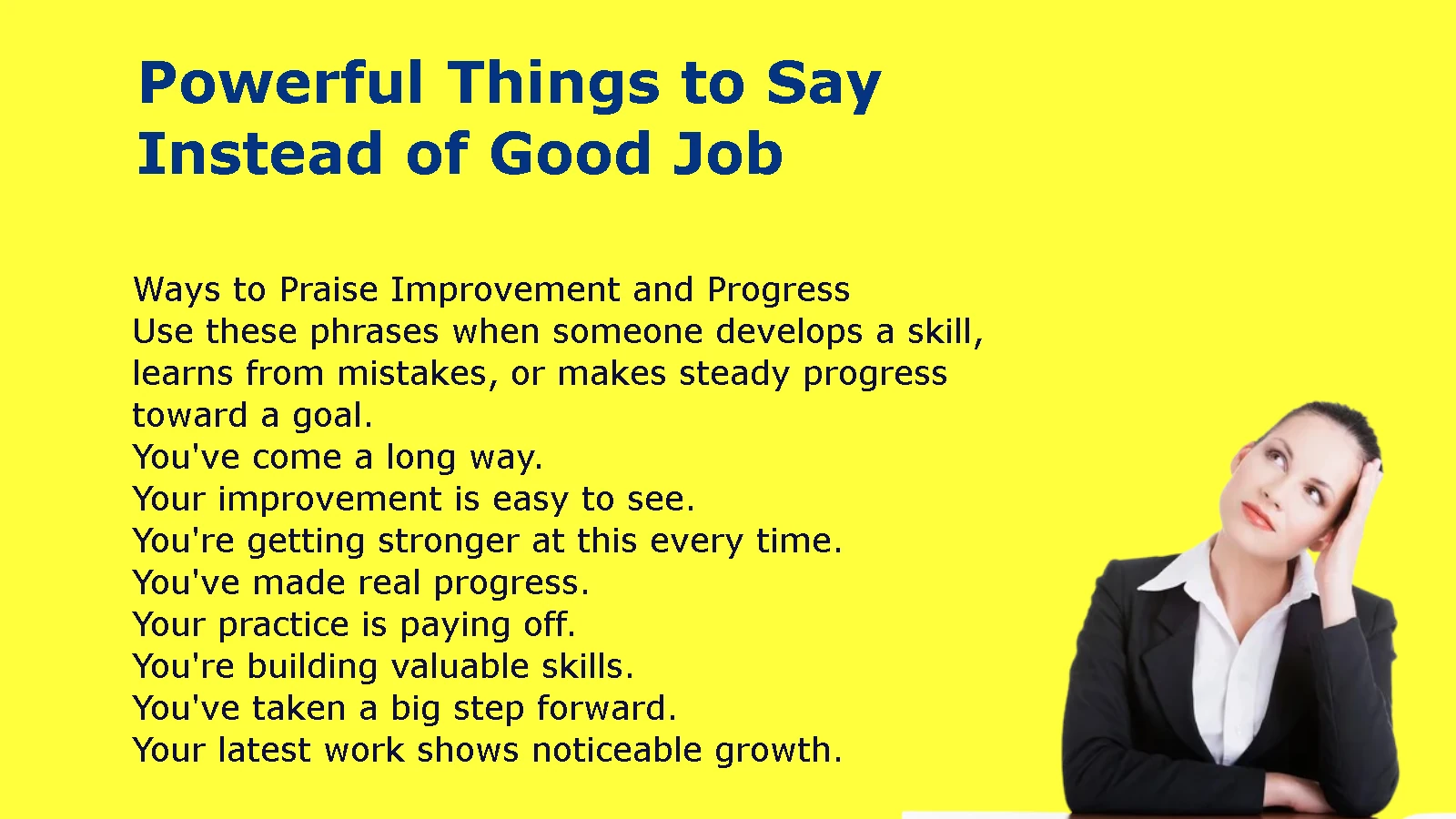
Ways to Praise Improvement and Progress
Use these phrases when someone develops a skill, learns from mistakes, or makes steady progress toward a goal.
- You’ve come a long way.
- Your improvement is easy to see.
- You’re getting stronger at this every time.
- You’ve made real progress.
- Your practice is paying off.
- You’re building valuable skills.
- You’ve taken a big step forward.
- Your latest work shows noticeable growth.
- You’re learning from each experience.
- You’ve improved your approach considerably.
- You’re becoming more confident in your abilities.
- You should be proud of how far you’ve come.
- Your consistency is producing results.
- You’re moving in the right direction.
- You’ve turned a challenge into a learning opportunity.
Ways to Praise Creativity and Problem-Solving
These expressions suit people who develop original ideas, solve difficult problems, or find more effective ways to complete a task.
- That’s a clever solution.
- You’ve thought outside the box.
- Your idea brings a fresh perspective.
- You found an excellent way to solve that problem.
- That’s an inventive approach.
- Your creativity really stands out.
- You spotted a solution others might have missed.
- That’s an insightful observation.
- You made a complicated problem easier to understand.
- Your thinking opened up a new possibility.
- You’ve found a smarter way to do this.
- That’s an original and effective idea.
- You approached the challenge from a useful new angle.
- Your judgment was spot on.
- You turned a difficult situation into an opportunity.
Ways to Recognize Teamwork and Collaboration
Praise teamwork when someone supports colleagues, shares knowledge, communicates clearly, or helps a group reach a common goal.
- You were a real asset to the team.
- Your contribution helped everyone succeed.
- You made collaboration easier for everyone.
- You brought the team together.
- You communicated your ideas clearly.
- Your support made a real difference.
- You helped keep the project on track.
- You stepped up when the team needed you.
- You made sure everyone had a voice.
- Your leadership helped us move forward.
- You were dependable throughout the project.
- You made a valuable contribution.
- You helped turn our plans into results.
- Your willingness to help did not go unnoticed.
- We achieved more because of your contribution.
Ways to Celebrate Major Achievements
Use these expressions for significant milestones, challenging projects, competitions, promotions, or personal accomplishments.
- You’ve accomplished something remarkable.
- This is a milestone worth celebrating.
- You earned this success.
- You’ve achieved something you can be proud of.
- That’s a major accomplishment.
- You rose to the occasion.
- You turned a big goal into reality.
- You’ve given yourself a great reason to celebrate.
- Your achievement reflects your commitment.
- You made the impossible look manageable.
These 100 expressions cover different kinds of praise. Select one that matches the achievement instead of choosing the most dramatic phrase automatically. A colleague who fixes a spreadsheet may appreciate “You found a clever solution,” while someone who completes a demanding project may deserve “You’ve accomplished something remarkable.”
How to Say Well Done Professionally
To say well done professionally, recognize the person’s contribution with clear, respectful language. Phrases such as “Your attention to detail made a real difference” and “You handled that challenge exceptionally well” work because they identify a strength rather than offering vague approval. Professional praise should fit the achievement and the relationship.
Professional Alternatives to Good Job at Work
Use these expressions in meetings, performance discussions, project updates, or everyday workplace conversations.
- Excellent work on this project.
- Your contribution made a meaningful impact.
- You’ve handled this with great professionalism.
- Your work met a very high standard.
- You delivered a strong result.
- Your attention to detail was impressive.
- You’ve managed this responsibility exceptionally well.
- Your approach was thoughtful and effective.
- You demonstrated excellent judgment.
- Your work helped us achieve our objective.
For example, instead of telling a colleague “Good job on the report,” say, “Your clear analysis helped the team make a more informed decision.” The second version explains the value of the work and gives the colleague a specific reason to feel appreciated.
Professional Ways to Praise a Colleague
Colleague-to-colleague praise should feel genuine and respectful. You don’t need to sound formal every time; the key is to acknowledge the other person’s contribution without exaggerating it.
Try these phrases:
- I appreciate the care you put into this.
- You made that process much smoother.
- Your input helped clarify the issue.
- I learned something useful from your approach.
- You handled that conversation skillfully.
- Your preparation made the meeting more productive.
- Thanks for stepping in when we needed support.
- You brought valuable insight to the discussion.
How to Praise an Employee for Excellent Performance
When praising an employee, connect the compliment to observable behavior, a result, or a meaningful contribution. This gives the employee useful feedback and makes the recognition feel earned.
Examples include:
- “You completed the project ahead of schedule while maintaining quality.”
- “Your initiative helped us resolve the issue before it affected the customer.”
- “You handled the client’s concerns calmly and professionally.”
- “Your consistent follow-through has made the team more reliable.”
- “You identified a risk early and helped us avoid unnecessary delays.”
A manager should also consider the employee’s preferences. Some people appreciate public recognition, while others prefer a private conversation or a personal message.
Professional Ways to Say Well Done in an Email
Email praise works best when it identifies the achievement and explains why it matters. Keep the message concise, especially when communicating with a busy colleague or team.
Example: Project completion
Subject: Excellent Work on the Project
Hi Jordan,
You’ve done an excellent job bringing this project together. Your organization, attention to detail, and consistent follow-through helped us complete the work smoothly.
Thank you for your contribution.
Best,
Alex
Example: Successful presentation
“Your presentation was clear, well-structured, and persuasive. You explained the key findings effectively and handled the questions with confidence. Excellent work.”
Example: Team recognition
“Thank you all for the effort you put into this launch. Everyone contributed something valuable, and your coordination helped us meet our deadline.”
Formal Alternatives to Great Job for Managers and Leaders
Choose formal wording when writing performance reviews, communicating with senior colleagues, or recognizing important professional achievements.
| Expression | Best situation |
| Your performance was exemplary. | Formal evaluations |
| You demonstrated excellent leadership. | Team management |
| Your contribution was highly valuable. | Project recognition |
| Your work reflects a strong professional standard. | Quality-focused feedback |
| You handled the responsibility with distinction. | Significant assignments |
| Your results demonstrate considerable expertise. | Specialized work |
| Your approach was both effective and thoughtful. | Complex decisions |
Formal praise should still sound human. A short, specific statement often communicates more than a long paragraph filled with corporate language.
How to Say You Did a Great Job in Different Ways
To tell someone they did a great job, describe what they accomplished or what they did particularly well. “You explained that idea clearly,” “You handled the pressure remarkably well,” and “Your preparation made the difference” provide more meaningful recognition than a generic compliment.
Ways to Praise Someone’s Results
Use outcome-focused phrases when the result matters most.
- You delivered exactly what the project needed.
- Your work produced an excellent outcome.
- You achieved the goal with impressive precision.
- Your solution worked exceptionally well.
- You turned a difficult assignment into a success.
- The final result is better than we expected.
Ways to Praise Someone’s Effort
Effort-focused praise recognizes the process, not just the final outcome.
- You worked through that challenge with patience.
- I admire the effort you put into this.
- You stayed focused even when the task became difficult.
- Your preparation was clear from the beginning.
- You approached the work with care and determination.
- You kept going and learned a great deal along the way.
This distinction matters when someone has worked hard but hasn’t achieved the intended result. Recognizing their effort can encourage them without pretending that the outcome was perfect.
Ways to Praise Someone’s Skills and Talent
Choose expressions that reflect the skill the person demonstrated.
- Your communication skills really stood out.
- You have a strong eye for detail.
- You explained the issue with impressive clarity.
- You showed excellent judgment.
- You handled the technical details with confidence.
- Your ability to bring ideas together is impressive.
- You made a difficult decision thoughtfully.
Ways to Give Specific and Sincere Compliments
A useful formula for meaningful praise is specific action + positive impact.
For example:
- Generic: “Great presentation!”
- Specific: “Your examples made the technical information easy for everyone to understand.”
Another example:
- Generic: “You did well.”
- Specific: “You stayed calm during the discussion and helped the group reach a decision.”
The specific versions show that you paid attention. They also tell the recipient which behavior made a difference, making the praise more useful in future situations.
Other Ways to Say Keep Up the Good Work
Other ways to say keep up the good work include “Keep building on this success,” “You’re making excellent progress,” and “Keep that momentum going.” These expressions encourage continued effort while recognizing progress. Choose wording that suits the person’s situation rather than implying that they must maintain perfect performance all the time.
Encouraging Alternatives for Everyday Conversations
Use these friendly expressions with friends, family members, classmates, or teammates.
- Keep going; you’re doing well.
- You’re on the right track.
- Don’t lose that momentum.
- Keep pushing toward your goal.
- You’re making great strides.
- Stay with it; your effort is showing.
- You’re getting closer every day.
- Keep building on what you’ve learned.
- You’re doing better than you realize.
- There’s more progress ahead.
Professional Ways to Encourage Continued Success
In a workplace, encouragement should recognize current progress and support future development.
- Keep building on these results.
- Continue applying this thoughtful approach.
- You’re establishing a strong standard.
- Your progress is encouraging; keep moving forward.
- Keep developing the skills you’ve demonstrated here.
- Your consistency is making a positive difference.
- I look forward to seeing how you develop this further.
- Continue bringing this level of care to your work.
Ways to Encourage Someone Who Is Making Progress
Someone who is improving may need reassurance more than another demand to perform.
- Every step forward counts.
- You’re making meaningful progress.
- Your practice is beginning to pay off.
- You’re learning what works for you.
- You have good reason to feel encouraged.
- Keep trusting the process and learning as you go.
- You’re closer than you were yesterday.
- Your progress deserves recognition.
How to Encourage Someone Without Sounding Repetitive
Instead of repeating “keep up the good work,” mention the specific progress you noticed.
For example, a manager could say, “Your last three reports have been clearer and more concise. Keep developing that approach.” A teacher might say, “You’re showing your reasoning more clearly in each assignment.”
Both statements connect encouragement to an observable change. They give the recipient something concrete to continue doing.
Other Ways to Say Good Job to Students
Good alternatives to “good job” for students recognize effort, improvement, curiosity, problem-solving, and learning strategies. Teachers and parents can say “You explained your reasoning clearly” or “You tried a different approach when the first one didn’t work.” Specific feedback helps students understand what they did well and how they can build on it.
Positive Praise Phrases for Elementary Students
Young learners often benefit from simple, concrete language.
- You kept trying, and you figured it out.
- You asked a thoughtful question.
- You took your time and checked your work.
- You were kind and helpful to your classmates.
- You tried something new today.
- You remembered the steps we practiced.
- You explained your idea clearly.
- You made a great effort.
- You found another way to solve the problem.
- You should feel proud of your progress.
Encouraging Words for Middle School and High School Students
Older students may respond well to praise that respects their independence and acknowledges their thinking.
- Your argument was clear and well-supported.
- You used strong evidence to explain your answer.
- You managed your time effectively.
- Your revision made the essay much stronger.
- You approached the problem from a thoughtful angle.
- You took responsibility for improving your work.
- You connected the ideas in a meaningful way.
- Your preparation showed in your performance.
- You handled the feedback maturely.
- Your reasoning was more detailed this time.
Ways to Praise Student Effort Instead of Just Grades
Grades describe performance on a particular assessment. They don’t always show the effort, strategy, or learning that led to the result.
Teachers and parents can recognize those parts of the process:
- “You practiced the difficult questions instead of avoiding them.”
- “You checked your calculations carefully and caught the mistake.”
- “You used the feedback to improve your second draft.”
- “You kept working even when the first method didn’t help.”
- “You organized your notes in a way that made the topic easier to understand.”
This type of praise gives students a clearer picture of the behaviors they can repeat. It also avoids making a single grade the only measure of their ability.
Teacher Feedback Phrases for Assignments and Projects
| Situation | Example feedback |
| Essay writing | Your introduction establishes the argument clearly. |
| Mathematics | You showed each step, which made your reasoning easy to follow. |
| Science project | Your observations were organized and carefully recorded. |
| Group assignment | You shared responsibilities and helped the group stay organized. |
| Oral presentation | Your examples helped the audience understand the main point. |
| Creative work | Your choices show originality and thoughtful planning. |
| Research task | You connected the evidence to your main question effectively. |
Ways to Praise Students Who Are Struggling
Students who struggle need honest encouragement, not empty reassurance. Acknowledge the challenge, recognize a specific action, and offer a realistic next step.
For example, instead of saying “You’re a genius” after one correct answer, say, “You checked the problem carefully and corrected your earlier mistake.” This reinforces a useful strategy without attaching the student’s identity to perfect performance.
Other examples include:
- “That step is clearer than it was in your last attempt.”
- “You identified exactly where you got stuck.”
- “You asked for help and used the explanation to try again.”
- “Let’s build on the part you’ve already figured out.”
Examples of Specific Praise for Students
Compare generic compliments with feedback that explains what the student did well.
| Generic praise | More specific alternative | Why it helps |
| Good job! | You explained how you reached your answer. | Recognizes reasoning |
| Great work! | You revised the introduction to make your argument clearer. | Highlights improvement |
| You’re smart! | You tried a new strategy when the first one failed. | Recognizes problem-solving |
| Excellent! | You supported your answer with relevant evidence. | Identifies a useful skill |
| Keep it up! | Your calculations are becoming more accurate because you’re checking each step. | Connects progress to behavior |
Funny Ways to Say Good Job
Funny ways to say good job add personality to praise, especially among friends, teammates, or colleagues who enjoy lighthearted humor. Expressions such as “You understood the assignment,” “Absolute legend,” and “Achievement unlocked!” celebrate success without sounding formal. Use humor when it suits the relationship and the achievement.
Funny and Playful Ways to Praise Someone
Try these expressions when a little humor makes the moment more enjoyable.
- You understood the assignment.
- Absolute legend!
- Someone give this person a trophy.
- Look at you, making things happen!
- Achievement unlocked!
- You came, you saw, you conquered.
- The mission was completed successfully.
- Somebody’s been practicing!
- Well, look who decided to be brilliant.
- That deserves a standing ovation.
- You’ve officially raised the bar.
- Save some talent for the rest of us.
- Someone clearly woke up and chose excellence.
- The results speak louder than the victory dance.
- Take a bow; you’ve earned it.
Sarcastic-Sounding Praise That Stays Friendly
Playful sarcasm works when both people understand the joke. Keep the humor focused on the achievement rather than the person’s weaknesses.
Examples include:
- “Well, look at you being all competent!”
- “Not bad for someone who claimed they couldn’t do it.”
- “Should we alert the history books?”
- “And here I thought you were just showing off.”
- “Fine, I’ll admit that was impressive.”
Tone matters. A phrase that sounds affectionate between close friends may feel insulting when a manager says it to an employee. If you’re unsure how someone will react, choose straightforward praise instead.
Funny Ways to Say Good Job at Work
Workplace humor should bring people together rather than embarrass anyone.
- “Another day, another problem defeated.”
- “Consider that task officially conquered.”
- “You’ve earned at least three imaginary gold stars.”
- “Productivity level: impressive.”
- “That deserves a celebratory coffee.”
- “You made that look suspiciously easy.”
- “The spreadsheet has met its match.”
- “Crisis avoided. Hero status confirmed.”
Use these expressions in informal team chats or friendly conversations. For formal feedback, customer communication, or sensitive situations, choose a more direct compliment.
Funny Ways to Congratulate Friends
Friends can usually enjoy more playful expressions, especially when celebrating everyday victories.
- “Please accept this imaginary award.”
- “Main-character energy!”
- “You absolute superstar.”
- “The legend continues.”
- “Someone’s collecting wins today.”
- “That’s a certified success story.”
- “You deserve a victory lap.”
- “Another achievement for the highlight reel.”
When Funny Praise Is Appropriate
Before making a joke, consider three things:
- Relationship: Does the person enjoy this kind of humor?
- Timing: Is the moment relaxed, or does the achievement carry serious consequences?
- Impact: Will the joke make the person feel appreciated or make them feel that you’re minimizing their work?
A useful rule is to make the praise clear even if the joke doesn’t land. “You absolutely crushed that presentation—and yes, I expect your autograph now” communicates genuine recognition first and humor second.
How to Say Good Work in Different Ways by Situation
The best way to say good work depends on the achievement. Praise for a difficult task should recognize problem-solving, while praise for a presentation can highlight clarity and preparation. Matching your words to the situation makes your compliment more precise and helps the recipient understand what made their contribution valuable.
Praise for Completing a Difficult Task
- You worked through that challenge exceptionally well.
- You found a practical solution to a difficult problem.
- You handled the complicated parts with care.
- You stayed focused and brought the task to completion.
- You made a demanding assignment manageable.
For example, if a colleague resolves a technical issue that delayed a project, “You identified the root cause and helped us get back on schedule” is more informative than “Good job.”
Praise for a Presentation or Public Speaking
- You explained the main points with clarity and confidence.
- Your examples made the topic easy to follow.
- You handled the questions thoughtfully.
- Your preparation showed throughout the presentation.
- You kept the audience engaged with a clear structure.
If you want to help someone improve, recognize what worked before offering a suggestion. For instance, “Your examples were strong, and the structure made the presentation easy to follow. A shorter opening could make the main point stand out even sooner.”
Praise for Creative Ideas and Innovation
- That’s a fresh and useful perspective.
- You found an original way to approach the problem.
- Your idea solves a real challenge.
- You’ve made the concept easier to understand.
- Your design choices support the purpose well.
Good creative feedback identifies the value of the idea. “This layout makes the information easier to scan” gives a designer more useful recognition than “You’re so creative.”
Praise for Leadership and Team Contributions
- You helped the team stay focused on the goal.
- Your decision gave everyone a clear direction.
- You made space for different viewpoints.
- You handled the disagreement constructively.
- You helped the group move from discussion to action.
These phrases recognize behaviors that support a team rather than treating leadership as a title alone.
Praise for Consistency and Reliability
- You consistently deliver work we can depend on.
- Your follow-through makes a real difference.
- You handled every commitment responsibly.
- Your attention to detail has been dependable.
- You kept the project moving without losing sight of quality.
Consistency may seem less dramatic than a major achievement, but it often makes a lasting contribution to a team. Recognizing reliability shows that you notice the work people do repeatedly, not just their most visible successes.
Good Job Alternatives by Tone and Formality
The right alternative to good job also depends on tone. A casual phrase may work perfectly among friends but sound out of place in a formal review. Choose language that reflects the relationship, the setting, and the importance of the achievement.
Casual and Friendly Expressions
Use these in everyday conversations:
- Nice one!
- You did great!
- That’s the stuff!
- You nailed it!
- What a win!
- Great going!
- You’re on fire!
- That was awesome!
Warm and Heartfelt Expressions
Choose these when you want to communicate pride, gratitude, or admiration.
- I’m genuinely proud of what you’ve accomplished.
- You should feel good about the effort you put in.
- It means a lot to see your hard work pay off.
- You’ve accomplished something worth celebrating.
- I admire how you handled that challenge.
- You have every reason to be proud of yourself.
Formal and Respectful Expressions
These suit professional correspondence, academic settings, and formal recognition.
- Your work was of an excellent standard.
- You demonstrated outstanding professionalism.
- Your contribution was highly valuable.
- You approached the task with care and precision.
- Your performance deserves recognition.
- You handled the responsibility exceptionally well.
Enthusiastic and High-Energy Expressions
Use these to celebrate a major win or encourage a team after a successful effort.
- You absolutely crushed it!
- That was incredible!
- What an achievement!
- You knocked it out of the park!
- That’s a huge win!
- You made it happen!
- What a performance!
- You were brilliant out there!
Encouraging Expressions for Someone Who Needs Confidence
Sometimes people need reassurance that their effort matters, particularly when they are learning something difficult.
- You’re making more progress than you realize.
- You’ve already improved in several ways.
- You can build on what you’ve learned here.
- You handled that part well.
- One difficult attempt doesn’t erase your progress.
- You’ve got a solid starting point to work from.
- Your willingness to keep learning is a strength.
Avoid making promises about future success that you can’t guarantee. Focus on what the person has already done and the next step they can realistically take.
How to Give Better Praise Than Simply Saying Good Job
Better praise identifies what someone did well and why it mattered. Instead of using a generic compliment, describe a specific action, connect it to a useful result, and keep your wording sincere. This approach makes recognition more meaningful in workplaces, classrooms, and personal relationships.
Be Specific About What the Person Did Well
Specific praise tells people that you noticed their contribution.
Compare these examples:
- General: “Great work on the meeting.”
- Specific: “You summarized the different viewpoints clearly and helped everyone agree on the next steps.”
The second statement identifies the behavior that made the meeting more productive. It also reinforces a skill the person can use in future discussions.
Recognize Effort, Strategy, and Improvement
Praise can focus on several different aspects of performance:
- Effort: “You put careful work into preparing this.”
- Strategy: “Breaking the problem into smaller steps helped you solve it.”
- Improvement: “Your latest draft is clearer and better organized.”
- Result: “Your analysis helped us make a sound decision.”
- Collaboration: “You shared information early and helped the team avoid delays.”
Choose the category that best reflects the achievement. If the result was strong because someone used a thoughtful process, recognize both.
Match Your Words to the Relationship
Consider who will receive the praise and where you’ll share it.
A manager might say, “Your analysis gave us a clear basis for the decision.” A teacher could say, “You explained your reasoning step by step.” A friend might say, “You worked so hard for this, and I’m happy to see it pay off.”
All three statements express appreciation, but each suits a different relationship and situation.
Avoid Overused or Insincere Compliments
Praise becomes less meaningful when it sounds automatic or exaggerated. Calling every routine task “incredible” can make it difficult for people to tell when you genuinely consider something exceptional.
Instead, use language that reflects the achievement. “You caught two errors before the report went out” gives a clear reason for praise. You don’t need to add dramatic adjectives to make the compliment count.
Turn Generic Praise Into Meaningful Feedback
Use this table to replace familiar expressions with more specific alternatives.
| Generic phrase | More meaningful alternative | Best use |
| Good job | Your attention to detail made the final result much stronger. | Quality-focused work |
| Great work | You finished the project on time without sacrificing accuracy. | Professional achievements |
| Well done | You explained a difficult concept clearly and confidently. | Presentations and teaching |
| Keep it up | Your consistent practice is already improving your results. | Ongoing development |
| Nice work | Your solution saved the team time and reduced unnecessary steps. | Problem-solving |
| You’re amazing | You stayed calm and helped everyone work through the problem. | Leadership and teamwork |
| Excellent effort | You revised the draft carefully and addressed the main weaknesses. | Learning and improvement |
A Practical Example: Turning Generic Praise Into Useful Recognition
Imagine a team member completes a customer report before a deadline. Saying “Good job” acknowledges the result, but it doesn’t explain why the work mattered.
A more useful compliment would be:
“Your report was accurate, easy to follow, and ready before the deadline. That gave the team enough time to review the findings before the client meeting.”
This example identifies three strengths: accuracy, clarity, and timeliness. It also explains the impact on the team.
You can apply the same method in a classroom. Instead of “Great answer,” say, “You supported your answer with evidence and explained how it connects to the question.” The student now knows which parts of their reasoning worked well.
Frequently Asked Questions
What Are the Best Things to Say Instead of Good Job?
Some versatile alternatives include “Well done,” “You nailed it,” “Excellent work,” “Your effort really paid off,” and “That was impressive.” For more meaningful praise, identify the specific action or result you appreciated. For example, “Your clear explanation helped everyone understand the problem” gives more information than a general compliment.
How Do You Say Well Done Professionally?
Use phrases such as “Your work exceeded expectations,” “You handled that responsibility exceptionally well,” or “Your contribution made a meaningful impact.” In professional emails, connect the compliment to a result or skill. This keeps the recognition respectful, specific, and useful.
What Is a More Powerful Way to Say Good Job?
Words such as “outstanding,” “exceptional,” “remarkable,” and “exemplary” can communicate stronger praise when they accurately describe the achievement. You can also make praise more powerful by explaining its impact: “Your solution prevented unnecessary delays and helped the team meet its deadline.”
How Do You Tell Someone They Did a Great Job?
Describe what the person did well and why it mattered. For example, say, “You handled that difficult conversation calmly and helped everyone agree on a solution.” This approach makes your appreciation more personal and shows that you paid attention to the person’s contribution.
What Can You Say Instead of Keep Up the Good Work?
Try “Keep building on this success,” “You’re making excellent progress,” “Keep that momentum going,” or “Continue developing the skills you’ve demonstrated.” These alternatives encourage continued effort while recognizing the progress the person has already made.
How Do You Praise Students Without Saying Good Job?
Recognize a specific action, learning strategy, or improvement. You might say, “You checked your work carefully,” “Your explanation is clearer than it was last time,” or “You tried another method when the first one didn’t work.” Specific feedback helps students understand what they can repeat and develop.
Conclusion: Choose Words That Make Your Praise Count
The best things to say instead of good job depend on what you want to recognize. Use professional expressions to acknowledge workplace achievements, specific feedback to support student learning, encouraging phrases to recognize progress, and funny alternatives when the situation calls for humor.
You don’t need an elaborate compliment to make someone feel appreciated. A simple, accurate statement can have a stronger impact than exaggerated praise. Focus on the person’s effort, skill, decision, or result, and explain why it stood out.