Other ways to say well done include “excellent work,” “outstanding job,” “you nailed it,” “fantastic effort,” and “you exceeded expectations.” The best phrase depends on the situation, whether you want to praise a colleague, congratulate someone on an achievement, encourage a student, or recognize someone’s hard work. Choosing specific, meaningful words makes your praise sound more natural and sincere.
Professional recognition, positive feedback, academic encouragement, and heartfelt congratulations all serve different purposes. For example, a manager might say “Your attention to detail made this project a success,” while a teacher could say “You’ve made impressive progress.” Both expressions recognize achievement, but each suits a different audience and goal.
Quick Answer: Other Ways to Say Well Done
| Question | Answer |
| What is another way to say well done? | Excellent work, outstanding job, fantastic effort, impressive achievement, or great work. |
| How do you say well done professionally? | “Excellent work on this project,” “You exceeded expectations,” or “Your contribution made a real difference.” |
| What can I say instead of good job? | “You nailed it,” “That was impressive,” “Brilliant work,” or “You handled that beautifully.” |
| What are powerful ways to praise someone? | “Your dedication paid off,” “You went above and beyond,” or “That achievement is worth celebrating.” |
| How do you praise a student? | “You’ve made excellent progress,” “Your hard work shows,” or “You should be proud of your improvement.” |
What Are the Best Other Ways to Say Well Done?
The best alternatives to “well done” express what someone accomplished rather than offering general approval. Use “excellent work” for professional tasks, “you nailed it” for an impressive performance, and “you should be proud” to recognize personal progress. Specific praise feels more genuine because it connects the compliment to an actual achievement.
The Best Alternatives to Well Done at a Glance
| Alternative | Tone | Best situation |
| Excellent work | Professional | Workplace tasks and projects |
| Outstanding achievement | Formal | Major accomplishments |
| You nailed it | Casual | Successful presentations or performances |
| Fantastic effort | Encouraging | Difficult tasks and learning experiences |
| Brilliant work | Enthusiastic | Creative or intellectual achievements |
| You exceeded expectations | Professional | Exceptional results |
| That was impressive | Natural | A skillful performance |
| You should be proud | Supportive | Personal growth and milestones |
| You went above and beyond | Appreciative | Extra effort and initiative |
| Keep up the great work | Encouraging | Ongoing progress |
When to Say Well Done Instead of Congratulations
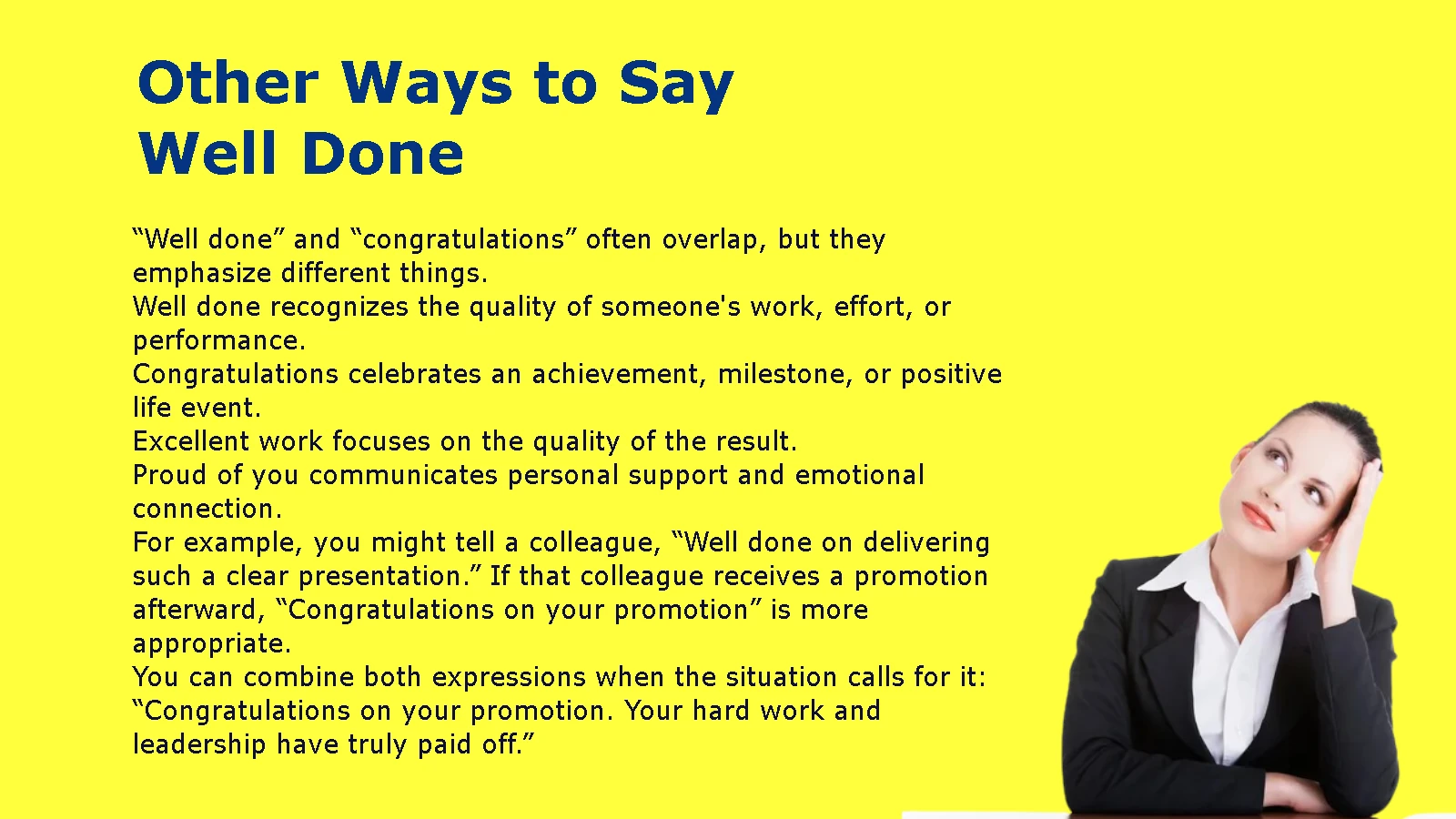
“Well done” and “congratulations” often overlap, but they emphasize different things.
- Well done recognizes the quality of someone’s work, effort, or performance.
- Congratulations celebrates an achievement, milestone, or positive life event.
- Excellent work focuses on the quality of the result.
- Proud of you communicates personal support and emotional connection.
For example, you might tell a colleague, “Well done on delivering such a clear presentation.” If that colleague receives a promotion afterward, “Congratulations on your promotion” is more appropriate.
You can combine both expressions when the situation calls for it: “Congratulations on your promotion. Your hard work and leadership have truly paid off.”
How to Choose a Phrase That Sounds Genuine
Good praise is specific, proportionate, and appropriate for the relationship. A brief compliment works well for a routine task, while a significant achievement deserves more thoughtful recognition.
Use this simple framework:
- Identify the achievement: What did the person do well?
- Choose the right tone: Should the praise sound formal, friendly, enthusiastic, or supportive?
- Explain the impact: Did the work save time, solve a problem, improve a result, or help someone else?
Instead of saying, “Good job,” try “Your clear instructions helped the entire team finish ahead of schedule.” This version explains exactly why the work deserves recognition.
100 Ways to Say Well Done
These 100 alternatives cover everyday conversations, professional achievements, creative work, personal milestones, and moments when someone deserves extra encouragement. Choose the expression that fits the accomplishment rather than relying on the same compliment every time.
Simple and Everyday Ways to Say Well Done
- Excellent work!
- Great job!
- Fantastic work!
- Nicely done!
- Well played!
- Good work!
- You did great!
- Wonderful job!
- That was excellent!
- Very impressive!
- Great effort!
- You did a wonderful job!
- That turned out beautifully!
- You handled that well!
- Superb work!
- That was well executed!
- You did a terrific job!
- Really well done!
- That looks fantastic!
- You got it right!
Enthusiastic Ways to Say Well Done
- You absolutely nailed it!
- That was phenomenal!
- What an incredible achievement!
- You knocked it out of the park!
- That was brilliant!
- You crushed it!
- Simply outstanding!
- What a fantastic result!
- You were amazing!
- That was next-level work!
- You made it look effortless!
- You really delivered!
- What a performance!
- You blew me away!
- That was exceptional!
- You smashed your goal!
- You made it happen!
- That was a masterful performance!
- You were on fire!
- What a brilliant accomplishment!
Warm and Heartfelt Ways to Say Well Done
- You should be proud of yourself.
- Your hard work has paid off.
- You deserve every bit of this success.
- I’m genuinely happy for you.
- You’ve earned this recognition.
- I’m proud of what you’ve accomplished.
- Your dedication really shows.
- You’ve come such a long way.
- This is a wonderful achievement.
- You worked hard for this, and it shows.
- Your persistence made the difference.
- You deserve to celebrate this moment.
- I knew you could do it.
- You’ve given yourself every reason to feel proud.
- Your effort is inspiring.
- You’ve accomplished something special.
- It’s wonderful to see your progress.
- You made something difficult look possible.
- Your commitment deserves recognition.
- You earned this success through your effort.
Creative and Memorable Ways to Say Well Done
- You turned a challenge into a win.
- You raised the bar.
- You made excellence look easy.
- You turned a great idea into reality.
- You delivered beyond the brief.
- You set a new standard.
- You made every detail count.
- You brought your A-game.
- You found a brilliant solution.
- You turned potential into performance.
- You made a real difference.
- You gave this your signature touch.
- You made the impossible look achievable.
- You showed what great work looks like.
- You created something worth celebrating.
- You turned hard work into a remarkable result.
- You made this outcome possible.
- You delivered exactly what the moment needed.
- You made a strong impression.
- You proved what determination can accomplish.
Short Phrases for Texts, Chats, and Social Media
- Brilliant!
- Nailed it!
- Love this!
- Absolutely ace!
- Huge win!
- So impressive!
- You rock!
- Incredible stuff!
- Big congratulations!
- What a win!
- Pure excellence!
- That’s the spirit!
- Mission accomplished!
- You’re amazing!
- Fantastic result!
- Major achievement!
- Huge respect!
- Keep shining!
- You’ve got this!
- More than deserved!
How to Say Well Done Professionally
To say well done professionally, recognize the person’s contribution, identify the quality of their work, and explain its impact. Phrases such as “Your analysis was thorough and insightful” or “You exceeded expectations on this project” communicate respect without sounding overly casual. The strongest workplace praise remains sincere, specific, and relevant to the achievement.
Professional Alternatives to Well Done at Work
Use these expressions when communicating with colleagues, employees, clients, supervisors, or business partners.
| Professional phrase | Best use | Example |
| Excellent work | General recognition | Excellent work on the quarterly report. |
| Outstanding performance | Exceptional results | Your outstanding performance helped us meet the deadline. |
| You exceeded expectations | Results above the target | You exceeded expectations with this client proposal. |
| Impressive attention to detail | Accuracy and quality | Your attention to detail prevented several costly errors. |
| A job exceptionally well done | Formal recognition | This was a job exceptionally well done. |
| Your contribution was invaluable | Teamwork | Your contribution was invaluable to the project’s success. |
| You delivered excellent results | Measurable outcomes | You delivered excellent results within a tight schedule. |
| Your work made a difference | Meaningful impact | Your recommendations made a difference to our planning process. |
| You handled this professionally | Judgment and conduct | You handled the client complaint professionally. |
| You went above and beyond | Extra effort | You went above and beyond to support the launch. |
Ways to Praise a Colleague or Coworker
Colleague-to-colleague praise should sound respectful and natural. You can acknowledge a useful contribution without making the interaction feel like a formal performance review.
Try these phrases:
- “Your suggestions helped us see the problem from a different angle.”
- “You made that complicated process much easier to understand.”
- “I really appreciate how you supported the team.”
- “Your preparation made the meeting much more productive.”
- “You handled that last-minute change exceptionally well.”
- “Your feedback helped me improve the final draft.”
- “You brought a valuable perspective to the discussion.”
- “The team benefited from the effort you put into this.”
For example, if a coworker helps you resolve a technical issue before a deadline, say, “Your troubleshooting saved us a lot of time. Excellent work.” This recognizes both the action and its practical value.
How Managers Can Recognize Employees
Managers should connect praise to specific behaviors and outcomes. This approach helps employees understand what they did well and which actions they should repeat.
A useful recognition formula is:
Action + impact + appreciation
For example:
“Your careful review caught the reporting error before submission. That protected the team’s credibility and saved us from having to correct the report later. Excellent work.”
Managers can also use these phrases:
- “You took ownership of the problem and found a practical solution.”
- “Your leadership helped the team stay focused under pressure.”
- “You consistently deliver work we can rely on.”
- “Your initiative helped us improve the process.”
- “You handled a difficult situation with maturity and professionalism.”
- “Your progress over the past month has been impressive.”
Avoid praising employees only for long hours or personal sacrifice. Recognize good judgment, collaboration, quality, improvement, and meaningful results as well.
Professional Praise Phrases for Emails
Written recognition should be clear enough that the recipient understands exactly what you appreciate. Match the length and formality of the message to the achievement.
Short email:
Subject: Excellent Work on the Project
Hi Jordan,
Excellent work on the project presentation. Your clear explanations and well-organized data made the recommendations easy to understand.
Thank you for the effort you put into this.
Best,
Alex
Formal recognition:
Subject: Recognition for Outstanding Performance
Hello Morgan,
I want to recognize the quality of your work on the recent client proposal. Your research was thorough, and your recommendations addressed the client’s main concerns directly.
Your contribution strengthened the proposal and helped the team move forward with confidence. Thank you for delivering such a strong result.
Best regards,
Taylor
Quick team message:
“Great work, everyone. The team coordinated effectively, resolved the outstanding issues, and delivered the project on schedule. Thank you for your contributions.”
Formal Expressions for Reports, Presentations, and Meetings
Formal praise is useful when addressing senior colleagues, recognizing achievements in public, or documenting performance.
Examples include:
- “The results demonstrate an exceptional standard of work.”
- “Your presentation was clear, persuasive, and well supported.”
- “This achievement reflects strong planning and execution.”
- “The quality of this analysis deserves recognition.”
- “Your contribution significantly strengthened the final outcome.”
- “The team delivered a highly effective solution.”
- “Your approach demonstrated sound judgment and professional expertise.”
Choose the expression that matches the evidence. A routine task may warrant “well executed,” while a significant business result may justify “an exceptional achievement.”
Examples of Professional Praise in Complete Sentences
- For a successful project: “You coordinated the project effectively and kept every major milestone on track.”
- For a strong presentation: “Your presentation was concise, persuasive, and supported by clear evidence.”
- For problem-solving: “You identified the root cause quickly and proposed a practical solution.”
- For leadership: “Your calm leadership helped the team navigate a challenging deadline.”
- For client service: “You handled the client’s concerns thoughtfully and maintained a positive working relationship.”
Specific language makes professional recognition more useful than a generic compliment.
Well Done Synonyms for Congratulations and Achievements
Well done synonyms for congratulations include “bravo,” “congratulations on your achievement,” “you earned this,” and “what an accomplishment.” These expressions celebrate success, but each carries a slightly different tone. Use a warm message for personal milestones, a formal expression for career achievements, and enthusiastic praise for a performance that deserves immediate recognition.
Ways to Say Congratulations for a Major Accomplishment
- “Congratulations on this outstanding achievement!”
- “You worked hard for this, and you deserve to celebrate.”
- “What an incredible milestone!”
- “Your determination has paid off.”
- “You should be proud of everything you’ve accomplished.”
- “This achievement reflects your commitment and talent.”
- “You’ve earned this success.”
- “Here’s to an achievement worth celebrating!”
A strong congratulations message recognizes the event and the effort behind it. For example, someone who completes a demanding professional qualification may appreciate: “Congratulations on earning your certification. Your persistence and preparation have paid off.”
Phrases for Promotions, Awards, and Career Milestones
Career milestones often call for a professional tone that still feels personal.
| Situation | Suggested phrase |
| Promotion | Congratulations on your well-deserved promotion! |
| New leadership role | Your leadership journey is off to an excellent start. |
| Industry award | This recognition is a wonderful reflection of your work. |
| Successful business launch | Congratulations on turning your vision into reality. |
| Career anniversary | Your contributions over the years deserve recognition. |
| Major sales target | Outstanding work on reaching your target. |
| Graduation | Congratulations on reaching this important milestone. |
| New qualification | Your commitment to learning has paid off. |
Expressions for Passing Exams and Completing Certifications
Academic and professional qualifications represent preparation, discipline, and achievement.
Use expressions such as:
- “Congratulations on passing your exam!”
- “Your preparation really paid off.”
- “You earned that result through consistent effort.”
- “Well done on completing your certification.”
- “Your hard work brought you to this milestone.”
- “You should be proud of the progress you’ve made.”
- “That result reflects your commitment to learning.”
If the person struggled with a particular subject, acknowledge the progress without exaggerating the result: “You worked through a difficult topic and made real progress. Congratulations on passing.”
Congratulations for Personal Goals and Important Milestones
Personal achievements may include finishing a marathon, learning a new skill, completing a creative project, or reaching a long-term goal.
Consider these messages:
- “You set a goal and followed through. That’s worth celebrating.”
- “Your consistency has brought you a long way.”
- “You turned a personal ambition into an achievement.”
- “You kept going even when the process became difficult.”
- “This is a wonderful reminder of what persistence can accomplish.”
- “I’m happy to see your hard work paying off.”
Keep personal praise sensitive to the circumstances. Not everyone wants public recognition, so consider whether a private message would feel more appropriate.
How to Combine Congratulations With Meaningful Praise
Pair the achievement with a specific reason it deserves recognition.
Instead of writing, “Congratulations! Great job!” try:
“Congratulations on completing the project ahead of schedule. Your planning and communication helped the entire team deliver a better result.”
The longer message feels more personal because it connects the milestone to the actions that made it possible.
25 Things to Say Instead of Good Job
If you want to avoid repeating “good job,” choose an alternative that describes the quality of the work, the effort involved, or the result achieved.
Everyday Alternatives to Good Job
- “You did a fantastic job.”
- “That was really impressive.”
- “You handled that beautifully.”
- “You got it exactly right.”
- “You made that look easy.”
- “That was a smart move.”
- “You did a great job with that.”
- “I love how that turned out.”
More Specific Ways to Recognize Excellent Work
- “Your attention to detail really shows.”
- “You found an excellent solution.”
- “Your explanation made everything clear.”
- “You made the final result much stronger.”
- “Your preparation paid off.”
- “You delivered exactly what we needed.”
- “Your creativity made this stand out.”
- “You approached the challenge thoughtfully.”
Phrases That Recognize Effort and Improvement
- “I can see how much work you put into this.”
- “You’ve improved so much.”
- “Your persistence made a real difference.”
- “You kept going, and it paid off.”
- “You handled that challenge with determination.”
- “Your progress deserves recognition.”
- “You should be proud of how far you’ve come.”
- “You learned from the challenge and improved the result.”
- “You’ve earned this success.”
Examples of Good Job Alternatives in Real Conversations
After a presentation: “Your explanation of the results was clear and convincing.”
After a difficult assignment: “You stayed focused and worked through the hardest parts.”
When a creative project: “Your original ideas gave this project a distinctive feel.”
After a team contribution: “You helped everyone stay organized and move forward.”
After a personal improvement: “Your progress is easy to see, and your effort has paid off.”
These expressions work because they replace vague approval with meaningful feedback.
Well Done Synonyms for Students
Well done synonyms for students include “excellent progress,” “thoughtful work,” “you’ve mastered this concept,” and “your effort is paying off.” Effective student praise identifies what the learner did well and encourages continued improvement. Teachers can recognize correct answers, persistence, creativity, collaboration, and progress without relying on the same general compliment after every assignment.
Praise Phrases for Academic Achievement
Use these phrases to recognize strong assignments, successful exams, and mastery of a subject.
- “Your answer shows a clear understanding of the topic.”
- “You explained your reasoning very well.”
- “This is an excellent piece of work.”
- “You applied the concept accurately.”
- “Your research strengthened your argument.”
- “You organized your ideas clearly.”
- “You demonstrated impressive subject knowledge.”
- “Your work shows careful thought and preparation.”
Specific feedback helps students understand which skills contributed to their success.
Encouraging Words for Effort and Persistence
Students need recognition for effort, especially when they face difficult material or recover from mistakes.
Try these expressions:
- “You kept working even when the question was challenging.”
- “Your persistence helped you solve the problem.”
- “You tried a different approach, and it worked.”
- “You asked thoughtful questions to improve your understanding.”
- “You stayed focused and completed the task.”
- “Your preparation is reflected in your work.”
- “You showed real determination today.”
Praise effort honestly. A student who tried hard but has not yet reached the correct answer may benefit more from encouragement and guidance than from being told the answer is excellent.
Positive Feedback for Improvement and Progress
Recognizing progress helps students see learning as a process rather than a fixed measure of ability.
- “Your writing is clearer than it was in your last assignment.”
- “You’re using the method more confidently.”
- “You corrected your earlier mistakes and improved the result.”
- “Your explanations have become more detailed.”
- “You’re making steady progress with this skill.”
- “You used the feedback effectively.”
- “Your revision made this answer much stronger.”
For example, a student who previously struggled with essay structure might hear: “Your paragraphs follow a clearer order this time, and your examples support the main argument. Keep building on that progress.”
Ways Teachers Can Praise Students Without Repeating Themselves
| What the student demonstrates | Useful praise |
| Accuracy | “You applied the rule correctly.” |
| Creativity | “Your approach is original and thoughtful.” |
| Persistence | “You stayed with the problem until you found a solution.” |
| Collaboration | “You listened to your classmates and helped the group move forward.” |
| Independence | “You used your knowledge to solve this without step-by-step guidance.” |
| Improvement | “Your work shows clear progress.” |
| Critical thinking | “You supported your answer with strong reasoning.” |
| Organization | “Your ideas are easy to follow.” |
Well Done Messages for Exams and Completed Assignments
For a strong exam result: “Excellent result! Your preparation and understanding of the material really show.”
For an improved grade: “You’ve made meaningful progress. Keep using the study strategies that helped you improve.”
For a completed assignment: “Your work is organized, thoughtful, and complete. You should feel proud of the effort you put into it.”
For a challenging subject: “You worked through a difficult concept and showed a stronger understanding this time.”
Constructive Praise That Supports Learning
Effective praise should help students understand what they can repeat or improve.
Compare these examples:
- General praise: “You’re brilliant.”
- Specific praise: “You compared both arguments and used evidence to support your conclusion.”
The second example points to a behavior the student can use again. It also leaves room for growth without tying success to an identity such as being naturally talented.
100 Powerful Ways to Say Good Job
Powerful ways to say good job emphasize outstanding results, skill, resilience, leadership, or consistent effort. Use strong expressions when the achievement genuinely stands out. For everyday work, a simple compliment may be enough; for a major accomplishment, choose language that reflects the importance of the result and the contribution behind it.
Powerful Phrases for Outstanding Performance
- You delivered an exceptional result.
- Your performance exceeded every expectation.
- That was an outstanding accomplishment.
- You set a remarkable standard.
- Your work speaks for itself.
- You delivered excellence from start to finish.
- You produced a truly impressive result.
- Your execution was exceptional.
- You turned a demanding assignment into a success.
- That achievement deserves recognition.
- You demonstrated remarkable expertise.
- You delivered beyond what was expected.
- Your work raised the standard for the team.
- You made a difficult task look manageable.
- This is an excellent example of quality work.
- You brought exceptional focus to the task.
- You delivered a result worth celebrating.
- Your contribution strengthened the entire project.
- You performed at an outstanding level.
- You accomplished something genuinely impressive.
Words That Recognize Skill, Creativity, and Problem-Solving
- Your solution was both practical and innovative.
- You approached the problem with impressive clarity.
- Your creativity made the difference.
- You identified an issue others had overlooked.
- Your reasoning was sharp and well supported.
- You found a smarter way to approach the task.
- Your technical skill really showed.
- You combined creativity with careful execution.
- You simplified a complicated problem.
- Your judgment led to a strong result.
- You connected the details in a thoughtful way.
- Your idea gave the project a new direction.
- You made an excellent decision under pressure.
- You found a solution that addressed the real problem.
- Your analysis uncovered useful insights.
- You used your expertise effectively.
- You thought beyond the obvious solution.
- You turned a complex challenge into a clear plan.
- Your attention to detail strengthened the final result.
- You brought fresh thinking to the discussion.
Strong Expressions for Overcoming Challenges
- You showed remarkable resilience.
- You stayed focused when things became difficult.
- You worked through the challenge with determination.
- You turned a setback into a learning opportunity.
- You kept moving forward despite the obstacles.
- Your persistence made this achievement possible.
- You adapted quickly and delivered a strong result.
- You handled the pressure exceptionally well.
- You found a way forward when the path was unclear.
- You showed real determination.
- You faced the challenge with confidence.
- You learned from the setback and improved your approach.
- You refused to let the difficulty define the outcome.
- You stayed committed to the goal.
- You made steady progress through a demanding process.
- You handled an unexpected problem with maturity.
- You recovered quickly and got the work back on track.
- Your patience helped you reach the finish line.
- You demonstrated impressive perseverance.
- You proved that consistent effort can make a difference.
Phrases That Recognize Leadership and Teamwork
- Your leadership helped everyone stay focused.
- You brought the team together.
- Your support made a real difference.
- You helped the group achieve more together.
- You communicated the plan clearly.
- You made sure every voice was heard.
- Your coordination kept the project moving.
- You led by example.
- You made collaboration easier for everyone.
- You helped the team navigate a difficult decision.
- Your initiative kept us ahead of schedule.
- You created space for better ideas.
- Your guidance helped the team succeed.
- You handled the responsibility with confidence.
- You strengthened the team’s performance.
- Your willingness to help improved the outcome.
- You made a valuable contribution to the group.
- You brought clarity to a complicated discussion.
- You helped everyone work toward the same goal.
- Your leadership turned the plan into action.
Meaningful Praise for Consistent Effort and Growth
- Your consistency is paying off.
- You’ve made impressive progress.
- Your commitment is easy to see.
- You keep finding ways to improve.
- Your discipline has produced a strong result.
- You’ve built a skill you can be proud of.
- Your work reflects real growth.
- You’ve become more confident and capable.
- Your continued effort is making a difference.
- You’re building a strong foundation for future success.
- Your improvement deserves recognition.
- You’re applying feedback more effectively.
- You’ve developed a thoughtful approach to the work.
- You’re becoming more independent in your decisions.
- Your dedication has strengthened your performance.
- You’ve turned practice into progress.
- Your effort has led to measurable improvement.
- You’ve developed a reliable way to solve the problem.
- You’re showing what steady progress looks like.
- You’ve earned recognition for the work you’ve put in.
Well Done Phrases for Different Situations
The most effective well done phrases match the task, relationship, and result. A successful presentation calls for different praise than a difficult personal milestone. Choose language that reflects what happened, then add a detail that shows you understand why the achievement matters.
Ways to Praise Someone for Completing a Difficult Task
- “You worked through a tough challenge and delivered a strong result.”
- “Your patience and persistence paid off.”
- “You stayed focused and found a practical solution.”
- “You handled the difficult parts with real determination.”
- “That was a demanding task, and you completed it exceptionally well.”
Example: A colleague finishes a complicated report after resolving several data problems. Instead of saying “Great job,” try: “You worked through the data issues carefully and delivered a clear, reliable report. Excellent work.”
Phrases for a Successful Presentation or Project
- “Your presentation was clear, engaging, and persuasive.”
- “You explained the key points exceptionally well.”
- “The project came together beautifully.”
- “Your planning helped everything run smoothly.”
- “You delivered a polished final result.”
- “You made the main findings easy to understand.”
Praise for Creative Ideas and Innovative Solutions
- “Your idea brought a fresh perspective to the problem.”
- “That’s a clever solution.”
- “Your creativity made this stand out.”
- “You found an original way to approach the challenge.”
- “Your idea was imaginative and practical.”
- “You turned a promising concept into something useful.”
Expressions for Teamwork and Collaboration
- “You helped the team stay aligned.”
- “Your cooperation made the process smoother.”
- “You made sure everyone had the information they needed.”
- “Your contribution helped the group reach its goal.”
- “You supported your teammates when it mattered.”
- “You brought a positive and constructive attitude to the project.”
Ways to Celebrate Small Wins and Everyday Progress
Small achievements deserve recognition when they represent meaningful progress. A person learning a new skill, improving a routine, or completing an overdue task may value a brief, sincere compliment.
Try these expressions:
- “Nice progress!”
- “You’re getting the hang of it.”
- “That’s a step in the right direction.”
- “You followed through, and that matters.”
- “You made real progress today.”
- “Keep building on that momentum.”
Praise for Achieving a Personal Goal
- “You set a goal and followed through.”
- “You should be proud of the commitment you showed.”
- “Your consistency brought you here.”
- “You turned a personal ambition into reality.”
- “You earned this moment.”
- “It’s wonderful to see your effort pay off.”
How to Make Your Praise More Meaningful
Meaningful praise identifies a real action, connects it to an outcome, and respects the recipient’s perspective. Instead of relying on broad compliments, explain what the person did well and why it mattered. This approach makes recognition more credible, helps people understand their strengths, and gives them useful feedback they can apply again.
Be Specific About What the Person Did Well
General praise can feel pleasant, but specific praise tells the recipient what made the work successful.
Compare the following:
| General praise | More meaningful praise |
| Good job! | Your clear instructions helped the new team members get started quickly. |
| Excellent work! | Your research gave us the evidence we needed to make the decision. |
| You’re amazing! | You stayed calm and resolved the client’s concern professionally. |
| Great effort! | You revised the draft carefully and improved the argument. |
Specificity shows that you paid attention. It also makes praise more useful because the recipient can identify the behavior worth repeating.
Recognize Effort as Well as Results
Results matter, but they do not tell the whole story. Someone may demonstrate persistence, sound judgment, or meaningful improvement even when a task does not end exactly as planned.
For example, a student who improves a weak essay through careful revision deserves recognition for the progress. A colleague who identifies a project risk before it causes a delay deserves praise for their judgment.
Useful expressions include:
- “Your preparation helped you handle the challenge.”
- “You improved the result by acting on the feedback.”
- “You identified the risk early and gave us time to respond.”
- “You kept testing different approaches until you found one that worked.”
Match the Tone to the Person and Situation
A message that works in a team chat may sound too casual in a formal report. Consider the relationship, the size of the achievement, and whether the praise is public or private.
| Context | Suitable tone | Example |
| Workplace email | Professional | “Excellent work on the client proposal.” |
| Friendly conversation | Casual | “You nailed it!” |
| Classroom feedback | Encouraging | “Your explanation shows real progress.” |
| Formal award | Celebratory | “This achievement deserves recognition.” |
| Personal milestone | Warm | “You should be proud of how far you’ve come.” |
Avoid Exaggerated or Insincere Compliments
Praise loses meaning when every small task receives an extreme reaction. Calling routine work “the greatest achievement ever” can make recognition feel automatic rather than genuine.
Keep the language proportionate to the result. Say “Thanks for organizing the files so clearly” for a helpful routine task. Save “Your contribution transformed the project” for work that truly changed the outcome.
Avoid comparisons that create unnecessary competition, such as “You’re the only competent person here.” Recognize the person’s contribution without putting other people down.
Use Examples to Make Praise Feel Personal
A useful way to personalize praise is to mention a detail that only someone familiar with the work would notice.
Instead of:
“Fantastic work on the event.”
Try:
“Fantastic work on the event. Your revised schedule kept the speakers on time, and the clear signs made registration easier for everyone.”
The second message shows that you noticed specific contributions. It also explains why the person’s effort mattered.
Examples of Well Done Phrases in Real Messages
Well done phrases become more useful when you see how they fit into complete messages. The following examples show how to recognize achievements without making praise sound stiff, exaggerated, or repetitive.
Professional Email Examples
Recognizing a successful project
Subject: Excellent Work on the Project
Hi Sam,
Excellent work on the project. Your planning kept the team organized, and your regular updates helped us address issues before they affected the deadline.
Thank you for your contribution.
Best,
Jordan
Recognizing a colleague’s problem-solving
Hi Taylor,
You handled that issue exceptionally well. Your investigation identified the root cause, and your proposed fix addressed the problem without creating unnecessary delays.
I appreciate the thought you put into the solution.
Best,
Morgan
Short Text Messages for Friends and Family
- “You absolutely nailed it. I knew you could do it!”
- “That’s such a fantastic achievement. You deserve to celebrate.”
- “I’m proud of how hard you worked for this.”
- “You made it happen. Enjoy the moment!”
- “Your effort has paid off, and I’m so happy for you.”
- “What a result! You should feel proud.”
Teacher-to-Student Praise Examples
For improved writing: “Your ideas are organized more clearly this time, and your examples support your argument well. Keep building on that progress.”
For persistence: “You kept trying different methods instead of giving up. That persistence helped you reach the answer.”
For classroom participation: “Your question helped the class examine the topic more deeply. Thank you for contributing.”
Manager-to-Employee Recognition Examples
For initiative: “You noticed the process was slowing the team down and proposed a practical improvement. Your initiative made a real difference.”
For collaboration: “You shared information clearly and supported your teammates throughout the project. That cooperation helped us deliver on time.”
For quality: “Your final review caught several issues before submission. Your attention to detail strengthened the finished work.”
Congratulations Messages for Major Achievements
For a promotion: “Congratulations on your promotion! Your commitment, judgment, and consistent performance have earned you this opportunity.”
For graduation: “Congratulations on graduating. Your hard work has brought you to an important milestone, and you have every reason to feel proud.”
For a business milestone: “Congratulations on reaching this milestone. Building something successful takes patience and persistence, and your progress deserves to be celebrated.”
A Practical Case Study: Turning Generic Praise Into Useful Feedback
Imagine a team member completes a customer research report. Their manager could simply say, “Good job.” The comment is positive, but it does not identify what worked well.
A more useful response would be:
“Your report grouped customer feedback into clear themes and identified the main reasons people abandoned their purchases. That gave us a practical starting point for improving the checkout process. Excellent work.”
This message identifies three things:
- Action: The employee organized customer feedback into useful themes.
- Impact: The report revealed reasons for abandoned purchases.
- Recognition: The manager praised the quality and value of the work.
The same principle works in schools, personal relationships, and team settings. When praise describes the achievement and its impact, the recipient understands why the work matters.
Frequently Asked Questions
What Is Another Word for Well Done?
Common alternatives include excellent, outstanding, impressive, commendable, superb, and exceptional. Choose “excellent” for general praise, “outstanding” for unusually strong performance, and “commendable” for an action or effort that deserves respect. The best synonym depends on the tone and context.
How Do You Say Well Done in a Professional Way?
Use expressions such as “Excellent work on this project,” “Your contribution made a real difference,” or “You exceeded expectations.” Professional praise works best when it identifies a specific achievement and explains its value. Keep the tone respectful and avoid exaggerating the result.
What Can I Say Instead of Good Job?
Try “You nailed it,” “That was impressive,” “Your effort paid off,” “You handled that beautifully,” or “You found an excellent solution.” For workplace communication, use “Excellent work” or “You delivered strong results.” For personal encouragement, choose a warmer phrase that recognizes effort and progress.
What Is a More Powerful Way to Say Well Done?
“Outstanding achievement,” “You exceeded expectations,” “You raised the standard,” and “Your performance was exceptional” are powerful alternatives. Reserve the strongest expressions for achievements that genuinely warrant them. Specific praise usually carries more weight than an exaggerated compliment.
How Do You Praise a Student Without Saying Well Done?
Recognize the student’s actions and progress with phrases such as “Your reasoning is clear,” “You’ve improved your explanation,” or “You kept working through a difficult problem.” This kind of feedback shows students what they did well and encourages them to repeat effective learning behaviors.
Is Well Done the Same as Congratulations?
Not exactly. “Well done” praises someone’s work, effort, or performance, while “congratulations” celebrates an achievement or milestone. You can use both together when appropriate: “Congratulations on your promotion. Well done on earning this opportunity through your hard work.”
Choose the Right Words to Recognize Great Work
The best other ways to say well done are the ones that fit the person, the achievement, and the moment. “Excellent work” suits professional settings, “you nailed it” adds energy to casual praise, and “your effort has paid off” recognizes persistence and growth.
You do not need an elaborate compliment every time someone succeeds. A short, specific sentence can be more meaningful than a long message filled with generic praise.