Another word for pick up depends on what you mean: collect, retrieve, grab, lift, fetch, and acquire are common alternatives. You can also use learn when talking about skills, transport when referring to passengers, and answer when discussing phone calls. The right synonym depends on the action, situation, and tone.
The phrasal verb pick up has several meanings in everyday English. It can describe collecting someone from the airport, lifting an object, learning a new skill, retrieving lost property, answering a phone call, or improving speed and activity. Some expressions also have different opposites, such as put down, drop off, ignore, and slow down.
This guide explores more than 75 alternatives, including formal synonyms, casual expressions, slang, antonyms, and context-specific replacements. You’ll also learn how to distinguish words such as collect, fetch, retrieve, acquire, and snatch so you can use them naturally.
Quick Answers: Another Word for Pick Up
| Question | Answer |
| What is another word for pick up? | Collect, retrieve, grab, lift, fetch, or obtain. |
| What is another word for pick up and drop off? | Transport, shuttle, transfer, or collect and deliver. |
| What is another word for picked up skills? | Acquired, learned, developed, or mastered. |
| What is the opposite of pick up? | Put down, drop, leave, decline, or decrease, depending on context. |
| What is a slang word for picked up? | Snagged, copped, scored, grabbed, or got hold of. |
What Is Another Word for Pick Up?
The best synonyms for pick up include collect, retrieve, grab, lift, fetch, acquire, and obtain. However, these words do not mean exactly the same thing. Collect usually involves getting something from a place, lift describes raising an object, and acquire refers to gaining possession or knowledge.
The expression pick up is a phrasal verb with several meanings. Its replacement changes according to how someone uses it in a sentence.
For example:
- I’ll pick up the package tomorrow. → I’ll collect the package tomorrow.
- Can you pick up that box? → Can you lift that box?
- She picked up Spanish quickly. → She learned Spanish quickly.
- Please pick up the documents. → Please retrieve the documents.
- He picked up the phone. → He answered the phone.
Common Synonyms for Pick Up
Here are useful alternatives for different situations:
| Synonym | Meaning | Example |
| Collect | Get something or someone from a place | I’ll collect the package. |
| Retrieve | Get something back | Retrieve the missing file. |
| Grab | Take something quickly | Grab your jacket. |
| Lift | Raise something physically | Lift the suitcase. |
| Gather | Bring several things together | Gather the scattered papers. |
| Fetch | Go and bring something back | Fetch the keys. |
| Acquire | Gain possession or knowledge | Acquire new abilities. |
| Obtain | Get something through an action | Obtain the required documents. |
| Get | Receive or obtain something | Get your order from reception. |
| Recover | Get something back after losing it | Recover the missing equipment. |
| Raise | Move something to a higher position | Raise the container carefully. |
| Snatch | Take something suddenly or forcefully | He snatched the wallet away. |
Formal and Professional Alternatives to Pick Up
In professional writing, you may want a more precise expression than pick up. Formal alternatives make instructions, reports, business emails, and workplace communication clearer.
Consider these options:
- Retrieve: Use when getting information, documents, or stored items back.
- Collect: Use when gathering orders, packages, payments, or people.
- Acquire: Use when gaining knowledge, assets, or skills.
- Obtain: Use when securing something through a request or process.
- Gather: Use when bringing information, materials, or people together.
- Recover: Use when restoring something lost or unavailable.
- Transport: Use when moving people or goods between locations.
For example, instead of writing:
“Please pick up the documents from the front desk.”
You could write:
“Please retrieve the documents from the front desk.”
Similarly, “The company picked up several new clients” could become “The company acquired several new clients.”
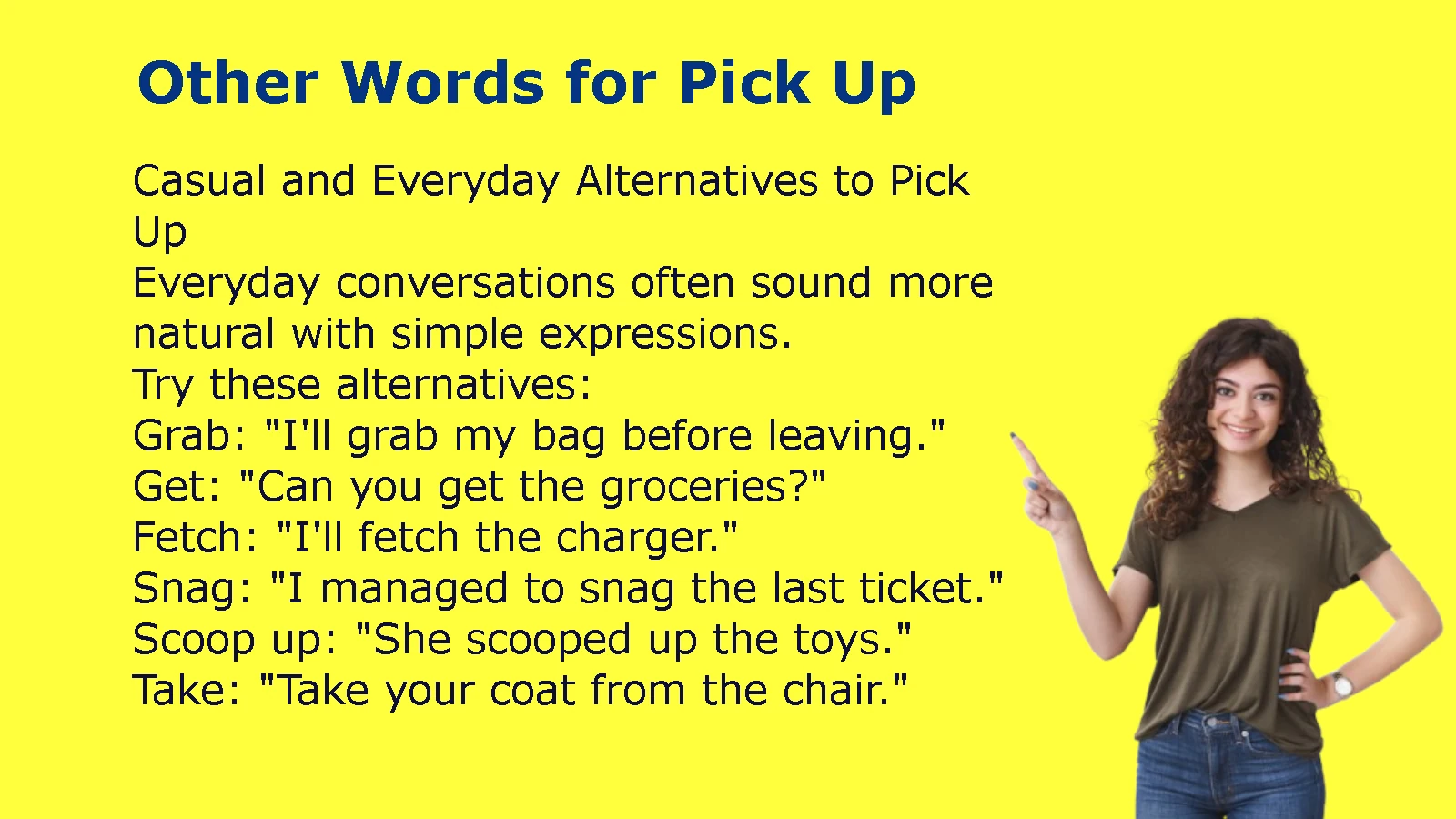
Casual and Everyday Alternatives to Pick Up
Everyday conversations often sound more natural with simple expressions.
Try these alternatives:
- Grab: “I’ll grab my bag before leaving.”
- Get: “Can you get the groceries?”
- Fetch: “I’ll fetch the charger.”
- Snag: “I managed to snag the last ticket.”
- Scoop up: “She scooped up the toys.”
- Take: “Take your coat from the chair.”
The main difference comes from tone. Retrieve sounds more formal, while grab and get fit casual conversations.
Another Word for Pick Up and Drop Off
Another way to say pick up and drop off is transport, shuttle, transfer, or collect and deliver. These expressions describe moving a person or item from one location to another. The most appropriate choice depends on whether you mean passenger transportation, package delivery, or a complete transportation service.
For example, a school may provide a student transportation service, while an airport company may offer passenger transfers.
Synonyms for Pick Up and Drop Off
| Alternative | Best use | Example |
| Transport | Moving people or goods | We transport employees to the office. |
| Shuttle | Regular transportation between locations | The hotel provides an airport shuttle. |
| Transfer | Moving passengers between places | The company arranged an airport transfer. |
| Collect and deliver | Handling both collection and delivery | We collect and deliver packages. |
| Drive and drop off | Taking someone somewhere by car | I’ll drive and drop off the guests. |
| Take and return | Moving something and bringing it back | The service takes and returns equipment. |
| Passenger transfer | Organized movement of passengers | The hotel offers passenger transfers. |
Another Way to Say Pick Up and Drop Off Passengers
When talking about passenger transportation, these expressions work particularly well:
- Passenger transfer: A service that moves passengers between destinations.
- Shuttle service: A vehicle that travels between specific locations, often repeatedly.
- Transportation service: A broad term for organized passenger movement.
- Airport transfer: A journey between an airport and another destination.
- Chauffeur service: A professional driving service.
- Courtesy transportation: A complimentary ride provided by a business.
For example:
- “The hotel offers complimentary airport transfers.”
- “Our company provides employee shuttle services.”
- “The driver will collect and transport the guests.”
- “We arranged a private passenger transfer.”
Important distinction: A shuttle usually operates on a route or schedule. An airport transfer may involve a private, one-time journey. A chauffeur service focuses on professional driving.
Examples of Pick Up and Drop Off in Sentences
The following examples show how to replace the expression in different situations.
School transportation
Original: “The school bus picks up and drops off students.”
Alternative: “The school bus transports students between their homes and school.”
Airport transportation
Original: “The driver will pick us up and drop us off at the hotel.”
Alternative: “The driver will provide an airport transfer to the hotel.”
Business delivery
Original: “We pick up and drop off office supplies.”
Alternative: “We collect and deliver office supplies.”
Personal transportation
Original: “Can you pick me up and drop me off after the event?”
Alternative: “Can you drive me to the event and bring me home afterward?”
What Is the Opposite of Pick Up From the Airport?
The opposite of pick up from the airport is usually drop off at the airport. Picking someone up means collecting an arriving passenger, while dropping someone off means taking a departing passenger to the airport. You can also say drive someone to the airport, take someone to the terminal, or see someone off.
Here is the difference:
| Expression | Meaning |
| Pick up from the airport | Collect an arriving passenger |
| Drop off at the airport | Take a departing passenger to the airport |
| See off | Accompany someone who is leaving |
| Take to the airport | Drive someone to the airport |
| Leave at the terminal | End the journey at the airport |
Examples:
- “I’ll pick you up from the airport at 8 p.m.”
- “I’ll drop you off at the airport before your flight.”
- “Her family came to see her off.”
- “My brother will take me to the airport tomorrow.”
Notice that see off emphasizes saying goodbye, while drop off describes the transportation action.
Another Word for Picking Up Things Quickly
When someone picks up an object quickly, suitable alternatives include grab, snatch, scoop up, seize, and snatch up. Each expression describes a slightly different action. Grab suggests a quick movement, snatch often implies sudden or forceful action, and scoop up usually describes collecting several objects together.
The best choice depends on the speed, manner, and intention behind the action.
Quick Synonyms for Picking Up Objects
| Synonym | Meaning | Example |
| Grab | Take something quickly | Grab your phone before leaving. |
| Snatch | Take something suddenly or forcefully | He snatched the letter from the desk. |
| Scoop up | Collect something with a sweeping movement | She scooped up the scattered toys. |
| Seize | Take hold of something firmly | The child seized the opportunity. |
| Snatch up | Pick up something suddenly | He snatched up his keys. |
| Gather | Bring several objects together | Gather the papers quickly. |
| Sweep up | Collect scattered items | Sweep up the fallen leaves. |
| Take hold of | Grasp something | Take hold of the handle. |
| Collect | Bring items together | Collect the books from the table. |
| Pick up quickly | Retrieve something without delay | Pick up the files before the meeting. |
Words for Picking Up Something in a Hurry
Sometimes you need an expression that communicates urgency rather than simply describing the physical action.
These alternatives work well:
- Grab: Take something quickly, often without much preparation.
- Snatch: Take something suddenly, sometimes aggressively.
- Seize: Take hold of something firmly or act on an opportunity.
- Scoop up: Gather several things in one movement.
- Snatch up: Quickly take an available object.
- Rush to collect: Retrieve something under time pressure.
- Take hold of: Quickly establish a firm grip.
For example:
- “I grabbed my wallet and ran outside.”
- “She snatched up the documents before the rain started.”
- “He scooped up the scattered photographs.”
- “The goalkeeper seized the ball before it crossed the line.”
Difference Between Grab, Snatch, and Scoop Up
These three expressions are related, but they create different impressions.
| Word | Speed | Force | Typical situation |
| Grab | Usually quick | Can be gentle or firm | Taking a phone or bag |
| Snatch | Very quick | Often forceful | Taking something suddenly |
| Scoop up | Usually quick | Not necessarily forceful | Collecting several small objects |
Consider these examples:
Grab: “She grabbed her coat before leaving.” This sounds natural and neutral.
Snatch: “The thief snatched the handbag.” This suggests sudden, unwanted action.
Scoop up: “The mother scooped up her child’s toys.” This suggests gathering multiple items, often with one sweeping movement.
Avoid using these words interchangeably when the manner of the action matters.
Example Sentences for Quickly Picking Up Things
Here are additional examples you can use in everyday communication:
- He grabbed his keys from the kitchen counter.
- She snatched the falling glass before it hit the floor.
- The cleaner scooped up the scattered paper.
- I quickly collected my belongings before checking out.
- The child seized the opportunity to take the last cookie.
- Please gather the documents before the meeting starts.
- The player snatched up the ball and continued running.
Another Word for Picked Up Skills
Another way to say picked up skills is acquired skills, learned abilities, developed competencies, or mastered techniques. When someone picks up a skill, they gain the ability through practice, observation, instruction, or experience. The best alternative depends on whether they are beginning to learn, improving their ability, or achieving a high level of proficiency.
For example, someone who learns basic computer skills through daily practice has acquired new abilities. Someone who becomes highly proficient may have mastered those skills.
Synonyms for Picking Up New Skills
| Synonym | Meaning | Example |
| Acquired | Gained through learning or experience | She acquired excellent communication skills. |
| Learned | Gained knowledge or ability | He learned basic programming. |
| Developed | Improved or built an ability | She developed strong leadership skills. |
| Mastered | Reached a high level of proficiency | He mastered advanced Excel techniques. |
| Gained | Obtained through experience | They gained valuable technical skills. |
| Absorbed | Learned information through exposure | She absorbed new concepts quickly. |
| Cultivated | Gradually developed through effort | He cultivated strong negotiation skills. |
| Improved | Became better at something | She improved her writing abilities. |
| Strengthened | Made an existing ability stronger | He strengthened his analytical skills. |
| Accomplished | Achieved a level of competence or success | She became an accomplished designer. |
Another Way to Say Someone Picks Up Skills Quickly
Some people learn new tasks faster than others. You can describe this ability without repeatedly using the expression “picks things up quickly.”
Consider these alternatives:
- Fast learner: Someone who understands new information quickly.
- Quick to grasp concepts: Someone who understands ideas with little explanation.
- Quick study: An informal expression for someone who learns rapidly.
- Rapid learner: A person who acquires knowledge at a fast pace.
- Absorbs information quickly: Someone who remembers and understands new material efficiently.
- Catches on quickly: Someone who understands a task or situation without much instruction.
- Gets the hang of it: Someone who becomes comfortable with a new activity.
- Adapts quickly: Someone who adjusts to unfamiliar tasks or situations.
Example sentences:
- “She is a quick study and understands new software easily.”
- “He catches on quickly when learning technical processes.”
- “Our new employee grasps concepts quickly.”
- “Mia absorbs information rapidly during training.”
- “He’s a fast learner who needs very little supervision.”
Professional Alternatives to Picked Up Skills
In resumes, performance reviews, professional biographies, and job applications, more precise expressions often communicate experience better.
Use these alternatives:
| Everyday expression | Professional alternative |
| Picked up new skills | Acquired new competencies |
| Picked up experience | Gained practical experience |
| Picked up technical knowledge | Developed technical expertise |
| Picked up leadership skills | Strengthened leadership capabilities |
| Picked up new software | Gained proficiency in new software |
| Picked up communication skills | Developed effective communication abilities |
| Picked up industry knowledge | Expanded industry knowledge |
For example, instead of writing:
“I picked up several new skills during my internship.”
You could write:
“I developed practical skills in project coordination, data analysis, and client communication during my internship.”
The second sentence provides more information and communicates professional growth more clearly.
Example Sentences Using Skills Synonyms
- She acquired excellent customer service skills through her first job.
- He developed strong problem-solving abilities during his training.
- The intern learned several programming languages.
- Our manager mastered the new reporting system.
- They gained valuable experience working with international clients.
- The student absorbed new vocabulary through daily conversations.
- She cultivated her presentation skills by speaking at weekly meetings.
Practical example: Imagine an employee who learns a company’s inventory software in two days. You could say the employee “picked up the software quickly.” In a performance review, however, “demonstrated a strong ability to acquire technical skills” sounds more professional and communicates the same achievement.
Picked Up Synonym Slang: Casual and Informal Alternatives
Popular slang alternatives for picked up include snagged, copped, scored, grabbed, and bagged. These expressions often describe obtaining an item, finding something desirable, or getting hold of something. Other informal expressions, such as caught on and got the hang of it, describe learning something quickly.
Slang depends on context, region, and social group. A word that sounds natural among friends may feel inappropriate in a business email.
Popular Slang Words for Picked Up
| Slang expression | Meaning | Example |
| Snagged | Managed to get something | I snagged the last concert ticket. |
| Copped | Bought or obtained something | He copped a new pair of sneakers. |
| Scored | Successfully obtained something desirable | We scored free tickets. |
| Grabbed | Took something quickly | I grabbed a coffee on my way home. |
| Bagged | Obtained or secured something | She bagged a great deal. |
| Scooped up | Quickly collected or obtained something | They scooped up all the available seats. |
| Got hold of | Managed to obtain something | I finally got hold of the documents. |
| Picked up on | Noticed or understood something | She picked up on his frustration. |
Slang for Picking Up Knowledge or Skills
If you mean learning something informally, these expressions sound more natural than using slang for obtaining physical objects.
- Caught on: Understood something after a short explanation.
- Got the hang of it: Became comfortable with an activity.
- Learned the ropes: Learned how a job or process works.
- Picked up on it: Noticed or understood a detail.
- Caught the drift: Understood the general meaning.
- Got the gist: Understood the main idea.
- Figured it out: Found a way to understand or solve something.
Examples:
- “I caught on after the second lesson.”
- “She got the hang of it within a few days.”
- “He quickly learned the ropes at his new job.”
- “I got the gist of the conversation.”
- “They figured out how to operate the machine.”
Slang Examples in Everyday Conversations
Situation: Buying something
Person A: “Did you get those new headphones?”
Person B: “Yes, I snagged them during the sale.”
Situation: Getting a good opportunity
Person A: “How did you get those concert tickets?”
Person B: “I scored them through a friend.”
Situation: Learning a new activity
Person A: “Are you comfortable using the software now?”
Person B: “Yeah, I got the hang of it.”
Situation: Understanding a conversation
Person A: “Did you understand what she was suggesting?”
Person B: “Yes, I caught the drift.”
Formal Words vs. Slang Alternatives
| Slang | Formal alternative | Example context |
| Snagged | Obtained | Getting an item |
| Copped | Purchased | Buying clothing |
| Scored | Secured | Getting an opportunity |
| Grabbed | Collected | Taking an item |
| Bagged | Acquired | Securing something |
| Got the hang of it | Became proficient | Learning a task |
| Caught on | Understood | Learning information |
One important distinction: copped often refers to buying something, especially clothing or accessories, in informal speech. It does not work as a universal replacement for collected or retrieved.
Another Word for Picked Up
Another word for picked up can be collected, retrieved, lifted, acquired, obtained, learned, gathered, or noticed. The correct alternative depends on what happened. Someone may have picked up a package, picked up a new language, picked up a phone call, or picked up on an important detail.
The past-tense expression picked up can therefore describe several different actions.
Synonyms for Picked Up in Different Contexts
| Context | Synonym | Example |
| Collecting an item | Collected | I collected my parcel. |
| Getting something back | Retrieved | She retrieved her documents. |
| Raising an object | Lifted | He lifted the suitcase. |
| Gaining knowledge | Acquired | They acquired new knowledge. |
| Learning something | Learned | She learned French. |
| Obtaining something | Obtained | He obtained a new certificate. |
| Bringing things together | Gathered | We gathered the equipment. |
| Getting something lost | Recovered | They recovered the missing files. |
| Understanding a detail | Noticed | She noticed the change in his voice. |
| Answering a call | Answered | He answered the phone. |
Picked Up vs. Collected vs. Retrieved
These expressions are closely related, but they emphasize different actions.
Picked up is the broadest expression. It can describe collecting, lifting, or obtaining something.
Collected usually means gathering or obtaining something from a particular place.
Retrieved emphasizes getting something back, especially something stored, lost, or previously placed somewhere.
Compare these sentences:
- “I picked up the package from reception.”
- “I collected the package from reception.”
- “I retrieved the package from the storage room.”
All three are grammatically correct. However, the third sentence emphasizes recovering or getting the item from a specific location.
Example Sentences With Picked Up Alternatives
Collecting an object
Original: “I picked up my order.”
Alternative: “I collected my order.”
Learning a language
Original: “She picked up Italian while living in Rome.”
Alternative: “She learned Italian while living in Rome.”
Receiving information
Original: “He picked up some useful information during the meeting.”
Alternative: “He gathered some useful information during the meeting.”
Answering a phone
Original: “She picked up the phone.”
Alternative: “She answered the phone.”
Getting a passenger
Original: “We picked up our guests at the station.”
Alternative: “We collected our guests at the station.”
The examples show why you should identify the intended meaning before choosing a synonym.
Another Word for Retrieve
Another word for retrieve includes recover, reclaim, fetch, collect, regain, obtain, and bring back. These expressions describe getting something from a place, restoring something previously lost, or bringing an item back to someone. However, each word carries a slightly different meaning.
For example, you can retrieve a computer file, recover a lost wallet, reclaim your property, or fetch a document for someone.
Common Synonyms for Retrieve
| Synonym | Meaning | Example |
| Recover | Get something back after losing it | She recovered her lost wallet. |
| Reclaim | Take back something that belongs to you | He reclaimed his property. |
| Fetch | Go somewhere and bring something back | Please fetch my notebook. |
| Collect | Gather or obtain something | Collect the documents from reception. |
| Regain | Get back something you previously had | She regained her confidence. |
| Obtain | Get something through a process | Obtain a copy of the report. |
| Get back | Receive something again | I need to get back my keys. |
| Bring back | Return something to a person or place | Bring back the library books. |
| Rescue | Save something from danger or loss | The team rescued the equipment. |
Formal Synonyms for Retrieve
When writing professionally, these alternatives can make your sentences more precise:
- Recover: Use for lost files, data, property, or information.
- Reclaim: Use when taking back something you own or have a right to.
- Regain: Use when recovering a previous condition, ability, or possession.
- Reacquire: Use when obtaining something again after losing or giving it up.
- Obtain: Use when securing something through a process.
- Restore: Use when returning something to its original condition.
Examples:
- “The technician recovered the deleted files.”
- “The owner reclaimed the abandoned property.”
- “The athlete regained his previous level of fitness.”
- “The administrator restored the deleted account.”
Casual Alternatives to Retrieve
In ordinary conversations, simpler expressions often sound more natural.
- Get back
- Fetch
- Bring back
- Pick up
- Collect
- Grab
- Go and get
Examples:
- “Can you fetch my charger?”
- “I’ll get back the book tomorrow.”
- “Please bring back the documents.”
- “I’ll pick up the package after work.”
Retrieve vs. Recover vs. Reclaim vs. Fetch
Although these words share a connection with getting something, they are not interchangeable in every situation.
| Word | Main emphasis | Natural example |
| Retrieve | Getting something from a location or system | Retrieve the saved document. |
| Recover | Getting something back after loss or difficulty | Recover deleted photographs. |
| Reclaim | Taking back something you own | Reclaim your belongings. |
| Fetch | Going to get something and bringing it back | Fetch a glass of water. |
A useful way to remember the distinction is to focus on the result:
- Retrieve: You get the item.
- Recover: You get something lost or unavailable back.
- Reclaim: You take back something that belongs to you.
- Fetch: You go somewhere to bring something to another person.
Example Sentences Using Retrieve Synonyms
- The technician recovered the missing data from the computer.
- Please fetch the files from the office.
- She reclaimed her belongings after the investigation.
- I need to retrieve my passport from the drawer.
- He regained access to his account.
- The assistant collected the signed documents.
- Can you bring back the equipment tomorrow?
Pick Up Antonyms: What Is the Opposite of Pick Up?
The opposite of pick up depends on its meaning. When it describes lifting an object, the opposite is put down or lower. When it means collecting someone, the opposite may be drop off or leave.
There is no single antonym that works in every situation.
Common Antonyms of Pick Up
| Antonym | Meaning | Example |
| Put down | Place something on a surface | Put down the heavy box. |
| Drop | Let something fall | Don’t drop the glass. |
| Lower | Move something downward | Lower the suitcase carefully. |
| Release | Stop holding something | Release the handle. |
| Leave | Go away without collecting something | Leave the package at reception. |
| Abandon | Give up or leave something behind | They abandoned the old equipment. |
| Ignore | Pay no attention to something | Ignore the incoming call. |
| Forget | Fail to remember something | Don’t forget your appointment. |
| Decline | Refuse an invitation or request | She declined the offer. |
| Decrease | Become smaller or lower | Sales decreased last month. |
Opposite of Pick Up an Object
When pick up means lifting or raising something, these antonyms are appropriate:
- Put down
- Set down
- Lower
- Drop
- Release
- Place
- Lay down
Examples:
- Pick up the box. → Put down the box.
- Lift the suitcase. → Lower the suitcase.
- Grab the handle. → Release the handle.
- Raise the object. → Lower the object.
Notice that drop can imply accidentally letting something fall. If you mean placing an object carefully, put down or set down is more accurate.
Opposite of Picking Up a Person
When someone picks up a passenger, they collect that person from a location. The opposite action usually involves leaving the passenger at a destination.
Useful alternatives include:
- Drop off
- Leave
- Let out
- Discharge
- Set down
Examples:
- “I’ll pick you up at the station.” → “I’ll drop you off at the station.”
- “The driver picked up the passengers.” → “The driver dropped off the passengers.”
- “The taxi picked up the customer.” → “The taxi let the customer out.”
Drop off is generally the most natural opposite when discussing passenger transportation.
Opposite of Picking Up Skills
When pick up means learning or acquiring an ability, its opposite involves losing knowledge, failing to learn, or forgetting something.
Possible alternatives include:
- Forget
- Unlearn
- Lose proficiency
- Fail to acquire
- Remain unfamiliar with
- Lose knowledge
- Become less skilled
Examples:
- “She picked up several new skills.” → “She failed to acquire the required skills.”
- “He quickly learned the software.” → “He never became familiar with the software.”
- “She gained confidence.” → “She lost confidence.”
Be careful with unlearn. It means deliberately removing or changing previously learned knowledge, habits, or assumptions. It does not simply mean failing to learn something.
Opposite of Picking Up Speed or Business Activity
The expression pick up can also describe an increase in speed, business activity, sales, or general momentum.
In these situations, appropriate antonyms include:
- Slow down
- Decline
- Decrease
- Dwindle
- Taper off
- Lose momentum
- Weaken
- Drop
Examples:
- “Business started to pick up.” → “Business started to slow down.”
- “Sales picked up in December.” → “Sales declined in December.”
- “Traffic picked up after lunch.” → “Traffic decreased later in the afternoon.”
- “The project gained momentum.” → “The project lost momentum.”
The distinction matters because put down cannot replace pick up when the original sentence describes increasing business activity.
What Is the Opposite of Pick Up the Phone?
The opposite of pick up the phone is usually not answer, ignore the call, or decline the call. If someone has already answered, the opposite action is hang up, end the call, or disconnect. The right expression depends on whether the person refuses an incoming call or ends an existing conversation.
Words and Phrases for Not Answering the Phone
Use these alternatives when someone receives a call but does not answer it:
- Ignore the call: Choose not to respond.
- Miss the call: Fail to answer before the caller disconnects.
- Decline the call: Actively reject an incoming call.
- Reject the call: Refuse an incoming call.
- Let the phone ring: Allow the phone to ring without answering.
- Not answer: Simply fail to respond.
Examples:
- “He ignored my call yesterday.”
- “I missed three calls during the meeting.”
- “She declined the incoming call.”
- “He let the phone ring until it stopped.”
These expressions describe different actions. Missing a call may happen accidentally, while declining a call usually involves an intentional action.
Opposite of Answering or Picking Up a Call
Once a person has answered the phone, the following expressions describe ending the conversation:
| Expression | Meaning | Example |
| Hang up | End a phone call | She hung up after saying goodbye. |
| End the call | Finish a conversation | Please end the call when you’re done. |
| Disconnect | Break the phone connection | The network disconnected the call. |
| Terminate the call | Formally end a phone connection | The operator terminated the call. |
| Cut off | Interrupt or unexpectedly end a call | The connection cut off. |
Pick Up the Phone vs. Hang Up the Phone
These expressions describe opposite stages of a telephone conversation.
Pick up the phone means answering an incoming call.
Example: “Please pick up the phone; your manager is calling.”
Hang up the phone means ending an active call.
Example: “She hung up the phone after confirming the appointment.”
A third expression, decline the call, describes rejecting an incoming call without answering it.
Example Sentences for Phone Call Opposites
- I couldn’t answer because I was driving.
- He decided to ignore the unknown number.
- She declined the call during her presentation.
- Please don’t hang up before I explain.
- The customer service agent ended the call after resolving the issue.
- My phone disconnected because the signal was weak.
These examples are useful for text messages, workplace communication, customer service, and everyday conversations.
Another Word for Picking on Someone
Another word for picking on someone includes bullying, teasing, taunting, mocking, harassing, ridiculing, and tormenting. These expressions describe behavior that targets another person through criticism, insults, jokes, intimidation, or repeated mistreatment. The best alternative depends on the seriousness, intention, and frequency of the behavior.
For example, friendly teasing between friends differs from repeated bullying at school or harassment in the workplace.
Synonyms for Picking on Someone
| Synonym | Meaning | Example |
| Bullying | Repeatedly harming or intimidating someone | The older students bullied the younger child. |
| Teasing | Making playful or sometimes hurtful remarks | His friends teased him about his haircut. |
| Taunting | Provoking someone with insulting remarks | The crowd taunted the opposing player. |
| Harassing | Repeatedly troubling or intimidating someone | She reported a colleague for harassing her. |
| Mocking | Making someone appear ridiculous | They mocked his unusual accent. |
| Ridiculing | Making someone an object of disrespect or laughter | The group ridiculed his suggestion. |
| Tormenting | Causing someone repeated emotional or physical distress | The bully tormented his classmates. |
| Targeting | Singling someone out for negative treatment | The manager kept targeting one employee. |
| Picking at | Repeatedly criticizing small faults | He kept picking at her mistakes. |
| Criticizing | Expressing disapproval | She criticized his work unfairly. |
Words for Making Fun of Someone
If you mean making jokes about another person, these expressions may fit:
- Mock: Imitate someone to make them look foolish.
- Ridicule: Make someone or something seem ridiculous.
- Make fun of: Joke about someone, sometimes unkindly.
- Laugh at: Treat someone as an object of amusement.
- Tease: Make playful or hurtful remarks.
- Taunt: Provoke someone with insulting comments.
- Deride: Express contempt or ridicule.
Examples:
- “The children made fun of his new shoes.”
- “He mocked her pronunciation.”
- “The audience laughed at his mistake.”
- “They taunted the opposing team.”
- “The critic derided the proposal.”
Stronger Words for Repeatedly Picking on Someone
Some words describe more serious behavior than ordinary teasing.
Bullying involves repeated aggressive behavior, often involving a power imbalance.
Harassment describes unwanted behavior that intimidates, threatens, or repeatedly troubles someone. Its legal meaning depends on the situation and applicable law.
Intimidation involves making someone feel afraid or pressured.
Tormenting suggests causing prolonged distress or suffering.
Persecuting describes repeatedly treating someone unfairly or cruelly, often because of their identity, beliefs, or circumstances.
For example:
- “The supervisor intimidated the junior employee.”
- “The students bullied a classmate.”
- “The online users harassed the content creator.”
- “His classmates tormented him for his appearance.”
Difference Between Teasing, Mocking, and Bullying
These expressions overlap, but their meanings are not identical.
| Expression | Typical intention | Severity |
| Teasing | Playful joking or provoking | Can be mild or hurtful |
| Mocking | Making someone look foolish | Often disrespectful |
| Ridiculing | Publicly expressing contempt | Usually harsh |
| Taunting | Provoking through insults | Often aggressive |
| Bullying | Repeatedly intimidating or harming someone | Serious |
| Harassing | Repeated unwanted conduct | Potentially serious |
The most important distinction is context.
A friend teasing another friend about a harmless mistake may be engaging in friendly joking. However, repeatedly humiliating someone after they ask for the behavior to stop can become bullying or harassment.
Example Sentences Using Picking on Someone Synonyms
School situation
“The older students kept bullying the younger student.”
Alternative: “The older students repeatedly targeted the younger student.”
Workplace situation
“My supervisor keeps picking on me during meetings.”
Alternative: “My supervisor repeatedly criticizes and singles me out during meetings.”
Friendship situation
“His friends tease him about his cooking.”
Alternative: “His friends joke about his cooking.”
Online situation
“People started mocking her post.”
Alternative: “People began ridiculing her post.”
Choose the word that accurately reflects the behavior rather than automatically using the strongest available synonym.
How to Choose the Right Synonym for Pick Up
Choosing the right synonym for pick up starts with identifying what the expression means in your sentence. A word that works for collecting a passenger may not work for lifting an object or learning a skill. Consider the action, intended meaning, and level of formality before replacing the original expression.
Choose a Synonym Based on Context
Use this guide to find the most suitable alternative:
| Intended meaning | Best synonyms | Example |
| Physical action | Lift, raise, grab | Lift the box. |
| Collecting something | Collect, fetch, retrieve | Collect the parcel. |
| Learning something | Acquire, learn, absorb | Acquire new skills. |
| Passenger transportation | Transport, shuttle, transfer | Arrange a passenger transfer. |
| Answering a phone | Answer, respond | Answer the incoming call. |
| Improving performance | Increase, improve, accelerate | Sales increased this month. |
| Obtaining something | Obtain, secure, get | Obtain the required documents. |
| Recovering something | Recover, reclaim, regain | Recover the missing files. |
| Teasing someone | Mock, taunt, bully | Stop mocking your classmate. |
Choose Between Formal and Informal Expressions
The right synonym also depends on your audience.
Professional writing
Use precise expressions such as:
- Retrieve the documents.
- Collect the payment.
- Acquire new competencies.
- Arrange passenger transportation.
- Obtain the necessary information.
Academic writing
Choose expressions that describe the learning process accurately:
- Acquire knowledge.
- Develop practical skills.
- Gain experience.
- Absorb information.
- Master a technique.
Everyday conversations
Simple alternatives usually sound more natural:
- Grab your bag.
- Get the groceries.
- Fetch the keys.
- Pick up the package.
- Get the hang of it.
Texting and informal communication
Short expressions work well:
- “I’ll grab it.”
- “I got it.”
- “I snagged one.”
- “I’ll swing by and get you.”
- “I caught on.”
Common Mistakes When Replacing Pick Up
Even though many synonyms share similar meanings, using the wrong one can change the message.
Using retrieve when you mean lift
Incorrect: “Can you retrieve that heavy box?”
Better: “Can you lift that heavy box?”
Retrieve usually suggests getting something from a location, while lift describes raising an object.
Using acquire when you mean learn
Awkward: “She acquired how to use the software.”
Better: “She learned how to use the software.”
You can acquire knowledge or skills, but you generally learn how to perform a particular action.
Confusing drop off with put down
“Drop off the passengers” means leaving them at a destination.
“Put down the passengers” does not normally communicate that meaning.
Using snatch when no force is involved
“Snatch” often suggests sudden or forceful action. Use “grab” or “collect” when you want a neutral expression.
Confusing answer with hang up
Answering a call starts a conversation. Hanging up ends it. These expressions describe different stages of a phone call.
Quick Reference Table of Pick Up Synonyms and Antonyms
Use this consolidated table when you need a quick replacement.
| Meaning of pick up | Synonym | Antonym or opposite |
| Lift an object | Raise, lift | Lower, put down |
| Collect an item | Retrieve, fetch | Leave behind |
| Collect a passenger | Collect, transport | Drop off |
| Learn a skill | Acquire, develop | Forget, unlearn |
| Answer a phone | Answer, respond | Ignore, decline |
| End a phone call | Hang up, disconnect | Answer, connect |
| Increase speed | Accelerate, increase | Slow down |
| Improve business | Grow, improve | Decline, decrease |
| Obtain something | Acquire, secure | Give up, relinquish |
| Make fun of someone | Tease, mock | Support, encourage |
Frequently Asked Questions About Pick Up Synonyms
What Is the Most Common Synonym for Pick Up?
Collect is one of the most common synonyms when pick up means getting a person or object from a particular location. Other alternatives include grab, retrieve, fetch, and lift. Use the word that matches the action rather than treating every synonym as interchangeable.
What Is a More Professional Way to Say Pick Up?
Professional alternatives include retrieve, collect, obtain, acquire, and transport. For example, instead of writing “Pick up the documents from reception,” you can write “Retrieve the documents from reception.” In business communication, precise wording makes instructions easier to understand.
What Is the Opposite of Pick Up?
The opposite of pick up depends on its meaning. Put down is appropriate when discussing physical objects, while drop off works for passenger transportation. When pick up means learning something, forget or unlearn may express the opposite. Slow down is appropriate when discussing speed.
What Is Another Word for Pick Up and Drop Off?
Common alternatives include transport, shuttle, transfer, and collect and deliver. A shuttle service usually moves passengers between specific locations, while an airport transfer describes transportation between an airport and another destination.
What Is a Slang Word for Picked Up?
Popular informal alternatives include snagged, copped, scored, grabbed, and bagged. For learning something, expressions such as “caught on,” “got the hang of it,” and “learned the ropes” sound more natural.
What Is Another Word for Picking Up Skills Quickly?
You can say someone is a fast learner, quick study, or quick to grasp concepts. Other expressions include “catches on quickly,” “absorbs information rapidly,” and “gets the hang of things.” These alternatives work in everyday conversations, professional reviews, and resumes.
Conclusion: Find the Best Alternative to Pick Up
The best alternative to pick up depends on the action you want to describe. Use collect or fetch when getting something from a location, lift when raising an object, and retrieve when getting something back. For learning, choose acquire, develop, or master. When discussing passengers, use transport, shuttle, or drop off.
Remember that phrasal verbs often carry several meanings, so their synonyms and antonyms change with context. A precise replacement makes your writing clearer, more natural, and easier to understand.
Next time you use “pick up,” identify its intended meaning first. Then choose an alternative that communicates the same action without changing your message.