Other ways to say “Any Progress?” include “Have you made any headway?”, “Are there any updates?” “How is it coming along?”, and “Have there been any developments?” These expressions help you ask about ongoing work without sounding repetitive or impatient. The best alternative depends on your audience, communication style, and situation.
Whether you’re following up on a workplace project, writing an academic essay, checking on someone’s goals, or preparing a professional email, choosing the right synonym for progress makes your communication clearer. Words such as advancement, improvement, development, growth, and headway describe different aspects of forward movement. However, they don’t always mean exactly the same thing.
This guide explores professional alternatives to asking about progress, academic vocabulary, synonyms and antonyms, positive progress expressions, and words that describe achievements already made. You’ll also learn how to choose expressions that fit your intended meaning.
| Question | Answer |
| What is another way to say any progress? | Have you made any headway? |
| What is a professional way to ask about progress? | Have there been any developments? |
| What is another word for progress in an essay? | Advancement, improvement, or development. |
| What is another word for good progress? | Steady advancement or significant improvement. |
| What is the opposite of progress? | Regression, stagnation, or decline. |
What Does Any Progress Mean?
“Any progress?” is a shortened question that asks whether someone has moved closer to completing a task, achieving a goal, or improving a situation. People commonly use it in conversations, workplace messages, project updates, and informal follow-ups.
The expression focuses on whether something has changed since the last discussion. It doesn’t necessarily suggest that someone should have finished the task.
For example, a manager might ask an employee, “Any progress on the report?” The question simply requests an update about the work.
Understanding the Meaning of Progress
Progress refers to movement toward a desired result or a better condition. It can describe physical movement, personal improvement, professional development, academic achievement, or changes within an organization.
The word functions as both a noun and a verb.
| Word form | Meaning | Example |
| Progress (noun) | Forward movement or improvement | The project has made good progress. |
| Progress (verb) | To move forward or develop | The team continues to progress. |
| Progressing (verb form) | Currently developing or moving forward | The research is progressing well. |
| Progressed (past tense) | Moved forward or improved | The project progressed quickly. |
| Progressive (adjective) | Supporting or involving gradual improvement | The organization adopted a progressive approach. |
The central idea remains the same: something is moving forward, developing, or becoming better.
Asking About Progress vs. Describing Progress
These two communication purposes require different expressions.
Asking about progress means requesting information about something that is still happening.
Examples:
- Have you made any progress on the assignment?
- How is the renovation coming along?
- Are there any updates on the application?
Describing progress means explaining how much improvement or forward movement has already occurred.
Examples:
- We have made significant headway.
- The project has achieved several milestones.
- Our team has demonstrated measurable improvement.
Understanding this distinction helps you select a suitable synonym instead of replacing words without considering their grammatical function.
45+ Other Ways to Say Any Progress
There are several ways to ask someone whether they have moved forward with a task or achieved a particular goal. Some expressions sound professional, while others work better in friendly conversations.
The following alternatives help you communicate the same general question without repeatedly using “Any Progress?”
Professional Ways to Ask About Any Progress
Professional communication requires expressions that sound respectful, clear, and purposeful. When contacting colleagues, clients, managers, or business partners, avoid language that might suggest impatience.
These alternatives work particularly well in workplace emails, meetings, and project discussions.
| Alternative | Example sentence |
| Have you made any headway? | Have you made any headway with the client proposal? |
| How is the project coming along? | How is the project coming along after our last meeting? |
| Have there been any developments? | Have there been any developments regarding the new contract? |
| Is there any movement on this? | Is there any movement on the recruitment process? |
| Have you made any advancements? | Have you made any advancements with the research? |
| What’s the latest update? | What’s the latest update on the website redesign? |
| How far along are we? | How far along are we with the implementation? |
| Has anything moved forward? | Has anything moved forward since the last discussion? |
| Are we making progress? | Are we making progress toward the monthly target? |
| Where do things stand? | Where do things stand with the supplier agreement? |
Why these expressions work:
- “Have you made any headway?” focuses on noticeable movement toward a goal.
- “Have there been any developments?” invites information about new events or changes.
- “Where do things stand?” requests a current status rather than assuming progress has occurred.
- “What’s the latest update?” encourages a concise report.
- “How far along are we?” focuses on completion and remaining work.
Choose your wording based on the information you actually need.
Polite Ways to Ask About Progress
Sometimes you need an update without making someone feel pressured. This situation often occurs when following up with a client, colleague, freelancer, or business partner.
Polite alternatives acknowledge that the other person may have competing responsibilities.
Here are useful expressions:
| Alternative | Example sentence |
| Just checking in on the progress. | Just checking in on the progress of the application. |
| Have you had a chance to make any progress? | Have you had a chance to make any progress on the proposal? |
| I wanted to see how things are coming along. | I wanted to see how things are coming along with the new design. |
| Is there any update you could share? | Is there any update you could share about the delivery? |
| How are things moving forward? | How are things moving forward with the project? |
| Have you been able to move things along? | Have you been able to move things along with the paperwork? |
| I was wondering if there had been any developments. | I was wondering if there had been any developments with the application. |
| When you have a moment, could you share an update? | When you have a moment, could you share an update on the report? |
A useful approach is to combine a polite opening with a specific request.
For example:
“Hi Sarah, I hope everything is going well. I wanted to check whether you’ve had a chance to review the proposal. Whenever you have a moment, please share an update.”
This message sounds more considerate than simply writing, “Any progress?”
Casual Ways to Ask About Progress
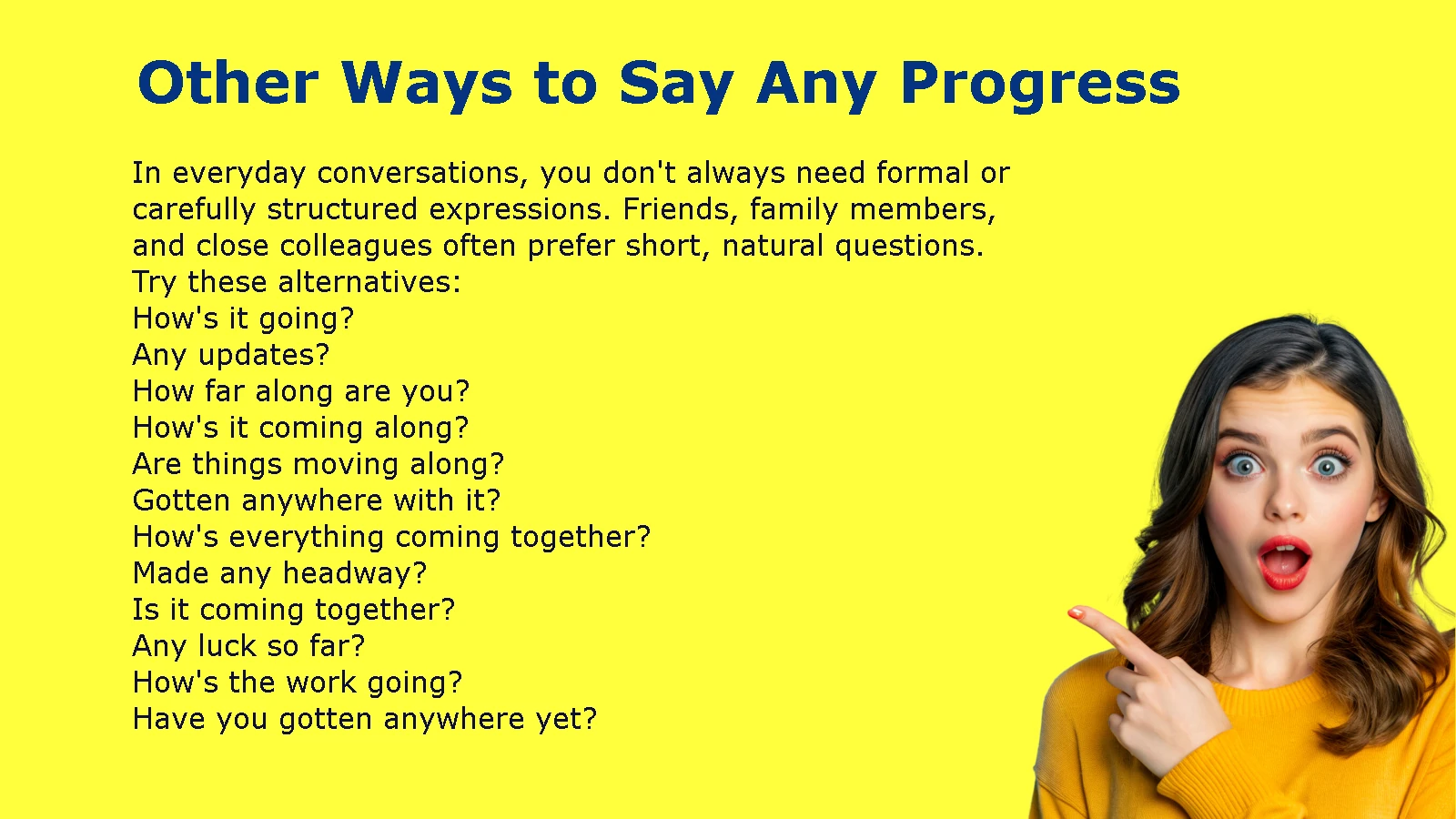
In everyday conversations, you don’t always need formal or carefully structured expressions. Friends, family members, and close colleagues often prefer short, natural questions.
Try these alternatives:
- How’s it going?
- Any updates?
- How far along are you?
- How’s it coming along?
- Are things moving along?
- Gotten anywhere with it?
- How’s everything coming together?
- Made any headway?
- Is it coming together?
- Any luck so far?
- How’s the work going?
- Have you gotten anywhere yet?
Examples in everyday conversations:
- “How’s it going with your new business?”
- “Any luck finding a suitable apartment?”
- “How far along are you with the assignment?”
- “Gotten anywhere with the car repairs?”
- “How’s everything coming together for the event?”
These expressions work because they sound natural and don’t require lengthy explanations.
However, consider your relationship with the recipient. “Gotten anywhere with it?” may sound friendly between close friends but slightly blunt in a formal business conversation.
Formal Alternatives to Any Progress
Formal language works well in official correspondence, business reports, academic discussions, and communication with senior management.
These expressions place more emphasis on measurable developments and documented results.
- Has there been any measurable advancement?
- What progress has been achieved?
- Have any significant developments occurred?
- Has the situation improved?
- What is the current status?
- Has the initiative moved forward?
- Have we reached any important milestones?
- What results have been recorded so far?
- Has the process advanced?
- Are there any notable changes to report?
Example:
Informal: “Any progress on the investigation?”
Formal: “Have there been any significant developments in the investigation?”
The formal version sounds more suitable for official communication because it identifies the type of information being requested.
Synonyms of Progress: What Is Another Word for Progress?
The best synonyms of progress include advancement, improvement, development, growth, headway, evolution, and momentum. Each word describes forward movement from a slightly different perspective. Some emphasize better results, while others focus on gradual change, increased capability, or movement toward a specific objective.
Common Synonyms for Progress
These words work in everyday writing, professional conversations, and general descriptions.
| Synonym | Meaning | Example sentence |
| Advancement | Movement toward a higher or better position | The advancement of technology has changed communication. |
| Improvement | A change that makes something better | We noticed an improvement in customer satisfaction. |
| Development | Growth or gradual change | The development of the project took several months. |
| Growth | An increase in size, ability, or value | The company experienced substantial growth. |
| Headway | Forward movement toward a goal | The researchers made considerable headway. |
| Evolution | Gradual change over time | The evolution of digital technology continues. |
| Momentum | Increasing force or speed | The campaign has gained momentum. |
| Achievement | Something successfully accomplished | Completing the first phase was a major achievement. |
| Expansion | Growth in size, reach, or scope | The business plans further expansion. |
| Stride | A significant step toward improvement | The team has made great strides. |
Although these words share a connection with progress, they aren’t interchangeable in every sentence.
For example, improvement suggests that something has become better. Development can describe change without necessarily suggesting that the result is better. Similarly, achievement usually refers to a completed result rather than ongoing movement.
Formal and Professional Synonyms for Progress
Professional writing often benefits from precise vocabulary. Rather than repeatedly using “progress” in reports and business correspondence, choose a word that explains the nature of the development.
Consider these options:
- Advancement: Suitable for career growth, research, technology, and organizational development.
- Enhancement: Appropriate when something receives an upgrade or becomes more effective.
- Expansion: Useful when a business, operation, or project increases in size or reach.
- Achievement: Describes a successful result or completed objective.
- Progression: Refers to a sequence of stages or gradual movement.
- Evolution: Describes gradual transformation over time.
- Implementation: Refers to putting a plan, policy, or system into practice.
- Improvement: Highlights better performance, quality, or results.
- Optimization: Describes making a process or system work more efficiently.
- Maturation: Refers to becoming more developed, established, or advanced.
For example, a company might describe its software upgrade as an enhancement, while its expansion into a new market represents business growth.
Choosing the more specific term gives readers a clearer understanding of what actually happened.
Progress Synonyms With Different Meanings
A synonym can change the meaning of a sentence if you use it carelessly. Understanding the differences between common alternatives helps you write with greater accuracy.
| Word | Main emphasis | Best context |
| Advancement | Moving toward a higher position | Careers and technology |
| Improvement | Becoming better | Skills and performance |
| Development | Gradual growth or change | Business and education |
| Headway | Making noticeable movement | Tasks and projects |
| Momentum | Increasing speed or force | Campaigns and long-term goals |
| Growth | Increasing size or ability | Business and personal development |
| Evolution | Gradual transformation | Ideas, systems, and society |
| Achievement | Successfully reaching a result | Personal and professional goals |
| Enhancement | Improving an existing feature | Products and services |
| Progression | Moving through stages | Processes and sequences |
Consider this example:
“The company made progress.”
You can make the sentence more informative by identifying the actual change:
- “The company achieved significant growth in annual revenue.”
- “The company made substantial advancements in product development.”
- “The company recorded measurable improvements in customer service.”
Each version communicates a different type of progress.
Another Word for Progress in an Essay
The best alternatives to progress in an essay include advancement, development, improvement, evolution, growth, and transformation. Academic writers should select vocabulary that reflects the subject and evidence. For example, advancement suits scientific discoveries, development describes gradual change, and improvement highlights better conditions or performance.
Formal Academic Synonyms for Progress
Academic writing requires clear and accurate language. Repeating “progress” throughout an essay can make your vocabulary sound limited, especially when discussing complicated subjects.
The following alternatives provide more variety:
| Academic synonym | Suitable subject | Example |
| Advancement | Science and technology | Scientific advancement has improved medical diagnosis. |
| Development | Education and society | Educational development requires long-term investment. |
| Improvement | Performance and quality | The findings indicate an improvement in learning outcomes. |
| Evolution | History and social change | The evolution of democratic institutions took centuries. |
| Expansion | Economics and business | Economic expansion can create new employment opportunities. |
| Enhancement | Technology and systems | The enhancement of public services benefits communities. |
| Transformation | Major changes | Digital transformation has reshaped modern industries. |
| Innovation | New ideas and methods | Innovation has accelerated technological change. |
| Growth | Economics and personal development | Economic growth can influence living standards. |
| Maturation | Biological and organizational processes | The maturation of the institution strengthened its operations. |
Not every academic synonym works in every subject. For instance, “innovation” refers to introducing something new, not simply making progress. Use it when the sentence describes new ideas, methods, or technologies.
How to Use Progress Synonyms in Academic Sentences
Replacing a word is only useful when the new sentence retains the original meaning.
Here are practical examples:
Example: Technology
Original: Technology has made significant progress.
Improved: Technology has experienced significant advancement.
Example: Medical research
Original: The research shows progress in medical science.
Improved: The research demonstrates considerable advancement in medical science.
Example: Education
Original: Students have made progress in their academic performance.
Improved: Students have demonstrated measurable improvement in their academic performance.
Example: Society
Original: Society has made progress in promoting equality.
Improved: Society has experienced meaningful social development in promoting equality.
Example: Business
Original: The organization has made progress in its expansion plans.
Improved: The organization has achieved substantial headway in its expansion plans.
Notice how each alternative provides a slightly different emphasis. This approach improves vocabulary without making academic writing unnecessarily complicated.
Best Words to Replace Progress in Different Essay Contexts
Your choice should depend on the subject you’re discussing.
| Essay topic | Recommended word | Why it fits |
| Scientific research | Advancement | Highlights new knowledge or discoveries |
| Social change | Development | Describes gradual changes in society |
| Education | Improvement | Focuses on better learning outcomes |
| Economic conditions | Growth | Describes increases in economic activity |
| Historical change | Evolution | Highlights gradual transformation |
| Personal development | Growth | Describes increasing ability or maturity |
| Technology | Innovation | Emphasizes new ideas and solutions |
| Healthcare | Advancement | Highlights medical discoveries and capabilities |
| Environmental protection | Improvement | Describes better environmental conditions |
| Business strategy | Expansion | Highlights increased reach or operations |
Common Mistakes When Using Progress Synonyms in Essays
Even a sophisticated vocabulary can weaken an essay if the words don’t match the intended meaning.
Avoid these mistakes:
Using advancement when you mean improvement
Advancement usually suggests movement toward a higher level or position. Improvement focuses on becoming better.
For example, “The student’s improvement in mathematics” sounds more natural than “The student’s advancement in mathematics” when discussing better test performance.
Replacing progress with achievement too early
Achievement describes a result that someone has successfully reached. Progress can occur without completing the final objective.
For example, completing three chapters of a book is progress, while finishing the entire book is an achievement.
Using informal expressions in academic writing
Words such as “headway” and “getting somewhere” may work in general writing, but formal alternatives often suit research papers better.
Repeating synonyms without considering context
Using advancement, development, improvement, and growth interchangeably can make your writing confusing. Each term should explain a specific type of change.
Another Word for Good Progress
Another word for good progress includes steady advancement, significant improvement, substantial growth, positive momentum, and encouraging development. These expressions describe situations where someone or something moves closer to a desired result. The best choice depends on whether the progress is consistent, measurable, rapid, or particularly successful.
Words That Describe Positive Progress
Positive progress can take different forms. Someone may improve gradually, complete important milestones, or achieve results faster than expected.
Use these expressions to describe different types of success:
| Expression | Meaning | Example |
| Steady advancement | Consistent forward movement | The team is making steady advancement toward its goals. |
| Significant improvement | A noticeable positive change | We have seen significant improvement in performance. |
| Encouraging development | A positive change that suggests future success | The latest results represent an encouraging development. |
| Substantial growth | A considerable increase | The business has experienced substantial growth. |
| Remarkable progress | An unusually impressive improvement | The students have demonstrated remarkable progress. |
| Positive momentum | Increasing forward movement | The project has gained positive momentum. |
| Strong headway | Considerable movement toward a goal | The researchers have made strong headway. |
| Notable improvement | An improvement worth recognizing | The latest assessment shows notable improvement. |
| Meaningful advancement | Important movement toward an objective | The initiative has achieved meaningful advancement. |
| Consistent development | Regular and continuing growth | The organization has shown consistent development. |
Professional Ways to Say Good Progress
When communicating positive results at work, choose expressions that sound confident and specific.
Here are useful alternatives:
- We are making steady headway.
- The project is moving forward successfully.
- We have achieved several important milestones.
- The results show encouraging improvement.
- The initiative is progressing as planned.
- We have made substantial advancements.
- The team is delivering consistent results.
- Our performance continues to improve.
- We are seeing positive developments.
- The project is gaining momentum.
Workplace example:
Instead of writing:
“The team is making good progress.”
Try:
“The team has achieved three major milestones this month and continues to make steady headway toward the final deadline.”
The second sentence provides evidence of progress. It tells the reader what happened rather than relying on a general statement.
Examples of Good Progress in Different Situations
In education:
“Sarah has demonstrated significant improvement in her writing skills over the past semester.”
In business:
“Our sales team has achieved substantial growth during the second quarter.”
In project management:
“The development team has completed several key milestones and remains on schedule.”
In personal development:
“James is making steady progress toward his fitness goals.”
In research:
“The latest findings represent an encouraging development in the investigation.”
These examples show why precise descriptions are more useful than repeatedly calling everything “good progress.”
Another Word for Progression and Development
Progression and development describe gradual movement or change, but they emphasize different aspects of that process. Progression generally refers to movement through stages or a sequence, while development focuses on growth, formation, or increasing complexity. Advancement, evolution, growth, and maturation can replace these terms in suitable contexts.
Synonyms for Progression
Progression usually describes movement from one stage, condition, or level to another.
Common alternatives include:
- Advancement: Movement toward a higher level.
- Evolution: Gradual change over time.
- Transition: Movement from one condition to another.
- Continuation: The process of carrying something forward.
- Sequence: A series of connected stages or events.
- Movement: A change in position or direction.
- Progress: Forward movement toward a goal.
- Escalation: An increase in intensity or seriousness.
Example sentences:
- The advancement of the project depends on additional funding.
- The evolution of the industry has created new opportunities.
- The transition to digital services improved efficiency.
- The progression of the treatment followed several stages.
One important distinction: progression does not always mean improvement. A disease can progress, for example, even when the patient’s condition becomes worse.
Synonyms for Development
Development focuses on growth, formation, or gradual change.
Useful alternatives include:
- Growth: An increase in size, ability, or value.
- Expansion: An increase in reach or scope.
- Improvement: A positive change in quality.
- Evolution: Gradual transformation.
- Formation: The process of creating or establishing something.
- Maturation: Becoming more developed or established.
- Enhancement: Making something better.
- Refinement: Improving something through small adjustments.
Example sentences:
- The growth of the company created hundreds of jobs.
- The expansion of the service improved customer access.
- The refinement of the process reduced operating costs.
- The maturation of the organization strengthened its leadership structure.
Progression vs. Development vs. Progress
These three words overlap, but their meanings differ.
| Word | Definition | Example |
| Progress | Forward movement toward a goal | The team made progress on the project. |
| Progression | Movement through stages or a sequence | The progression of the course follows four levels. |
| Development | Growth, formation, or gradual change | The development of the new product took two years. |
A practical way to remember the difference:
- Use progress when discussing movement toward a goal.
- Use progression when describing a series of stages.
- Use development when explaining how something grows or changes.
This distinction helps prevent awkward word choices in essays, reports, and professional writing.
Words for Progress Starting With In
Several words beginning with “In” relate to improvement, growth, or forward movement. However, they do not all function as direct synonyms for progress. Improvement and increase describe positive changes, while innovation and initiative relate to actions that can produce progress.
It is one of the closest alternatives to progress when the intended meaning involves a positive change.
Examples:
- The company has experienced considerable improvement in customer service.
- Regular practice resulted in an improvement in writing ability.
- The latest update brought noticeable improvements to the software.
Use improvement when you want to highlight a better result rather than simply describe movement.
Increment
An increment is a small increase or addition to an existing amount.
It often appears in business, finance, mathematics, and technical writing.
Examples:
- The company introduced an incremental increase in employee salaries.
- Productivity improved in small increments.
- Each increment in production brought additional revenue.
An increment describes the size or step of a change, not progress itself.
Increase
Increase refers to becoming greater in number, amount, size, or intensity.
It can describe positive or negative developments depending on the context.
Examples:
- The business recorded an increase in annual revenue.
- The school reported an increase in student enrollment.
- The organization experienced an increase in operational costs.
Use increase when you can identify a measurable rise.
Innovation
Innovation refers to introducing new ideas, products, processes, or methods.
It often contributes to progress by helping individuals and organizations solve problems differently.
Examples:
- Innovation has accelerated technological advancement.
- The company encourages innovation across its departments.
- Medical innovation has introduced new treatment possibilities.
Innovation and progress are connected, but they are not identical. An innovation can create an opportunity for progress without guaranteeing a successful result.
Other Related Words Beginning With In
| Word | Meaning | Example |
| Inception | The beginning of something | The project has evolved considerably since its inception. |
| Initiative | An action taken to achieve an objective | The organization launched an initiative to improve education. |
| Integration | Combining separate elements into a whole | System integration improved the company’s workflow. |
| Intensification | An increase in strength or degree | The intensification of research accelerated development. |
| Investment | Resources committed to achieving a future benefit | Investment in education supports long-term growth. |
These words can strengthen your vocabulary when discussing development and forward movement. However, use them according to their actual meanings rather than treating them as interchangeable synonyms.
Progress Synonyms and Antonyms
Progress synonyms describe forward movement, improvement, or development. Antonyms describe the opposite, including regression, decline, stagnation, and deterioration. The correct opposite depends on the situation because moving backward, remaining unchanged, and becoming worse represent different conditions.
Synonyms of Progress
Here are common alternatives to progress:
| Synonym | Example sentence |
| Advancement | The advancement of medical technology saves lives. |
| Improvement | The new strategy produced an improvement in results. |
| Development | The development of the project required careful planning. |
| Growth | The organization experienced rapid growth. |
| Headway | The team made significant headway. |
| Achievement | Completing the course was a major achievement. |
| Evolution | The evolution of communication has changed society. |
| Momentum | The campaign gained momentum after its launch. |
| Expansion | The company’s expansion created new opportunities. |
| Enhancement | The enhancement improved the product’s performance. |
Progress Antonyms: Words That Mean the Opposite of Progress
Not every opposite of progress means failure. Sometimes an activity stops moving forward. In other situations, its condition becomes worse.
Here are the most useful antonyms:
| Antonym | Meaning | Example |
| Regression | Movement backward to an earlier condition | The team experienced regression after changing its strategy. |
| Decline | A reduction in quality, value, or amount | The company reported a decline in sales. |
| Deterioration | A worsening condition | The deterioration of the building required immediate repairs. |
| Stagnation | A lack of movement or development | Economic stagnation affected business investment. |
| Setback | An event that delays progress | The unexpected delay caused a temporary setback. |
| Reversal | A change that moves something in the opposite direction | The policy reversal affected the project. |
| Diminution | A reduction in size, importance, or value | The diminution of resources slowed development. |
| Retrogression | A return to a less advanced condition | The report highlighted retrogression in certain performance measures. |
| Declination | A downward movement or decrease in certain contexts | The data showed a declination in participation. |
Progress Synonyms vs. Antonyms
Understanding opposites becomes easier when you compare words with similar grammatical and contextual functions.
| Progress synonym | Antonym | Main difference |
| Advancement | Regression | Moving forward vs. moving backward |
| Improvement | Deterioration | Becoming better vs. becoming worse |
| Growth | Decline | Increasing vs. decreasing |
| Development | Stagnation | Developing vs. remaining unchanged |
| Headway | Setback | Moving toward a goal vs. encountering an obstacle |
| Increase | Decrease | Becoming greater vs. becoming smaller |
| Evolution | Retrogression | Developing over time vs. returning to an earlier condition |
| Expansion | Contraction | Becoming larger vs. becoming smaller |
How to Choose the Correct Antonym for Progress
The best antonym depends on what happened.
Use regression when something moves backward.
Example: “The new approach caused regression in the team’s performance.”
Use stagnation when development stops.
Example: “The industry experienced stagnation after several years of limited investment.”
Use decline when something decreases.
Example: “The company experienced a decline in annual revenue.”
Use deterioration when quality or condition becomes worse.
Example: “The deterioration of the equipment affected production.”
Use setback when an obstacle delays progress.
Example: “The unexpected technical issue created a setback for the project.”
These distinctions matter because a temporary setback doesn’t necessarily mean that a project has failed or entered a period of long-term decline.
Synonym for Progress Made
A synonym for progress made includes headway, achievements, accomplishments, milestones reached, gains, and measurable improvements. These expressions describe forward movement that has already occurred. However, progress made can refer to partial completion, while achievements and accomplishments usually emphasize results or successfully completed objectives.
Words and Phrases for Progress Already Made
Use these expressions when discussing completed work, positive results, or movement toward an objective.
| Alternative | Meaning | Example |
| Achievements | Successfully completed results | The team’s achievements exceeded expectations. |
| Accomplishments | Tasks or goals successfully completed | Her accomplishments demonstrate strong leadership. |
| Milestones reached | Important stages successfully completed | We have reached three major milestones. |
| Ground covered | Amount of work or progress completed | We have covered considerable ground this week. |
| Headway made | Forward movement toward a goal | The researchers have made significant headway. |
| Gains achieved | Positive results obtained | The organization has achieved measurable gains. |
| Improvements recorded | Better results documented | Several improvements were recorded during testing. |
| Advances made | Developments or forward movement achieved | Important advances were made in the research. |
| Results obtained | Outcomes produced through an activity | The results obtained support the new strategy. |
| Targets met | Planned objectives successfully achieved | The department has met its quarterly targets. |
Professional Examples of Progress Made
Professional communication often requires more than saying that work has moved forward. Managers and clients want to know what has changed and which objectives have been completed.
Consider these examples:
Project management
“We have completed the initial design phase and made significant headway on development.”
Business reporting
“The department achieved measurable gains in productivity during the reporting period.”
Academic research
“The research team has made important advances in identifying the main factors affecting the results.”
Employee performance
“Alex has demonstrated considerable improvement in communication and problem-solving skills.”
Client communication
“We have completed the first two stages and are moving toward the final delivery milestone.”
Each statement identifies a specific result, making the update more useful than a general claim about progress.
How to Describe Progress Made in Reports and Emails
The best progress updates include three elements:
- Completed work: Explain what has already happened.
- Current position: Identify where the task or project stands.
- Next step: Describe what will happen next.
For example:
“During the past week, we completed the initial research and finalized the project requirements. The design phase is now underway, and our next step is to prepare the first prototype.”
This structure gives readers a clear picture of the situation.
You can also use the following email examples.
Project status update
Subject: Project Progress Update
“Hello David,
We have completed the research phase and made substantial headway with the initial design. The team is now working on the remaining technical requirements.
I’ll share another update once we complete the next milestone.”
Client follow-up
Subject: Update on Project Development
“Hello Sarah,
I wanted to share a quick update on the project. We have completed the initial requirements and made encouraging progress on implementation.
Please let me know if you’d like any additional details.”
Internal team report
“The team has achieved its first major milestone, improved the testing process, and resolved several technical issues. Work continues on the remaining deliverables.”
These examples show how to communicate progress without repeating the same expression.
How to Choose the Best Alternative to Any Progress
Choosing the right alternative depends on your audience, purpose, and the type of development you’re describing. A casual question may work perfectly with a friend but sound unprofessional in a client email. Similarly, an academic essay requires more precise vocabulary than an informal conversation.
Consider Your Audience
Think about your relationship with the recipient before selecting an expression.
For example:
- With friends: “How’s it going?”
- With colleagues: “How is the project coming along?”
- With clients: “Have there been any developments?”
- With managers: “What is the current status?”
- In academic writing: “What advancement has been achieved?”
The goal is to communicate naturally without sounding unnecessarily formal or overly casual.
Identify Whether You’re Asking a Question or Describing a Result
This distinction affects your word choice.
If you’re requesting an update, use questions such as:
- Have you made any headway?
- Are there any developments?
- How far along are we?
If you’re describing completed work, use statements such as:
- We have achieved significant milestones.
- The team has recorded measurable improvements.
- The project has made substantial advancements.
Don’t confuse a request for information with a description of an outcome.
Choose Formal, Neutral, or Casual Language
Your communication style should match the situation.
| Communication style | Recommended expression |
| Formal | Have any significant developments occurred? |
| Professional | Have you made any headway? |
| Neutral | How is the project progressing? |
| Polite | I wanted to check how things are coming along. |
| Casual | Any updates? |
| Friendly | How’s everything coming together? |
Consider Whether the Progress Is Measurable
Some expressions work better when you have actual results to discuss.
For example, “significant improvement” suggests a noticeable positive change. If you have performance figures, project milestones, or measurable outcomes, you can support the statement with evidence.
Consider this comparison:
General: “The company has made good progress.”
Specific: “The company increased customer retention by 12% and completed four major operational improvements.”
The second statement provides concrete information. In business reports, measurable descriptions help readers evaluate the actual results.
Common Mistakes When Using Progress Alternatives
Even familiar synonyms can create confusion when you use them incorrectly.
Confusing progress with achievement
Progress can describe an ongoing process, whereas achievement usually describes a completed result.
Using development when you mean improvement
Development can be neutral. A situation may develop without becoming better. Improvement always suggests a positive change.
Choosing overly formal expressions for casual conversations
“Have any significant advancements occurred?” may sound unnatural when asking a friend about a personal project.
Using antonyms without considering the situation
A setback doesn’t always mean regression. A temporary obstacle may delay progress without reversing previous achievements.
Repeating the same synonym throughout an essay
Avoid replacing every instance of progress with advancement. Instead, use a more specific term whenever the meaning supports it.
Real-World Examples: Choosing the Right Progress Expression
Understanding vocabulary becomes easier when you see how people use it in realistic situations.
Consider three common scenarios.
Case Study: Following Up on a Workplace Project
Imagine a project manager who needs an update from a colleague responsible for preparing a marketing campaign.
A direct question such as “Any progress?” may sound abrupt, particularly if the colleague has been working under a tight deadline.
A better message would be:
“Hi Mark, I wanted to check how the marketing campaign is coming along. Have there been any developments since our last discussion?”
Why this works:
- It sounds professional and considerate.
- It identifies the specific project.
- It asks for new information.
- It avoids suggesting that the colleague has failed to complete the work.
Case Study: Describing Academic Progress
A student is writing an essay about changes in educational systems.
Using “progress” repeatedly can make the discussion less precise.
Instead, the student can distinguish between different developments:
- Educational advancement describes improvements in educational opportunities or capabilities.
- Educational development describes the gradual growth of institutions and systems.
- Educational improvement highlights better teaching quality or learning outcomes.
- Educational transformation describes major changes to how education operates.
These distinctions make an essay more informative because each word explains a different aspect of change.
Case Study: Reporting Business Growth
A business owner wants to explain the company’s performance during the previous quarter.
A general statement might read:
“We have made good progress this quarter.”
A more useful report would say:
“The company expanded its customer base, improved order processing, and achieved its quarterly sales target. These results demonstrate substantial business growth and stronger operational performance.”
The improved version separates growth, improvement, and achievement instead of treating them as identical.
The lesson is simple: specific language communicates progress more effectively than general praise.
Frequently Asked Questions
What Is Another Way to Say Any Progress?
Other ways to say “Any Progress?” include “Have you made any headway?”, “Are there any updates?”, “How is it coming along?”, and “Have there been any developments?” Use the expression that best matches your relationship with the recipient and the formality of the conversation.
What Is the Best Synonym for Progress in an Essay?
Advancement, development, and improvement are among the best synonyms for progress in an essay. Advancement works well for science and technology, development suits gradual changes, and improvement describes better conditions or results.
What Are Five Synonyms for Progress?
Five common synonyms for progress are:
- Advancement
- Improvement
- Development
- Growth
- Headway
Each word describes forward movement or positive change, but the exact meaning depends on the context.
What Is the Opposite of Progress?
Regression is a direct opposite of progress when something moves backward. Other antonyms include stagnation, decline, deterioration, and setback. Use stagnation when development stops and deterioration when a condition becomes worse.
What Is Another Word for Good Progress?
Other expressions for good progress include steady advancement, substantial improvement, positive momentum, remarkable development, and significant headway. These phrases describe consistent or noticeable movement toward a goal.
What Is Another Word for Progress Made?
Alternatives to progress made include achievements, accomplishments, milestones reached, gains achieved, headway made, and improvements recorded. Use achievements for completed goals and headway when describing movement toward an unfinished objective.
Conclusion: Choose the Right Words to Describe Progress
Finding the best alternative to “Any Progress?” depends on what you want to communicate. In professional conversations, expressions such as “Have you made any headway?” and “Have there been any developments?” sound clear and respectful. For casual discussions, “Any updates?” and “How’s it coming along?” feel more natural.
When writing essays or reports, choose precise synonyms such as advancement, improvement, development, and growth. Use regression, stagnation, and decline when discussing the opposite of progress. If you’re describing completed work, expressions such as achievements, milestones reached, and headway made provide more specific information.
The most effective approach is to match your vocabulary to the situation rather than replacing every occurrence of progress with a different word.