Other ways to say circle back include follow up, get back to you, revisit this topic, check in, touch base, and return to this discussion. The best alternative depends on whether you want to request a response, provide an update, resume a conversation, or discuss an unfinished task.
The phrase circle back appears frequently in business communication, professional emails, meetings, and workplace conversations. Although it sounds friendly and professional, it can sometimes feel vague or repetitive. Choosing a more specific expression helps your reader understand exactly what you mean and what should happen next.
Whether you’re writing a client email, replying to your manager, preparing an essay, or following up on a project, these alternatives will help you communicate more naturally.
| Question | Answer |
| What is another word for circle back? | Follow up is a common alternative, especially when checking progress or requesting a response. |
| What does circle back mean? | It means returning to a previous topic, conversation, question, or task. |
| What is a formal synonym for circle back? | Revisit this matter, return to this discussion, or follow up on this matter. |
| How do you say circling back in an email? | Try “I’m following up on my previous email” or “I wanted to check in about our discussion.” |
| Is it circle back to you or with you? | Both can be correct, depending on the intended meaning and sentence context. |
What Does Circle Back Mean?
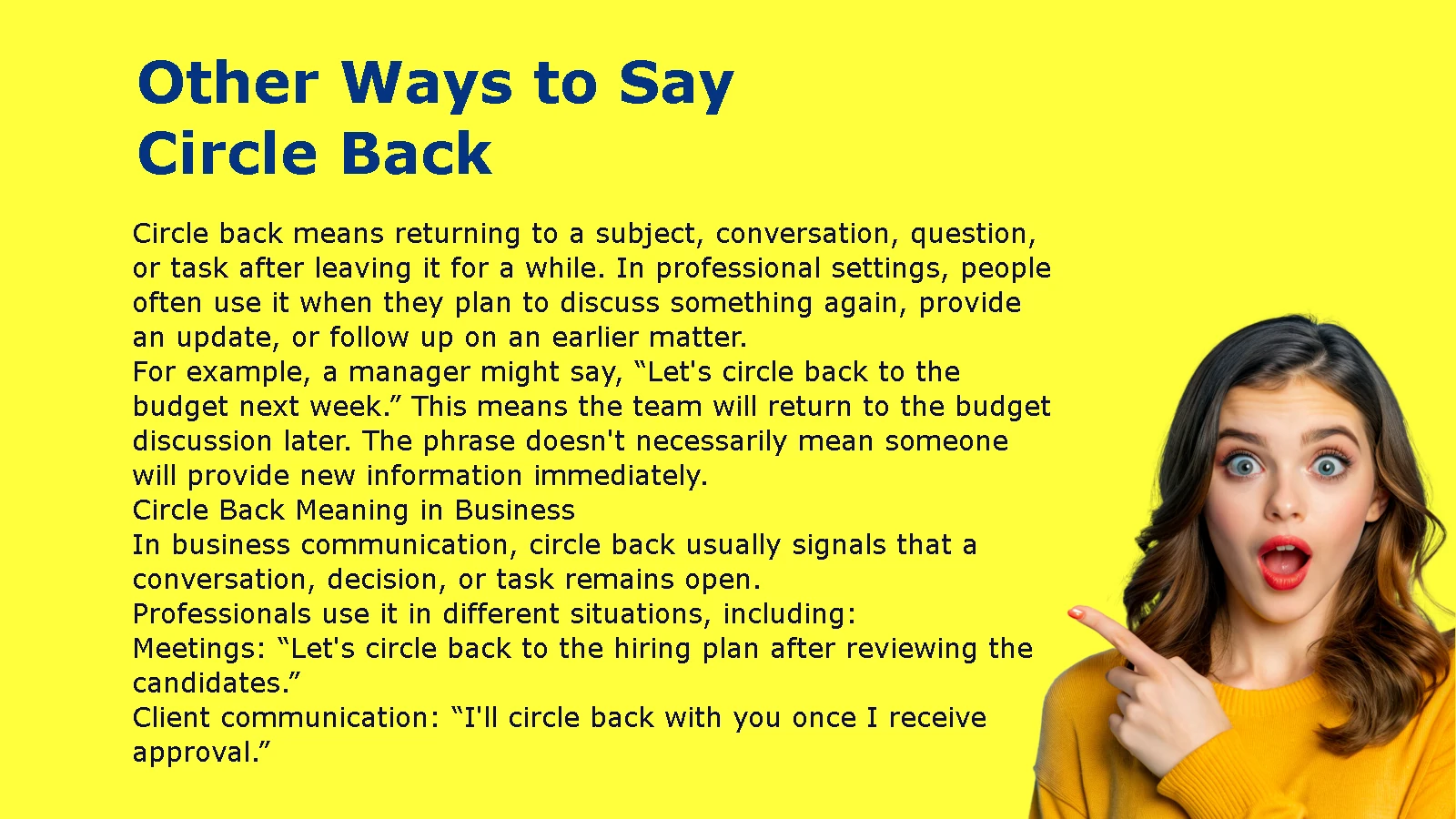
Circle back means returning to a subject, conversation, question, or task after leaving it for a while. In professional settings, people often use it when they plan to discuss something again, provide an update, or follow up on an earlier matter.
For example, a manager might say, “Let’s circle back to the budget next week.” This means the team will return to the budget discussion later. The phrase doesn’t necessarily mean someone will provide new information immediately.
Circle Back Meaning in Business
In business communication, circle back usually signals that a conversation, decision, or task remains open.
Professionals use it in different situations, including:
- Meetings: “Let’s circle back to the hiring plan after reviewing the candidates.”
- Client communication: “I’ll circle back with you once I receive approval.”
- Project management: “We should circle back on the delivery schedule.”
- Sales conversations: “I’ll circle back next week to discuss your requirements.”
- Team discussions: “Let’s circle back to this question during tomorrow’s meeting.”
The intended meaning depends on the context.
For instance, “I’ll circle back with you tomorrow” suggests future communication. However, “Let’s circle back to the proposal” suggests revisiting a particular subject.
This distinction matters because a vague follow-up can leave the recipient wondering whether you need a response, plan to share information, or simply want to reopen a conversation.
Is Circle Back Formal or Informal?
Circle back is professional but conversational. It works in many workplace emails, meetings, and everyday business discussions. However, it may sound less precise than alternatives such as “follow up on the request” or “provide an update.”
Use it when the context makes your meaning clear.
For example:
- Natural: “I’ll circle back with you after the meeting.”
- More specific: “I’ll send you the revised proposal by Thursday.”
- Formal: “I will provide an update once the review is complete.”
The second and third examples give the reader a clearer expectation.
Circle back isn’t inherently incorrect or unprofessional. The issue is usually not the phrase itself but the lack of a defined action or deadline.
35+ Other Ways to Say Circle Back
The best alternatives to circle back communicate your actual purpose instead of simply replacing one expression with another.
Some phrases emphasize following up, while others focus on revisiting a topic, reconnecting, or sharing information.
| Alternative | Tone | Best use |
| Follow up | Professional | Checking progress |
| Get back to you | Natural | Promising a response |
| Revisit this topic | Professional | Returning to a discussion |
| Touch base | Conversational | Briefly reconnecting |
| Check in with you | Friendly | Asking for an update |
| Return to this discussion | Formal | Meetings and written communication |
| Provide an update | Direct | Sharing new information |
| Pick up where we left off | Natural | Resuming an earlier conversation |
| Discuss this further | Professional | Continuing a conversation |
| Follow up on this matter | Formal | Business correspondence |
| Reconnect | Friendly | Starting communication again |
| Address this again | Professional | Returning to an issue |
| Resume our discussion | Formal | Continuing a previous conversation |
| Reexamine this point | Analytical | Reviewing an argument or decision |
| Get in touch again | Neutral | Future communication |
| Send you an update | Direct | Communicating progress |
| Check on the status | Professional | Tracking a task |
| Reopen this conversation | Neutral | Restarting a discussion |
| Return to this question | Professional | Answering an unresolved question |
| Continue our conversation | Neutral | Resuming communication |
| Follow up with you | Professional | Contacting someone again |
| Bring this up again | Conversational | Mentioning a topic later |
| Take another look | Natural | Reviewing information |
| Reassess the situation | Professional | Evaluating something again |
| Confirm the details | Direct | Verifying information |
| Share the next steps | Direct | Explaining what happens next |
| Revisit this issue | Professional | Discussing an unresolved problem |
| Keep you posted | Friendly | Sharing future developments |
| Respond once I know more | Natural | Delaying a response until facts are available |
| Report back | Professional | Providing findings or results |
| Return to the main point | Academic | Refocusing an argument |
| Reconsider this proposal | Professional | Reviewing a suggestion |
| Arrange a follow-up | Professional | Scheduling another discussion |
| Continue from where we stopped | Natural | Resuming unfinished work |
| Contact you with an update | Formal | Promising future communication |
| Discuss the next steps | Professional | Moving a project forward |
Professional Alternatives to Circle Back
When communicating with coworkers, clients, or managers, choose language that reflects your intention.
Follow up
Use this expression when checking progress, requesting a response, or continuing an earlier communication.
Example: “I’ll follow up on the invoice tomorrow.”
Revisit this matter
Choose this phrase when you want to return to an issue that needs additional consideration.
Example: “We can revisit this matter after the quarterly review.”
Return to this discussion
This expression works well in formal emails and meeting notes.
Example: “Let’s return to this discussion once the financial figures are available.”
Address this point again
Use it when a particular question or concern deserves another look.
Example: “We should address this point again before approving the contract.”
Provide an update
This alternative works when your goal is to share new information rather than restart a conversation.
Example: “I’ll provide an update after speaking with the supplier.”
Reconnect regarding this issue
This phrase suits situations where you need to resume communication about an ongoing matter.
Example: “I’ll reconnect with the operations team regarding this issue.”
Casual Alternatives to Circle Back
A relaxed expression often feels more natural when you’re speaking with familiar teammates or colleagues.
- Touch base: “Let’s touch base tomorrow about the presentation.”
- Check in: “I’ll check in with you next week.”
- Get back to you: “I’ll get back to you after lunch.”
- Pick this up later: “We can pick this up later when everyone is available.”
- Catch up on this: “Let’s catch up on this during our next call.”
- Talk about this again: “We can talk about this again after you’ve reviewed the draft.”
These phrases aren’t always interchangeable.
For example, “touch base” usually suggests a brief conversation or contact. Meanwhile, “pick this up later” suggests continuing an unfinished discussion or task.
Direct Alternatives That Make Your Message Clearer
Sometimes the best alternative isn’t another synonym. It’s a sentence that states the action directly.
Consider these examples:
- Instead of “I’ll circle back,” write “I’ll send you the updated figures by Friday.”
- Instead of “Let’s circle back later,” write “Let’s revisit this after the client meeting.”
- Instead of “I’ll circle back on the issue,” write “I’ll check the shipment status this afternoon.”
- Instead of “We’ll circle back with next steps,” write “We’ll email the implementation plan tomorrow.”
- Instead of “I’ll circle back when I can,” write “I’ll respond once the review is complete.”
Specific wording improves accountability because readers know what to expect.
Another Way to Say Circling Back in an Email
A good alternative to circling back in an email depends on whether you’re following up on a previous message, promising a response, requesting information, or reopening a discussion.
Instead of repeating “Just circling back,” identify the subject and explain what you need or plan to do.
Email Phrases for Following Up on a Previous Message
Use these expressions when someone hasn’t responded or when you need to revisit an earlier email.
- I’m following up on my previous email.
- I wanted to check in about my earlier message.
- I’m reaching out regarding our previous discussion.
- Have you had a chance to review this?
- I’m checking on the status of this request.
- I’m following up to see whether you need any additional information.
- I wanted to see if there are any updates on this matter.
Example:
“Hi Jordan,
I’m following up on the proposal I sent on Monday. Have you had a chance to review it?
I’d be happy to answer any questions.
Best,
Alex”
This email explains the reason for writing and gives the recipient a simple way to respond.
Email Phrases When You Promise to Respond Later
When you don’t have an answer yet, use a phrase that sets a realistic expectation.
- I’ll get back to you by Thursday.
- I’ll send you an update once I confirm the details.
- I’ll follow up when I have more information.
- I’ll share my response as soon as I can.
- I’ll revisit this and let you know the next steps.
- I’ll contact you once the review is complete.
- I’ll confirm the timeline after speaking with the team.
Example:
“Hi Morgan,
I need to confirm a few details with our finance team before giving you an accurate answer.
I’ll get back to you by Thursday afternoon.
Best,
Taylor”
The deadline makes this message stronger than “I’ll circle back soon.” However, only promise a deadline you can reasonably meet.
Email Phrases for Reopening a Discussion
When you want to return to an earlier conversation, these expressions work well.
- I’d like to revisit our earlier conversation.
- Let’s return to this topic next week.
- I’d like to pick up where we left off.
- Can we discuss this further during our next meeting?
- I’m reaching out to continue our discussion.
- I’d like to resume our conversation about the project.
- Could we set aside time to review the proposal again?
Example:
“Hi Sam,
I’d like to revisit our earlier conversation about the website redesign.
We’ve received the updated estimates, so I think we’re ready to compare the options.
Would Wednesday morning work for you?
Best,
Chris”
This version provides a reason to reopen the discussion and suggests a practical next step.
Complete Email Examples Using Circle Back Alternatives
Client Follow-Up Email
Subject: Following Up on the Project Proposal
Hi Emily,
I’m following up on the project proposal I shared last week.
Have you had a chance to review the timeline and pricing? I’d be happy to clarify anything or discuss possible adjustments.
I look forward to hearing your thoughts.
Best,
Daniel
Internal Team Email
Subject: Update on the Launch Timeline
Hi Team,
The design review is complete, and we’re waiting for final approval.
I’ll share an update by Wednesday afternoon once I confirm the revised launch timeline.
Thanks,
Morgan
Manager Email
Subject: Follow-Up on the Quarterly Report
Hi Sarah,
I’d like to revisit our discussion about the quarterly report.
I’ve updated the figures and included the latest performance data. Could we review the revised version during tomorrow’s meeting?
Best,
James
These examples show how a clear subject line, a specific reason for writing, and an appropriate next step can make business emails more effective.
Formal Synonyms for Circle Back
Formal synonyms for circle back include follow up on this matter, revisit this issue, return to this subject, resume our discussion, and provide further clarification.
The best choice depends on whether you want to continue a conversation, review an issue, or communicate new information.
Best Formal Alternatives for Business Communication
Follow up on this matter
Use this phrase for professional correspondence involving a request, decision, or pending task.
Example: “I will follow up on this matter after consulting the legal team.”
Revisit this issue
This phrase suits problems or decisions that require another review.
Example: “We may need to revisit this issue before finalizing the agreement.”
Return to this subject
Choose this alternative when you want to resume a previous topic.
Example: “We can return to this subject at our next scheduled meeting.”
Resume our discussion
This expression emphasizes continuing a conversation that has stopped.
Example: “I would welcome the opportunity to resume our discussion next week.”
Provide further clarification
Use this phrase when the recipient needs additional explanation.
Example: “I will provide further clarification once I receive the updated documentation.”
Formal Alternatives for Clients and Senior Managers
The following examples work well in professional settings:
- “I will follow up with you regarding this matter.”
- “I will provide an update once the review is complete.”
- “We can revisit this issue at our next meeting.”
- “I will contact you again with the relevant details.”
- “I would like to return to our earlier discussion.”
- “I will share the findings as soon as they become available.”
For senior managers and clients, prioritize clarity, respect, and accountability.
Avoid making a message sound overly formal just to replace a simple expression. “I’ll send you an update tomorrow” often works better than “I shall revert to you in due course.”
The latter can sound stiff and doesn’t establish a useful deadline.
Circling Back Synonyms for Essays and Academic Writing
In essays, suitable synonyms for circling back include revisit the argument, return to the central question, reexamine this point, reconsider the earlier claim, and return to the original question.
Academic writing generally benefits from precise transitions rather than conversational business jargon.
Academic Alternatives for Returning to an Earlier Idea
Use these phrases when discussing an argument or revisiting evidence.
- Revisit the argument: Reconsider an earlier claim in light of new evidence.
- Return to the central question: Refocus the discussion on the main research problem.
- Reexamine this point: Analyze a previous idea more closely.
- Reconsider the earlier claim: Evaluate whether an argument remains convincing.
- Return to the original question: Connect the discussion to its starting point.
- Reassess the evidence: Review the strength of the supporting information.
Example:
“After examining the survey results, we can revisit the original argument about consumer behavior.”
This expression works because it explains why the writer is returning to the earlier idea.
Alternatives for Connecting Ideas in an Essay
Transitions can help readers understand how one section relates to another.
| Alternative | Purpose | Example |
| As discussed earlier | Refer to previous information | As discussed earlier, access to education affects employment outcomes. |
| Returning to the main argument | Refocus the discussion | Returning to the main argument, the evidence supports the proposed approach. |
| This brings us back to | Connect a new point to an earlier question | This brings us back to the question of public accountability. |
| In light of the earlier discussion | Reconsider a subject using previous analysis | In light of the earlier discussion, the policy requires further evaluation. |
| To return to the original question | Reconnect with the essay’s central purpose | To return to the original question, the findings suggest a mixed outcome. |
Not every transition belongs in every paragraph.
For example, “As discussed earlier” works when you genuinely refer to a previous section. However, using it repeatedly can make your essay feel mechanical.
Choose transitions that explain the logical relationship between your ideas.
Circle Back in a Sentence: Examples and Usage
You can use circle back in a sentence when you want to express the idea of returning to a discussion, question, or task later.
The phrase commonly appears with to, with, and on, depending on the meaning and sentence structure.
Circle Back Examples in Business Communication
- I’ll circle back with the client tomorrow.
- Let’s circle back to this question after reviewing the data.
- I’ll circle back once the team makes a decision.
- Can we circle back on this during Friday’s meeting?
- We should circle back to the hiring plan next month.
- I’ll circle back with the department once I receive approval.
Each sentence communicates a slightly different intention.
For example, “circle back to this question” focuses on the question itself. Meanwhile, “circle back with the client” emphasizes contacting the client.
Circle Back Examples in Emails
- I’ll circle back to you by the end of the day.
- I’m circling back on the proposal I sent last week.
- Let’s circle back to this after you’ve reviewed the document.
- I’ll circle back with you when I have the confirmed figures.
- I’m circling back regarding the changes we discussed.
- We can circle back to the remaining questions during our next call.
Although these sentences are grammatically understandable, some alternatives may sound more natural in polished business writing.
For example:
“I’m circling back on the proposal I sent last week.”
can become:
“I’m following up on the proposal I sent last week.”
The revised version communicates the same general purpose with less corporate jargon.
Circle Back Examples in Everyday Conversations
- I’ll circle back with you later this week.
- Let’s circle back to that idea when we have more time.
- We can circle back after lunch.
- I’ll circle back once I’ve checked my schedule.
- Let’s return to this conversation tomorrow.
In casual conversation, simpler alternatives often sound more relaxed.
For example, “Let’s talk about this tomorrow” is usually clearer than “Let’s circle back tomorrow” when the subject is already obvious.
Should You Say Circle Back to You or Circle Back With You?
Both circle back to you and circle back with you can be correct. “To you” often emphasizes directing a response or update toward someone, while “with you” often emphasizes reconnecting or communicating with that person.
However, the meanings overlap in everyday business English, so context matters.
When to Use Circle Back to You
Use “circle back to you” when you want to emphasize returning with information, a response, or an update for someone.
Examples:
- I’ll circle back to you once I have the figures.
- I’ll circle back to you tomorrow with the revised schedule.
- Let me confirm the details, and I’ll circle back to you.
- I’ll circle back to you after reviewing the application.
A simple alternative is get back to you.
For example:
“I’ll get back to you once I confirm the details.”
This version sounds natural in both professional emails and everyday communication.
When to Use Circle Back With You
Use “circle back with you” when you want to emphasize reconnecting, contacting someone, or continuing communication.
Examples:
- I’ll circle back with you about the project timeline.
- Let’s circle back with you after the team meeting.
- I’ll circle back with you next week to discuss the results.
- We can circle back with you once everyone has reviewed the proposal.
The third example sounds natural in many business contexts.
However, “Let’s circle back with you” may sound awkward if you mean that two people should revisit a subject together. A clearer option would be:
“Let’s circle back to this topic after the team meeting.”
Or:
“Let’s reconnect next week to discuss the results.”
Use “with you” when the sentence naturally emphasizes contact or communication with the person.
Circle Back On, To, and With: What’s the Difference?
These prepositions help indicate the focus of the sentence.
| Construction | Typical function | Example |
| Circle back to | Return to a topic or direct communication toward someone | Let’s circle back to the budget. |
| Circle back with | Reconnect or communicate with someone | I’ll circle back with the client. |
| Circle back on | Follow up on a subject, issue, or task | I’ll circle back on your request. |
Circle back to often identifies the topic you’re returning to.
Example: “We should circle back to the pricing discussion.”
Circle back with often identifies the person you’re contacting.
Example: “I’ll circle back with the supplier.”
Circle back on often identifies the task or matter you’re following up on.
Example: “I’ll circle back on the pending approval.”
These patterns are common, but they’re not strict grammatical formulas. English speakers sometimes use them differently depending on context and workplace habits.
If a sentence feels unclear, replace the expression with a more direct verb.
For instance:
- Circle back on the invoice → Follow up on the invoice.
- Circle back with the client → Contact the client again.
- Circle back to the question → Return to the question.
How to Choose the Best Circle Back Alternative
Choose the best circle back alternative by identifying what you actually want to communicate. Are you requesting a response, promising information, reviewing a previous subject, or continuing a conversation?
The most effective phrase communicates that purpose without making the reader guess.
Choose a Phrase Based on Your Goal
When requesting a response
Try:
“Have you had a chance to review this?”
This wording works when you need feedback or a decision.
When promising an update
Try:
“I’ll send you an update by Friday.”
This creates a clear expectation and deadline.
When revisiting an issue
Try:
“Let’s revisit this question after reviewing the report.”
This tells the reader that the topic needs another look.
When reconnecting
Try:
“I’ll check in with you next week.”
This sounds friendly and appropriate for ongoing communication.
When continuing a discussion
Try:
“Let’s pick up where we left off.”
This expression works when a previous conversation stopped before reaching a decision.
Match Your Wording to the Audience
Different readers may respond better to different communication styles.
| Audience | Recommended wording | Why it works |
| Clients | I’ll follow up with you tomorrow. | Polite and clear |
| Managers | I’ll send the revised figures by noon. | Direct and accountable |
| Teammates | Let’s pick this up tomorrow. | Natural and collaborative |
| Academic readers | Returning to the central question… | Focused and appropriate |
| Suppliers | Could you confirm the delivery status? | Requests specific information |
A phrase doesn’t need to sound complicated to be professional.
In many cases, a short sentence with a clear purpose is the strongest choice.
Avoid Vague Follow-Up Messages
Vague messages often create unnecessary email exchanges.
Consider this example:
“Hi, just circling back on this.”
The recipient may wonder:
- What exactly are you following up on?
- Do you need a response?
- Is there a deadline?
- Has something changed?
A stronger version would be:
“Hi, I’m following up on the revised quotation. Could you confirm whether the pricing is still valid through Friday?”
This version identifies the subject and asks a clear question.
A Practical Framework for Better Follow-Up Emails
Use this simple three-part framework:
Context + Action + Deadline
- Context: Identify the previous conversation or task.
- Action: Explain what you need or what you’ll do.
- Deadline: Include a realistic date or timeframe when useful.
Example:
“I’m following up on the contract we discussed yesterday. Could you confirm whether your team has approved the revised terms by Thursday?”
This framework helps you replace vague wording with actionable communication.
A Realistic Workplace Example: Replacing Repeated Circle Back Messages
Imagine a project coordinator who sends three emails during a delayed software launch.
The first email says:
“Let’s circle back on the testing.”
The second says:
“Just circling back again.”
The third says:
“Any updates? Circling back.”
These messages repeat the same request without making the next step clear.
A better communication sequence would be:
First message:
“Could you confirm whether testing has started and share the expected completion date?”
Second message:
“I’m following up on the testing schedule. Please share an update by Wednesday so we can adjust the launch plan if needed.”
Third message:
“Testing remains the main blocker for launch. Can we review the outstanding issues during today’s 2 PM meeting and assign owners?”
The difference is practical. Each message adds purpose, urgency, or a specific action instead of repeating the same phrase.
The lesson is simple: use follow-up language to move work forward, not just to announce another message.
Frequently Asked Questions
What Is Another Word for Circle Back?
Follow up is one of the most common alternatives to circle back. It works well when you want to check progress, request a response, or continue earlier communication. For returning to a topic, “revisit this issue” or “return to this discussion” may be more precise.
What Is a More Professional Way to Say Circle Back?
“Follow up on this matter,” “provide an update,” and “revisit this issue” are professional alternatives. Choose the expression that reflects your purpose. For example, use “provide an update” when sharing information and “follow up” when checking progress.
What Does Circle Back Mean in Business?
In business, circle back means returning to a previous topic, conversation, question, or task. Professionals may use it when discussing project updates, pending decisions, client communication, or unfinished meeting topics. Its exact meaning depends on context.
Is It Correct to Say Circle Back to You or Circle Back With You?
Both constructions can be correct. “Circle back to you” often emphasizes sending a response or update, while “circle back with you” often emphasizes reconnecting or communicating. However, everyday usage overlaps, and “get back to you” is often a simpler alternative.
How Do You Say Circling Back in an Email?
You can write “I’m following up on my previous email,” “I wanted to check in about our discussion,” or “I’m reaching out regarding the proposal.” Mention the specific subject and explain what you need from the recipient.
Is Circle Back Appropriate in Formal Writing?
Circle back can work in professional correspondence, but it often sounds conversational. For formal reports and academic essays, phrases such as “revisit the issue,” “return to the central question,” or “reexamine the argument” may communicate your meaning more precisely.
Conclusion: Choose a Clearer Way to Say Circle Back
Finding the best alternative to circle back starts with understanding your purpose. Follow up works for checking progress, get back to you suits future responses, and revisit this topic helps you return to an earlier discussion.
For business emails, prioritize specific actions, realistic deadlines, and straightforward language. Academic writing benefits from precise transitions that connect ideas without relying on workplace jargon.
You don’t need to eliminate circle back from every conversation. However, choosing a more specific expression can make your emails clearer, your requests easier to answer, and your communication more effective.