Other ways to say step by step include sequentially, systematically, methodically, gradually, in stages, one step at a time, and in a logical order. These alternatives help you describe an organized process, explain instructions, or show how someone completes a task through a series of actions. The best choice depends on your audience, writing style, and intended meaning.
Whether you’re writing a professional email, preparing an academic paper, explaining a technical procedure, or creating a tutorial, choosing the right step-by-step synonym makes your message clearer and more natural. Some expressions emphasize the order of actions, while others highlight gradual progress or careful execution.
| Question | Answer |
| What is another word for step by step? | Sequentially, systematically, methodically, or gradually. |
| What is a formal synonym for step by step? | Sequentially, methodically, or in a structured manner. |
| What is another word for a step-by-step process? | Sequential process, systematic procedure, or phased approach. |
| What is another way to say step-by-step instructions? | Sequential instructions, detailed directions, or procedural guidelines. |
| What is the opposite of step by step? | Randomly, haphazardly, or all at once, depending on context. |
What Does Step by Step Mean?
Step by step means completing an activity through a series of individual actions in a particular order. Each action moves you closer to the desired result. The expression often describes instructions, procedures, learning methods, and complicated tasks that become easier when divided into smaller parts.
For example, a teacher might explain a difficult mathematical problem step by step so students can understand each calculation before moving forward.
Step-by-Step Definition
The expression step by step describes a process in which someone completes one action before moving to the next. It emphasizes an organized sequence rather than attempting everything simultaneously.
Consider these examples:
- The instructor explained the installation process step by step.
- She learned to operate the machine step by step.
- We completed the project step by step to avoid mistakes.
- The guide shows beginners how to build a website step by step.
In each sentence, the expression communicates that the activity involves multiple connected actions.
Is Step by Step One Word or Two?
The correct spelling depends on how you use the expression in a sentence.
| Form | Usage | Example |
| Step by step | Adverbial phrase | Follow the instructions step by step. |
| Step-by-step | Compound adjective | Read the step-by-step guide. |
| Stepwise | One-word alternative | The system uses a stepwise approach. |
Use step by step when describing how someone performs an action. Use step-by-step before a noun to describe something that provides an organized sequence of instructions.
Examples:
- Correct: The trainer explained the exercise step by step.
- Correct: The trainer provided a step-by-step exercise guide.
- Correct: We followed the procedure step by step.
- Correct: This is a step-by-step procedure.
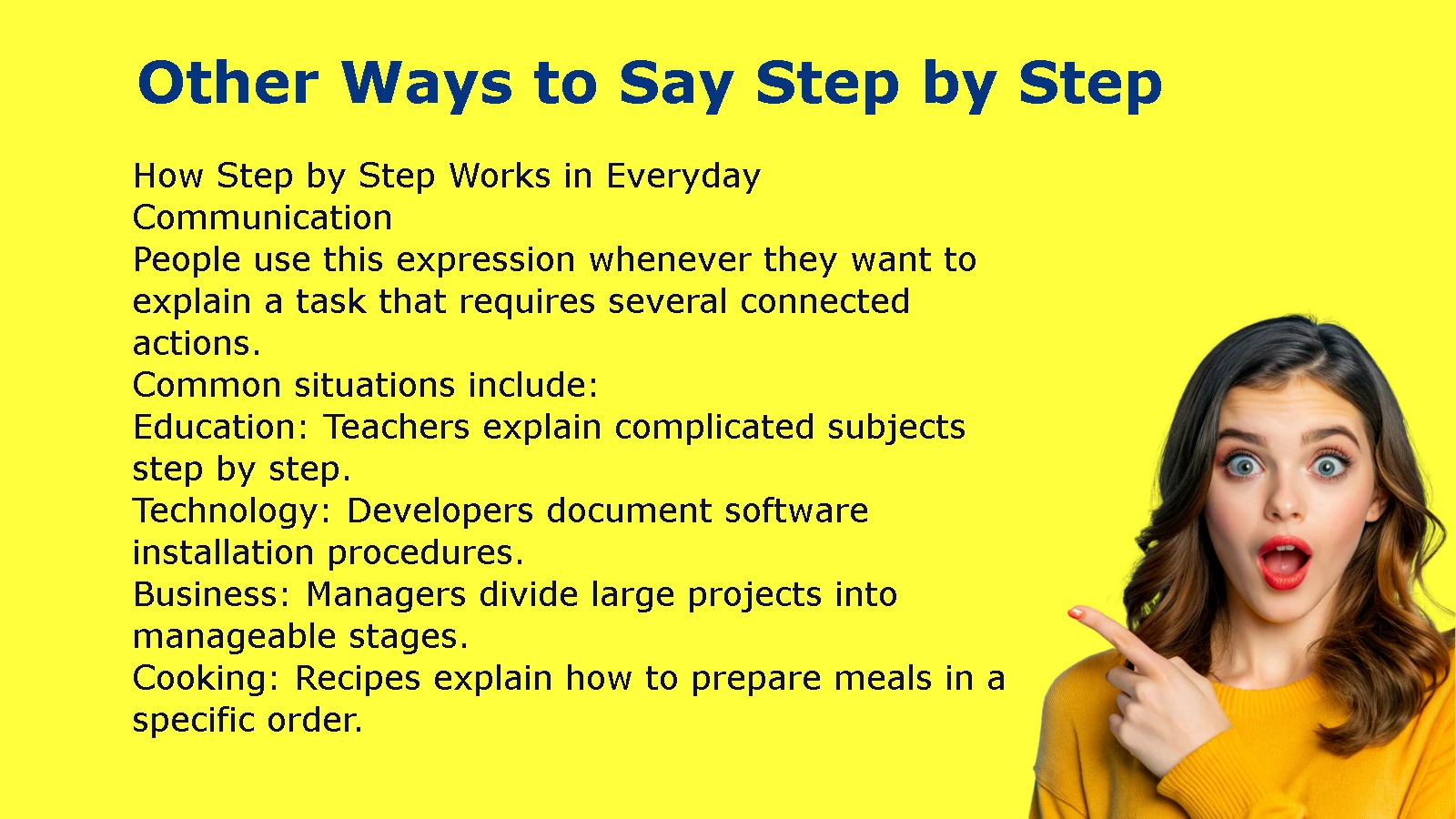
How Step by Step Works in Everyday Communication
People use this expression whenever they want to explain a task that requires several connected actions.
Common situations include:
- Education: Teachers explain complicated subjects step by step.
- Technology: Developers document software installation procedures.
- Business: Managers divide large projects into manageable stages.
- Cooking: Recipes explain how to prepare meals in a specific order.
- Personal development: Individuals work toward goals through gradual improvements.
The expression also makes complicated information less intimidating. Instead of asking someone to complete a large task immediately, you can guide them through smaller, understandable actions.
35+ Other Ways to Say Step by Step
You can replace step by step with several expressions, depending on the meaning you want to communicate. Some alternatives emphasize an established order, while others describe gradual progress, careful execution, or separate phases.
The following table compares useful synonyms and explains when each one works best.
Quick List of Step-by-Step Synonyms
| Alternative | Meaning or context | Formality |
| Sequentially | Following a particular order | Formal |
| In stages | Through separate phases | Neutral |
| One step at a time | Completing individual actions gradually | Casual |
| Systematically | Following an organized method | Formal |
| Methodically | Acting carefully and logically | Formal |
| Gradually | Progressing over time | Neutral |
| In sequence | Following an established order | Neutral |
| Stage by stage | Completing one phase after another | Neutral |
| Stepwise | Through successive steps | Formal |
| Progressively | Advancing gradually | Formal |
| In order | Following a particular arrangement | Neutral |
| One after another | Completing actions in succession | Casual |
| Phase by phase | Through individual phases | Formal |
| In a structured manner | Following an organized structure | Formal |
| Through a series of steps | Completing connected actions | Neutral |
| Following a procedure | Using an established method | Formal |
| In a logical order | Following a sensible sequence | Neutral |
| Piece by piece | Completing smaller parts | Casual |
| Incrementally | Making small changes or additions | Formal |
| Individually | Handling separate elements | Neutral |
| In succession | Following one another | Formal |
| At a steady pace | Maintaining consistent progress | Neutral |
| Little by little | Making gradual progress | Casual |
| Bit by bit | Completing something in small parts | Casual |
| In an orderly fashion | Following an organized arrangement | Formal |
| Through successive stages | Moving through consecutive phases | Formal |
| In a planned sequence | Following a predetermined order | Formal |
| In a controlled manner | Managing each action carefully | Formal |
| Step after step | Completing successive actions | Neutral |
| In a progressive manner | Advancing through gradual development | Formal |
| Following a logical progression | Moving through connected stages | Formal |
| At each stage | Addressing individual phases | Neutral |
| By degrees | Progressing gradually | Formal |
| In turn | Completing actions according to their order | Neutral |
| In manageable portions | Dividing work into smaller parts | Neutral |
Best Alternatives Based on Context
Not every synonym communicates exactly the same idea. Choosing an appropriate expression depends on what you want readers to understand.
For describing an organized process:
- Sequentially
- Systematically
- In a logical order
- In a structured manner
- Following a procedure
For explaining gradual progress:
- Gradually
- Incrementally
- Little by little
- Progressively
- One step at a time
Describing separate phases:
- In stages
- Phase by phase
- Stage by stage
- Through successive stages
- In successive phases
giving instructions:
- In sequence
- Following the directions
- Through a series of steps
- Using a guided procedure
- In an orderly fashion
For example, if you’re explaining how to install software, “sequentially” communicates the order of the installation actions. However, if you’re describing someone’s progress toward learning a programming language, “gradually” or “progressively” may communicate the intended meaning more accurately.
Formal Synonyms for Step by Step
Formal alternatives to step by step help you communicate procedures, explain methods, and describe organized activities in professional or academic writing. Expressions such as sequentially, systematically, methodically, and in successive stages sound more precise than the everyday phrase.
Use these alternatives in reports, business proposals, research papers, technical documents, and workplace communication.
Sequentially
Sequentially means completing actions in a particular order, with one action following another. It is one of the closest formal synonyms for step by step.
Examples:
- The software processes the uploaded files sequentially.
- Employees must complete the training modules sequentially.
- The researcher examined each sample sequentially.
- Follow the numbered instructions sequentially to avoid errors.
Use this word when the order of actions matters. It works particularly well in technical writing, academic explanations, and operational procedures.
Systematically
Systematically means following an organized, planned, and consistent method. It emphasizes structure and organization rather than simply completing actions in sequence.
Examples:
- The management team systematically reviewed each department.
- We systematically analyzed the available data.
- The technician systematically checked every component.
- The company addressed customer complaints systematically.
Choose this alternative when you want to emphasize a repeatable method or organized approach.
For instance, a researcher who examines several variables according to a defined framework works systematically, even if the process involves reviewing multiple items in a carefully planned order.
Methodically
Methodically describes performing an activity carefully, deliberately, and according to an established method.
Examples:
- She methodically organized the research findings.
- The engineer methodically inspected the equipment.
- He methodically worked through every question.
- The team methodically evaluated each proposal.
This expression works well when accuracy, attention to detail, and careful execution matter.
Methodically vs. systematically: Both words describe organized work. However, methodically places more emphasis on careful execution, while systematically highlights the overall structure of an approach.
Procedurally
Procedurally refers to following established procedures, rules, or official methods.
Examples:
- The application must be reviewed procedurally before approval.
- The organization handled the complaint according to its established procedures.
- Staff members must complete the required checks procedurally.
This word is particularly useful in legal, administrative, technical, and organizational contexts.
However, it does not always replace step by step naturally. If you’re describing a simple series of instructions, “sequentially” or “methodically” may sound clearer.
Incrementally
Incrementally means making progress through small additions, changes, or improvements rather than completing everything at once.
Examples:
- The company incrementally improved its customer service system.
- Developers introduced new features incrementally.
- Students developed their writing skills incrementally.
- The organization increased production capacity incrementally.
Use this expression when describing gradual development.
For example, a business that introduces three new features over several months makes incremental improvements. The emphasis falls on gradual change, not necessarily on a fixed sequence of instructions.
In a Structured Manner
In a structured manner means following an organized arrangement or established framework.
Examples:
- The consultant presented the findings in a structured manner.
- Employees must complete the onboarding activities in a structured manner.
- The teacher explained the lesson in a structured manner.
This expression fits professional reports, presentations, proposals, and instructional documents.
It also works when you want to describe an organized approach without specifying the exact order of every action.
Another Word for Step-by-Step Process
A step-by-step process can also be called a sequential process, systematic procedure, structured workflow, phased approach, or series of actions. These alternatives describe methods that divide larger activities into smaller, connected tasks.
The best expression depends on whether you want to emphasize order, organization, separate phases, or the overall workflow.
Sequential Process
A sequential process consists of actions that follow a particular order. Each stage typically depends on the completion of an earlier stage.
Examples:
- The application follows a sequential process from submission to approval.
- Manufacturing involves a sequential process of assembly and inspection.
- The training program uses a sequential process to introduce new skills.
This expression works well when changing the order of activities could affect the final result.
Best for: Manufacturing, software development, education, research, and technical documentation.
Systematic Procedure
A systematic procedure describes an organized method that follows a consistent approach.
Examples:
- The laboratory uses a systematic procedure to test samples.
- The company developed a systematic procedure for handling customer requests.
- Every employee must follow the systematic procedure during equipment inspections.
This alternative emphasizes consistency and repeatability.
A systematic procedure may contain sequential steps, but its main purpose is to ensure that people perform the activity according to an organized method.
Best for: Workplace policies, research methods, quality control, and administrative processes.
Phased Approach
A phased approach divides a large project or activity into separate periods or stages. Each phase has its own objectives and deliverables.
Examples:
- The company introduced the new software through a phased approach.
- The construction project follows a phased approach to minimize disruption.
- Management adopted a phased approach to organizational changes.
This expression is especially useful when a process takes weeks, months, or years.
For example, a business might implement a new customer management system in three phases:
- Planning phase: Identify requirements and select suitable software.
- Implementation phase: Install the system and transfer existing data.
- Evaluation phase: Test performance and address technical problems.
The term “phased approach” communicates this broader project structure more effectively than simply saying “step by step.”
Structured Workflow
A structured workflow describes an organized series of connected activities used to complete a task or achieve a business objective.
Examples:
- The department created a structured workflow for processing invoices.
- Our team follows a structured workflow when publishing new articles.
- The automated system uses a structured workflow to handle customer requests.
This alternative is particularly appropriate for business operations and project management.
Best for: Business processes, content production, team management, and automation.
Series of Actions
A series of actions means multiple activities performed to achieve a particular result.
Examples:
- Installing the equipment requires a series of actions.
- The investigation involved a series of actions to identify the problem.
- Completing the application requires a series of actions from the applicant.
This is a straightforward alternative when you want simple, accessible language.
Unlike “sequential process,” it does not always imply that every action must happen in a strict order.
Progressive Method
A progressive method describes an approach that develops gradually, with each stage building on previous work.
Examples:
- The instructor used a progressive method to teach advanced mathematics.
- The company adopted a progressive method for employee training.
- The program introduces new concepts through a progressive method.
Use this expression when the process involves gradual learning, development, or improvement.
Another Way to Say Step-by-Step Instructions
Another way to say step-by-step instructions includes sequential instructions, detailed directions, procedural guidelines, numbered directions, and stepwise guidance. These alternatives explain how someone can complete a task through clear, organized information.
Choose the expression according to the type of guidance you’re providing and the audience you’re addressing.
Sequential Instructions
Sequential instructions are directions arranged in a specific order. Readers complete each action before moving to the next.
Examples:
- Follow the sequential instructions to assemble the furniture.
- The manual provides sequential instructions for installing the application.
- Students received sequential instructions for completing the experiment.
This phrase is especially useful for technical manuals, tutorials, and educational materials.
Detailed Directions
Detailed directions provide specific information about what someone needs to do.
Examples:
- The technician provided detailed directions for repairing the device.
- Read the detailed directions before operating the machine.
- The website offers detailed directions for creating an account.
Use this expression when instructions contain explanations, warnings, examples, or additional information.
Stepwise Guidance
Stepwise guidance describes assistance that divides a complicated task into smaller, manageable actions.
Examples:
- The online course provides stepwise guidance for beginners.
- New employees receive stepwise guidance during their first week.
- The tutorial offers stepwise guidance for setting up a website.
This phrase works well in education, training, customer support, and instructional content.
Guided Procedure
A guided procedure is a process in which someone receives assistance while completing individual actions.
Examples:
- The technician demonstrated a guided procedure for configuring the equipment.
- Beginners can use the guided procedure to complete registration.
- The training platform includes a guided procedure for new users.
This alternative is useful when instructions actively support the reader rather than simply presenting a list of actions.
Numbered Instructions
Numbered instructions organize directions into a numbered list. This format makes it easier to follow a process and identify individual actions.
Examples:
- The manual includes numbered instructions for assembling the chair.
- Follow the numbered instructions to complete your registration.
- The teacher distributed numbered instructions for the classroom activity.
Numbered instructions work particularly well when readers must complete tasks in a fixed order.
Procedural Guidelines
Procedural guidelines explain the recommended or required way to complete an activity.
Examples:
- Employees must follow the procedural guidelines when handling confidential records.
- The organization updated its procedural guidelines for workplace safety.
- Review the procedural guidelines before beginning the inspection.
This phrase suits professional documents, workplace policies, compliance materials, and official communication.
Another Word for Instructions
The word instructions refers to information that explains how to perform an activity or complete a task. Depending on the context, you can replace it with directions, guidelines, procedures, guidance, protocols, or manuals.
Although these alternatives share similar meanings, they have different uses.
Directions
Directions explain what someone should do or where someone should go.
Examples:
- The teacher gave students directions for completing the assignment.
- Follow the directions on the screen to reset your password.
- The technician explained the directions for operating the machine.
Directions work well in everyday conversations, tutorials, and practical explanations.
Guidelines
Guidelines provide recommendations or general rules for completing an activity correctly.
Examples:
- Follow the writing guidelines before submitting your article.
- The organization published guidelines for handling customer complaints.
- Employees should review the safety guidelines before entering the facility.
The main difference is that instructions often tell someone exactly what to do, while guidelines provide broader recommendations.
Procedures
Procedures describe established methods for completing particular activities.
Examples:
- Employees must follow company procedures when processing payments.
- The hospital updated its administrative procedures.
- The document explains the procedures for conducting an inspection.
This word works well in professional, technical, legal, and organizational writing.
Guidance
Guidance refers to advice, support, or direction that helps someone make decisions or complete an activity.
Examples:
- New employees receive guidance from experienced team members.
- The instructor provided guidance throughout the project.
- Students can access additional guidance through the online learning platform.
Unlike detailed instructions, guidance does not always require a fixed sequence of actions.
Protocols
Protocols are established rules or procedures that people follow in specific situations.
Examples:
- Medical staff must follow infection-control protocols.
- The IT department introduced new security protocols.
- Researchers followed established testing protocols.
Use this word when describing formal standards or agreed procedures.
Manuals
Manuals are documents that provide information about using, maintaining, assembling, or operating something.
Examples:
- The equipment comes with an instruction manual.
- Employees must read the training manual before operating the machinery.
- The website includes a user manual for beginners.
A manual usually contains more than individual instructions. It may include diagrams, explanations, troubleshooting advice, and safety information.
Instructions vs. Directions vs. Guidelines vs. Procedures
| Word | Main purpose | Example context |
| Instructions | Explain specific actions | Installing software |
| Directions | Tell someone what to do or where to go | Completing a task |
| Guidelines | Provide recommendations | Workplace writing |
| Procedures | Describe established methods | Company operations |
| Guidance | Offer advice and support | Employee training |
| Protocols | Establish formal rules | Safety and compliance |
| Manuals | Provide comprehensive information | Operating equipment |
Step-by-Step Words and Phrases to Use in Different Situations
The best replacement for step by step depends on the type of writing you’re producing. A phrase that sounds natural in a conversation may feel too informal in a business report. Similarly, technical documentation often requires precise language that tells readers exactly how to complete an action.
Here are useful alternatives for different writing situations.
Alternatives for Business and Professional Writing
Professional communication benefits from expressions that sound clear, organized, and precise.
Consider these alternatives:
| Alternative phrase | Example sentence |
| Following a defined procedure | Employees must complete the application following a defined procedure. |
| Through an organized workflow | The department processes requests through an organized workflow. |
| In a logical sequence | The manager presented the recommendations in a logical sequence. |
| Using a systematic approach | We resolved the technical issues using a systematic approach. |
| In successive stages | The company introduced the new policy in successive stages. |
| According to established procedures | The team reviewed each application according to established procedures. |
| Through a planned sequence | The project progressed through a planned sequence of activities. |
Writing tip: Use “following a defined procedure” when discussing official workplace activities. Choose “through an organized workflow” when describing how different tasks connect within a department.
Alternatives for Academic Writing
Academic writing often requires precise language to explain research methods, experiments, observations, and logical arguments.
Useful expressions include:
- Sequentially
- Methodically
- In successive phases
- Through a structured process
- In a progressive manner
- According to a defined methodology
- In a logical progression
- Through systematic analysis
Examples:
- The researchers examined the samples sequentially.
- Students completed the experiment methodically.
- The study evaluated the results through a structured process.
- The investigation progressed through successive phases.
- The researchers analyzed the collected information systematically.
Writing tip: Avoid replacing every instance of “step by step” with “sequentially.” Academic writing becomes repetitive when the same formal expression appears throughout a paper. Alternate between terms that accurately describe the method.
Alternatives for Everyday Conversations
Casual expressions make everyday communication sound friendly and natural.
Try these phrases:
| Alternative | Example |
| One thing at a time | Let’s solve this problem one thing at a time. |
| One step at a time | You’ll learn the process one step at a time. |
| Bit by bit | She improved her English bit by bit. |
| Little by little | We finished the renovation little by little. |
| One after another | The children entered the classroom one after another. |
| Piece by piece | He assembled the model piece by piece. |
| Slowly but surely | We’re making progress slowly but surely. |
| At your own pace | Learn the new software at your own pace. |
These expressions work well in conversations, text messages, informal emails, and friendly explanations.
For example, telling someone “We’ll work through the problem one step at a time” sounds more encouraging than “We’ll address the problem sequentially.”
Alternatives for Tutorials and Technical Documentation
Tutorials and technical documents need language that minimizes confusion. Readers should understand what action to perform and when to proceed.
Useful alternatives include:
- Follow these instructions in order.
- Complete each stage.
- Proceed to the next step.
- Work through the procedure.
- Follow the numbered directions.
- Complete each task individually.
- Repeat the process for each section.
- Continue until all stages are complete.
- Perform the actions in the specified order.
- Follow the installation procedure.
Examples:
Software tutorial:
Instead of writing:
“Install the program step by step.”
Write:
“Follow the installation instructions in the specified order.”
Technical manual:
Instead of writing:
“Check the machine step by step.”
Write:
“Inspect each component according to the maintenance procedure.”
Online learning guide:
Instead of writing:
“Learn the topic step by step.”
Write:
“Complete each lesson before progressing to the next module.”
The improved versions tell readers more about the expected process.
Step-by-Step Antonyms and Opposite Expressions
The opposite of step by step depends on the intended meaning. If the expression describes actions performed in an organized sequence, possible opposites include randomly, haphazardly, and unsystematically. If it emphasizes completing one action before another, “simultaneously” or “all at once” may express a contrasting approach.
Randomly
Randomly means doing something without following a particular order or predictable pattern.
Examples:
- The computer selected the questions randomly.
- He arranged the files randomly instead of organizing them by date.
- Participants entered the room randomly.
Unlike a step-by-step approach, random actions do not necessarily follow a planned sequence.
Haphazardly
Haphazardly means doing something without proper planning, organization, or care.
Examples:
- The workers arranged the equipment haphazardly.
- She completed the assignment haphazardly and missed several important details.
- The documents were stored haphazardly.
This word often communicates poor organization rather than simply a different sequence.
Simultaneously
Simultaneously means two or more activities happen at the same time.
Examples:
- The two teams worked simultaneously on different sections.
- The system processes several requests simultaneously.
- She answered questions while simultaneously taking notes.
This is a useful contrast when the original expression emphasizes completing one action before starting another.
However, simultaneous actions can still follow an organized procedure. Therefore, the word is not a universal antonym.
All at Once
All at once means doing or experiencing several things together rather than spreading them across separate stages.
Examples:
- Don’t try to complete every assignment all at once.
- The company introduced all the changes all at once.
- Several notifications appeared all at once.
This expression is common in everyday conversations and informal writing.
Unsystematically
Unsystematically describes performing an activity without using an organized or consistent method.
Examples:
- The information was collected unsystematically.
- Employees handled the requests unsystematically.
- The researcher reviewed the documents unsystematically.
It provides a direct contrast with “systematically,” especially in academic and professional writing.
Indiscriminately
Indiscriminately means acting without making careful distinctions or selections.
Examples:
- The files were deleted indiscriminately.
- The company distributed promotional materials indiscriminately.
- He applied the same solution indiscriminately to every problem.
This expression does not directly mean the opposite of step by step. However, it can contrast with a careful, selective, and organized approach.
Are All These Words True Antonyms?
No. Some expressions describe the opposite of an organized sequence, while others contrast with gradual or individual action.
| Expression | What it contrasts with | Is it a direct contextual opposite? |
| Randomly | Following an established order | Yes |
| Haphazardly | Working methodically | Yes |
| Simultaneously | Completing actions one after another | In some contexts |
| All at once | Completing tasks gradually | In some contexts |
| Unsystematically | Following an organized method | Yes |
| Indiscriminately | Acting carefully and selectively | In some contexts |
For example, consider these sentences:
- Sequential approach: The technician inspected each machine one after another.
- Random approach: The technician inspected the machines randomly.
- Simultaneous approach: The technicians inspected several machines at the same time.
Each sentence describes a different working method. Understanding these differences helps you choose an appropriate antonym without changing your intended meaning.
Step by Step in a Sentence: Examples and Usage
The expression step by step works in everyday conversations, academic writing, business communication, and instructional materials. Its meaning stays consistent, but the surrounding language changes according to the situation.
The following examples show how to use the expression and its alternatives naturally.
Step-by-Step Examples in Everyday English
Here are original examples suitable for daily conversations:
- She learned to drive step by step with the help of her instructor.
- We solved the complicated puzzle one step at a time.
- My father showed me how to repair the bicycle step by step.
- The children learned the new game gradually.
- He assembled the bookshelf piece by piece.
- We completed the home renovation in stages.
- The teacher explained the difficult lesson in a logical order.
- She improved her cooking skills little by little.
These examples demonstrate how different expressions communicate similar ideas without making every sentence sound repetitive.
Step-by-Step Examples in Professional Writing
Business communication often requires language that emphasizes organization, consistency, and accuracy.
Examples:
- The team completed the project systematically.
- Employees must follow the procedure sequentially.
- The company introduced the changes incrementally.
- The manager reviewed the applications in a structured manner.
- Our department processes customer requests according to established procedures.
- The organization implemented the new system in successive stages.
- The consultant presented the recommendations in a logical sequence.
These alternatives make professional documents sound more precise.
Step-by-Step Examples in Academic Writing
Academic examples often describe research, experiments, analysis, and learning.
Examples:
- The experiment followed a methodical procedure.
- Students analyzed the results in a logical sequence.
- The research progressed through successive stages.
- The scientists examined each sample systematically.
- The study evaluated the collected information incrementally.
- Researchers completed the investigation according to a predefined methodology.
- The instructor demonstrated the mathematical solution one stage at a time.
Choose words that accurately describe the research method rather than using formal synonyms simply to make a sentence sound complicated.
Before-and-After Sentence Transformations
The easiest way to learn synonyms is to compare how they work in the same sentence.
| Original sentence | Improved alternative | Main difference |
| Explain the process step by step. | Explain the process sequentially. | More formal and concise |
| Complete the project step by step. | Complete the project in stages. | Highlights separate phases |
| Review the documents step by step. | Review the documents methodically. | Emphasizes careful examination |
| Improve your skills step by step. | Improve your skills gradually. | Highlights gradual development |
| Follow the instructions step by step. | Follow the instructions in order. | Uses simpler wording |
| Build the system step by step. | Build the system incrementally. | Emphasizes gradual development |
| Organize the files step by step. | Organize the files systematically. | Emphasizes an organized method |
| Complete each task step by step. | Complete each task individually. | Highlights separate tasks |
Practical Case Study: Choosing the Right Synonym
Imagine a company introducing new accounting software to its employees.
The manager needs to explain three different activities:
- Teaching employees how to use the software.
- Introducing the software across multiple departments.
- Improving the system after receiving feedback.
Using “step by step” for all three activities would communicate the general idea, but more precise expressions would improve the explanation.
| Activity | Less precise wording | Better alternative |
| Employee training | Teach employees step by step. | Provide stepwise guidance. |
| Software introduction | Introduce the software step by step. | Implement the software through a phased approach. |
| System improvements | Improve the software step by step. | Improve the software incrementally. |
The difference is important. Each alternative communicates a specific aspect of the project.
Practical lesson: Don’t select synonyms simply because they look different. Choose words that preserve the original meaning while making the sentence more specific.
How to Choose the Best Step-by-Step Synonym
Choosing the right alternative involves more than replacing one expression with another. You need to consider the intended meaning, audience, writing style, and situation.
A suitable synonym should make your sentence easier to understand without changing its original message.
Consider Your Audience
Think about who will read your content before choosing an alternative.
For example:
- General readers: Use “one step at a time” or “in stages.”
- Business professionals: Choose “systematically” or “following a defined procedure.”
- Academic readers: Use “sequentially” or “methodically.”
- Technical readers: Choose “in the specified order” or “following the installation procedure.”
- Beginners: Prefer “one step at a time” or “follow these instructions in order.”
Simple expressions often communicate ideas more effectively than complicated vocabulary.
Match the Alternative to Your Meaning
Different synonyms emphasize different aspects of a process.
Consider these distinctions:
| If you want to communicate… | Choose this alternative |
| Actions following a fixed order | Sequentially |
| Careful and deliberate execution | Methodically |
| An organized and consistent approach | Systematically |
| Progress through separate phases | In stages |
| Gradual development | Gradually |
| Small changes or improvements | Incrementally |
| Individual actions | One step at a time |
| A larger organized process | Structured workflow |
| A series of connected instructions | Sequential instructions |
For example, “The company improved its operations incrementally” emphasizes gradual improvements. However, “The company organized its operations systematically” emphasizes the method used to improve them.
Both sentences describe organized work, but they communicate different ideas.
Consider Formality and Tone
The same message can sound different depending on the expression you choose.
| Casual | Neutral | Formal |
| Bit by bit | Gradually | Incrementally |
| One step at a time | In stages | Sequentially |
| One after another | In order | In succession |
| Little by little | Stage by stage | Progressively |
| Piece by piece | Through several steps | Methodically |
Use casual expressions in conversations and friendly messages. Choose neutral wording for general articles and instructions. Formal alternatives work better in reports, academic papers, and professional documents.
Avoid Synonyms That Change the Intended Meaning
Some alternatives look interchangeable but describe different situations.
For example:
- Sequentially vs. gradually: Sequentially describes order, while gradually describes slow or progressive change.
- Systematically vs. methodically: Systematically emphasizes organization, while methodically emphasizes careful execution.
- Incrementally vs. in stages: Incrementally highlights small additions or changes, while in stages emphasizes separate phases.
- Simultaneously vs. sequentially: Simultaneously means happening together, while sequentially means happening in an order.
Consider this example:
“The student learned mathematics sequentially.”
This suggests that the student learned topics in a particular order.
“The student learned mathematics gradually.”
This suggests that the student’s understanding developed over time.
The two sentences are related, but they do not communicate exactly the same thing.
Frequently Asked Questions
What Is Another Word for Step by Step?
Some common alternatives to step by step include sequentially, systematically, methodically, gradually, in stages, and one step at a time. Use sequentially when actions follow a fixed order, systematically when following an organized method, and gradually when describing progressive development.
What Is a More Formal Way to Say Step by Step?
Formal alternatives include sequentially, methodically, systematically, incrementally, and in successive stages. These expressions work well in academic papers, business reports, technical documents, and professional emails. Choose the word that best describes the process rather than selecting an alternative based only on formality.
What Is Another Word for a Step-by-Step Process?
A step-by-step process can also be called a sequential process, systematic procedure, structured workflow, phased approach, or series of actions. A sequential process emphasizes order, while a phased approach divides a larger activity into separate stages.
How Do You Say Step-by-Step Instructions Professionally?
You can use expressions such as sequential instructions, detailed directions, procedural guidelines, stepwise guidance, and established procedures. For example, instead of writing “Follow the instructions step by step,” you can write “Complete each action according to the specified procedure.”
What Is the Opposite of Step by Step?
Depending on the context, opposite expressions include randomly, haphazardly, unsystematically, simultaneously, and all at once. Randomly describes actions without a particular order, while simultaneously describes multiple activities happening together.
Is Step by Step the Same as Sequentially?
Both expressions describe actions that follow an order, but they differ in formality and grammatical use. “Step by step” is a common everyday expression, while “sequentially” is a more formal adverb. For example, “Follow the instructions step by step” and “Follow the instructions sequentially” communicate similar ideas.
Conclusion: Choose the Right Alternative to Step by Step
Finding the best alternative to step by step depends on what you want to communicate. Words such as sequentially, systematically, methodically, gradually, and incrementally provide useful options for different writing situations.
Remember these distinctions:
- Use sequentially when actions must follow a particular order.
- Choose systematically when describing an organized method.
- Use methodically when emphasizing careful execution.
- Select gradually when describing slow progress.
- Choose incrementally when explaining small changes or improvements.
- Use in stages when dividing a larger activity into separate phases.
- Choose one step at a time for friendly, everyday communication.