Other ways to say touching base include checking in, following up, reconnecting, getting an update, discussing progress, and catching up. The best alternative depends on your purpose, whether you want to request information, check a project’s status, reconnect with a client, or arrange a meeting. In professional communication, specific phrases often work better than vague expressions because they tell the recipient exactly why you’re reaching out.
The phrase touching base is common in business emails, workplace conversations, project updates, and client relationships. However, some alternatives sound more formal, while others feel friendly, direct, or collaborative. Choosing the right wording can make your emails clearer, your meeting invitations more useful, and your follow-up messages more effective.
| Question | Answer |
| What is another way to say touching base? | Checking in, following up, reconnecting, or getting an update. |
| What is a formal alternative to touching base? | I’m writing to follow up on… or I’d appreciate an update on… |
| What does touching base mean in business? | It means briefly contacting someone to exchange information, check progress, or maintain communication. |
| Is it touch base or touchbase? | Touch base is the standard spelling when used as a verb phrase. |
| What do you call a meeting to touch base? | A project check-in, progress review, team sync, or status meeting. |
What Does Touching Base Mean?
Touching base means briefly contacting someone to exchange information, check progress, reconnect, or maintain communication. People often use this expression in business emails, meetings, and workplace conversations. Depending on the situation, touching base might involve requesting an update, sharing news, discussing next steps, or simply checking how someone is doing.
For example:
- I’ll touch base with the marketing team tomorrow.
- I wanted to touch base about the proposal.
- Let’s touch base next week to review our progress.
The expression doesn’t automatically mean a formal meeting. A short email, phone call, chat message, or quick conversation can all count as touching base.
Touching Base Meaning in Business
In business, touching base usually refers to a brief interaction that helps people stay informed, coordinated, or connected.
Professionals use it for several reasons:
- Project coordination: Checking whether tasks are moving forward.
- Client communication: Maintaining relationships and addressing questions.
- Team management: Sharing updates and identifying obstacles.
- Sales follow-ups: Checking whether a potential customer needs more information.
- Decision-making: Confirming responsibilities or discussing the next steps.
Consider a project manager who wants to know whether a designer has completed a presentation.
They could write:
“Just touching base to see how the presentation is coming along.”
However, a clearer message would be:
“Could you share an update on the presentation? We need the final slides by Thursday.”
The second message gives the recipient a specific request and a deadline. This approach works especially well when timing matters.
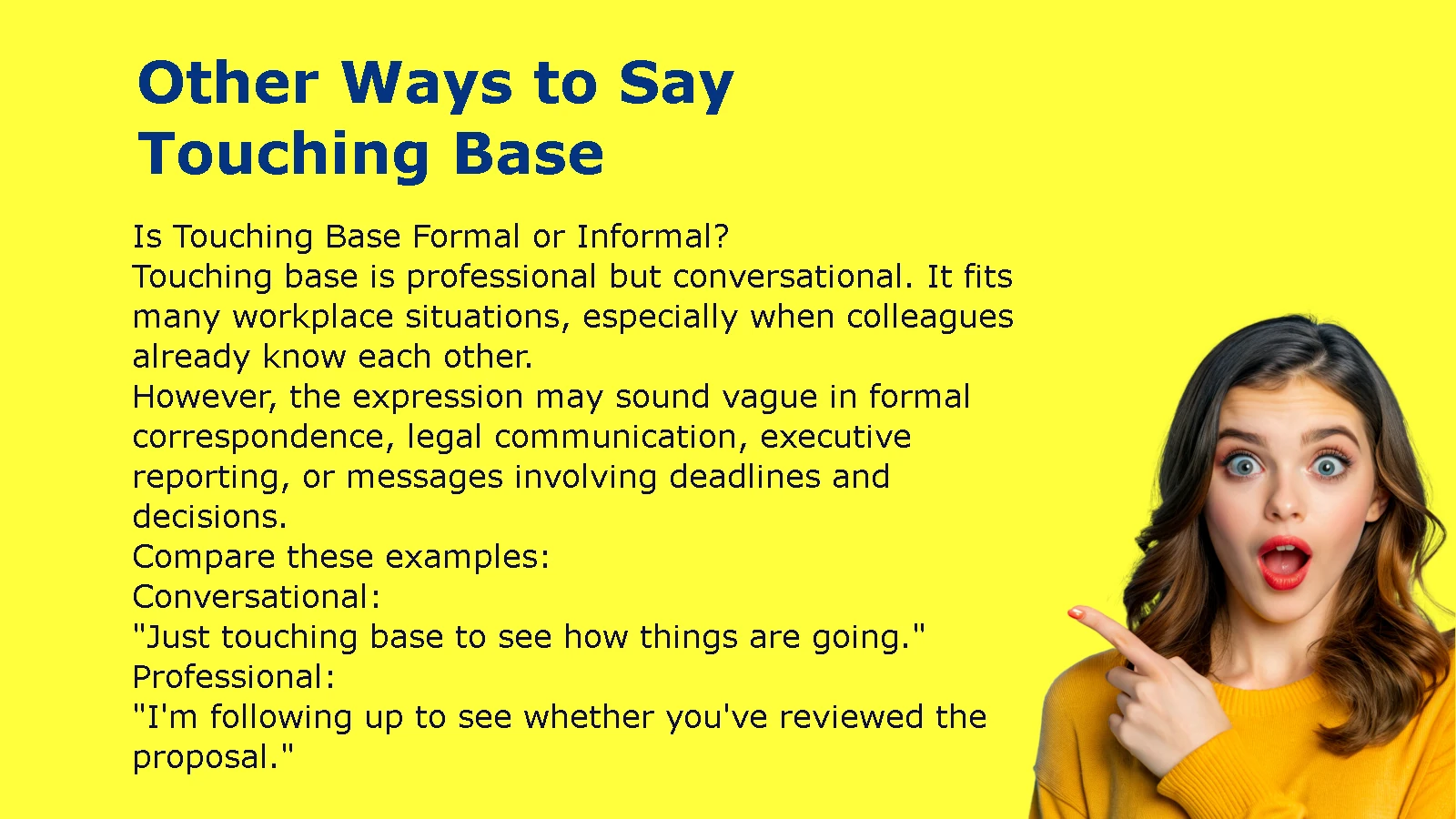
Is Touching Base Formal or Informal?
Touching base is professional but conversational. It fits many workplace situations, especially when colleagues already know each other.
However, the expression may sound vague in formal correspondence, legal communication, executive reporting, or messages involving deadlines and decisions.
Compare these examples:
Conversational:
“Just touching base to see how things are going.”
Professional:
“I’m following up to see whether you’ve reviewed the proposal.”
More formal:
“I would appreciate an update regarding the proposal review.”
The right choice depends on your relationship with the recipient, your communication goal, and the seriousness of the subject.
35+ Other Ways to Say Touching Base
The best touch base alternative communicates your purpose without making the message sound stiff or unnatural. Use the following expressions according to the situation.
Professional and Formal Alternatives to Touching Base
These expressions work well in business emails, client communication, management updates, and formal workplace messages.
I’m writing to follow up on…
Use this when you’ve already sent a message, shared a document, or discussed a subject.
Example: “I’m writing to follow up on the contract we discussed last Friday.”
I’d like to check on the progress of…
This phrase works when you need a progress update.
Example: “I’d like to check on the progress of the website redesign.”
I’m reaching out regarding…
Use this when introducing the reason for your message.
Example: “I’m reaching out regarding the revised project timeline.”
I’d appreciate an update on…
This is a polite and direct way to request information.
Example: “I’d appreciate an update on the hiring process.”
I’d like to discuss the current status of…
Choose this when the subject requires more than a quick response.
Example: “I’d like to discuss the current status of our partnership agreement.”
I wanted to see whether there have been any developments.
This works when you’re waiting for news or a decision.
Example: “I wanted to see whether there have been any developments with the funding application.”
I’m contacting you to coordinate…
Use this when you need to organize people, schedules, or responsibilities.
Example: “I’m contacting you to coordinate next week’s client presentation.”
I’d like to arrange a brief discussion about…
Choose this when you genuinely need a conversation.
Example: “I’d like to arrange a brief discussion about the proposed budget changes.”
Polite and Friendly Alternatives to Touching Base
These phrases sound natural when contacting coworkers, familiar clients, former colleagues, or professional contacts.
Just checking in.
A simple expression for a friendly message.
Example: “Just checking in to see how the new role is going.”
I wanted to see how things are going.
Use this when you care about someone’s progress or experience.
Example: “I wanted to see how things are going with your new project.”
Hope everything is going well.
This is a warm opening, but add a clear purpose if you need something.
Example: “Hope everything is going well. Have you had a chance to review the draft?”
I thought I’d reach out.
This works when you want to initiate a conversation without sounding too formal.
Example: “I thought I’d reach out and see if you’re available for a quick conversation.”
I wanted to reconnect.
Choose this when you haven’t spoken to someone in a while.
Example: “I wanted to reconnect and hear how your business has been doing.”
How have things been?
A natural option for maintaining professional relationships.
Example: “Hi Jordan, how have things been since we last spoke?”
I’d love to hear how you’re doing.
This feels warmer and more personal.
Example: “I’d love to hear how you’re doing and how the new position is working out.”
Alternatives for Project Updates and Progress Checks
When you need work-related information, choose language that identifies the project, task, or expected outcome.
Get an update
Example: “Can we get an update on the campaign results?”
Check on progress
Example: “I’ll check on progress with the development team this afternoon.”
Review the current status
Example: “Let’s review the current status of the product launch.”
Discuss next steps
Example: “Can we discuss next steps after the client approves the design?”
Share a progress report
Example: “Please share a progress report before Friday’s meeting.”
Align on priorities
Example: “Let’s align on priorities before assigning the remaining tasks.”
Confirm where things stand
Example: “Could you confirm where things stand with the supplier?”
These phrases are especially useful when communicating with multiple departments. They reduce confusion because they explain what the conversation needs to accomplish.
Alternatives for Reconnecting With Someone
Sometimes touching base has little to do with deadlines or project updates. You may simply want to rebuild a connection.
Consider these alternatives:
- Reconnect: “I’d love to reconnect and hear what you’ve been working on.”
- Catch up: “Would you have time to catch up over coffee?”
- Get back in touch: “I thought I’d get back in touch after our conference.”
- Resume our conversation: “I’d like to resume our conversation about the collaboration.”
- Pick up where we left off: “Let’s pick up where we left off last month.”
- See how things have been going: “I wanted to see how things have been going at your company.”
Although these expressions overlap, they aren’t interchangeable in every situation.
For example, “catch up” often suggests a relaxed conversation. “Resume our conversation” implies that you want to continue a previous discussion, while “reconnect” emphasizes restoring contact.
Alternatives for Following Up on Emails or Requests
Use these phrases when you need a response, confirmation, or progress update.
- Follow up on my previous email: “I’m following up on my previous email about the invoice.”
- Check whether you received my message: “I wanted to check whether you received my message from Tuesday.”
- See if you’ve had a chance to review…: “I wanted to see if you’ve had a chance to review the proposal.”
- Ask about the status of…: “Could you let me know the status of the application?”
- Follow up on our conversation: “I’m following up on our conversation about the new schedule.”
- Check whether you need anything else from me: “I’m checking whether you need anything else from me before moving forward.”
A useful rule: if you’re waiting for a response, follow up is often more precise than touch base.
Which Touch Base Alternative Should You Use?
Choose an alternative based on the action you want the recipient to take. Use “follow up” for an earlier conversation, “check on progress” for a task, “reconnect” for a relationship, and “discuss next steps” when you need a decision or plan.
Best Alternatives by Situation
| Situation | Best phrase | Tone |
| Formal business email | I’m writing to follow up on… | Professional |
| Asking for project progress | Could you share an update on…? | Direct and polite |
| Contacting a colleague | Just checking in. | Friendly |
| Reconnecting with a client | I wanted to reconnect. | Warm |
| Planning action items | Let’s discuss next steps. | Collaborative |
| Requesting a response | Could you let me know where things stand? | Polite and clear |
| Following up after an interview | I’m following up on the status of my application. | Professional |
| Confirming responsibilities | Let’s clarify ownership of the remaining tasks. | Direct |
| Asking for a meeting | Are you available for a brief discussion about…? | Professional |
How to Choose Between Touching Base, Checking In, and Following Up
These three expressions have similar meanings, but each emphasizes a different purpose.
Touching base is broad. It can describe a quick conversation, a status check, or a friendly message.
Example: “I’ll touch base with Priya next week.”
Checking in often sounds warmer. It can show interest in someone’s well-being or ask how work is progressing.
Example: “I’m checking in to see how you’re settling into your new role.”
Following up usually connects to an earlier message, task, request, or discussion.
Example: “I’m following up on the pricing estimate I sent yesterday.”
Here’s another way to distinguish them:
- Use touching base when you want to maintain communication.
- Use checking in when you want to ask how things are going.
- Use following up when you want to continue an existing matter.
- Use requesting an update when you need specific information.
- Use discussing next steps when you need an action plan.
Choosing the most specific phrase can help the recipient understand your message before opening it.
How to Say Touching Base in a Formal Email
In formal emails, replace “touching base” with a phrase that explains your purpose. “I’m writing to follow up on…” works for previous discussions, while “I’d appreciate an update on…” works when you need information.
A good business email usually identifies the subject, provides brief context, and makes the requested action clear.
Formal Email Examples for Different Situations
Following up with a client
Subject: Follow-Up on the Project Proposal
Hi Morgan,
I’m writing to follow up on the project proposal we shared last week. I’d appreciate any feedback you may have and would be happy to clarify any questions.
Best,
Alex
Asking a manager for an update
Subject: Update on the Hiring Process
Hi Taylor,
I wanted to check whether there have been any updates regarding the hiring process. Please let me know if you need any additional information from me.
Best regards,
Sam
Contacting a colleague about a project
Subject: Website Redesign Progress
Hi Jamie,
Could you share an update on the website redesign? It would be helpful to know whether the remaining design revisions are on schedule for Friday.
Thanks,
Chris
Reconnecting with a business partner
Subject: Reconnecting on Our Partnership
Hi Morgan,
I hope you’ve been doing well. I’d love to reconnect and discuss whether there may be opportunities for us to work together again.
Would you be available for a short call next week?
Best,
Jordan
Requesting a decision
Subject: Approval Needed for the Campaign Budget
Hi Taylor,
I’m following up on the campaign budget approval. Could you confirm whether we can proceed with the proposed allocation by Wednesday?
Thank you,
Alex
Copy-and-Paste Professional Email Templates
Use these templates when you need a ready-to-send alternative to touching base.
Project status update
Subject: Project Status Update
Hi [Name],
Could you share an update on [project name]? I’d appreciate knowing the current progress, any outstanding issues, and the expected completion date.
Best,
[Your Name]
Client follow-up
Subject: Following Up on [Topic]
Hi [Name],
I’m following up on our recent conversation about [topic]. Please let me know if you’ve had a chance to review the information or if you have any questions.
Best regards,
[Your Name]
Checking on a pending request
Subject: Status of [Request]
Hi [Name],
I’m checking on the status of [request]. Could you let me know if there are any updates or if you need anything else from me?
Thank you,
[Your Name]
Reconnecting after a long gap
Subject: Reconnecting
Hi [Name],
I hope you’ve been well. It’s been a while since we last spoke, and I wanted to reconnect. I’d love to hear what you’ve been working on and explore whether there’s an opportunity to collaborate.
Best,
[Your Name]
Requesting a short discussion
Subject: Brief Discussion About [Topic]
Hi [Name],
Would you be available for a 15-minute discussion about [topic] sometime this week? I’d like to review the current status and agree on the next steps.
Best regards,
[Your Name]
What to Say Instead of “Just Touching Base”
“Just touching base” is common, but it doesn’t always tell the recipient what you want.
Compare these examples.
Vague: “Just touching base about the proposal.”
Clearer: “Have you had a chance to review the proposal? I’d appreciate your feedback by Thursday.”
Vague: “Just wanted to touch base.”
Clearer: “I wanted to check whether you need any help with the onboarding process.”
Vague: “Touching base on the meeting.”
Clearer: “Could you confirm whether Friday at 10 a.m. still works for our meeting?”
The improved versions make the purpose obvious. They also reduce unnecessary back-and-forth messages.
Touch Base in a Sentence: Examples and Usage
“Touch base” works as a verb phrase that means to make brief contact. You can use it with a person, team, or subject, often with words such as “with,” “about,” “on,” or “regarding,” depending on the sentence.
Touch Base Examples in Professional Sentences
Here are natural examples for different workplace situations.
For everyday communication
- I’ll touch base with the team tomorrow.
- Let’s touch base after the client meeting.
- She touched base with her manager before submitting the report.
- We should touch base next week to review our progress.
For projects
- I’ll touch base with the developer about the remaining fixes.
- Can we touch base on the timeline before sending it to the client?
- The project lead touched base with everyone before the launch.
business relationships
- I plan to touch base with our supplier next Monday.
- Let’s touch base with the client after they review the estimate.
- He touched base with his former colleague about a possible partnership.
For planning
- We’ll touch base before making the final decision.
- Can we touch base tomorrow to confirm responsibilities?
- I’ll touch base with you once I receive the revised figures.
Touching Base Examples in Emails and Conversations
The expression “touching base” often appears in email openings and informal workplace conversations.
Examples:
- “I’m touching base to see if you need any assistance.”
- “I wanted to touch base regarding our last discussion.”
- “Thanks for touching base with me.”
- “I’m reaching out to see whether we can reconnect next week.”
- “Just touching base to confirm the delivery schedule.”
- “I thought I’d touch base before the presentation.”
Notice that the phrase can introduce different intentions. Some examples request help, others confirm details, and some maintain contact.
For that reason, the surrounding words matter more than the phrase alone.
Common Mistakes When Using Touch Base
Using the phrase without a clear purpose
“Let’s touch base sometime” doesn’t give the other person much information.
Better: “Let’s meet Thursday to review the budget.”
Using repeated follow-ups without new information
Sending “Just touching base” several times can frustrate the recipient.
Better: Explain what has changed or what response you need.
Using overly casual wording in a formal situation
A sensitive contract discussion may require precise language.
Better: “I’m writing to request confirmation of the revised terms.”
Assuming touching base always means a meeting
A quick message may be enough.
Better: Ask for a meeting only when you need discussion, collaboration, or a decision.
Touch Base Meeting: What Should You Call It?
A touch base meeting is usually a short conversation to share updates, resolve questions, coordinate work, or agree on next steps. Suitable names include Project Check-In, Progress Review, Weekly Team Sync, and Project Status Meeting. The best title reflects the meeting’s purpose.
Professional Names for a Touch Base Meeting
Choose a meeting title that helps attendees understand what they’ll discuss.
| Meeting name | Best use |
| Project Check-In | Brief project update |
| Project Status Meeting | Reviewing progress, risks, and deadlines |
| Weekly Team Sync | Regular team coordination |
| Progress Review | Evaluating completed and pending work |
| Client Check-In | Maintaining client communication |
| Brief Coordination Meeting | Organizing tasks and responsibilities |
| Team Update | Sharing announcements and updates |
| Next Steps Discussion | Agreeing on upcoming actions |
| Project Alignment Meeting | Resolving differences in priorities |
| Stakeholder Update | Sharing information with stakeholders |
Not every check-in needs a formal title. For a short conversation with a coworker, “Quick Sync” may be enough.
For a meeting with external clients, “Project Status Review” may communicate the purpose more clearly.
What to Call a Meeting to Touch Base With Different People
The ideal meeting title depends on who will attend and what you want to accomplish.
With a manager: Weekly Progress Check-In
Use this for discussing workload, priorities, obstacles, and deadlines.
With a client: Client Project Update
This title signals that the meeting will focus on project progress or outstanding questions.
With a colleague: Quick Sync
This is suitable for a brief conversation about shared tasks.
With a project team: Project Status Review
Use this when participants need to discuss milestones, risks, responsibilities, and delivery dates.
With a business partner: Partnership Update
This works for reviewing shared initiatives or exploring future opportunities.
With a new contact: Introductory Discussion
This sounds more purposeful than “Touch Base” when two people haven’t worked together before.
Touch Base Meeting Invitation Examples
Example: Weekly team check-in
Title: Weekly Team Sync
Hi everyone,
Let’s meet for 15 minutes on Thursday to review progress, identify blockers, and confirm priorities for next week.
Agenda:
- Key updates
- Outstanding issues
- Next steps and owners
Thanks!
Example: Client meeting
Title: Client Project Update
Hi Morgan,
Would you be available for a brief project update meeting on Tuesday? I’d like to review our progress, discuss the remaining questions, and confirm the upcoming milestones.
Best,
Alex
Example: Quick colleague discussion
Title: Quick Sync on the Website Launch
Hi Jamie,
Are you available for a quick 15-minute sync tomorrow? I’d like to confirm the remaining tasks before launch.
Thanks!
Practical tip: A short meeting can still waste time if nobody knows its purpose. Include an objective, an estimated duration, and the outcome you expect.
For a simple check-in, a 15-minute agenda might look like this:
- 3 minutes: Updates
- 5 minutes: Blockers
- 5 minutes: Decisions and next steps
- 2 minutes: Confirm owners and deadlines
Adjust the agenda to the team’s needs rather than following the schedule mechanically.
Touch Base or Touchbase: Which Is Correct?
Touch base is the standard spelling when used as a verb phrase. Write it as two words in sentences such as “I’ll touch base tomorrow.” “Touchbase” is generally incorrect in ordinary prose, while “touch-base” may appear in limited compound usage depending on context and style.
Is Touch Base One Word or Two?
Use touch base as two words when describing the act of contacting someone.
Correct examples:
- I’ll touch base with the client tomorrow.
- Let’s touch base after the presentation.
- She wants to touch base about the schedule.
- We touched base last week.
Incorrect in standard usage:
- I’ll touchbase with the client tomorrow.
- Let’s touchbase after lunch.
The distinction matters in professional emails, articles, reports, and other edited writing.
Touch Base vs. Touching Base vs. Touched Base
These forms use the same verb phrase in different grammatical constructions.
| Form | Usage | Example |
| Touch base | Base form | Let’s touch base tomorrow. |
| Touches base | Present tense, third-person singular | She touches base with the team weekly. |
| Touching base | -ing form | I’m touching base about the schedule. |
| Touched base | Past tense | We touched base yesterday. |
| To touch base | Infinitive | I’d like to touch base with you. |
The phrase usually takes the preposition with when you identify the person or group you contact.
Example: “I’ll touch base with the finance team.”
You can also use about or on to introduce the subject.
Example: “Let’s touch base about the proposal.”
Should You Hyphenate Touch Base?
In ordinary writing, keep the verb phrase open.
Correct: “We should touch base before Friday.”
Correct: “I’m touching base with the supplier.”
Hyphenation may appear in limited compound constructions, but it isn’t the normal form for the verb phrase.
When writing for a business, publication, or organization, follow its style guide if it provides a specific convention.
How to Make Your Follow-Up Messages More Effective
A strong follow-up message gives the recipient enough information to understand the context, purpose, and requested action. Rather than sending a vague check-in, explain what you need and what should happen next.
A Simple Framework for Better Business Follow-Ups
Use this three-part framework for professional communication.
Context: Remind the recipient what the message concerns.
Example: “Following our discussion about the launch schedule…”
Purpose: Explain why you’re contacting them.
Example: “I’d like to confirm whether the revised timeline is approved.”
Next step: Make the requested action clear.
Example: “Could you confirm by Wednesday afternoon?”
Put together:
“Following our discussion about the launch schedule, I’d like to confirm whether the revised timeline is approved. Could you confirm by Wednesday afternoon?”
This message gives the recipient a clear reason to respond.
Before-and-After Examples
Small changes can make everyday business communication more effective.
Example: Requesting an update
Before: “Just touching base.”
After: “Could you share an update on the proposal review?”
Why it works: The improved version identifies the information needed.
Example: Scheduling a conversation
Before: “Let’s touch base sometime.”
After: “Are you available Thursday for a 15-minute project review?”
Why it works: The revised message offers a specific time frame and purpose.
Example: Following up on a request
Before: “Touching base on this.”
After: “I’m following up on the approval request I sent Monday. Could you confirm its status?”
Why it works: It identifies the earlier request and asks for a useful response.
Example: Checking on a colleague
Before: “Need to touch base.”
After: “How is the onboarding process going? Let me know if you need any support.”
Why it works: The new message feels helpful rather than demanding.
A Practical Workplace Example
Imagine a marketing team preparing to launch a campaign on Friday.
The campaign manager needs three updates:
- The designer must finish the final graphics.
- The copywriter must submit revised headlines.
- The analyst must confirm tracking setup.
A vague message might say:
“Hi everyone, just touching base on the campaign.”
That message forces each recipient to figure out what the manager needs.
A clearer message would say:
“Hi team, could you confirm the status of your remaining campaign tasks by 2 p.m. today? Please flag any blockers that could affect Friday’s launch.”
The manager could then follow up individually where needed.
This example shows an important communication principle: one message should make the next action obvious.
A team-wide check-in can work for shared coordination, while individual messages may be better for specific responsibilities or sensitive concerns.
When Not to Use Touching Base
Although touching base works in many situations, another phrase may serve you better.
When you need an urgent response
Instead of: “Just touching base on the issue.”
Write: “Please confirm receipt of the revised schedule by 3 p.m. today.”
When you need a formal decision
Instead of: “Let’s touch base about approval.”
Write: “Please confirm whether you approve the revised budget.”
When the subject is sensitive
Instead of: “Touching base about the performance issue.”
Write: “I’d like to schedule a private discussion about the recent project concerns.”
When the recipient needs a specific task
Instead of: “Let’s connect about the report.”
Write: “Could you review the report’s final section and send your comments by Thursday?”
The goal isn’t to eliminate the phrase from your vocabulary. It’s to use it when it fits and choose more precise wording when the situation calls for it.
Frequently Asked Questions
What Is Another Way to Say Touching Base?
Other ways to say touching base include checking in, following up, reconnecting, getting an update, and discussing next steps. Choose “checking in” for a friendly message, “following up” for an earlier conversation, and “getting an update” when you need specific information.
What Is a Formal Way to Say Touching Base?
A formal alternative is “I’m writing to follow up on…” Other professional options include “I’d appreciate an update on…,” “I’d like to discuss the current status of…,” and “I’m reaching out regarding….” Choose wording that explains your purpose clearly.
What Does Touching Base Mean in Business?
Touching base in business means briefly contacting a colleague, client, manager, or business partner to exchange information, check progress, maintain communication, or discuss next steps. It can involve an email, phone call, chat, or meeting.
Is Touch Base Professional or Too Casual?
Touch base is professional enough for many workplace conversations, especially with familiar colleagues and clients. However, it can sound vague in formal requests or time-sensitive situations. Use more direct phrases when you need a decision, response, or specific action.
Is It Touch Base or Touchbase?
Touch base is the standard spelling when used as a verb phrase. Write “I’ll touch base with you tomorrow,” not “I’ll touchbase with you tomorrow.” The two-word form is appropriate in ordinary professional writing.
What Do You Call a Meeting to Touch Base?
You can call it a Project Check-In, Progress Review, Weekly Team Sync, Client Check-In, or Project Status Meeting. Select a title that reflects the meeting’s actual purpose, such as reviewing progress, resolving blockers, or confirming next steps.
Conclusion: Choose a Touch Base Alternative That Gets Results
The best alternatives to touching base make your communication clearer, more natural, and more purposeful.
Use checking in for friendly conversations, following up for previous discussions, reconnecting to rebuild relationships, and requesting an update when you need information. For workplace meetings, choose a specific title such as Project Check-In or Progress Review instead of relying on a generic meeting name.
Before sending your next business email, ask yourself one simple question: What do I want the recipient to do after reading this message?
Answer that question, choose the right phrase, and make your next step clear. Your communication will sound more professional and help others respond with less confusion.