Other ways to say learn include study, acquire, understand, discover, master, absorb, grasp, and gain knowledge. Each alternative describes a slightly different way of developing knowledge, understanding information, or building a new skill. Choosing the right synonym helps you write more naturally in everyday conversations, academic assignments, IELTS essays, and professional communication.
Whether you want another word for learning new things, a more sophisticated expression for professional development, or useful synonyms and antonyms of learn, the right vocabulary depends on your context. Some words describe gaining information, while others emphasize practical experience, intellectual growth, or becoming proficient in a subject.
Quick Answers: Other Ways to Say Learn
| Question | Answer |
| What is another word for learn? | Study, acquire, understand, discover, master, absorb, and grasp. |
| What are the best synonyms for learn? | Acquire, study, comprehend, memorize, develop, and gain knowledge. |
| What is another word for learning new things? | Discover, explore, expand your knowledge, and broaden your understanding. |
| What is a synonym for learn that starts with B? | Broaden, as in broaden your knowledge, or the expression bone up on. |
| What are the antonyms of learn? | Forget, unlearn, ignore, overlook, and disregard. |
What Does Learn Mean?
Learn means to gain knowledge, develop a skill, or understand something through study, instruction, practice, or experience. People learn by reading books, attending classes, observing others, experimenting, and applying information in real situations. The word can describe both acquiring new facts and becoming capable of doing something.
For example, a student learns mathematics through classroom instruction, while an employee learns to operate new software through practical training.
The word also describes knowledge gained from personal experiences. Someone might learn patience after facing a difficult situation or learn from a mistake after recognizing what went wrong.
Learn as a Verb
Learn is a regular verb. Its grammatical forms change depending on the tense and sentence structure.
| Verb form | Word | Example |
| Base form | Learn | I want to learn French. |
| Third-person singular | Learns | She learns quickly. |
| Present participle | Learning | They are learning new skills. |
| Simple past | Learned | He learned to drive last year. |
| Past participle | Learned | I have learned several useful techniques. |
In American English, learned is the standard past-tense and past-participle spelling.
British English also commonly uses learnt. Both forms are grammatically correct.
Learn can also appear in different grammatical structures:
- Learn something: She learned the basic rules.
- Learn to do something: He learned to swim.
- Learn about something: We learned about climate change.
- Learn from someone: I learned a lot from my mentor.
- Learn that something is true: They learned that the schedule had changed.
Understanding these patterns helps you choose synonyms without creating grammatical errors.
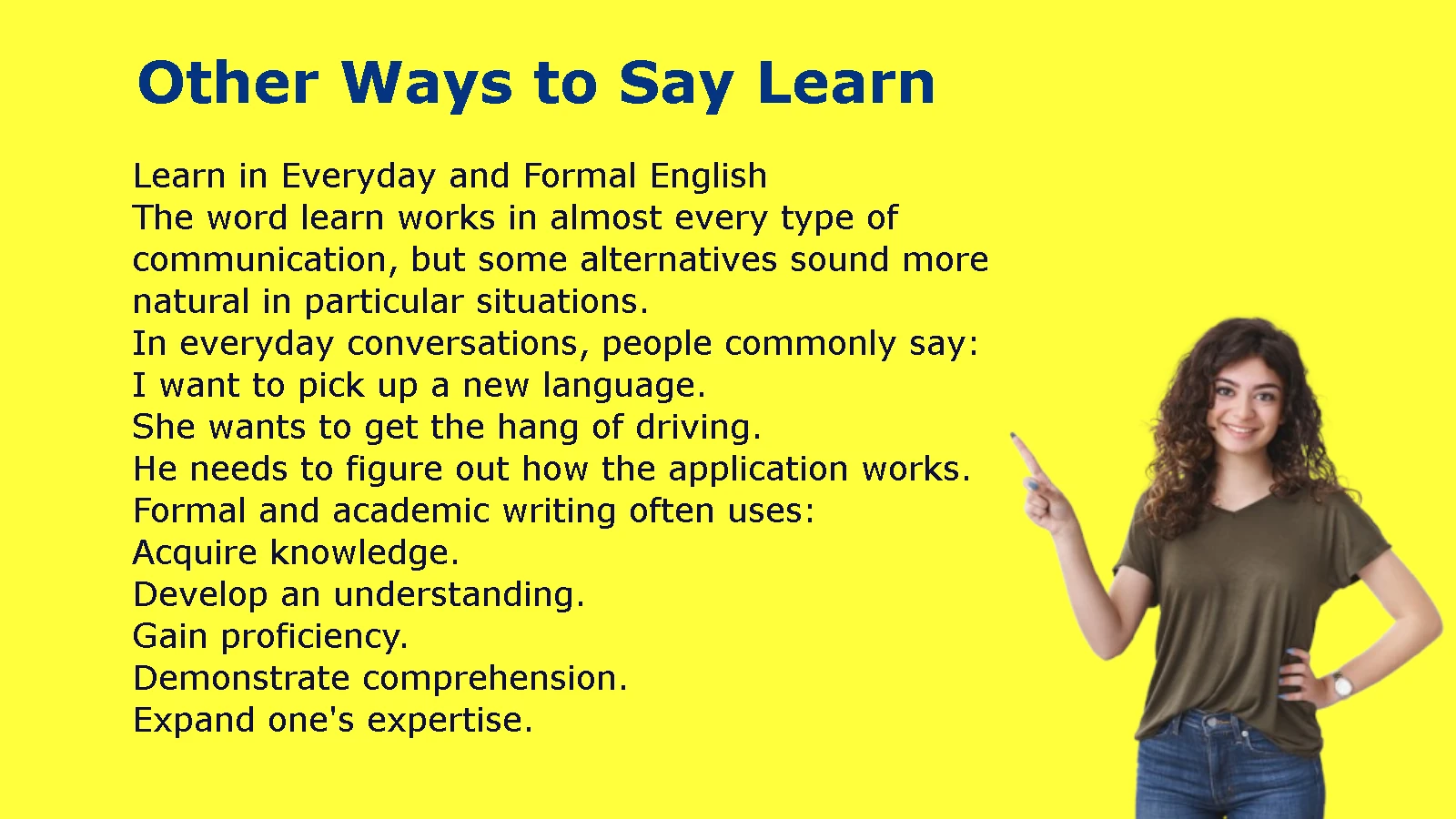
Learn in Everyday and Formal English
The word learn works in almost every type of communication, but some alternatives sound more natural in particular situations.
In everyday conversations, people commonly say:
- I want to pick up a new language.
- She wants to get the hang of driving.
- He needs to figure out how the application works.
Formal and academic writing often uses:
- Acquire knowledge.
- Develop an understanding.
- Gain proficiency.
- Demonstrate comprehension.
- Expand one’s expertise.
The difference is mainly tone and precision. You would probably say “pick up a few cooking skills” when speaking with a friend, but “acquire practical culinary skills” in a formal training report.
50+ Other Ways to Say Learn (With Meanings and Examples)
Common Synonyms of Learn
Some alternatives work in a wide range of everyday situations. These are particularly useful when you want to avoid repeating learn in the same paragraph.
- Study: Focus on a subject to gain knowledge.
- Acquire: Gain information, knowledge, or abilities.
- Understand: Grasp the meaning of an idea.
- Discover: Find something previously unknown.
- Grasp: Understand a concept or explanation.
- Absorb: Take in information through exposure.
- Master: Become highly skilled in a subject.
For example:
Original: I want to learn computer programming.
Alternative: I want to master computer programming.
The revised sentence suggests a deeper goal than simply gaining basic knowledge.
Formal Synonyms for Learn
Formal alternatives work well in academic papers, professional reports, presentations, and business communication.
| Formal synonym | Example |
| Acquire | Employees acquire industry-specific knowledge. |
| Comprehend | Students must comprehend the underlying principles. |
| Assimilate | Participants assimilated the new information. |
| Attain | She attained advanced proficiency in English. |
| Internalize | Learners internalized the essential concepts. |
| Familiarize | Staff familiarized themselves with the updated procedures. |
| Cultivate | The program cultivates analytical thinking. |
| Develop | The training develops professional competencies. |
These expressions add precision, but avoid choosing complicated words simply to sound intelligent. A familiar word that communicates your meaning clearly is usually better than an unnatural substitute.
Informal Synonyms for Learn
Informal alternatives make conversations and friendly messages sound more natural.
- Pick up: Learn naturally or without formal instruction.
- Catch on: Begin understanding something.
- Figure out: Understand something by thinking about it.
- Get the hang of: Become comfortable performing an activity.
- Bone up on: Study intensively before an event or examination.
- Brush up on: Refresh knowledge you already have.
- Read up on: Learn by reading about a subject.
Examples:
- I picked up some useful photography techniques from my brother.
- She caught on after watching the demonstration.
- We figured out how the new application works.
- He is brushing up on his English before the interview.
Academic and Professional Alternatives to Learn
Professional communication often requires words that describe measurable progress rather than simply acquiring information.
Consider these expressions:
- Gain proficiency: Develop the ability to perform a task competently.
- Build expertise: Develop extensive knowledge in a particular field.
- Acquire competencies: Develop the skills required for a role.
- Expand professional knowledge: Gain additional industry information.
- Develop technical capabilities: Improve practical and technical abilities.
- Enhance understanding: Improve comprehension of a subject.
- Cultivate expertise: Gradually develop advanced knowledge.
For example, instead of writing “The employees will learn new management techniques,” a professional training document could say:
“The employees will develop management competencies through practical workshops and supervised projects.”
This alternative explains the intended outcome more precisely.
Another Word for Learning New Things
Another word for learning new things includes discovering, exploring, acquiring knowledge, broadening your understanding, and gaining new insights. These expressions describe the process of encountering unfamiliar information, developing fresh perspectives, and improving your understanding of the world.
The best choice depends on how someone gains knowledge. Discovery emphasizes finding something new, while exploration suggests actively investigating an unfamiliar subject.
Synonyms for Discovering New Things
Use these alternatives when describing curiosity, investigation, or exposure to unfamiliar ideas.
| Alternative | Meaning | Example |
| Discover | Find something previously unknown | We discovered a more efficient technique. |
| Explore | Investigate unfamiliar subjects | She explored different career opportunities. |
| Uncover | Reveal previously hidden information | The investigation uncovered important facts. |
| Find out | Obtain new information | I found out how the system works. |
| Investigate | Examine something carefully | Researchers investigated the new theory. |
| Become acquainted with | Develop familiarity | Students became acquainted with different cultures. |
| Encounter | Come across something unfamiliar | He encountered several new ideas during the course. |
Expressions for Gaining New Knowledge
Sometimes a phrase communicates the idea of learning new things better than a single synonym.
Consider these options:
- Expand your knowledge: Add new information to what you already know.
- Broaden your understanding: Develop a wider perspective.
- Acquire new information: Obtain previously unfamiliar facts.
- Gain fresh insights: Develop new ways of understanding a subject.
- Enrich your knowledge: Make your existing understanding more valuable.
- Broaden your horizons: Become exposed to new ideas and experiences.
- Build intellectual curiosity: Develop an interest in exploring unfamiliar subjects.
These phrases work especially well in educational content, professional development plans, personal statements, and motivational writing.
Example Sentences for Learning New Things
Here are practical examples for different situations.
Personal development
- Reading different genres helps me broaden my horizons.
- Traveling allows people to discover unfamiliar cultures.
- Trying new hobbies gives us opportunities to develop fresh interests.
Academic writing
- University students should continually expand their knowledge beyond classroom instruction.
- Scientific research helps scholars uncover new information.
- Group discussions allow students to gain fresh insights into complex subjects.
Professional communication
- Employees should acquire new competencies to remain effective in changing workplaces.
- The workshop helped participants develop a deeper understanding of customer behavior.
- Regular training enables professionals to broaden their expertise.
Another Word for Learning and Development
Another word for learning and development includes professional growth, skill development, personal development, knowledge enhancement, and continuous education. These expressions describe the ongoing process of improving knowledge, building abilities, and developing greater competence in personal or professional settings.
The phrase learning and development often appears in workplaces, educational institutions, and career planning. Its meaning extends beyond acquiring information because it also includes applying knowledge and improving performance.
Professional Learning and Development Synonyms
These alternatives are particularly useful in business documents, employee training materials, and human resource communication.
| Alternative | Meaning | Example sentence |
| Professional growth | Progress in a person’s career | Mentoring supports professional growth. |
| Skill development | Improving practical abilities | The company invests in skill development. |
| Career advancement | Moving toward greater career opportunities | Additional training supports career advancement. |
| Knowledge enhancement | Improving existing knowledge | The course focuses on knowledge enhancement. |
| Capacity building | Strengthening individual or organizational abilities | The initiative supports capacity building. |
| Employee development | Improving employees’ knowledge and abilities | Employee development improves workplace performance. |
| Professional education | Structured education related to a career | Professional education helps workers maintain their expertise. |
| Competency development | Building abilities needed for particular responsibilities | Competency development prepares employees for leadership roles. |
Synonyms for Personal Learning and Growth
Personal development focuses on improving yourself beyond formal education or workplace requirements.
Useful alternatives include:
- Self-improvement: Making positive changes to your abilities or habits.
- Personal development: Improving different areas of your life.
- Intellectual growth: Expanding your thinking and understanding.
- Lifelong learning: Continuing to gain knowledge throughout life.
- Continuous education: Maintaining and expanding knowledge through ongoing study.
- Self-education: Learning independently without relying entirely on formal instruction.
- Personal enrichment: Developing interests, experiences, and understanding.
For example:
“Reading regularly contributes to intellectual growth and helps individuals develop a broader perspective.”
Examples of Learning and Development in Sentences
Workplace example:
“The organization introduced a professional development program to improve employees’ leadership and communication abilities.”
Career example:
“Continuous education helps professionals remain competitive as industry requirements change.”
Personal example:
“Self-improvement requires consistent effort, curiosity, and a willingness to develop new abilities.”
Educational example:
“The university promotes lifelong learning through flexible courses and practical training opportunities.”
Synonyms for Learning Experience
Synonyms for learning experience include educational experience, training experience, academic experience, educational journey, skill-building opportunity, and knowledge-building experience. These expressions describe situations in which people develop knowledge, gain practical abilities, or improve their understanding through instruction and participation.
The best alternative depends on the situation. A classroom activity might be an educational experience, while workplace instruction is more accurately described as a training experience.
Formal Alternatives to Learning Experience
Use these expressions in professional reports, educational documents, academic writing, and resumes.
| Alternative | Meaning | Example |
| Educational experience | An experience that provides knowledge | The internship was a valuable educational experience. |
| Training experience | Knowledge gained through organized training | Her training experience improved her technical abilities. |
| Academic experience | Experience gained through formal education | His academic experience prepared him for research. |
| Instructional experience | Experience involving teaching or structured instruction | The program provides practical instructional experience. |
| Developmental experience | An experience that encourages personal or professional growth | The assignment became a developmental experience. |
| Practical experience | Knowledge gained through hands-on activities | Employers often value practical experience. |
Creative and Engaging Alternatives to Learning Experience
If you are writing website content, presentations, personal statements, or promotional materials, these expressions can make your writing more engaging.
- Educational journey: The overall process of gaining knowledge.
- Knowledge-building experience: An activity that expands understanding.
- Hands-on exploration: Learning through direct participation.
- Skill-building opportunity: A chance to improve practical abilities.
- Learning opportunity: An experience that provides a chance to develop knowledge.
- Growth journey: A process of personal or professional improvement.
- Knowledge-sharing experience: An activity involving the exchange of information and ideas.
Examples in Professional and Academic Writing
Compare these sentences to understand how different alternatives change the tone.
| Original sentence | Improved alternative |
| The course was a great learning experience. | The course provided a valuable educational experience. |
| Working abroad was a learning experience. | Working abroad offered meaningful cultural exposure. |
| The internship was an important learning experience. | The internship provided valuable practical experience. |
| The workshop created a positive learning experience. | The workshop offered an engaging educational opportunity. |
| It was a good learning experience for the team. | The project became a valuable professional development opportunity. |
Writing tip: Avoid replacing learning experience with an impressive-sounding phrase if the meaning changes. For instance, practical experience emphasizes direct involvement, while academic experience usually relates to formal education.
Learn Synonyms for IELTS and Academic Writing
The best learn synonyms for IELTS include acquire, develop, gain, enhance, comprehend, master, and absorb. These alternatives help candidates express ideas more precisely in Writing Task 2 and Speaking responses. However, you should select vocabulary according to meaning and grammatical context rather than using difficult words simply to demonstrate vocabulary range.
IELTS rewards clear, accurate communication. Replacing every occurrence of learn with an advanced synonym can make an essay sound unnatural.
Best Synonyms for Learn in IELTS Writing
| Synonym | Best context | IELTS-style example |
| Acquire | Gaining knowledge or skills | Children acquire language skills through social interaction. |
| Develop | Improving an ability | Students develop critical thinking through independent research. |
| Gain | Obtaining knowledge or experience | University graduates gain valuable professional experience. |
| Enhance | Improving existing knowledge or abilities | Technology can enhance students’ educational opportunities. |
| Master | Achieving advanced proficiency | Learners need regular practice to master a foreign language. |
| Comprehend | Understanding complex information | Students must comprehend scientific concepts before applying them. |
| Absorb | Taking in information | Younger learners often absorb information through interactive activities. |
| Attain | Reaching a particular level | Individuals can attain greater proficiency through consistent practice. |
Advanced Vocabulary Alternatives for IELTS
The following expressions can improve precision in academic writing when used appropriately.
Acquire knowledge
Example: “Students acquire knowledge through formal instruction and independent research.”
This phrase works well when discussing education and information gathering.
Gain proficiency
Example: “Regular speaking practice helps learners gain proficiency in a second language.”
Use this expression when describing the ability to perform a task effectively.
Develop expertise
Example: “Professional training allows employees to develop expertise in specialized fields.”
This is appropriate when discussing careers and advanced skills.
Broaden one’s horizons
Example: “International education can broaden students’ horizons by exposing them to different cultures.”
This expression works when discussing travel, education, and cultural awareness.
Expand one’s understanding
Example: “Scientific research helps expand our understanding of environmental challenges.”
Use it when discussing deeper knowledge of a subject.
Cultivate a skill
Example: “Young people can cultivate communication skills through teamwork and discussion.”
This phrase emphasizes gradual improvement.
IELTS Example Sentences: Basic vs. Advanced Vocabulary
Compare these sentences to see how vocabulary choices affect precision.
| Basic sentence | More precise alternative |
| Children learn languages at school. | Children acquire language skills through formal education. |
| People learn new skills at work. | Employees develop professional competencies through workplace training. |
| Students learn about different cultures. | Students gain cultural awareness through international education. |
| Technology helps people learn. | Technology enhances access to educational resources. |
| We learn more about the environment through research. | Research expands our understanding of environmental issues. |
The advanced versions are not automatically better in every situation. Choose them when they communicate the intended meaning more accurately.
Common Synonym Mistakes in IELTS
Even strong vocabulary can weaken an essay when you use words incorrectly.
Watch out for these common mistakes:
- Using acquire for every type of learning: Acquire usually describes gaining something, such as knowledge, a language, or a skill. It does not always replace learn naturally.
- Confusing study with understand: Studying involves making an effort to gain knowledge, while understanding means grasping the meaning.
- Overusing master: Master suggests advanced proficiency, not simply beginning to learn.
- Using memorize instead of learn: Memorization involves remembering information, but learning can include understanding and applying it.
- Choosing complicated vocabulary unnecessarily: A precise, familiar word is better than an advanced word used incorrectly.
For IELTS, aim for vocabulary that fits the subject, sentence structure, and intended meaning.
Synonyms and Antonyms of Learn
Synonyms of learn are words with similar meanings, such as study, acquire, understand, discover, and master. Antonyms express opposite or contrasting ideas, including forget, unlearn, ignore, overlook, and disregard. The correct choice depends on whether the sentence describes gaining knowledge, losing it, or failing to pay attention.
Synonyms of Learn
Here are some common synonyms and their specific uses:
| Synonym | Meaning | Example |
| Study | Gain knowledge through focused effort | I study chemistry after school. |
| Acquire | Obtain knowledge or skills | She acquired new technical abilities. |
| Understand | Grasp meaning | He understands the lesson. |
| Discover | Find previously unknown information | We discovered a new solution. |
| Master | Become highly proficient | She mastered the instrument. |
| Absorb | Take information into the mind | Students absorb information through reading. |
| Comprehend | Understand fully | They comprehended the instructions. |
| Grasp | Understand an idea | I grasped the concept immediately. |
| Explore | Investigate a subject | We explored different learning methods. |
| Develop | Build an ability | He developed strong writing skills. |
Antonyms of Learn
The opposite of learn depends on the meaning you want to express. Some words describe losing knowledge, while others describe failing to gain it.
| Antonym | Meaning | Example |
| Forget | Lose information from memory | I forgot the password. |
| Unlearn | Replace or discard previously learned knowledge or habits | Drivers sometimes need to unlearn unsafe habits. |
| Ignore | Refuse to pay attention | He ignored the instructions. |
| Overlook | Fail to notice something | She overlooked an important detail. |
| Disregard | Pay no attention to something | The student disregarded the teacher’s advice. |
| Neglect | Fail to give something proper attention | He neglected his studies. |
| Misunderstand | Interpret something incorrectly | They misunderstood the explanation. |
| Remain unaware | Continue without knowing something | Many people remain unaware of the new rules. |
Not all these words are direct opposites of learn in every context. For example, forget describes losing previously acquired information, whereas ignore describes not paying attention to something.
Learn vs. Unlearn vs. Forget
These three words are related, but their meanings differ.
| Word | Definition | Example |
| Learn | Gain new knowledge or skills | She learned to drive. |
| Unlearn | Remove or change previously learned habits or beliefs | He had to unlearn incorrect pronunciation habits. |
| Forget | Lose something from memory | I forgot what the instructor said. |
Consider a language learner who has pronounced a word incorrectly for several years.
- First, the learner must learn the correct pronunciation.
- Next, the learner may need to unlearn the incorrect habit.
- If the learner cannot remember the new pronunciation later, they may forget it.
This distinction is especially useful in education, psychology, professional training, and language learning.
Synonyms and Antonyms in Example Sentences
Here are contrasting examples that show how these words work.
Example: Learning a language
- Synonym: She acquired basic Spanish vocabulary.
- Antonym: She forgot several words after months without practice.
Understanding a subject
- Synonym: The students comprehended the lesson.
- Antonym: Some students misunderstood the main concept.
Example: Developing a skill
- Synonym: He mastered the new software.
- Contrasting expression: He neglected his training and failed to improve.
These comparisons show why choosing an antonym requires understanding the original sentence rather than simply selecting a word from an opposite-meaning list.
Eight-Letter Synonyms of Learn
Eight-letter words related to learn include discover, memorize, research, practice, and acquaint. These words describe different parts of the learning process, such as finding information, remembering facts, investigating subjects, and developing practical abilities. They are not all exact replacements for learn, so context matters.
Discover
Discover means finding something previously unknown or becoming aware of new information.
Example: “Students discover new ideas when they explore different scientific theories.”
Use discover when the focus is finding information rather than following formal instruction.
Memorize
Memorize means committing information to memory so you can recall it later.
Example: “The students memorized important vocabulary before the examination.”
Memorize is especially useful when discussing facts, formulas, dates, definitions, and language vocabulary.
However, memorization does not always mean genuine understanding. Someone might memorize a mathematical formula without understanding how it works.
Research
Research means systematically investigating a subject to obtain information or develop knowledge.
Example: “The university students researched the effects of social media on communication.”
Research is suitable for academic assignments, scientific investigations, professional reports, and detailed studies.
Practice
Practice means repeatedly performing an activity to improve your ability.
Example: “You need to practice speaking English to improve your fluency.”
Practice relates to learning through repetition rather than simply acquiring information.
Acquaint
Acquaint means making someone familiar with a subject, person, or situation.
Example: “The orientation program helped new employees acquaint themselves with workplace procedures.”
The more natural structure is often acquaint yourself with something or become acquainted with something.
This word is related to learning, but it is not a direct substitute in every sentence.
Synonyms for Learn That Start With B
Useful expressions beginning with B include broaden, bone up on, build knowledge, and become acquainted with. These alternatives describe expanding understanding, studying intensively, developing knowledge gradually, or becoming familiar with unfamiliar information.
There are relatively few exact one-word synonyms for learn beginning with B. However, these expressions can communicate the same general idea in appropriate contexts.
Broaden
Broaden means to expand or increase the range of your knowledge, experience, or understanding.
Example: “Reading books from different cultures can broaden your understanding of the world.”
Other examples:
- Travel can broaden your perspective.
- University education helps broaden students’ intellectual horizons.
- Learning different subjects can broaden your knowledge.
Broaden works particularly well with knowledge, understanding, experience, and perspective.
Bone Up On
Bone up on is an informal expression meaning to study something intensively, often before an examination, interview, or important event.
Example: “I need to bone up on English grammar before taking the IELTS test.”
Additional examples:
- She is boning up on business terminology.
- He boned up on the company’s products before the interview.
- We should bone up on the safety procedures before starting the project.
This expression is natural in conversation but less suitable for formal academic writing.
Build Knowledge
Build knowledge means gradually developing understanding by collecting information, practicing, and connecting new ideas with existing knowledge.
Example: “Regular reading helps children build knowledge and improve their vocabulary.”
Other examples:
- Practical projects help students build knowledge.
- Daily revision allows learners to build a stronger foundation.
- Group discussions help employees build industry knowledge.
Become Acquainted With
Become acquainted with means developing familiarity with a subject, person, process, or environment.
Example: “New employees should become acquainted with the company’s policies before beginning their duties.”
This phrase works well in professional and formal communication.
Other Ways to Say Learn More About
Other ways to say learn more about include gain further insight into, explore in greater detail, investigate, look into, find out more about, and develop a deeper understanding of. These expressions help you communicate curiosity, research, and further investigation without repeating the same phrase.
The best alternative depends on the situation. Formal reports benefit from expressions such as gain further insight into, while everyday conversations sound more natural with find out more about.
Formal Alternatives to Learn More About
Use these phrases in reports, academic writing, business emails, and professional communication.
| Alternative | Meaning | Example |
| Gain further insight into | Develop a deeper understanding | The survey helped us gain further insight into customer preferences. |
| Explore in greater detail | Examine a subject more thoroughly | The report explores the issue in greater detail. |
| Develop a deeper understanding of | Improve comprehension | Students should develop a deeper understanding of economic principles. |
| Examine more closely | Investigate carefully | Researchers examined the results more closely. |
| Investigate further | Continue examining something | The team decided to investigate the matter further. |
| Obtain additional information about | Collect more details | Please contact the department to obtain additional information about the program. |
| Expand your knowledge of | Increase what you know | The course helps participants expand their knowledge of marketing. |
Casual Alternatives to Learn More About
These expressions work well in conversations, friendly emails, and informal writing.
- Find out more about: Discover additional information.
- Read up on: Learn through reading.
- Look into: Investigate something.
- Get to know: Become familiar with someone or something.
- Dig deeper into: Explore a subject more thoroughly.
- Check out: Examine something informally.
- Learn a little more about: Gain additional information.
Examples:
- I want to find out more about digital marketing.
- You should read up on the subject before the interview.
- We need to look into the company’s training program.
- She wants to dig deeper into the history of the region.
Professional Example Sentences
Here are some ways to replace learn more about in different professional situations.
Business email
Original: “I would like to learn more about your services.”
Alternative: “I would appreciate the opportunity to gain further insight into your services.”
Academic writing
Original: “Researchers need to learn more about this issue.”
Alternative: “Researchers should investigate this issue further.”
Workplace communication
Original: “Employees should learn more about the new software.”
Alternative: “Employees should familiarize themselves with the new software.”
Website content
Original: “Click here to learn more about our training program.”
Alternative: “Explore our training program to discover how it can support your professional development.”
How to Choose the Right Synonym for Learn
Choosing the right synonym requires more than finding a word with a similar dictionary definition. You should consider what the person is learning, how they gain the knowledge, and how much understanding or proficiency they achieve.
For example, study, memorize, and master all relate to learning, but they describe different activities and outcomes.
Choose Based on the Type of Knowledge
Start by identifying what the sentence describes.
| Intended meaning | Best alternative | Example |
| Gaining information | Acquire | She acquired knowledge of digital marketing. |
| Reading or studying a subject | Study | He studies history at university. |
| Finding something new | Discover | We discovered an effective solution. |
| Understanding an idea | Comprehend | Students comprehended the explanation. |
| Developing advanced ability | Master | She mastered the programming language. |
| Remembering information | Memorize | He memorized the important dates. |
| Learning informally | Pick up | I picked up a few phrases while traveling. |
| Improving through repetition | Practice | She practices pronunciation every day. |
| Becoming familiar with something | Familiarize yourself with | Please familiarize yourself with the instructions. |
| Expanding understanding | Broaden | The experience broadened his perspective. |
Choose Based on Formality
Your audience and writing situation should influence your vocabulary.
Casual conversations
Use familiar expressions that sound natural:
- Pick up.
- Figure out.
- Catch on.
- Get the hang of.
- Find out.
Example: “I finally got the hang of using the editing software.”
Academic writing
Choose precise vocabulary that communicates how knowledge develops:
- Acquire.
- Comprehend.
- Investigate.
- Analyze.
- Assimilate.
- Develop an understanding.
Example: “Students acquire scientific knowledge through research and experimentation.”
Professional communication
Use expressions that emphasize skills, performance, and development:
- Gain proficiency.
- Develop expertise.
- Build competencies.
- Enhance understanding.
- Expand professional knowledge.
Example: “The training program helps employees develop expertise in project management.”
Creative writing
Use expressive alternatives that add variety and describe the experience:
- Discover.
- Explore.
- Uncover.
- Absorb.
- Broaden your horizons.
Example: “Her travels allowed her to discover unfamiliar traditions and explore new perspectives.”
Choose Based on Sentence Structure
Not every synonym follows the same grammatical pattern. Replacing learn without adjusting the sentence can produce awkward or incorrect English.
Compare these examples:
| Original structure | Correct alternative | Explanation |
| Learn a language | Study a language | Both can take a direct object. |
| Learn about history | Read about history | Read about introduces the subject. |
| Learn to swim | Master swimming | The structure changes from an infinitive to a gerund. |
| Learn from mistakes | Gain insight from mistakes | The alternative emphasizes the benefit of experience. |
| Learn something new | Discover something new | Both can take a direct object, but their meanings differ slightly. |
| Learn how to use software | Figure out how to use software | The alternative is more informal. |
Pay attention to prepositions and verb patterns.
For instance:
- Correct: She acquired knowledge of economics.
- Correct: She became familiar with the software.
- Correct: He gained experience in management.
- Correct: They developed an understanding of the subject.
Common Mistakes When Using Learn Synonyms
Even closely related words can create confusion when you use them in the wrong context.
Treating every synonym as interchangeable
Study and understand do not mean exactly the same thing. You can study a subject for hours without fully understanding it.
Confusing learning with teaching
Learn describes gaining knowledge, while teach describes helping someone else gain knowledge.
For example:
- The student learned mathematics.
- The teacher taught mathematics.
Using master for basic knowledge
Master suggests advanced ability. A beginner who has completed one introductory lesson has not necessarily mastered the subject.
Using memorize when you mean understand
Memorizing information means remembering it. Understanding means knowing what it means and how it works.
Overusing formal vocabulary
Expressions such as assimilate and internalize are useful in certain contexts, but ordinary words often communicate ideas more clearly.
Ignoring verb patterns
Some alternatives require different grammatical structures. For example, you can say “learn a skill,” “become proficient in a skill,” and “master a skill.” These expressions do not all follow the same pattern.
Practical Case Study: Choosing the Right Alternative to Learn
Consider a student preparing for an English examination. The student repeatedly uses learn in essays, speaking responses, and study notes.
Here is how choosing more precise alternatives improves the writing.
Original paragraph:
“Students learn new words by reading books. They learn grammar through practice and learn how to communicate by speaking with others. These activities help them learn English.”
The paragraph communicates the basic idea, but repeating learn makes the writing less varied.
Improved paragraph:
“Students acquire new vocabulary by reading books. They develop their understanding of grammar through regular practice and improve their communication skills by speaking with others. These activities help them gain proficiency in English.”
The revised version makes several improvements:
- Acquire new vocabulary describes gaining words and expressions.
- Develop understanding emphasizes improved comprehension.
- Improve communication skills describes practical development.
- Gain proficiency communicates progress toward effective language use.
The important lesson is that vocabulary variety should improve meaning, not simply replace repeated words.
Conclusion: Find the Best Alternative to Learn
There are many useful ways to say learn, but the best choice depends on the meaning, context, and tone of your sentence. Words such as study, acquire, understand, discover, master, and absorb cover common learning situations, while expressions such as broaden your knowledge, gain proficiency, and develop expertise provide more specific alternatives.
For everyday conversations, informal expressions like pick up, catch on, and figure out sound natural. Academic writing benefits from precise words such as acquire, comprehend, and investigate. Professional communication often uses skill development, knowledge enhancement, and professional growth.
Remember that synonyms are similar in meaning, not always interchangeable. Choose vocabulary that accurately describes the process or outcome you want to communicate.
Ready to improve your vocabulary? Start using a few of these alternatives in your daily conversations, emails, essays, and professional writing. The more accurately you choose your words, the more naturally and confidently you can express your ideas.